
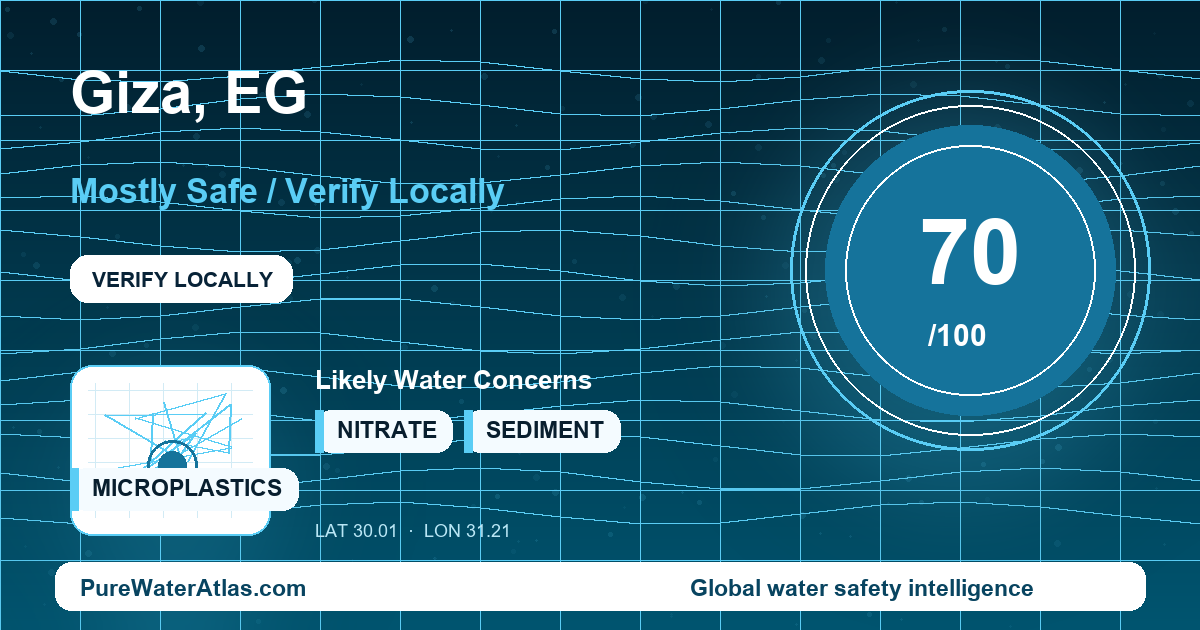
Giza uses treated Nile River surface water, but real tap-water safety can change building by building because of storage tanks, internal plumbing, pressure interruptions, and local maintenance.
Quick Answer
| Overall safety status | Mostly Safe / Verify Locally — Water safety score: 70/100. Giza’s municipal water is generally treated and chlorinated, but the condition of building tanks and plumbing can affect water at the tap. |
|---|---|
| Can tourists drink it? | Short-stay travelers should use sealed bottled water or verified hotel-filtered water for drinking. Tap water in established hotels is usually acceptable for showering and often for tooth brushing, but sensitive travelers should use bottled water. |
| Resident guidance | Residents can often use municipal tap water, but should verify building conditions, especially where roof tanks, ground tanks, old pipes, intermittent service, rusty water, or vulnerable household members are involved. |
| Main water source | Nile River surface water treated through municipal systems serving Greater Cairo and Giza. |
| Water authority | Giza Drinking Water and Wastewater Company, under Egypt’s Holding Company for Water and Wastewater, with national sector oversight involving the Ministry of Housing, Utilities and Urban Communities and the Egyptian Water Regulatory Agency. |
| Filter recommendation | A filter is not automatically required everywhere. Consider sediment plus activated carbon for particles, chlorine taste, and tank-related issues. Use reverse osmosis, UV, or other treatment only when testing or a specific risk justifies it. |
Why Giza Is Different
Giza’s drinking-water profile is closely tied to its position on the west bank of the Nile and its role as the western part of the Greater Cairo urban area. The city is not primarily a deep-groundwater drinking-water case; it is a large treated surface-water system where the Nile is the central raw-water source. That means the main public-health question is not simply whether water is treated before distribution. It is also whether the water remains protected as it moves through dense urban networks, pumps, local pressure zones, private roof tanks, ground tanks, and older internal plumbing.
The editorial verdict for Giza is therefore cautious rather than absolute. Municipal tap water is generally based on treated Nile River water and is expected to be chlorinated through the public system. However, safety at the consumer tap can vary after the water leaves the main network. A well-maintained modern building with clean, covered tanks is a different risk situation from an older building with corroded pipes, stagnant roof storage, or recent low-pressure episodes.
This matters for both residents and visitors. A visitor staying near the Pyramids or in a hotel apartment may be exposed less to the water leaving the treatment plant than to the condition of the specific building’s storage and plumbing. For residents, the safest interpretation is building-specific: Giza’s public system may be broadly treated, but each household should verify its own tap if conditions suggest local risk.
Where Does Giza’s Tap Water Come From?
Giza’s main municipal drinking-water source is the Nile River. Raw surface water is abstracted through Greater Cairo and Giza intake and treatment systems, then treated using conventional municipal processes such as coagulation, sedimentation, filtration, and chlorination before entering the distribution network. This treatment train is designed for a surface-water source that can be affected by turbidity, organic matter, and upstream pressures.
Historically, Giza developed directly along the Nile’s west bank, and the river has long been the dominant water source for the city. Older patterns of local canals, wells, and direct river access have largely been replaced in urban Giza by centralized treated surface-water supply. That does not mean all end-use water is identical. In many apartment districts and commercial areas, water may pass through trunk mains, pumping and booster stations, building-level storage, and internal pipes before reaching a kitchen tap.
Important infrastructure elements for Giza include Nile River raw-water intakes serving the west-bank Greater Cairo and Giza supply area, municipal Nile-bank surface-water treatment facilities referenced by Egyptian water-sector institutions, trunk mains and distribution networks, and local pumping systems serving dense urban neighborhoods. The final stage is often privately managed: roof tanks, ground tanks, and internal building pipework. Those private components can strongly influence taste, odor, sediment, and microbial risk.
Who Manages Drinking Water in Giza?
Urban water and wastewater service in Giza is associated with the Giza Drinking Water and Wastewater Company under Egypt’s Holding Company for Water and Wastewater. National water-sector policy and utilities oversight also involve the Ministry of Housing, Utilities and Urban Communities and the Egyptian Water Regulatory Agency, which is the national regulator for water and wastewater service performance.
Drinking water in Egypt is governed through national potable-water standards and public-health oversight. For Giza users, however, one practical limitation is transparency at the neighborhood level. Publicly accessible, recent, analyte-by-analyte compliance tables for Giza were not readily available in open English-language sources for this profile. That means this guide should not be read as a claim that every block, building, or tap in Giza has identical quality. The source-water system and responsible institutions are clear, but recent local laboratory results are limited in public availability.
Residents should also monitor local announcements from official local channels such as the Giza Governorate Official Portal, especially after pipe repairs, major street works, service interruptions, or local infrastructure events that may temporarily affect water clarity or pressure.
Main Local Water Concerns
The main water-quality concerns in Giza are linked to treated Nile surface water, dense urban distribution, and building-level storage. Nile raw water is vulnerable to upstream agricultural, municipal, and industrial pressures, so treatment performance and source-water monitoring are important. The available dataset does not provide current Giza neighborhood contaminant concentrations, so it is not appropriate to claim exact levels of any contaminant at the tap.
- Chlorine taste or odor: Giza’s municipal water is expected to be chlorinated to protect it through the distribution system. A chlorine smell can be noticeable, especially when residual disinfectant is present at the tap.
- Turbidity, brown water, or sediment: Cloudiness, grit, or brown water may appear after pipe repairs, pressure changes, outages, or disturbances in local plumbing. Water should be flushed until clear; persistent discoloration should be reported and tested.
- Private storage tanks: Roof tanks and ground tanks can become microbial risk points if uncovered, cracked, poorly cleaned, or connected through unsanitary plumbing.
- Old internal plumbing: Corroded pipes, fixtures, and unknown service materials can contribute metals or sediment. Lead risk should be evaluated by testing rather than assumed.
- Intermittent service or pressure changes: Low pressure can increase the importance of tank hygiene and backflow prevention.
- Private wells or informal supplies: These are not equivalent to treated municipal tap water and should be tested before drinking, particularly on the urban fringe.
Season also matters. Hot summer conditions can increase biological growth risk in poorly maintained storage tanks and can make chlorine residual dissipate faster inside buildings. High-demand periods may worsen low-pressure episodes in some buildings. Changes in Nile turbidity, algae, or organic matter can affect treatment operations and taste or odor even when water remains disinfected.
For Travelers
For most short-term visitors in Giza, the conservative recommendation is to drink sealed bottled water or a trusted hotel-filtered supply rather than relying on unverified tap water. This does not mean the municipal system is untreated. It means travelers usually do not know the condition of the building’s storage tanks, pipes, or recent maintenance history, and a short trip is not the time to test personal tolerance.
Tap water in better hotels is commonly acceptable for showering. It is usually low risk for tooth brushing if the water is clear, has a normal odor, and the hotel has no recent water-service problem. Travelers with sensitive stomachs, young children, or immunocompromised conditions should use bottled water for brushing teeth as well. Avoid swallowing shower water.
Use ice only in reputable hotels and restaurants that state they use treated or purified water. Avoid ice from street vendors or uncertain sources. In hotels, restaurants, or serviced apartments, ask whether the property uses filtration, bottled water, or maintained internal storage if you are unsure. If there has been a local outage, visible discoloration, sediment, or unusual taste, switch fully to bottled water until the issue is resolved.
For infant formula, use bottled water or water treated according to appropriate health guidance. During hot weather or gastrointestinal illness, carrying oral rehydration salts is a practical precaution. The CDC Travelers’ Health guidance for Egypt is also a useful traveler-health reference for food and water precautions.
For Residents
For Giza residents, the key question is not only “Is Giza’s water treated?” but “What happens to the water in my building?” A home filter is not automatically required in every household. However, treatment is reasonable where water passes through roof or ground tanks, has recurring sediment, tastes strongly of chlorine, comes from old plumbing, or will be consumed by infants, pregnant people, elderly people, or immunocompromised residents.
A certified sediment plus activated-carbon unit can improve particles, chlorine taste, and some odor complaints. Reverse osmosis should be considered only when testing indicates dissolved contaminants, high salinity, nitrate, or metals. UV can help with microbial risk only when water is first filtered for clarity and the UV unit is properly maintained. If the concern is short-term microbial contamination after an outage, tank problem, or suspected sewage intrusion, boiling may be more appropriate as an emergency measure; see the PureWaterAtlas Boiling Water Purification Guide.
Testing is especially important in older buildings or where storage tanks are involved. Test for total coliform and E. coli if the home uses roof tanks, ground tanks, private wells, or has experienced flooding, sewage backup, or long stagnation. In older buildings, collect both first-draw and flushed samples for lead and copper when plumbing materials are unknown. If water changes suddenly, check turbidity, color, odor, free chlorine residual, pH, electrical conductivity, and total dissolved solids. For private or non-municipal supplies, especially near agricultural or peri-urban areas, test nitrate and ammonia.
Storage tanks should be covered, screened, cleaned on a routine schedule, protected from sewage cross-connections, and inspected after dust storms, repairs, or long periods of low use. If tank hygiene is uncertain, use a maintained point-of-use system or boil water for short-term microbiological protection while the problem is investigated.
Relevant Contaminants and Water-Quality Issues
Several PureWaterAtlas contaminant guides are especially relevant to Giza’s local profile. Chlorine in drinking water is important because chlorination is central to disinfection in treated municipal systems and can explain common taste or odor complaints. Turbidity and sediment are relevant when water becomes cloudy, gritty, or brown after pressure changes, repairs, or disturbance of building tanks and pipes.
In older buildings, lead in drinking water should be evaluated by testing rather than assumed from citywide statements. The article Lead in Drinking Water: Testing and Detection Methods explains why first-draw and flushed samples can tell different stories about premise plumbing.
For microbial concerns linked to storage tanks, intermittent pressure, or suspected sewage intrusion, see E. coli in drinking water and the broader guide to Water Microbiology. For private wells or non-municipal supplies outside the treated network, nitrate and the guide to nitrate testing are relevant, especially in agricultural or peri-urban settings.
How to Verify Your Water Quality
Because recent neighborhood-level Giza laboratory results are not easily available from open official sources, verification should focus on the actual tap used for drinking. Start with visual and operational clues: Is the water clear? Does discoloration occur after outages? Is there sediment in taps or storage tanks? Does the building use roof or ground storage? Has there been recent plumbing work?
For a structured testing plan, use the PureWaterAtlas Complete Guide to Water Testing and Analysis. If a lab result or symptom points to a specific contaminant, search the Contaminants Search Engine. For broader decision-making, the PureWaterAtlas guide to Drinking Water Safety explains how to judge safety at the point of use, while the Water Treatment Systems guide helps match carbon filters, sediment filtration, UV, boiling, or reverse osmosis to the actual problem. You can also compare broader city and country guidance using the Global Water Quality Checker.
Do not rely only on taste. Chlorine taste may indicate disinfectant residual, while dangerous microbial contamination may have no obvious taste or smell. Conversely, sediment or discoloration may signal a localized plumbing issue rather than a citywide failure.
Official and Technical Sources
- Holding Company for Water and Wastewater, Egypt — national utility-sector source for Egypt’s public water and wastewater companies.
- Egyptian Water Regulatory Agency — official regulator for water and wastewater service oversight in Egypt.
- Ministry of Housing, Utilities and Urban Communities — national ministry responsible for housing and utilities policy.
- Giza Governorate Official Portal — local government reference point for Giza public services and local announcements.
- FAO AQUASTAT Egypt Country Profile — context on Egypt’s Nile-linked water resources and national water pressures.
- WHO/UNICEF Joint Monitoring Programme Data for Egypt — country-level drinking-water and sanitation service context.
- CDC Travelers’ Health: Egypt — traveler food and water precautions.
- WHO Guidelines for Drinking-water Quality — international benchmark for interpreting drinking-water risks.
Bottom Line
Giza’s tap water is best classified as mostly safe but locally variable. The city’s municipal supply is based on treated Nile River surface water and is expected to be chlorinated, but water quality at the tap can be affected by dense distribution networks, private roof or ground tanks, older building plumbing, pressure interruptions, and recent repairs. Tourists should drink sealed bottled water or verified hotel-filtered water, while using tap water mainly for showering and, in established hotels, usually tooth brushing. Residents should make decisions building by building: inspect tanks, watch for sediment or discoloration, test older plumbing, and use filtration or disinfection only when matched to a real risk. Public city-level compliance detail is limited, so local verification matters.
Read the full guide: Global Water Quality Guide
Explore more in this category: Global Water Quality Articles