
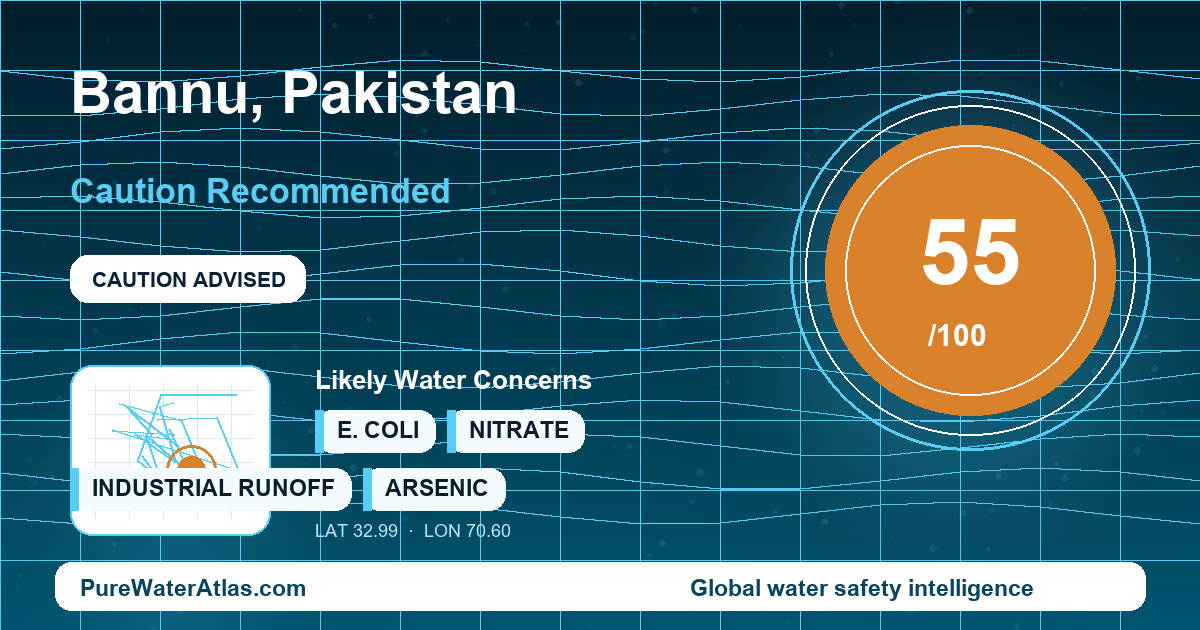
Bannu, Pakistan: groundwater-dependent drinking water with intermittent supply, household storage, monsoon-related turbidity, and limited public city-level testing data.
Quick Answer
| City | Bannu, Khyber Pakhtunkhwa, Pakistan |
|---|---|
| Water safety score | 55 / 100 |
| Risk level | Caution Recommended |
| Is tap water safe to drink? | Not reliably without household treatment or recent test results for the exact source and tap. |
| Traveler advice | Use sealed bottled water, boiled water, or properly filtered and disinfected water. Avoid untreated tap water, especially during monsoon rain, flooding, power outages, or visible changes in color, smell, or sediment. |
| Resident advice | Treat drinking and cooking water at the point of use unless recent laboratory testing confirms safety for the household connection, borehole, or filtration point. |
| Main water source pattern | Groundwater-dominated: public tube wells, private boreholes, hand pumps, municipal schemes, storage tanks, and local filtration points. |
| Relevant authorities | Local arrangements may involve Tehsil Municipal Administration Bannu, Khyber Pakhtunkhwa Public Health Engineering Department schemes, and other KP local government offices depending on the connection or area. |
| Filter recommendation | Sediment prefiltration plus disinfection such as UV or chlorination for microbial risk; consider reverse osmosis only where testing confirms high TDS, salinity, nitrate, arsenic, fluoride, or other dissolved contaminants. |
Verdict: Caution is recommended. Bannu’s tap water should not be treated as reliably potable without treatment or recent test results. The main concern is the combined risk profile: groundwater dependence, intermittent municipal supply, aging or leaking distribution lines, household tanks, sanitation proximity, turbidity after rain, and limited publicly available neighborhood-level water-quality reporting.
Why Bannu Is Different
Bannu is not a city where drinking water can be described as one uniform, fully centralized system. It sits in the Bannu basin, a southern Khyber Pakhtunkhwa valley system connected to the Kurram, Tochi/Gambila, and Baran watercourses. That setting makes groundwater quality central to everyday drinking-water safety. It also means local risk can be influenced by irrigation return flow, canals, runoff, and seasonal flooding.
The practical reality in Bannu is that the water reaching one household may differ sharply from the water reaching another. One family may use a municipal line supplied for limited hours. Another may pump from a private borehole, draw from a hand pump, buy tanker water, use a filtration point, or store water in a rooftop or underground tank. Because the final glass of water may pass through several source and storage steps, the most important question is not only “Is Bannu tap water safe?” but “Which source, pipe, tank, and treatment route supplied this water?”
Publicly accessible, recent, complete Bannu water-quality data by neighborhood, source, season, and parameter are limited. This guide therefore does not claim that all Bannu water is contaminated, and it does not claim that every source exceeds a legal limit. The safety rating reflects a conservative public-health interpretation of Bannu’s known water-system context and Pakistan/Khyber Pakhtunkhwa WASH evidence.
Where Does Bannu’s Tap Water Come From?
Bannu’s drinking-water supply is best understood as a groundwater-dominated urban and peri-urban system. The key sources and routes include public tube wells, groundwater pumping schemes, private boreholes, hand pumps, municipal distribution lines, overhead or local storage points where available, rooftop tanks, underground household tanks, and local filtration points.
The wider raw-water setting includes the Bannu basin, the Kurram, Tochi/Gambila and Baran river systems, irrigation canals, and Baran Dam area infrastructure. These surface-water and canal systems are important for recharge, agriculture, and local water availability, but public sources do not show one continuously documented, centralized advanced drinking-water treatment plant serving all Bannu households.
This matters because groundwater can vary by depth, local geology, nearby sanitation, agricultural influence, and well protection. Shallow or poorly protected sources are more vulnerable to microbial contamination, nitrate, and runoff influence. Deeper boreholes may reduce some surface risks, but they still require testing for dissolved constituents such as TDS, salinity, arsenic, fluoride, iron, manganese, and nitrate where relevant.
Intermittent supply is also important. When a network is not continuously pressurized, leaks and poor joints can allow contaminated water from soil, drains, or standing water to enter pipes during low-pressure periods. After power outages, pipe repairs, or dry-season interruptions, sediment and discolored water may appear and should not be consumed untreated.
Who Manages Drinking Water in Bannu?
Urban water and sanitation responsibilities in Bannu are associated with local government arrangements such as Tehsil Municipal Administration Bannu and provincial Public Health Engineering Department water-supply schemes. In Khyber Pakhtunkhwa, water and sanitation service-company arrangements may also be used in divisional cities. Responsibility can differ between the city area, cantonment areas, rural union councils, and individual public schemes.
For a household, the most useful step is to verify the operator of the exact connection: TMA Bannu, the local PHED office, the relevant KP local government office, a scheme operator, a filtration-plant manager, or a private borehole owner. If water comes from a private borehole, tanker, or household pump, the responsibility for testing and maintenance often shifts much closer to the user.
Pakistan’s drinking-water quality is benchmarked against the National Standards for Drinking Water Quality, and national water research and monitoring work is associated with the Pakistan Council of Research in Water Resources. Provincial environmental and public-health authorities also have roles. However, current public Bannu-specific distribution-system compliance data are not available in a complete enough form to support exact neighborhood safety claims.
Main Local Water Concerns
The leading practical concern in Bannu is microbial contamination risk. This risk is plausible where intermittent supply, leaking pipes, open drains, septic systems, unprotected wells, and poorly cleaned household tanks interact. E. coli is the key indicator organism for fecal contamination and should be part of any serious household or source test.
Seasonal turbidity is another important issue. Monsoon rains, local flooding, drain overflow, pipe disturbance, and tank cleaning can all introduce visible particles or cloudiness. High turbidity is not only unpleasant; it can reduce the effectiveness of disinfection because particles can shield microbes. Visible sediment after repairs, low-pressure events, or rainfall should be treated as a warning sign.
Groundwater chemistry can also vary. In a semi-arid basin setting, some sources may have high TDS, hardness, salinity, or a brackish taste, but this must be confirmed source by source. Nitrate is a concern where wells or boreholes are influenced by agriculture, animal waste, septic tanks, or shallow unprotected groundwater. Arsenic risk cannot be ruled out in Pakistan groundwater without testing, but there is not enough public evidence to claim a uniform Bannu-wide arsenic problem. Residents using groundwater should understand arsenic as a testing priority rather than an assumption.
Chlorination, where used, depends on maintaining an adequate residual through the network and into stored water. Chlorine residual can decay in rooftop tanks, underground tanks, warm conditions, or long storage periods. Iron and manganese may appear in some groundwater systems as staining, metallic taste, or discoloration, but those issues also require source-specific confirmation.
For Travelers
Travelers should not drink untreated tap water in Bannu. Use sealed bottled water, water boiled to a rolling boil, or water from a verified hotel treatment system. Be especially cautious during monsoon rains, local flooding, power outages, or after any visible change in smell, color, or sediment.
Use bottled, boiled, or filtered water for brushing teeth. This is especially important for short-stay visitors, children, pregnant travelers, immunocompromised people, and anyone prone to gastrointestinal illness. Avoid swallowing shower water if the hotel’s water source is uncertain.
Avoid ice unless the hotel or restaurant can confirm that it is made from treated or commercially purified water. Ice made from untreated municipal, borehole, or storage-tank water can preserve microbial risk rather than remove it.
At hotels and restaurants, ask simple source questions: Is drinking water sealed bottled water? Is it boiled? Is it from a maintained filter or UV system? Are storage tanks cleaned? Is the source municipal supply, borehole, tanker, or filtration plant? For backup, carry sealed bottled water during local travel. If bottled water is not available, boiling is the most practical immediate option for microbial risk; see the PureWaterAtlas Boiling Water Purification guide.
For Residents
For Bannu residents, household treatment is advisable for drinking and cooking unless recent laboratory results confirm that the actual drinking point is safe. A practical baseline for many homes is a washable sediment filter or cartridge prefilter followed by microbial disinfection such as UV or chlorination. UV can be effective only when water is clear enough; learn more in the PureWaterAtlas UV Water Purification guide.
Reverse osmosis should not be selected only because the water “looks unsafe.” RO is most relevant where testing confirms dissolved contaminants such as high TDS, salinity, nitrate, arsenic, fluoride, or other chemical concerns. For choosing between sediment filters, UV, chlorination, RO, and combined systems, see Water Treatment Systems and Water Purification Methods.
Storage tanks are a major practical risk point in Bannu. Keep rooftop and underground tanks covered, screened from insects and dust, cleaned on a schedule, and disinfected after repairs, flooding, or suspected contamination. Do not assume safe source water remains safe after storage in a dirty tank or transfer by hose or bucket.
Older buildings need extra attention. Older plumbing can add risk through corroded metal pipes, poor joints, cross-connections, stagnant water, and internal sediment. Lead plumbing is not proven as a citywide Bannu issue from public data, but older fixtures, solder, or brass fittings can contribute metals. If the building is old or water sits overnight, consider testing both first-draw and flushed samples; the PureWaterAtlas guide to lead testing in drinking water explains that approach.
Relevant Contaminants and Water-Quality Issues
The most relevant Bannu water-quality issue is not one confirmed citywide contaminant, but a cluster of source, network, storage, and seasonal risks. Start with E. coli and total coliform testing for microbial safety, especially after flooding, pipe repairs, low-pressure events, or tank cleaning. Pair that with turbidity and sediment checks when water appears cloudy, muddy, or discolored.
For boreholes, hand pumps, and private groundwater, include nitrate, arsenic, fluoride, TDS or electrical conductivity, hardness, iron, and manganese. For chlorinated supply, check residual chlorine at the point of use, not only near the source. Chlorine that is present at a public point may be depleted after long storage or passage through household tanks.
For broader background, PureWaterAtlas resources on Water Microbiology, Drinking Water Safety, and the Water Testing category can help interpret why a water sample that looks clear may still be unsafe.
How to Verify Your Water Quality
In Bannu, the best verification method is to test the actual drinking point, not only the source. Sample from the kitchen tap after water has passed through the household tank, pump, plumbing, and any filter. At minimum, request E. coli or thermotolerant coliforms, total coliforms, turbidity, pH, electrical conductivity or TDS, hardness, residual chlorine if chlorinated, nitrate, arsenic, iron, manganese, and fluoride.
Retest after monsoon flooding, pipe repairs, new borehole installation, changes in taste or color, or after installing a treatment system. Private boreholes and hand pumps should be tested annually for microbiology and periodically for arsenic, nitrate, fluoride, salinity, iron, and manganese. If infants, pregnant people, elderly people, or immunocompromised residents drink the water, prioritize microbiological testing and nitrate testing.
Use a recognized laboratory where possible, such as a PCRWR-related facility, provincial public-health laboratory, university lab, or accredited private lab. PureWaterAtlas resources can help plan the test list: How to Test Drinking Water, Nitrate Testing and Detection, and Arsenic Testing and Detection. You can also compare issues using the Contaminants Search Engine and the Global Water Quality Checker.
Official and Technical Sources
- Pakistan Council of Research in Water Resources — national water research, monitoring, and laboratory context.
- Pakistan National Standards for Drinking Water Quality — national potable-water benchmark context.
- Khyber Pakhtunkhwa Public Health Engineering Department — provincial water-supply infrastructure and public schemes.
- Khyber Pakhtunkhwa Local Government, Elections and Rural Development Department — municipal and tehsil-level service governance context.
- District Administration Bannu — local government information source for Bannu district.
- WHO Guidelines for Drinking-water Quality — international public-health guidance for microbial, turbidity, household treatment, and chemical-risk framing.
- WHO/UNICEF Joint Monitoring Programme for WASH — Pakistan-level water, sanitation, and hygiene context.
- UNICEF Pakistan Water, Sanitation and Hygiene — national unsafe water and sanitation-risk context.
- CDC Travelers’ Health: Pakistan — conservative traveler guidance on food and water safety.
- Pakistan Meteorological Department — monsoon, heavy rain, and flood context relevant to turbidity and microbial risk.
Bottom Line
Bannu tap water should be approached with caution. The city’s drinking water is groundwater-dominated and varies by public tube well, municipal line, private borehole, hand pump, tanker, filtration point, and household storage tank. Because supply can be intermittent and storage is common, microbial contamination, turbidity, sediment, and loss of chlorine residual are practical concerns, especially after monsoon rain, flooding, power outages, and pipe repairs. Some groundwater sources may also require testing for TDS, salinity, nitrate, arsenic, fluoride, iron, and manganese. Visitors should use bottled, boiled, or verified treated water. Residents should test the actual kitchen tap and use point-of-use treatment unless recent results confirm safety.
Read the full guide: Global Water Quality Guide
Explore more in this category: Global Water Quality Articles