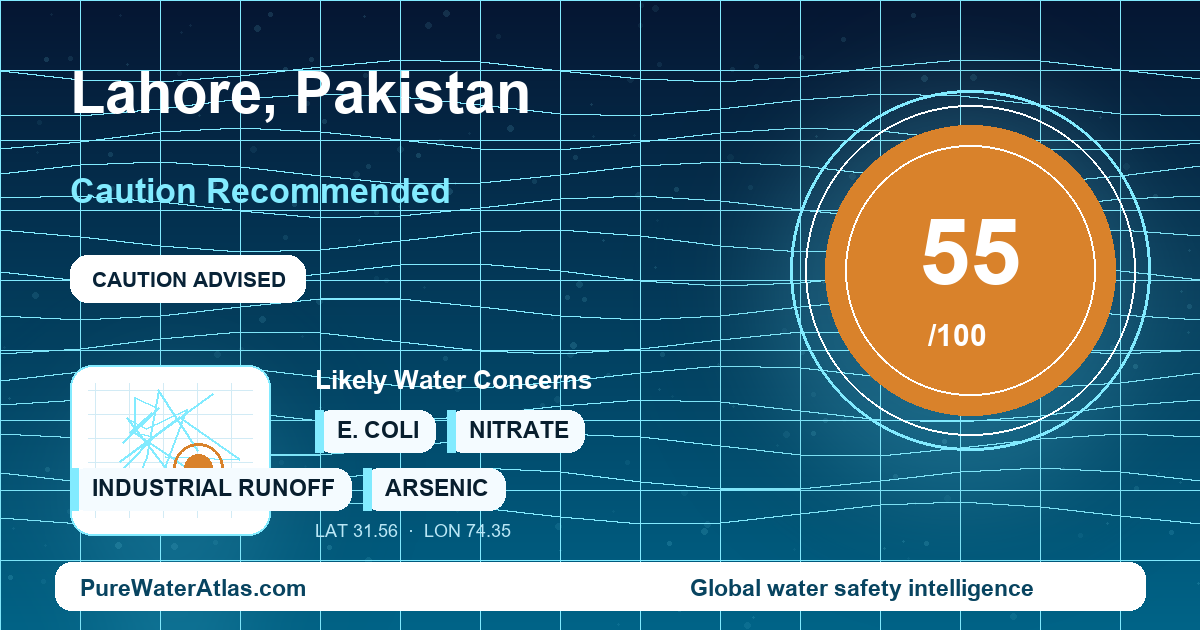
Lahore, Pakistan: municipal water is groundwater-dominated, locally variable, and best treated with caution at the tap because final safety depends on tube wells, distribution pipes, building storage tanks, plumbing, disinfection, and site-specific groundwater chemistry.
Quick Answer
| Overall safety status | Caution recommended. PureWaterAtlas water safety score: 55/100. Lahore tap water should not be treated as reliably drinkable at the point of use without verification or additional protection. |
|---|---|
| For travelers | Most visitors should avoid untreated tap water. Use sealed bottled water from reputable brands, boiled water, or water from a reliably maintained purifier. Be cautious with ice, unsealed water, street drinks, and hotel bathroom taps. |
| For residents | Do not assume every Lahore tap is unsafe, but do not assume it is safe either. Test the actual drinking tap and maintain a treatment system matched to results. |
| Main water source | Groundwater pumped from the alluvial aquifer beneath Lahore through municipal and private tube wells. |
| Main water authority | Water and Sanitation Agency Lahore, commonly known as WASA Lahore. |
| Practical filter recommendation | Common Lahore setup: sediment prefilter, activated carbon, and UV or boiling for microbial protection; add reverse osmosis only where testing confirms arsenic, nitrate, high TDS, salinity, or other dissolved contaminants. |
Short verdict: Lahore’s tap water risk is not defined by one single contaminant. The practical concern is the combination of groundwater stress, variable disinfection, old or leaky distribution infrastructure, household rooftop and underground tanks, and localized groundwater chemistry issues such as arsenic, salinity, hardness, chloride, high dissolved solids, nitrate, iron, and manganese.
Why Lahore Is Different
Lahore sits on the Ravi River alluvial plain in eastern Punjab. That geography gives the city access to a large groundwater aquifer, but it also makes drinking-water quality closely tied to aquifer depletion, river and canal recharge, wastewater infiltration, and dense urban land use. Lahore is not a city where most household tap water can be understood simply as river water treated in one central plant and sent through a uniform network. The practical backbone of supply is groundwater pumped through municipal and private tube wells.
This creates a very local pattern of risk. Water quality can change between a tube well, a distribution pipe, an underground sump, a rooftop tank, a private pump, and the final kitchen tap. A household with a clean covered tank, recent plumbing, good pressure conditions, and a maintained purifier may have much safer drinking water than a nearby building in the same supply zone with a dirty tank, cracked suction line, neglected filters, or cross-contamination from drains and sewers.
That is why the answer for Lahore is cautious rather than absolute. Residents should verify their own building. Short-term visitors, who usually cannot inspect tanks, plumbing, or filter maintenance, should avoid untreated tap water.
Where Does Lahore’s Tap Water Come From?
Lahore’s drinking water supply is dominated by groundwater drawn from the alluvial aquifer beneath the city. Municipal tube wells, private boreholes, and building-level pumping systems all play a role in how water reaches homes, offices, hotels, and institutions. The aquifer is part of the wider Indus Basin and Ravi River plain system. It is affected by intensive abstraction, urban recharge, canal and river interactions, and variable natural groundwater chemistry.
Historically, Lahore developed beside the Ravi River, but the modern city does not rely on a conventional large river-water treatment plant for most household tap water. Wells, hand pumps, and later tube wells became central because groundwater was accessible. Today, the Ravi is heavily affected by urban wastewater and low-flow conditions, so it is more important as part of the source-water and recharge context than as a simple treated drinking-water source for most consumers.
Key infrastructure includes municipal tube wells, distribution mains and neighborhood networks operated by WASA Lahore, chlorination points and operational disinfection within the system, private boreholes, filtration plants used by some households or institutions, and extensive building-level storage. Underground tanks, rooftop tanks, and private booster pumps can significantly affect the quality of water that people actually drink.
Surface-water treatment using canal sources has been discussed and developed through projects intended to reduce pressure on groundwater. Development-bank project documents for Lahore repeatedly identify groundwater depletion and investment needs in water and wastewater infrastructure as major issues. However, groundwater remains the practical backbone of household supply in the city.
Who Manages Drinking Water in Lahore?
The main urban water-supply and sanitation utility for Lahore is the Water and Sanitation Agency Lahore, commonly known as WASA Lahore. It operates under the Lahore Development Authority and the Government of Punjab framework. WASA Lahore is responsible for core municipal water and sanitation service delivery, including tube-well-based supply networks and related infrastructure.
Drinking-water oversight in Lahore is spread across Pakistan and Punjab standards, public-health institutions, environmental institutions, and research bodies rather than being presented through one highly visible independent municipal drinking-water regulator with a real-time public dashboard. Relevant institutions include WASA Lahore for service delivery, Punjab government departments, the Pakistan Council of Research in Water Resources for national water-quality research and monitoring, the Pakistan Standards and Quality Control Authority for national drinking-water standards, and public-health authorities for disease surveillance and advisories.
This matters for households because current, neighborhood-level tap compliance data are limited in the public domain. Lahore has enough city-specific evidence to identify the dominant groundwater system, infrastructure risks, and contaminant concerns, but not enough transparent public data to say that every neighborhood, hotel, apartment, or private borehole is safe or unsafe today without site-specific testing.
Main Local Water Concerns
- Microbial contamination risk: Lahore tap water can be affected by distribution leakage, intermittent pressure, sewer cross-connections, tank contamination, and private pumping arrangements. These conditions increase concern for organisms such as E. coli, which is used as an indicator of fecal contamination.
- Variable residual chlorine: Disinfection may not provide equal protection at every final tap, especially where water is stored for long periods before use. Low residual chlorine can allow microbial regrowth in tanks and pipes, while noticeable chlorine can also affect taste and odor. See the PureWaterAtlas guide to chlorine.
- Groundwater over-abstraction: Lahore’s reliance on tube-well groundwater has grown as the urban population has expanded. Falling water levels and aquifer stress are repeatedly identified in planning and development-bank discussions.
- Arsenic risk: Parts of the wider Punjab and Indus alluvial groundwater system have documented arsenic risk. For Lahore households, arsenic should be tested locally rather than assumed absent or assumed present at a fixed level. Learn more about arsenic.
- High TDS, salinity, hardness, chloride, and taste issues: Some groundwater and private-bore supplies may have elevated dissolved minerals or unpleasant taste. These are not solved by UV alone.
- Nitrate risk: Groundwater affected by wastewater, septic leakage, or urban nitrogen sources can require nitrate testing. Read the PureWaterAtlas profile on nitrate.
- Turbidity and sediment: Cloudiness or particles can appear after pipe repairs, supply interruptions, tank disturbance, or monsoon-related events. See turbidity and sediment.
- Building plumbing metals: Older buildings, brass fixtures, old galvanized pipes, solder, or private pumping equipment can contribute metals at the tap. This is a building-level concern, not a claim of proven citywide lead levels. If relevant, test for lead.
Season also matters. Monsoon rains can increase floodwater, sewer-overflow, and cross-contamination risks where drains, sewers, and water pipes are close or damaged. Summer heat can increase bacterial regrowth in storage tanks and pipes when chlorine residual is low. Power interruptions and high-demand periods can worsen low-pressure events, increasing intrusion risk in leaky networks.
For Travelers
For short-term visitors, untreated tap water in Lahore is not recommended. Use sealed bottled water from reputable brands, boiled water, or water from a reliably maintained purifier. This is a precautionary recommendation because visitors usually cannot verify the condition of a hotel’s storage tank, building plumbing, filter maintenance schedule, or recent supply interruptions.
Use bottled or treated water for brushing teeth if you are a short-term visitor, have a sensitive stomach, are immunocompromised, or are traveling with children. Long-term residents may use treated tap water if their household system is tested and maintained, but that is different from a visitor relying on an unknown bathroom tap.
Avoid ice unless you know it was made from bottled or properly treated water. In restaurants, wedding halls, street drinks, juice stalls, and informal food settings, ice is a common weak point because the original water source and handling chain are difficult to verify.
Higher-end hotels and restaurants may use filtration or reverse-osmosis systems, but do not assume bathroom tap water is purified. Ask directly. Prefer sealed bottled water opened in front of you, hot beverages made with boiling water, and cooked foods served hot. In hot weather, carry sealed water, check bottle seals, avoid refilled bottles, avoid raw drinks diluted with unknown water, and use oral rehydration salts if diarrhea occurs. The CDC Travelers’ Health guidance for Pakistan supports conservative food and water precautions for travelers.
For Residents
For Lahore residents, a home treatment system is often sensible, but the correct system depends on testing. A practical setup commonly starts with sediment prefiltration, followed by activated carbon for taste, odor, and chlorine management, and UV disinfection or boiling for microbial risk. Reverse osmosis may be appropriate where lab results show arsenic, nitrate, high TDS, salinity, or other dissolved contaminants that carbon and UV do not remove. Boiling is useful for microbial emergencies, but it does not remove arsenic, nitrate, salts, or many chemical contaminants.
Test the actual drinking tap, not only the municipal source, borehole, or storage tank. Building plumbing and tanks can change water quality after water leaves the supply network. At minimum, test for total coliform and E. coli, turbidity, pH, TDS or electrical conductivity, residual chlorine, hardness, chloride, nitrate, arsenic, iron, and manganese. If the building is old, newly renovated, uses unknown metal plumbing, or has brass fixtures, add lead and other metals testing using first-draw and flushed samples where possible.
Older Lahore buildings and renovated properties can have unknown plumbing materials, corroded pipes, rooftop tanks, underground sumps, and private booster pumps. If children or pregnant residents live in an older building, testing for lead and microbial indicators is a sensible precaution.
Storage tanks are one of the most important practical risk points in Lahore. Keep rooftop and underground tanks covered, sealed from insects and dust, protected from sewage or drain backflow, and cleaned and disinfected on a routine schedule. After tank cleaning, flushing and disinfection should be handled carefully so sediment or high-chlorine water is not consumed directly.
Relevant Contaminants and Water-Quality Issues
The most relevant Lahore water-quality topics are microbial safety, sediment, turbidity, groundwater chemistry, and building-level plumbing risk. Start with the PureWaterAtlas profiles for E. coli, turbidity, sediment, arsenic, nitrate, lead, and chlorine.
For treatment choices, see UV Water Purification: Complete Guide, Boiling Water Purification: Complete Guide, and Water Treatment Systems. For chemical risks that require testing before choosing a system, review Arsenic in Drinking Water: Testing and Detection Methods, Arsenic in Drinking Water: Best Filters, Systems and Solutions, Nitrate Contamination in Drinking Water: Testing and Detection Methods, and Lead in Drinking Water: Testing and Detection Methods.
How to Verify Your Water Quality
The most reliable way to answer “Is my Lahore tap water safe?” is to test the water you actually drink. Use an accredited or recognized laboratory where possible and keep the report. This reduces the risk of buying a generic reverse-osmosis system based only on a sales pitch rather than the actual contaminant profile.
Test after major pipe repairs, local flooding, recurring stomach illness in the household, unusual taste, odor, or color, a long low-pressure period, or a long supply interruption. After heavy rain, pipe repair, tank disturbance, or flooding, treat water as higher risk until it clears and is disinfected or tested.
Useful PureWaterAtlas resources include the complete guide to water testing, the Drinking Water Safety guide, the Water Microbiology guide, the Water Contamination guide, the Contaminants Search Engine, and the Global Water Quality Checker.
Official and Technical Sources
- Water and Sanitation Agency Lahore official website — local utility and government service context.
- Asian Infrastructure Investment Bank: Pakistan Lahore Water and Wastewater Management Project — Lahore water and wastewater infrastructure challenges and investment needs.
- Asian Development Bank project page: Punjab Urban Development Projects — urban water infrastructure and planning context for Punjab and Lahore-related systems.
- Pakistan Council of Research in Water Resources — national water-quality research and monitoring institution.
- PCRWR water quality reports and publications — published water-quality monitoring reports and Pakistan-wide contaminant context.
- Science Advances: Extensive arsenic contamination in high-pH unconfined aquifers in the Indus Valley — peer-reviewed evidence on arsenic risk in the Indus Basin aquifer system.
- CDC Travelers’ Health: Pakistan — public-health travel guidance supporting conservative food and water precautions.
- WHO Guidelines for Drinking-water Quality — international benchmark for microbial and chemical drinking-water risk.
- UNICEF Pakistan: Water, Sanitation and Hygiene — national WASH context relevant to drinking-water safety.
Bottom Line
Lahore tap water deserves caution, not blanket assumptions. The city depends mainly on groundwater pumped from the Ravi alluvial plain, and final tap quality can change through distribution pipes, intermittent pressure, sewer proximity, building storage tanks, and private pumps. Travelers should avoid untreated tap water and use sealed bottled, boiled, or reliably purified water, including for brushing teeth if sensitive. Residents should test the actual drinking tap and maintain treatment matched to results: typically sediment filtration, activated carbon, and UV or boiling for microbes, with reverse osmosis added only where arsenic, nitrate, salinity, high TDS, or similar dissolved contaminants are confirmed. Public data are not detailed enough to certify every neighborhood or building without site-specific testing.
Read the full guide: Global Water Quality Guide
Explore more in this category: Global Water Quality Articles