
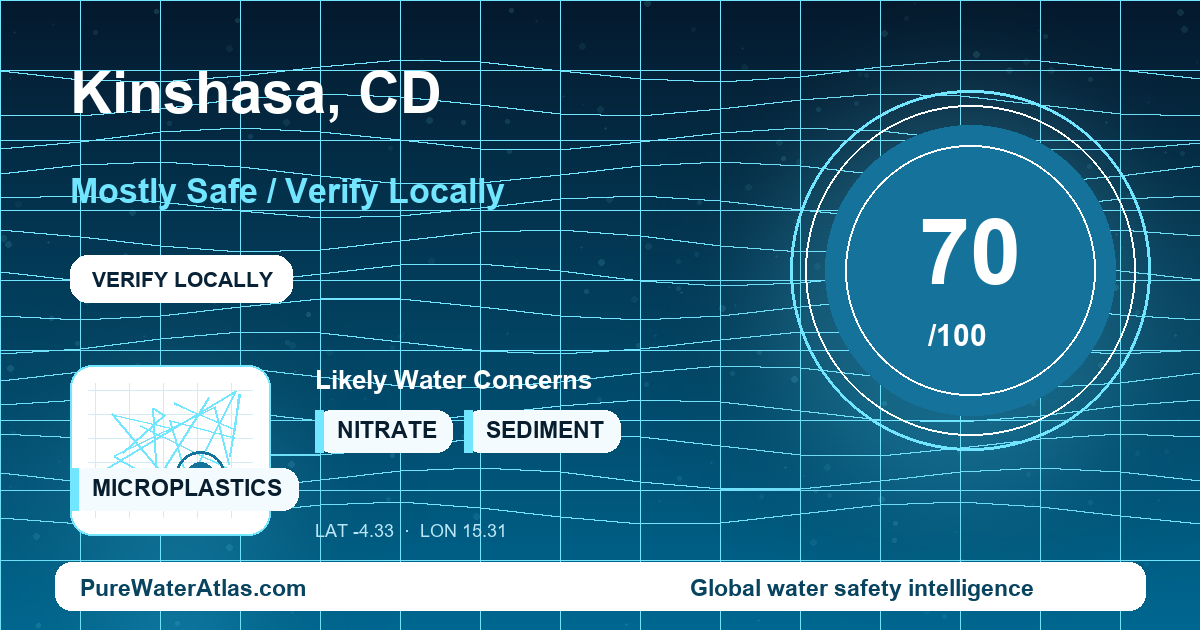
Kinshasa has a real treated municipal water system, but tap safety depends heavily on neighborhood pressure, distribution integrity, building storage tanks, and local verification.
Quick Answer
| Overall status | Mostly Safe / Verify Locally — PureWaterAtlas water safety score: 70/100. Kinshasa tap water should be treated as conditionally safe, not universally safe at every tap. |
|---|---|
| Can visitors drink it? | Not from unknown taps. Short-term visitors should use sealed bottled water, boiled water, or water treated with a reliable purifier. |
| Resident guidance | Residents with a stable REGIDESO connection and clear water may use tap water with precautions, but homes with outages, tanks, old plumbing, or boreholes should test and treat water. |
| Main water source | Primarily treated surface water, including major supply from the N’djili River through the N’djili treatment plant, with other REGIDESO surface-water intakes and facilities associated with the Congo River or Pool Malebo area and local systems such as Lukunga and Lukaya. |
| Water authority | REGIDESO, the national public water utility of the Democratic Republic of the Congo. |
| Filter recommendation | Where water is intermittent, visibly turbid, stored, or used by higher-risk people, use sediment prefiltration plus activated carbon and a final microbial barrier such as UV or boiling when contamination is suspected. |
Why Kinshasa Is Different
Kinshasa is not a city where the main drinking-water question is simply “river water versus treated water.” The city has a municipal treated-water system operated by REGIDESO, and that matters: piped water from a treatment plant is fundamentally different from untreated river water, shallow wells, or informal vendor sources. However, the safety question in Kinshasa is highly local. Water may leave a treatment plant adequately treated and still become unsafe before it reaches a kitchen tap.
The key Kinshasa-specific issue is the long chain between surface-water abstraction, treatment, pumping, distribution mains, service reservoirs, building plumbing, rooftop or underground storage tanks, and household containers. Any weak point in that chain can affect final tap quality. Low pressure, pipe breaks, illegal or poorly sealed connections, intermittent service, dirty tanks, and long stagnation inside buildings can all increase the risk of microbial contamination or sediment at the tap.
Kinshasa’s geography also shapes its water story. The city sits on the south bank of the Congo River near Pool Malebo, giving it access to very large freshwater surface-water resources. That does not mean every tap is safe. Large surface-water sources can carry turbidity, urban runoff, and seasonal changes, especially during heavy rains. The practical verdict is therefore mixed: Kinshasa has treated municipal water, but tap safety should be verified locally.
Where Does Kinshasa’s Tap Water Come From?
Kinshasa is supplied primarily by treated surface water. Sector and infrastructure sources identify the N’djili River as a major raw-water source through the large N’djili water treatment plant. Additional production is associated with other REGIDESO surface-water intakes and treatment facilities linked to the Congo River or Pool Malebo area and local river systems such as Lukunga and Lukaya.
This is an inland freshwater system. Salinity is not described in the available sources as the dominant citywide issue for Kinshasa. The more important concerns are treatment capacity, turbidity management, disinfection, distribution coverage, pressure stability, and protection of water quality after treatment.
Historically, Kinshasa grew from the Leopoldville river settlement on the south bank of the Congo River. Its drinking-water system developed around river and stream intakes rather than groundwater desalination. As the city expanded rapidly, the drinking-water challenge shifted from raw-water availability to the reliability and condition of urban water infrastructure. World Bank project records for urban water supply in the DRC document investment needs related to REGIDESO performance, production, and distribution, including in Kinshasa, which supports the view that the city has a real public system but not a uniformly modernized or uniformly monitored network.
Who Manages Drinking Water in Kinshasa?
Kinshasa’s principal piped drinking-water operator is REGIDESO, the national public water utility of the Democratic Republic of the Congo. REGIDESO operates municipal production and distribution infrastructure serving Kinshasa, including treatment plants, intakes, pumps, reservoirs, and distribution networks.
The national legal context includes the Democratic Republic of the Congo’s water-sector framework, including the 2015 Water Law, Loi n° 15/026 du 31 décembre 2015 relative à l’eau. Oversight involves national water and public-health authorities, while REGIDESO operates the public network.
A major limitation for consumers is transparency at the tap level. Unlike some countries where utilities publish detailed consumer confidence reports with monthly contaminant results, recent neighborhood-level public tap-water datasets for Kinshasa are not consistently easy to find. That means this profile should not be read as a claim that every tap in every commune meets a specific standard at all times. It is a risk-based city assessment built from available public information about sources, infrastructure, utility context, and known practical vulnerabilities.
Main Local Water Concerns
Microbial contamination after treatment is the most important practical concern. The issue is not that Kinshasa lacks treated water; it is that bacteria, viruses, or parasites can enter water after treatment during pressure loss, leaks, contaminated storage, damaged service connections, or pipe repairs. Outages, cloudy water when service returns, sewage odors, or recent network work should all increase caution.
Turbidity and sediment are also relevant because Kinshasa relies on surface-water sources. Heavy rains can increase raw-water turbidity, and if treatment or distribution flushing is stressed, fine sediment may appear at the tap. Brown, yellow, or visibly cloudy water should not be consumed directly. It should be avoided or settled, filtered, and disinfected before drinking.
Chlorine residual variability matters in a large, warm, complex distribution network. Chlorination is essential for microbial control, but disinfectant residual can be depleted in long or poorly maintained networks and in storage tanks. A mild chlorine smell does not automatically mean water is unsafe. Conversely, no detectable disinfectant after storage can be a concern if microbial testing is unavailable.
Lead and metals from building plumbing are building-specific concerns. The available dataset does not identify a citywide lead-in-water crisis for Kinshasa, but older buildings, repairs, brass fittings, solder, galvanized materials, and long stagnation can create local metal risks. This is especially relevant for children, pregnant people, and long-term residents using old internal plumbing.
Private wells, boreholes, vendors, and informal sources should not be assumed to have the same safety profile as treated REGIDESO water. Households without reliable municipal service may rely on alternative sources that vary greatly and may be vulnerable to fecal contamination or local pollution. These sources need microbial and basic chemical testing before regular drinking use.
For Travelers
Short-term visitors to Kinshasa should not drink tap water straight from an unknown tap. Use sealed bottled water, boiled water, or water treated with a reliable purifier. Check bottle seals when buying water, carry water during outings, and avoid drinks mixed with unknown ice.
For brushing teeth, visitors should use bottled, boiled, or filtered water, especially if they are immunocompromised, pregnant, traveling with young children, or staying in accommodation where water storage practices are unclear. Avoid ice unless a hotel or restaurant confirms it is made from treated water. Ice from informal vendors should be avoided.
Higher-end hotels, embassy compounds, and well-maintained apartments may have municipal water plus filtration, UV, chlorination, or bottled-water systems. That can make a major difference, but it should be confirmed directly. A reputable building does not automatically prove that rooftop tanks, underground cisterns, kitchen filters, or ice machines are maintained. The CDC Travelers’ Health page for the Democratic Republic of the Congo supports conservative food and water precautions for travelers.
For Residents
Residents with a stable REGIDESO connection, clear water, no storage problems, and no pressure interruptions may be able to use tap water after basic household precautions. However, many Kinshasa households should take additional steps because the final tap quality can depend as much on the building as on the municipal source.
A home treatment setup is advisable where water is intermittent, visibly turbid, stored in tanks, or consumed by infants, pregnant people, elderly people, or immunocompromised residents. For municipal water, a practical approach is sediment prefiltration to remove particles, activated carbon for taste, odor, and some chemical concerns, and a final microbial barrier such as UV or boiling when contamination is suspected. Reverse osmosis can be considered for households concerned about dissolved metals or nitrate, but it requires maintenance and safe storage after treatment.
Testing is important after outages, plumbing repairs, tank replacement, new pump installation, flooding, or a major change in taste, color, or odor. Residents should test for E. coli or thermotolerant coliforms if water is stored, pressure is intermittent, or gastrointestinal illness is recurring in the household. Turbidity, color, odor, pH, and free chlorine residual should be checked after outages and after tank cleaning.
Older apartment blocks, colonial-era properties, renovated buildings with mixed materials, and buildings with long internal pipe runs can have risks not reflected by treatment-plant water quality. Flush stagnant water before use and test first-draw and flushed samples for lead and other metals if children or pregnant people drink the water regularly.
Storage tanks are a major practical risk in Kinshasa. A dirty rooftop tank, underground cistern, jerrycan, or kitchen storage container can contaminate water that was safe at the street connection. Tanks should be covered, screened, cleaned, and disinfected on a schedule.
Relevant Contaminants and Water-Quality Issues
The most relevant Kinshasa water-quality issues are microbial safety, turbidity, sediment, chlorine residual, and building-level metals. For background on the key microbial indicator used in drinking-water testing, see E. coli in Drinking Water. If E. coli is detected, water should not be treated as safe without disinfection and investigation of the source.
Visible cloudiness or discoloration after heavy rain, outages, or pipe work should be taken seriously. Learn more from Turbidity in Drinking Water and Sediment in Drinking Water. Turbidity can interfere with disinfection and can signal stress in treatment, distribution, or building storage.
For disinfectant issues, see Chlorine in Drinking Water. Chlorine is not automatically a bad sign; it is a key protection against microbes. The concern in Kinshasa is that residual protection may vary across long networks and after storage.
For older buildings and plumbing-specific risks, see Lead in Drinking Water and Lead in Drinking Water: Testing and Detection Methods. There is no public evidence in the dataset of a citywide lead crisis in Kinshasa, but building-level testing is prudent where old materials or long stagnation are present.
How to Verify Your Water Quality
Because recent, public, neighborhood-level tap monitoring data for Kinshasa are limited, the safest approach is local verification. Start with the basics: note whether the water is clear, whether pressure is stable, whether outages are common, whether the building uses storage tanks, and whether water changes after rain or service interruptions. Then test based on the actual risk profile of the household or building.
For stored water, intermittent pressure, private wells, boreholes, or repeated gastrointestinal illness, prioritize microbial indicators such as E. coli or thermotolerant coliforms. For old plumbing, test metals using both first-draw and flushed samples. For boreholes or wells, include nitrate, conductivity, iron, manganese, and basic chemistry, especially after flooding or seasonal changes.
PureWaterAtlas resources that can help include the Complete Guide to Water Testing and Analysis, the Drinking Water Safety guide, the Water Microbiology guide, and the Water Treatment Systems guide. You can also use the Global Water Quality Checker and search individual issues in the Contaminants Search Engine.
For treatment decisions, boiling is effective for microbes when done correctly, but it does not remove metals, fuel residues, or other chemical contamination. See Boiling Water Purification: Complete Guide and UV Water Purification: Complete Guide for method-specific guidance.
Official and Technical Sources
- REGIDESO official website — identifies the national public water utility responsible for piped water service, including Kinshasa.
- World Bank: Democratic Republic of Congo Urban Water Supply Project P091092 — documents support for urban water supply improvements involving REGIDESO and major DRC cities including Kinshasa.
- World Bank: DRC Urban Water Supply Project Additional Financing P155266 — provides context on continuing investment needs for production, distribution, and utility performance.
- WHO/UNICEF Joint Monitoring Programme country data for the Democratic Republic of the Congo — provides national and urban/rural drinking-water service context, but not tap-by-tap results for Kinshasa.
- CDC Travelers’ Health: Democratic Republic of the Congo — supports conservative traveler advice about food and water precautions.
- FAOLEX: DRC Water Law, Loi n° 15/026 du 31 décembre 2015 relative à l’eau — provides national water-law context.
- Encyclopaedia Britannica: Kinshasa — confirms Kinshasa’s location on the Congo River, relevant to its surface-water setting.
Bottom Line
Kinshasa’s tap water should be treated as conditionally safe only after local verification. The city has a real REGIDESO municipal treated-water system based mainly on surface-water sources, including the N’djili River and other surface-water facilities. The main risk is not a confirmed citywide chemical contaminant; it is variable distribution integrity, pressure interruptions, turbidity after rains, household storage, and building plumbing. Visitors should use sealed bottled, boiled, or reliably treated water and avoid unknown ice. Residents should pay close attention to outages, storage tanks, old pipes, and visible sediment, and should test for microbial indicators where pressure is intermittent or water is stored. A well-maintained central building may have much safer tap water than a poorly maintained or peripheral supply point.
Read the full guide: Global Water Quality Guide
Explore more in this category: Global Water Quality Articles