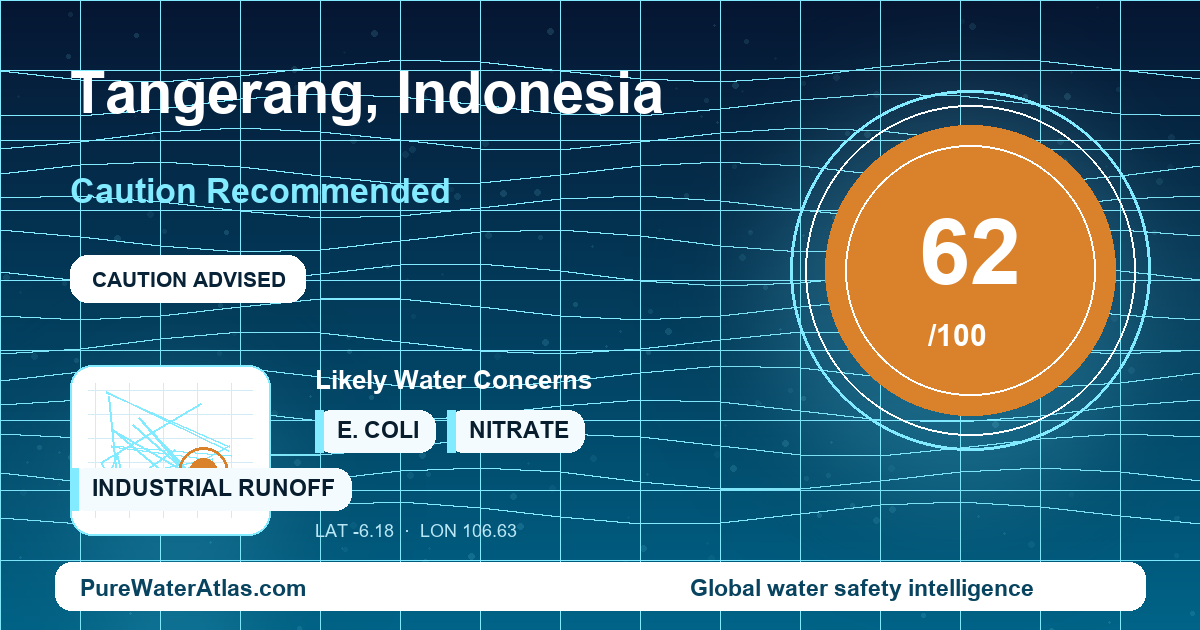
Tangerang, Indonesia: caution recommended for tap water because treated municipal supply exists, but consumer-tap data, household storage, wells, refill handling, and building plumbing can change the real drinking-water risk.
Quick Answer
| Overall safety status | Caution Recommended — PureWaterAtlas score: 62/100. Tangerang has a formal piped-water utility and treated supply, but ordinary tap water should not be treated as universally drinkable at every tap. |
|---|---|
| For travelers | Do not rely on ordinary tap water as your main drinking water. Use sealed bottled water, hotel-provided treated water, boiled water, or a filter designed for microbiological risks. Be cautious with ice unless it is from a reputable hotel, restaurant, or packaged ice supplier. |
| For residents | Piped-water customers generally have a safer baseline than households using shallow wells, but point-of-use treatment and periodic testing are prudent, especially where water is stored in roof tanks or ground tanks. |
| Main raw-water identity | The city’s municipal supply is closely tied to the Cisadane River, a major urban river system exposed to upstream settlement, runoff, wastewater, industry, and rainy-season turbidity. |
| Main authority | Perumda Tirta Benteng Kota Tangerang is the main local utility for Tangerang City. National drinking-water health standards sit under Indonesia’s Ministry of Health framework, including Permenkes No. 2 Tahun 2023. |
| Filter recommendation | For drinking and cooking, use a verified treatment barrier unless you have recent credible test results from your actual tap. Piped water may benefit from sediment plus activated carbon; wells require testing first and may need microbiological, nitrate, iron, manganese, salinity, or other treatment depending on results. |
Why Tangerang Is Different
Tangerang is not a city where a single answer applies cleanly to every household tap. It is an urban city in Banten Province immediately west of Jakarta, and the Cisadane River passes through the city before flowing north toward the Java Sea. That geography matters: Tangerang’s formal piped-water identity is closely connected to a surface-water system that serves a dense Greater Jakarta and Banten urban corridor.
The local risk picture is shaped by more than the treatment plant. A household in Tangerang may drink water from treated piped supply, stored piped water from a roof tank, a ground tank with booster pumps, private shallow-well water, refill gallons, bottled water, or some combination of these. Two homes on nearby streets can therefore have very different drinking-water risk depending on storage, maintenance, pressure interruptions, building plumbing, and whether the water has been treated again before drinking.
This is why PureWaterAtlas classifies Tangerang tap water as caution recommended rather than universally safe from the tap. The city has formal water infrastructure, but public, frequently updated, neighborhood-level finished-water laboratory results at consumer taps are not available in a consolidated way. In practice, the “last meter” inside homes, apartments, hotels, shops, and refill systems is often as important as the municipal supply itself.
Where Does Tangerang’s Tap Water Come From?
Tangerang’s municipal piped-water supply is closely tied to the Cisadane River system. The Cisadane functions as a central raw-water corridor for local surface-water supply and is managed within the broader Ciliwung-Cisadane river-basin institutional framework. Because the river moves through a heavily used urban basin, raw water can be influenced by upstream settlement, storm runoff, domestic wastewater, industrial activity, and rainy-season turbidity.
Before broader piped-water access, many households and businesses relied on groundwater from shallow or deeper wells. Private groundwater use remains relevant where piped supply is unavailable, intermittent, inconvenient, or not trusted by residents. This creates a second water-safety reality in Tangerang: well water may look clear but still be vulnerable to septic leakage, flooding, iron, manganese, salinity changes, and microbial contamination, particularly in dense urban neighborhoods.
Local infrastructure includes Perumda Tirta Benteng’s formal piped-water network, water-treatment plants, distribution pipes, household storage tanks, building pumps, refill-water depots, bottled water supply, and private wells. Regional bulk-water projects in the Greater Jakarta-Banten area, including planning linked to Karian and Serpong systems, are relevant for long-term supply resilience. However, household drinking-water safety still depends on how water is distributed, stored, handled, and treated at the point of use.
Who Manages Drinking Water in Tangerang?
The main local drinking-water utility for Tangerang City is Perumda Tirta Benteng Kota Tangerang. It is the city-owned company associated with formal piped-water service in Tangerang City. City context, municipal announcements, and public-service information are provided through the Pemerintah Kota Tangerang.
Raw-water and river-basin oversight are broader than the city utility. The Cisadane River sits within the Ciliwung-Cisadane basin framework, with institutional context from Balai Besar Wilayah Sungai Ciliwung Cisadane under Indonesia’s public-works water-resources system. Official city statistics and administrative context are available from Badan Pusat Statistik Kota Tangerang.
Health-based drinking-water standards in Indonesia are set nationally through the Ministry of Health framework. The current health-environment standards include Permenkes No. 2 Tahun 2023. Local governments and health offices have roles in sanitation, surveillance, and monitoring of drinking-water providers and refill-water depots. This page does not claim that every tap in Tangerang meets all standards because complete consumer-tap compliance data by neighborhood were not identified.
Main Local Water Concerns
The most important Tangerang-specific concern is the combination of a stressed urban raw-water source and variable last-meter conditions. The Cisadane River can experience high turbidity and pollutant loading from urban runoff, domestic wastewater, upstream land use, and other catchment pressures. During the rainy season, generally around November to March, storms can raise sediment, color, organic matter, and microbial pressure in raw water, wells, and storage systems.
Flooding is a practical risk for shallow wells, ground tanks, and damaged or depressurized plumbing. Even if water later looks clear, floodwater can introduce microbial contamination into wells and storage tanks. Dry-season low flows can concentrate pollutants in rivers and may increase reliance on groundwater or stored water in some areas.
Distribution and building-level issues also matter. Intermittent pressure, pipe repairs, or plumbing disturbance can introduce sediment and create opportunities for contamination. After heavy rain, pressure interruption, or repair work, residents should watch for cloudy, brown, or earthy-smelling water and flush taps before treating water for drinking.
Private wells in dense neighborhoods may be vulnerable to E. coli, thermotolerant coliforms, nitrate, and broader sanitation impacts where septic systems and drains are close to wells. Iron and manganese are also common aesthetic and operational concerns in many Indonesian groundwater settings, causing reddish-brown staining, dark particles, metallic taste, or sediment. Older premises may have uncertain plumbing materials; a citywide lead service-line problem is not documented for Tangerang, but lead can still come from old fittings, solder, brass components, or internal building plumbing.
For Travelers
Most visitors should treat ordinary tap water in Tangerang as not recommended for direct drinking. Use sealed bottled water, verified hotel-treated water, boiled water, or a filtration system designed for microbiological risk. This is especially important for short-stay visitors who are not adapted to local water handling conditions and who may be more vulnerable to travel-related gastrointestinal illness.
For brushing teeth, healthy adults can reduce risk by using bottled or boiled water, particularly in budget accommodation, older buildings, or places that rely on storage tanks. Avoid swallowing untreated tap water. Use bottled water for medications and infant formula, and do not refill drinking bottles from bathroom taps unless the water has been properly treated.
Ice deserves separate caution. Avoid ice from street vendors or small shops unless it is clearly made from commercial packaged ice or treated water. Reputable hotels, malls, and higher-end restaurants are lower risk, but not zero risk. Ask whether drinking water and ice are filtered or commercially supplied. If unsure, choose sealed bottled drinks and avoid raw drinks mixed with tap water.
Boiling is a strong emergency option for microbial safety. For practical steps, see PureWaterAtlas’ Boiling Water Purification: Complete Guide. Boiling does not remove metals, nitrate, salt, or many industrial chemicals, so it should not be treated as a complete solution for every contaminant.
For Residents
Residents connected to Perumda Tirta Benteng or another formal piped supplier generally start from a safer baseline than households relying on shallow wells. Even so, a household treatment barrier is advisable for drinking and cooking unless you have recent, credible results from your actual tap and reliable building storage. For piped water, a sediment prefilter plus activated carbon can improve particles, taste, and chlorine odor. For higher confidence, households may consider a certified purifier such as reverse osmosis, ultrafiltration, or UV, selected according to actual test results and maintenance capacity.
For private wells, do not choose a filter only by taste. Test first for E. coli or thermotolerant coliforms, nitrate, pH, conductivity or total dissolved solids, iron, manganese, hardness, and turbidity. After flooding, test or disinfect wells and tanks before drinking the water, even if it looks clear. Households with babies, pregnant residents, elderly people, or immunocompromised people should prioritize microbiological safety and use verified treatment while waiting for results.
If water is yellow, brown, metallic, salty, oily, or has a sewage smell, stop using it for drinking and investigate the source before relying on filtration. In older homes, apartments, or commercial premises where plumbing history is unknown, consider first-draw and flushed testing for lead and other metals if feasible. Tangerang does not have a publicly documented citywide lead service-line crisis, but old fixtures, brass taps, solder, galvanized pipes, and poorly maintained internal plumbing can still add metals or sediment.
Storage tanks are one of the most important practical control points. Roof tanks and ground tanks should be covered, screened against insects and rodents, cleaned on a schedule, protected from floodwater, and inspected after pressure interruptions. A clean utility supply can become unsafe if it sits in a dirty tank or passes through contaminated building plumbing.
Relevant Contaminants and Water-Quality Issues
Several PureWaterAtlas contaminant profiles are directly relevant to Tangerang’s risk pattern. Turbidity in drinking water is important because Cisadane River raw water and rainy-season events can increase suspended solids and treatment difficulty. Sediment in drinking water is relevant after pipe repairs, tank deposits, intermittent pressure, and discolored-water complaints.
Microbial safety is a central concern for shallow wells, flooded tanks, refill handling, and any system affected by sewage intrusion. See E. coli in drinking water and the broader Water Microbiology guide. Chlorination may be part of municipal protection, but chlorine taste alone does not prove tap-level safety; see Chlorine in drinking water.
For groundwater users, iron and manganese are relevant where staining, metallic taste, or dark particles appear. Nitrate matters for shallow wells near septic systems, drains, or dense settlement. Lead is relevant for older building plumbing and fixtures without implying a documented citywide lead problem in Tangerang.
How to Verify Your Water Quality
The most reliable answer for a Tangerang household is a test from the actual water you drink: tap, tank outlet, well, refill gallon, or purifier outlet. Start with the PureWaterAtlas Water Testing guide to choose parameters and sample locations. For older buildings, the guide to lead testing and detection methods can help distinguish stagnant first-draw water from flushed water. For wells near septic systems or drainage, see nitrate contamination testing.
If you are choosing treatment, use the Water Treatment Systems guide and, for microbial barriers, the UV Water Purification guide. You can compare Tangerang with other destinations using the Global Water Quality Checker, and research specific substances through the Contaminants Search Engine. For general decision rules, see Drinking Water Safety.
Data limitations matter. Tangerang has identifiable utility, city, river-basin, and regulatory sources, but PureWaterAtlas did not identify a complete, frequently updated public dataset of finished-water laboratory results at consumer taps by neighborhood. Conditions can differ between piped-water customers, apartment towers, hotels, refill-water users, and households using private wells.
Official and Technical Sources
- Perumda Tirta Benteng Kota Tangerang — official local utility source for Tangerang City piped-water service identity and customer information.
- Pemerintah Kota Tangerang — official municipal source for city government context, public services, and local announcements.
- Balai Besar Wilayah Sungai Ciliwung Cisadane — river-basin authority context for the Ciliwung-Cisadane system that includes the Cisadane River.
- Badan Pusat Statistik Kota Tangerang — official statistics source for Tangerang’s geography, population, and administrative context.
- Permenkes No. 2 Tahun 2023 — Indonesian national health-environment standard framework relevant to drinking-water quality.
- World Health Organization drinking-water fact sheet — public-health reference for safe drinking water and microbial protection.
- World Health Organization travel and health water advice — international travel-health guidance on water, ice, and food-and-water precautions.
Bottom Line
Tangerang tap water should be treated with caution. The city has a formal municipal water utility, Perumda Tirta Benteng, and a surface-water supply identity linked to the Cisadane River, but public consumer-tap test reporting is limited and household conditions vary widely. Travelers should use sealed bottled, boiled, or verified treated water and be cautious with ice. Residents on piped supply have a safer baseline than shallow-well users, but storage tanks, old plumbing, pressure interruptions, flooding, and refill-water handling can change the risk at the point of drinking. For households, the best approach is testing plus a treatment barrier matched to the actual source: piped tap, tank, well, or purifier outlet.
Read the full guide: Global Water Quality Guide
Explore more in this category: Global Water Quality Articles