Tijuana, Mexico: municipal water from a Colorado River-dependent system, with caution recommended at the tap because building storage, outages, plumbing, and limited neighborhood-level public data can affect real-world drinking safety.
Quick Answer
| Overall tap-water status | Caution recommended. Tijuana has a formal municipal supply operated by CESPT and is not an untreated-water city, but point-of-use risk depends on distribution conditions, service interruptions, storage tanks, and plumbing. |
|---|---|
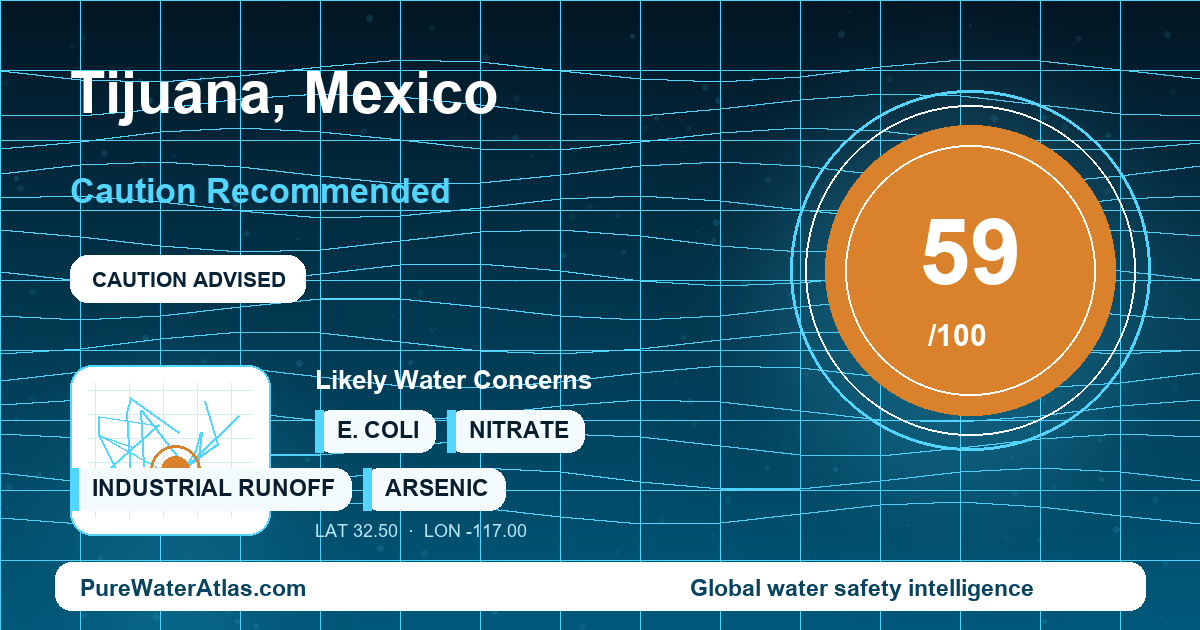
| PureWaterAtlas safety score | 59 / 100 — Risk level: Caution Recommended. |
| For short-term visitors | Most visitors should not drink unfiltered tap water. Use sealed bottled water, commercially purified water, or water confirmed to be purified by a reputable hotel, restaurant, or dispenser. |
| For residents | Residents connected to CESPT should treat the supply as managed municipal water, but use a point-of-use barrier for daily drinking, especially in older buildings, homes with tinacos or cisterns, or areas affected by pressure cuts. |
| Main water source | Heavy dependence on imported Colorado River water delivered through the Acueducto Río Colorado-Tijuana system, with El Carrizo reservoir and El Florido treatment plant as key infrastructure. |
| Water authority | Comisión Estatal de Servicios Públicos de Tijuana, commonly known as CESPT, serves Tijuana and Playas de Rosarito. |
| Practical filter recommendation | Sediment prefiltration plus activated carbon is a practical baseline; reverse osmosis is appropriate where dissolved solids, salinity, nitrate, arsenic, or metals are a concern. UV can help with microbial risk from tanks, but only when turbidity is low. |
Why Tijuana Is Different
Tijuana is not a typical city where the drinking-water question can be answered only by asking whether the utility treats the water. The city is a fast-growing border metropolis in a semi-arid coastal region with limited dependable local surface water. Its drinking-water security is unusually dependent on long-distance imported Colorado River water rather than on a large local river or lake immediately next to the city.
That dependence matters for safety decisions. Water must be moved across Baja California through major pumping, conveyance, storage, and treatment infrastructure before it reaches the Tijuana metropolitan distribution network. Because of that long supply chain, drought, pumping limitations, energy vulnerability, aqueduct maintenance, reservoir levels, and pressure-zone operations can all influence reliability. When service interruptions or low-pressure events occur, the concern can shift from treatment-plant quality to what happens inside the distribution system and inside individual buildings.
For many homes, apartments, hotels, and businesses, the final path to the tap may include a cistern, tinaco, private pump, internal plumbing, or rooftop or ground-level storage tank. In Tijuana, the condition of that building-level equipment can matter as much as the official municipal supply. A treated water supply can become less reliable at the faucet if it is stored in a dirty tank, exposed to dust or insects, left stagnant, or pushed through old internal plumbing.
There is also an important public-perception issue. The Tijuana River basin is internationally known for wastewater and stormwater pollution problems affecting the U.S.-Mexico border region. That regional wastewater issue should not be confused with Tijuana’s treated municipal drinking-water source, which is largely imported from the Colorado River system. However, it does show the broader infrastructure stress facing the region and helps explain why conservative drinking-water guidance is appropriate.
Where Does Tijuana’s Tap Water Come From?
Tijuana’s main municipal raw-water dependence is imported Colorado River water delivered across Baja California by the Acueducto Río Colorado-Tijuana. This system moves water from the Mexicali and Colorado River side of the state toward the coastal Tijuana area. The supply chain includes the El Carrizo reservoir, an important regulating storage point, and the Planta Potabilizadora El Florido, a principal drinking-water treatment facility serving the Tijuana metropolitan area.
The city’s best-known local historical surface-water source is the Presa Abelardo L. Rodríguez in the Tijuana River basin. In the modern metropolitan system, however, local runoff is variable and limited, so Tijuana relies heavily on imported water. This links the city’s water security to Colorado River availability, long-distance pumping infrastructure, and broader binational Colorado River management conditions.
Colorado River-derived water can also carry taste and mineral concerns common to long-distance surface-water supplies, including dissolved solids and salinity considerations. The binational importance of Colorado River salinity is documented in the International Boundary and Water Commission’s Minute 242 on Colorado River salinity. This does not mean that every Tijuana tap has a specific contaminant problem; it means that the source-water identity is relevant when choosing household treatment and interpreting taste, odor, and total dissolved solids complaints.
Who Manages Drinking Water in Tijuana?
Drinking water and sewer service in Tijuana and Playas de Rosarito are managed by CESPT, the Comisión Estatal de Servicios Públicos de Tijuana. CESPT is the local public utility responsible for operating the service network and communicating service information to customers.
At the state level, water-sector planning and public service context are connected to Baja California agencies such as SEPROA, the Secretaría para el Manejo, Saneamiento y Protección del Agua de Baja California. Nationally, water-resource and infrastructure context is associated with CONAGUA, while drinking water quality in Mexico is governed by health-based standards such as NOM-127-SSA1-2021.
The existence of a national drinking-water standard is important, but it should not be read as proof that water is safe at every individual faucet at every moment. Tap quality can vary by pressure zone, outage history, building storage, plumbing material, and tank maintenance. Publicly accessible, recent, neighborhood-level analytical results for Tijuana are more limited than the consumer-confidence-style reporting common in some U.S. cities. For that reason, this profile does not claim exact compliance percentages, contaminant concentrations, or block-by-block safety.
Main Local Water Concerns
- Colorado River dependence: Tijuana’s supply is heavily tied to imported Colorado River water during a period of regional drought and long-term basin stress.
- Long-distance infrastructure: Because water must be moved across mountains and long distances, pumping, energy, aqueduct, reservoir, and maintenance vulnerabilities are part of the local risk profile.
- Intermittent service and pressure events: Pressure reductions, scheduled maintenance, repairs, or outages can increase concerns about sediment, turbidity, intrusion risk, or microbial vulnerability at the tap.
- Building-level storage: Cisterns and tinacos can become contaminated if not sealed, cleaned, screened, and disinfected.
- Taste, odor, and minerals: Chlorination and dissolved solids can affect taste and odor, especially in Colorado River-derived supplies.
- Older plumbing: Internal plumbing, fixtures, solder, or stagnant dead-end lines can add metals or other tap-level problems even when utility water leaving treatment is acceptable.
- Limited granular data: The source-water and institutional picture is well documented, but current neighborhood-level tap-water data are not easily available to the public.
Seasonal and operational factors also matter. Winter storm events can mobilize sediment and overwhelm wastewater and stormwater infrastructure in the broader Tijuana River region, even though that is not the same as the treated drinking-water source. Hot, dry periods can increase demand and worsen storage-tank hygiene where water stagnates. After outages, repairs, or pressure restoration, residents may notice discolored water, air, chlorine changes, or sediment and should flush taps and follow CESPT advisories.
For Travelers
For most short-term visitors, the practical answer is simple: do not drink unfiltered tap water in Tijuana. Use sealed bottled water, commercially purified water, or water that has been boiled or treated with a reliable purifier. A traveler staying only a few days usually cannot verify a hotel’s tank maintenance, internal plumbing, recent outage history, or local pressure conditions.
For brushing teeth, conservative guidance is to use bottled or purified water, especially for children, pregnant travelers, older adults, and anyone with immune compromise or a sensitive stomach. Many travelers may brush with tap water without incident, but it is not the lowest-risk choice.
Ice requires judgment. Established hotels, chain restaurants, and busy restaurants often use purified water or purchased purified ice, but do not assume this at street stands, informal bars, or unknown venues. If the answer is unclear, skip ice or ask whether it is made from purified water.
Higher-end hotels and many restaurants commonly use garrafón water, filtration, or purchased purified ice for drinking service. Still, ask directly whether water and ice are purified. Buy sealed bottles or garrafón refills from reputable stores, check that caps are intact, and avoid drinking from bathroom taps. If you are prone to stomach illness, carry oral rehydration salts. Boiling can reduce microbial risk, but it does not remove dissolved salts, metals, or chemical contaminants; see the PureWaterAtlas Boiling Water Purification Guide for method limitations.
For general travel-health context in Mexico, the CDC Travelers’ Health Mexico page and the CDC Yellow Book section on water disinfection for travelers support conservative food and water precautions.
For Residents
Residents connected to CESPT should treat the tap supply as managed municipal water, not as an informal or untreated source. However, for daily drinking, a certified point-of-use system is prudent in Tijuana. A practical household setup is sediment prefiltration plus activated carbon to improve taste, reduce chlorine taste and odor, and capture particulates. Reverse osmosis is appropriate where dissolved solids, salinity, nitrate, arsenic, or metals are a concern. UV can be useful where tanks or cisterns create microbial concern, but UV requires low turbidity and does not remove salts or metals; see the PureWaterAtlas UV Water Purification Guide.
Residents should pay special attention to storage tanks. Tinacos and cisterns should be covered, screened, cleaned, and disinfected on a routine schedule. A treated municipal supply can become unsafe if stored in a dirty tank or exposed to insects, dust, animals, roof runoff, or cross-connections.
Older buildings require extra caution. Lead is not identified here as a confirmed Tijuana source-water issue, but premise plumbing can still create tap-level metal concerns through internal pipes, solder, fixtures, or stagnant lines. Testing is better than assuming. Homes with infants, pregnancy, kidney disease, immune compromise, old plumbing, unusual taste, turbidity, or repeated outages should consider laboratory testing at the kitchen tap.
Useful testing steps include sampling after the water has sat overnight and again after flushing, testing total coliform and E. coli in homes with cisterns or tinacos, and checking turbidity, color, odor, chlorine residual, pH, conductivity, and total dissolved solids after outages or repairs. Broader laboratory testing for lead, copper, nitrate, arsenic, and hardness is appropriate for higher-risk households or long-term daily consumption. If a household uses a private well, trucked water, or an informal source instead of CESPT supply, microbiological and chemical testing should be done before drinking.
Relevant Contaminants and Water-Quality Issues
The most relevant Tijuana issues are not framed as one confirmed citywide contaminant spike. They are a combination of municipal supply uncertainty, distribution events, building storage, and plumbing. Microbial indicators such as E. coli matter where tanks, cisterns, outages, or pressure loss are part of the picture. Turbidity and sediment are important after repairs, pressure changes, storms, or pipe disturbance because cloudy or particle-laden water can interfere with treatment barriers and signal distribution disturbance.
Chlorine is also relevant because chlorinated municipal water may have taste and odor complaints while chlorine residual remains an important microbial safety barrier. Lead should be considered for older-building tap testing, not as a confirmed source-water claim. Nitrate is especially relevant for private wells, informal sources, broader resident lab panels, infants, and pregnancy.
How to Verify Your Water Quality
The best verification step in Tijuana is to test the water at the tap where it is actually consumed, especially if a building uses a tinaco, cistern, internal pump, or older plumbing. Utility-level treatment information is useful, but it cannot fully describe water that has passed through building storage and premise plumbing.
Start with the PureWaterAtlas guide to Water Testing if you need to choose between home screening and laboratory analysis. For a broader framework on judging safety beyond official supply claims, see Drinking Water Safety. If your concern is bacteria, tanks, outages, or gastrointestinal risk, review Water Microbiology. For choosing boiling, filtration, reverse osmosis, or UV based on the problem, use the PureWaterAtlas Water Purification guide.
You can also compare destination-level guidance using the Global Water Quality Checker and research specific analytes in the Contaminants Search Engine. Related PureWaterAtlas categories include Drinking Water Safety, Global Water Quality, Water Testing, and Water Purification.
Official and Technical Sources
- Comisión Estatal de Servicios Públicos de Tijuana, CESPT — local public utility for Tijuana and Playas de Rosarito water and sewer service.
- SEPROA Baja California — state water-sector context for Baja California.
- CONAGUA — Mexico’s national water authority and water-management framework.
- NOM-127-SSA1-2021 — official Mexican drinking-water quality standard context.
- International Boundary and Water Commission Minute 242 — binational Colorado River salinity context.
- U.S. EPA Tijuana River Watershed — regional wastewater, stormwater, and infrastructure-stress context, not evidence that CESPT drinking water is untreated.
- CDC Travelers’ Health Mexico — conservative food and water precautions for travelers.
- CDC Yellow Book: Water Disinfection for Travelers — traveler treatment methods and limitations.
Bottom Line
Tijuana’s tap water should be approached with caution, not panic. The city has a formal CESPT municipal supply and relies heavily on imported Colorado River water treated through key infrastructure such as El Carrizo and El Florido. The practical risk is that water quality at the faucet can be affected by drought-related supply stress, long-distance aqueduct vulnerability, intermittent service, low-pressure events, storage tanks, and old building plumbing. Most visitors should use sealed bottled or verified purified water. Residents should maintain tinacos and cisterns, monitor CESPT notices, flush after outages, and use appropriate point-of-use treatment for daily drinking. Because recent neighborhood-level public testing data are limited, tap-level testing is the most reliable way to verify safety in a specific building.
Read the full guide: Global Water Quality Guide
Explore more in this category: Global Water Quality Articles