
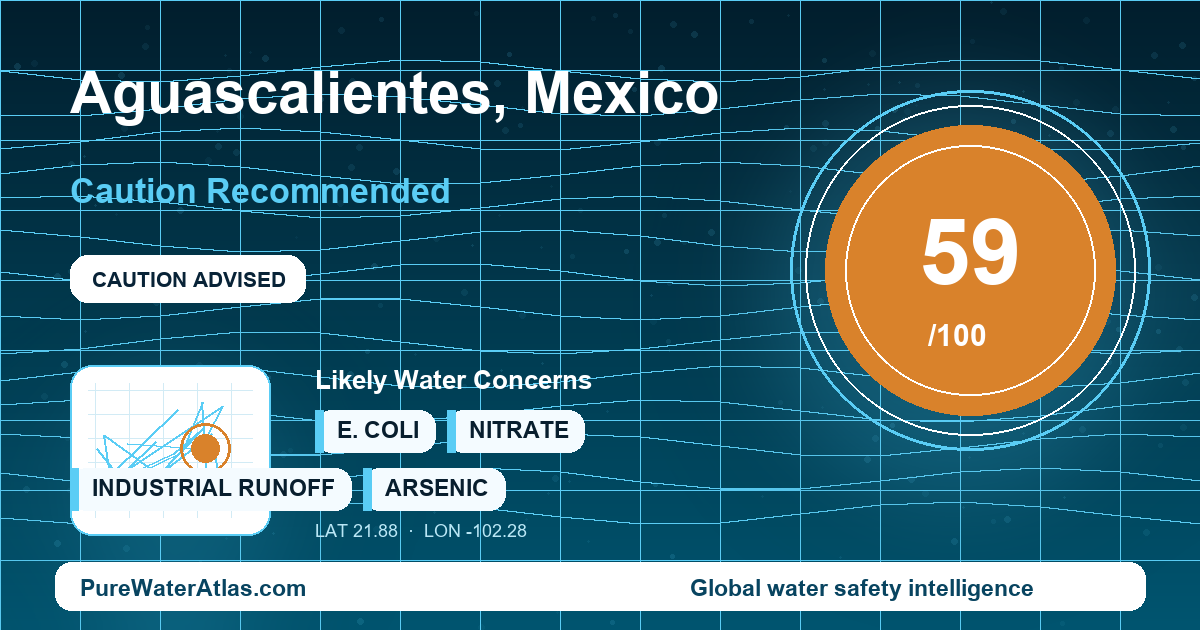
Aguascalientes, Mexico: caution recommended for drinking tap water because the city depends mainly on deep groundwater from a stressed aquifer, with household storage, mineral content, and limited public tap-level data shaping real-world safety.
Quick Answer
| Overall status | Caution recommended. PureWaterAtlas water safety score: 59/100. Do not assume untreated tap water is consistently safe to drink in Aguascalientes. |
|---|---|
| For visitors | Most short-term travelers should use sealed bottled water, trusted garrafón water, or water treated by a verified filtration and disinfection system. Tap water is generally acceptable for showering and handwashing. |
| For residents | Use household verification rather than taste alone. A maintained point-of-use system and periodic laboratory testing are prudent for drinking and cooking water. |
| Main source | Predominantly groundwater from municipal wells in the Valle de Aguascalientes aquifer system, not a large surface-water treatment system. |
| Water authority | MIAA, Modelo Integral de Aguas de Aguascalientes, the municipal public operator that replaced the prior concession-based model. |
| Filter recommendation | Sediment prefiltration plus activated carbon is useful for many homes; reverse osmosis is advisable where dissolved minerals, fluoride, arsenic, nitrate, salinity, or taste are concerns. UV helps only for microbial polishing after filtration and does not remove minerals or metals. |
This assessment is based on the city’s groundwater dependence, aquifer stress, local infrastructure realities, Mexican regulatory context, and traveler health guidance. It does not claim that every tap in Aguascalientes is contaminated, because recent public neighborhood-by-neighborhood finished-water results are not consistently available in a simple tap-level format.
Why Aguascalientes Is Different
Aguascalientes is a semi-arid highland city in north-central Mexico where limited natural surface-water availability makes groundwater the practical backbone of public water supply. That matters for drinking-water safety because the city’s tap water profile is shaped less by a single large surface reservoir and treatment plant, and more by deep wells, aquifer conditions, dissolved minerals, pumping pressure, distribution pipes, and building-level storage.
The city’s name is historically associated with hot springs and thermal waters, but that identity should not be confused with the modern municipal drinking-water supply. Today, the urban system relies predominantly on groundwater pumped from the Valle de Aguascalientes aquifer system. Deep groundwater can be clear and disinfected yet still contain high dissolved minerals or site-specific inorganic contaminants that are not obvious by sight or smell.
For residents, the practical drinking-water question is not simply “is the city water chlorinated?” It is whether the water reaching a specific kitchen tap has acceptable microbiological quality, reasonable mineral chemistry, and no building-level contamination from tanks or plumbing. For travelers, the safest answer is simpler: use bottled or verified purified water for drinking unless the hotel or residence can confirm properly maintained treatment and storage.
Where Does Aguascalientes’s Tap Water Come From?
Aguascalientes city relies mainly on groundwater pumped from municipal wells distributed across the urban area and surrounding valley. The relevant regional source is the Valle de Aguascalientes aquifer system. Official aquifer information from CONAGUA’s Valle de Aguascalientes aquifer file supports the finding that the city depends on a stressed groundwater system with limited availability.
Because the water supply depends on wells and pumping, water quality can vary with aquifer depth, well condition, mineral content, and operational pressure. The infrastructure also includes pumping stations, chlorination or disinfection points associated with the well network, municipal distribution mains, and household-level cisterns, roof tanks, and pressure systems. These building-level components are common where water pressure or continuity varies, and they can become important risk points even when water leaves the municipal system in acceptable condition.
Seasonal conditions can change the practical risk. During dry and hot periods, demand can stress pumping and pressure, making clean storage tanks and maintained treatment more important. During the rainy season, runoff, street flooding, repairs, and pressure drops can increase the short-term risk of turbidity or microbial intrusion if distribution integrity is compromised. After interruptions, unusual color, odor, sediment, or sudden low pressure should be treated as a warning sign.
Who Manages Drinking Water in Aguascalientes?
The municipal water service in Aguascalientes is handled by MIAA, Modelo Integral de Aguas de Aguascalientes. MIAA is the current municipal public operator. The city has gone through a long-running transition in water governance, moving from a private concession model associated with CAASA or Veolia Aguascalientes and earlier local oversight associated with CCAPAMA to the current public water-management model.
That transition matters when interpreting older local water records, service announcements, and investment information. Current repair notices, service updates, and local operating information should be checked through MIAA and the Municipio de Aguascalientes rather than assuming older concession-era data reflect present conditions.
Nationally, drinking water in Mexico is governed through federal health and water frameworks. The key drinking-water quality standard is NOM-127-SSA1-2021, which establishes sanitary criteria for water for human use and consumption. Sanitary surveillance context is provided by COFEPRIS, while aquifer administration and water availability are handled at the federal water level by CONAGUA, including through the Sistema Nacional de Información del Agua.
Main Local Water Concerns
The main water-quality concerns in Aguascalientes are tied to groundwater dependence, aquifer stress, distribution-system realities, and household storage. The Valle de Aguascalientes system is overexploited, increasing dependence on deeper pumping and creating long-term water-security pressure. In a semi-arid basin, deeper groundwater may also be more mineralized, which helps explain why many households notice hard water, scale, or a strong mineral taste.
Hardness and mineral taste do not automatically mean water is microbiologically unsafe. However, they do explain why many residents use garrafones, reverse osmosis units, or other point-of-use treatment for drinking water. Dissolved minerals also cannot be reliably evaluated by appearance. Clear water can still have high total dissolved solids, fluoride, nitrate, arsenic, sodium, chloride, sulfate, or other inorganic chemistry concerns that require laboratory testing.
Geogenic contaminants have been reported in parts of the regional groundwater context, especially fluoride and, in some studies or aquifer areas, arsenic. This does not prove that every household tap in Aguascalientes has unsafe levels. It does mean households should test before making confident claims about their own water. Nitrate is also a relevant groundwater concern where urban growth, agriculture, wastewater leakage, or septic influences affect recharge areas.
The other major concern is what happens after water enters the distribution network or a building. Pipe age, leaks, repairs, pressure variation, dirty cisterns, roof tanks, stagnant plumbing, and old fixtures can affect safety at the tap. Older buildings may have premise-plumbing risks from brass fixtures, solder, valves, galvanized pipe, or other components that can add metals or sediment. These are household or building risks, not necessarily uniform citywide source-water problems.
For Travelers
For most visitors to Aguascalientes, drinking untreated tap water is not recommended. Use sealed bottled water, trusted garrafón water, or water treated by a verified purification system. This is a risk-management recommendation for travelers, not a claim that every tap in the city is contaminated. Travelers often have less time to verify building storage, filter maintenance, or recent service interruptions, so the safer choice is to avoid direct tap-water consumption.
Tap water is generally acceptable for showering and handwashing. For brushing teeth, lower-risk travelers may use clear tap water in reputable hotels, but cautious travelers, children, pregnant travelers, and people with sensitive stomachs should use bottled or treated water. Avoid drinking from bathroom taps in rentals unless the water source and treatment system are clearly verified.
Use ice only in established hotels, restaurants, and cafés that can confirm it is made from purified water. Avoid street-vendor ice or ice of unknown origin. Better hotels and restaurants commonly use purified water for drinking, ice, and beverages, but it is still reasonable to ask. In short-term rentals, confirm whether drinking water comes from sealed garrafones, a maintained purifier, or untreated tap water.
During hot months, carry bottled water. During or after service interruptions, construction work, flooding, visible turbidity, unusual odor, or sudden discoloration, use bottled or boiled water until conditions normalize. The CDC Travelers’ Health guidance for Mexico supports cautious food and water practices for visitors.
For Residents
Residents should treat Aguascalientes tap water as a supply that may be disinfected at the system level but still needs household verification. A practical home setup for drinking and cooking water is sediment prefiltration, activated carbon, and reverse osmosis when dissolved minerals, salinity, fluoride, arsenic, nitrate, or taste are concerns. Activated carbon can improve chlorine taste and some organic byproducts, but it does not solve high dissolved minerals. Reverse osmosis is more appropriate for many inorganic groundwater concerns. UV can be useful only after filtration and only for microbiological polishing; it does not remove minerals, nitrate, arsenic, fluoride, or metals.
Testing is important when moving into a property, after installing treatment equipment, after major plumbing work, and after cistern or roof-tank repairs. Use a professional or accredited laboratory for microbiological indicators such as total coliforms and E. coli, especially if the home uses storage tanks. For groundwater chemistry, request fluoride, arsenic, nitrate, total dissolved solids, hardness, sodium, chloride, sulfate, iron, manganese, and pH. If the building is older or plumbing materials are unknown, test first-draw and flushed samples for lead and other metals to distinguish premise-plumbing risk from source-water risk.
Cisterns and roof tanks deserve special attention in Aguascalientes. A tank with sediment, insects, roof runoff entry, cracked covers, missing screens, or long stagnation can create a practical microbial risk even if municipal water is disinfected. Tanks should be sealed, screened, cleaned, and disinfected periodically. If children, pregnant people, older adults, or immunocompromised residents will drink the water, testing and maintenance should be prioritized over relying on taste, clarity, or a decorative faucet filter.
Relevant Contaminants and Water-Quality Issues
Several PureWaterAtlas contaminant profiles are especially relevant to Aguascalientes because of the city’s groundwater dependence and storage-tank realities. Chlorine in drinking water matters because disinfection residual helps protect against microbes but can affect taste. Turbidity and sediment are important during pipe repairs, service interruptions, rainy-season intrusion, tank disturbance, or old-main flushing.
For microbial risk, see E. coli in drinking water, especially if a home uses a cistern or roof tank. For groundwater chemistry, households should understand arsenic and nitrate, both of which require testing rather than guesswork. For older buildings, lead in drinking water is relevant as a premise-plumbing issue even when the municipal source is groundwater.
How to Verify Your Water Quality
The best way to verify Aguascalientes tap water is to test the specific tap used for drinking and cooking. Start with PureWaterAtlas guidance on how to test drinking water, then compare likely issues using the Contaminants Search Engine and the Global Water Quality Checker. For general context, see the PureWaterAtlas pillars on drinking water safety, water contamination, and water treatment systems.
For specific Aguascalientes concerns, the most useful testing articles include arsenic testing methods, nitrate testing methods, and lead testing methods. If results show a need for treatment, review arsenic filter options, nitrate treatment options, the boiling water purification guide, and the UV water purification guide. Boiling can help with many microbial emergencies, but it does not remove dissolved minerals, nitrate, fluoride, arsenic, or metals.
Official and Technical Sources
- MIAA, Modelo Integral de Aguas de Aguascalientes — official municipal water operator for service notices, repairs, billing, and local water-management information.
- Municipio de Aguascalientes — municipal government source for public services, water-management transition context, and local announcements.
- CONAGUA aquifer availability file for Valle de Aguascalientes, aquifer 0101 — official aquifer document supporting the groundwater-stress context.
- CONAGUA Sistema Nacional de Información del Agua — national water information system for aquifers, water stress, and infrastructure context.
- Diario Oficial de la Federación, NOM-127-SSA1-2021 — federal drinking-water quality standard for water for human use and consumption.
- COFEPRIS, Agua de uso y consumo humano — federal health-agency context for sanitary surveillance of drinking water.
- CDC Travelers’ Health, Mexico — traveler food and water precautions.
- WHO Guidelines for Drinking-water Quality — international public-health guidance for microbial hazards, chemical contaminants, and household water treatment principles.
Bottom Line
Aguascalientes tap water should be approached with caution for drinking. The city relies mainly on deep groundwater from the stressed Valle de Aguascalientes aquifer system, and real-world tap quality can be influenced by mineralized water, pressure changes, pipe conditions, repairs, cisterns, roof tanks, and building plumbing. Visitors should usually drink sealed bottled water, trusted garrafón water, or verified purified water. Residents should not rely on taste or clarity alone: laboratory testing and a maintained point-of-use system are sensible for drinking and cooking water, especially where hardness, salinity, fluoride, arsenic, nitrate, storage-tank hygiene, or old plumbing are concerns. Public citywide tap-level data are limited, so household verification remains the most reliable safety step.
Read the full guide: Global Water Quality Guide
Explore more in this category: Global Water Quality Articles