
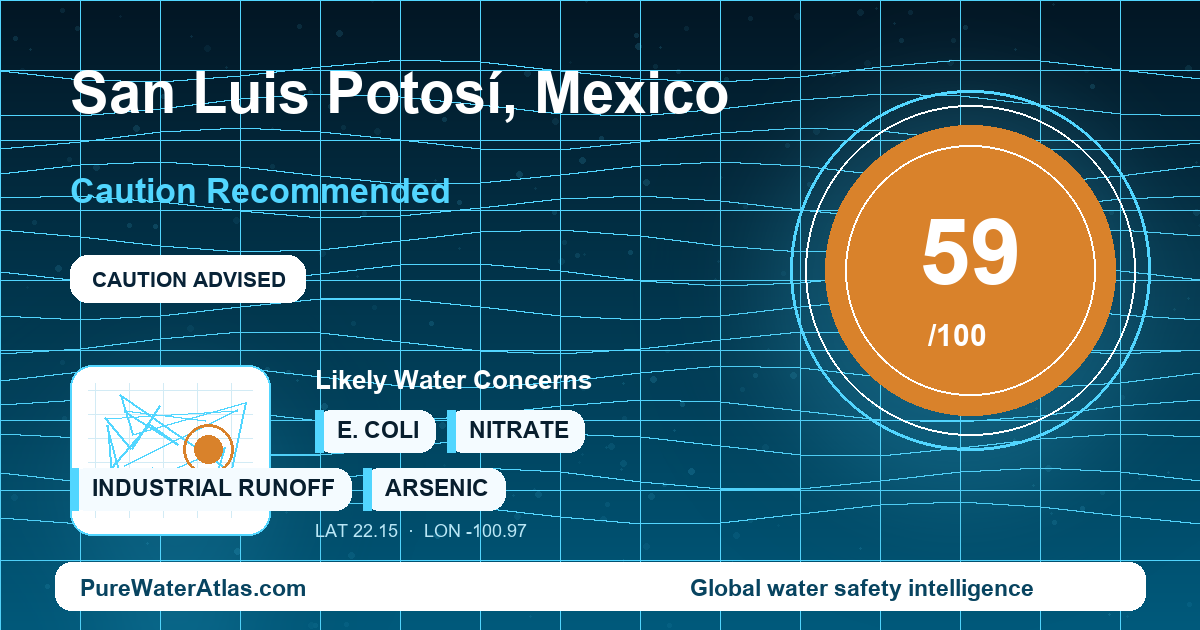
San Luis Potosí has treated municipal water, but aquifer stress, El Realito supply interruptions, intermittent service, household storage tanks, and limited neighborhood-level reporting mean visitors and many residents should use caution before drinking from the tap.
Quick Answer
| Overall safety status | Caution recommended. San Luis Potosí has an organized metropolitan water utility and treated public supply, but tap-water safety can vary between neighborhoods, buildings, storage tanks, and service conditions. |
|---|---|
| Water safety score | 59 / 100 — Caution Recommended |
| Traveler advice | Most visitors should use sealed bottled water, commercially purified garrafón water, or properly filtered water for drinking. Tap water is not recommended as the default choice for short-term travelers. |
| Resident advice | Residents should evaluate their own building and neighborhood. Service interruptions, cisterns, rooftop tinacos, older plumbing, and groundwater chemistry can all affect the water that reaches the kitchen tap. |
| Main water source | Primarily groundwater from the San Luis Potosí Valley aquifer, with supplemental surface-water supply from the El Realito dam and aqueduct system when operating. |
| Water authority | INTERAPAS, the metropolitan water operator for San Luis Potosí, Soledad de Graciano Sánchez, and Cerro de San Pedro, with state and federal roles from the Comisión Estatal del Agua de San Luis Potosí and CONAGUA. |
| Filter recommendation | Often advisable. A practical setup may include sediment filtration, activated carbon, and reverse osmosis for drinking and cooking water when testing indicates high dissolved solids, fluoride, arsenic, nitrate, salinity, or other inorganic concerns. |
Why San Luis Potosí Is Different
San Luis Potosí is not a city where tap-water advice can be reduced to a simple national rule. The city sits in a semi-arid highland basin in north-central Mexico, and its urban water supply depends heavily on groundwater stored in the San Luis Potosí Valley aquifer. That local geography matters: limited rainfall, high urban demand, and long-term groundwater stress make the city more vulnerable to drought, aquifer decline, and supply interruptions than wetter cities with large, reliable perennial surface-water sources.
The local water story also includes the El Realito system. El Realito was developed as a supplemental surface-water project intended to reduce pressure on the overdrawn valley aquifer. In practice, San Luis Potosí has continued to face supply stress because the aqueduct has experienced recurrent pipe breaks and operational interruptions, and drought conditions have reduced available surface-water storage. When imported surface water is unavailable or reduced, the metropolitan area may have to rely more heavily on wells, sectorized service, tanker deliveries, or rationing in affected zones.
Another city-specific factor is what happens after the water leaves the public network. Many homes and buildings use cisterns, rooftop tinacos, or internal storage systems. For drinking-water safety, that means the water at a kitchen tap may reflect not only municipal treatment but also building plumbing, tank hygiene, pressure history, and storage time. This is one reason PureWaterAtlas rates San Luis Potosí as Caution Recommended rather than broadly safe for all visitors.
Where Does San Luis Potosí’s Tap Water Come From?
The metropolitan drinking-water system is primarily groundwater-based. Municipal wells draw from the San Luis Potosí Valley aquifer, which has been identified in official water-resource materials as a critical local source. Groundwater can be stable in microbial terms when properly managed and disinfected, but it can also carry geogenic chemistry concerns depending on the well field and local geology. In central and northern Mexican aquifers, issues such as hardness, salinity, total dissolved solids, fluoride, arsenic, nitrate, iron, manganese, chloride, and sulfate can require local testing before drawing conclusions about a specific tap.
San Luis Potosí also has a supplemental surface-water component through the El Realito dam, treatment, and aqueduct system when that infrastructure is operating. This source was important because it was intended to reduce extraction from the stressed aquifer. However, El Realito has become a major local reliability issue because repeated aqueduct failures and drought-sensitive storage have limited its ability to function as a stable substitute source.
Historically, the city depended heavily on local groundwater and nearby surface-water works, including the San José dam area. Today, the relevant infrastructure includes the INTERAPAS metropolitan well network, the El Realito dam and aqueduct system, local storage tanks, pressure zones, distribution mains, and the household cisterns or tinacos that often sit between the public main and the drinking glass.
Who Manages Drinking Water in San Luis Potosí?
The local drinking-water operator is INTERAPAS, the Organismo Intermunicipal Metropolitano de Agua Potable, Alcantarillado, Saneamiento y Servicios Conexos. INTERAPAS serves San Luis Potosí and connected metropolitan municipalities including Soledad de Graciano Sánchez and Cerro de San Pedro. Its role includes drinking-water service, sewerage, sanitation, operational information, and local service notices.
State-level water planning and infrastructure context are associated with the Comisión Estatal del Agua de San Luis Potosí. At the federal level, CONAGUA regulates national water resources, concessions, aquifer administration, hydrological infrastructure, and drought information. CONAGUA’s Sistema Nacional de Información del Agua is an important source for water-resource, aquifer, dam, and drought context.
Drinking-water quality in Mexico is governed nationally through health standards such as NOM-127-SSA1 for water for human use and consumption. Sanitary oversight also involves health authorities such as Secretaría de Salud and COFEPRIS. However, public access to recent, granular, tap-by-tap results for San Luis Potosí is limited, so this profile does not claim that every tap either meets or fails the national standard.
Main Local Water Concerns
The first major concern is long-term stress on the San Luis Potosí Valley aquifer. Official aquifer documentation from CONAGUA, including the annual availability update for the San Luis Potosí aquifer, supports the importance of groundwater availability and aquifer management for the city. Overexploitation and groundwater-level decline are central to the local water-safety and water-reliability picture.
The second concern is reliability. El Realito aqueduct interruptions can reduce imported surface-water supply and force the city back onto wells or emergency operating patterns. Distribution-network interruptions, pressure changes, repairs, or sectorized service can also disturb sediment or create conditions where intrusion risk is higher, especially in older sections or during low-pressure events.
The third concern is building-level water quality. Cisterns and rooftop tinacos are common parts of the household water chain. If tanks are uncovered, dirty, exposed to insects or dust, or left with stored water for long periods in hot weather, microbial risk can increase even when the public supply is treated. This is especially relevant after outages, water hauling, or pressure loss.
The fourth concern is groundwater chemistry. San Luis Potosí’s dependence on aquifer water means residents should not rely only on taste or clarity. Hardness, total dissolved solids, fluoride, arsenic, nitrate, salinity-related ions, iron, manganese, pH, and conductivity are all reasonable parameters to consider in local testing. The correct interpretation depends on a sample from the actual tap being used.
For Travelers
For most travelers, the practical answer is simple: do not use San Luis Potosí tap water as your default drinking water. Use sealed bottled water, commercially purified garrafón water, or water treated by a reliable purifier. This recommendation is precautionary. It does not mean every tap in the city is unsafe, but it reflects the real variability caused by service interruptions, household storage, unfamiliar building plumbing, and limited public neighborhood-level water-quality data.
For brushing teeth, many healthy adults can use tap water if they avoid swallowing it. More cautious travelers, people with sensitive stomachs, pregnant travelers, young children, and immunocompromised visitors should use bottled or purified water for brushing as well. Use purified water for medications and infant formula.
Ice should be treated as a source question. In better hotels, established restaurants, and chains, ice is often made from purified water. Still, ask if the ice and drinking water are purified. Avoid unknown ice from informal vendors if your goal is to minimize gastrointestinal risk. Do not assume that bathroom tap water in a hotel room has the same treatment as water served in the restaurant.
If you are staying outside major hotels or for an extended period, consider carrying a travel bottle with a microbiological filter. Boiling can reduce microbial risk and is useful after suspected contamination, but it will not remove dissolved contaminants such as salts, fluoride, arsenic, nitrate, or metals. For a deeper explanation, see the PureWaterAtlas Boiling Water Purification Guide.
For Residents
Residents should base decisions on their own tap, not only on citywide assumptions. A practical home strategy in San Luis Potosí is staged treatment guided by testing. Sediment prefiltration can help where particles, turbidity, or post-repair discoloration are present. Activated carbon can improve taste and reduce chlorine-related taste and odor issues. Reverse osmosis is often the more appropriate drinking-water treatment when testing shows elevated dissolved solids, fluoride, arsenic, nitrate, salinity, or other inorganic contaminants. UV can help where microbial risk is tied to storage tanks, but UV requires low turbidity and does not remove dissolved chemicals.
Testing should be done at the kitchen tap. For groundwater-related concerns, include total dissolved solids, hardness, fluoride, arsenic, nitrate, chloride, sulfate, iron, manganese, pH, conductivity, and basic metals. For homes with infants, pregnant residents, or private storage tanks, include E. coli or total coliform testing, especially after outages or tank cleaning. Older buildings or plumbing of unknown age should test first-draw and flushed samples for lead and other metals.
Internal plumbing can be a separate risk from the municipal source. Older buildings may contain corroded pipes, aging valves, solder, fixtures, or service connections that are not represented by public source-water data. Metallic taste, discolored water, or low-use plumbing are reasons to test for lead, copper, iron, manganese, and other metals before drinking unfiltered tap water regularly.
Cisterns and rooftop tinacos deserve special attention in San Luis Potosí. They should be covered, screened, cleaned periodically, and protected from insects, dust, animals, and sunlight. After low-pressure events, water hauling, or long interruptions, residents should consider disinfection and microbiological testing before using stored water for drinking.
Relevant Contaminants and Water-Quality Issues
The most relevant San Luis Potosí water-quality issues are not limited to one contaminant. Intermittent service and repairs can disturb sediment in drinking water and increase turbidity. Turbid water can interfere with disinfection and is a reason to avoid drinking from the tap until the cause is understood.
Groundwater dependence makes inorganic testing important. Residents concerned about aquifer-related chemistry should review PureWaterAtlas resources on arsenic in drinking water and nitrate in drinking water, along with the detailed guides to arsenic testing and detection and nitrate testing and detection. These contaminants cannot be reliably identified by taste or appearance.
Microbial risk is especially relevant after outages, low pressure, dirty storage tanks, or water hauling. See the PureWaterAtlas profile on E. coli in drinking water and the broader guide to water microbiology. Older buildings should also consider lead in drinking water and the PureWaterAtlas guide to lead testing and detection methods.
How to Verify Your Water Quality
The best way to verify drinking-water safety in San Luis Potosí is to test the water that actually comes from your tap, ideally after considering your building storage system and service history. Source-water assumptions are not enough when water may pass through a cistern, rooftop tinaco, old plumbing, or a low-pressure distribution zone.
Start with the PureWaterAtlas Water Testing guide to choose parameters and understand sampling. If you need a broader framework for whether a tap is safe to drink, use the Drinking Water Safety guide. To compare treatment options, review Water Treatment Systems and the UV Water Purification Guide.
You can also use the Global Water Quality Checker for broader location-based context and the Contaminants Search Engine to research specific test results. For related PureWaterAtlas categories, see Global Water Quality, Drinking Water Safety, Water Testing, and Water Treatment Systems.
Data limitation: there is enough official information to identify the local utility, groundwater dependence, the El Realito role, and aquifer stress. However, recent public results by neighborhood, well, distribution zone, building type, and storage condition are not consistently available in an easily verifiable format. For that reason, individual testing is especially important.
Official and Technical Sources
- INTERAPAS official website — local metropolitan water utility for San Luis Potosí and connected municipalities.
- Comisión Estatal del Agua de San Luis Potosí — state water planning and infrastructure context.
- CONAGUA national water information portal — federal authority for water resources, concessions, drought information, and hydrological infrastructure.
- Sistema Nacional de Información del Agua — national water-resource, aquifer, dam, and drought data portal.
- CONAGUA aquifer availability document for the San Luis Potosí aquifer — official aquifer availability and groundwater context.
- NOM-127-SSA1 drinking water standard information — Mexico’s national health standard context for water for human use and consumption.
- COFEPRIS — federal sanitary-risk authority relevant to drinking-water surveillance and public-health protection.
- El Realito dam and water-infrastructure context — federal water-sector source context for the supplemental system affecting San Luis Potosí.
Bottom Line
San Luis Potosí has a formal metropolitan water utility and treated public water, but it is not a city where visitors should assume tap water is reliably drinkable. The system depends heavily on the stressed San Luis Potosí Valley aquifer and is affected by the reliability of the El Realito dam and aqueduct system. Intermittent service, pressure changes, repairs, household cisterns, rooftop tinacos, and older building plumbing can change water quality before it reaches the tap. Travelers should use bottled, garrafón, or properly filtered water. Residents should test their own kitchen tap, maintain storage tanks, and choose treatment based on results rather than assumptions. Because granular public water-quality data is limited, local verification is the safest approach.
Read the full guide: Global Water Quality Guide
Explore more in this category: Global Water Quality Articles