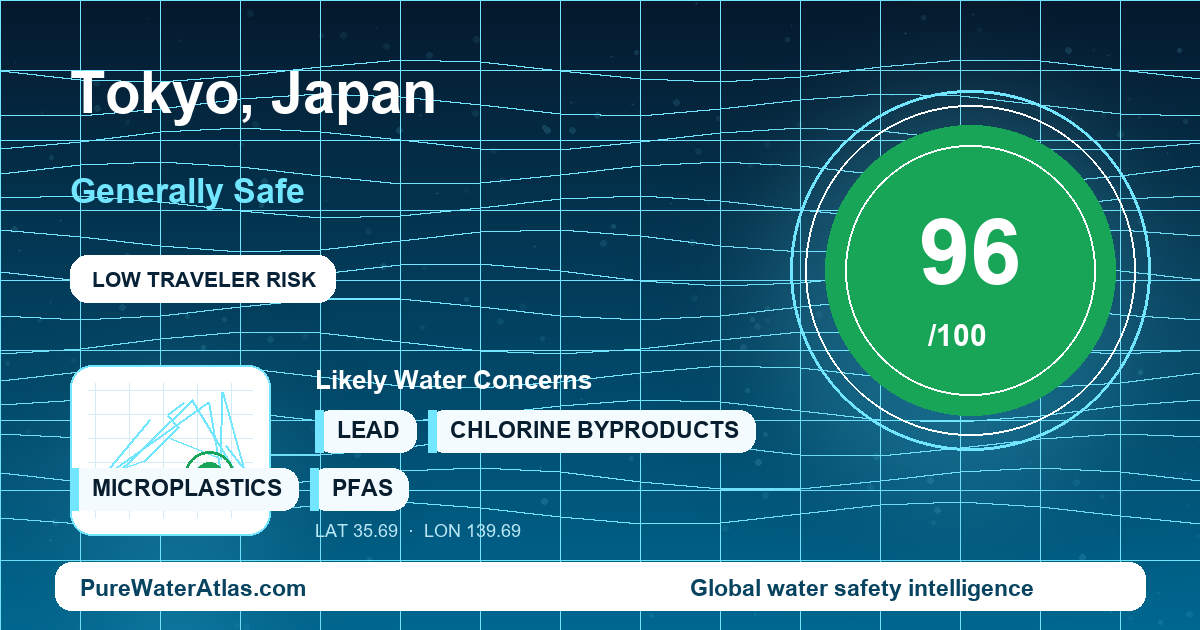
Tokyo tap water is generally safe to drink, with a PureWaterAtlas safety score of 96/100. The main practical risks are usually building plumbing, receiving tanks, rare disaster disruptions, and localized groundwater questions outside the central municipal supply.
Quick Answer
| Safety status | Generally Safe. Tokyo tap water is safe to drink under normal conditions for most travelers and residents. |
|---|---|
| Traveler advice | Use tap water for drinking, brushing teeth, tea, coffee, and normal restaurant or hotel ice. Bottled water is optional for taste preference or during an official advisory. |
| Resident advice | Most homes connected to the Tokyo municipal supply do not need a filter for safety. Older buildings, receiving tanks, and suspected lead-containing plumbing deserve targeted checks. |
| Main water source | Primarily treated river and reservoir water from the Tone River, Arakawa River, and Tama River systems, including storage associated with the Ogouchi Reservoir, also known as Lake Okutama. |
| Water authority | Tokyo Metropolitan Government Bureau of Waterworks for the main metropolitan system, with some broader Tokyo Metropolis areas potentially having local municipal arrangements or groundwater components. |
| Filter recommendation | A filter is not normally required for safety. A certified activated-carbon filter can improve chlorine taste and odor. Use contaminant-specific treatment only when testing or local records justify it. |
Why Tokyo Is Different
Tokyo is a coastal megacity on Tokyo Bay, but its normal drinking-water supply is not desalinated seawater. The metropolitan system is mainly a treated surface-water system drawing from river and reservoir sources far outside the densest urban core. Central Tokyo’s 23 wards are especially dependent on the Tone and Arakawa systems, while western parts of Tokyo also use the Tama River system.
What makes Tokyo’s drinking water distinctive is the scale and engineering of the system. The Tokyo Metropolitan Government Bureau of Waterworks operates one of the world’s largest municipal water systems, supported by upstream dams, reservoirs, diversion works, purification plants, large transmission mains, distribution reservoirs, emergency water supply points, and earthquake-response infrastructure.
Tokyo also has a very local “last meter” issue: the water leaving the municipal system may be high quality, but the water at an individual faucet can be affected by private building plumbing. High-rise apartments, offices, hotels, schools, and older commercial buildings may use receiving tanks or elevated tanks before water reaches taps. That means the most important household variable is often not the river source or the city treatment plant, but the condition of the building’s tanks, pipes, fixtures, and maintenance records.
Historically, Tokyo invested in advanced treatment after taste and odor problems associated with eutrophication and river-source quality pressures in the Tone and Arakawa systems. Ozonation and biological activated carbon at major facilities are important reasons Tokyo tap water is considered both safe and more palatable than many visitors expect from a large lowland river-based supply.
Where Does Tokyo’s Tap Water Come From?
Tokyo’s metropolitan tap-water supply is primarily treated surface water. The main raw-water sources are the Tone River, Arakawa River, and Tama River systems. These sources are supported by dams, reservoirs, river intakes, purification plants, and a large pressure-managed distribution network.
Major purification plants serving the Tokyo system include Kanamachi, Misato, Asaka, Higashimurayama, and Ozaku, with source mix varying by plant and service area. Tokyo Waterworks uses advanced water treatment processes at major facilities, notably ozonation and biological activated carbon, to reduce odor-causing substances and improve taste.
Western Tokyo’s water identity is also tied to the Tama River system and the Ogouchi Reservoir on the upper Tama River, also known as Lake Okutama. This reservoir is an important Tokyo-owned source reservoir. The older historical context goes back to Edo-period aqueducts such as the Tamagawa Josui, which once brought Tama River water toward Edo. The modern system, however, is much larger and more engineered, relying on multipurpose dams, reservoir releases, treatment plants, and distribution infrastructure rather than simple urban canals.
Because the broader Tokyo Metropolis includes central wards, suburban municipalities, and western areas, not every address should be assumed to have the exact same source mix. Residents outside the central 23 wards should confirm their exact supplier and the latest published local water quality information.
Who Manages Drinking Water in Tokyo?
The principal water authority for Tokyo’s metropolitan water system is the Tokyo Metropolitan Government Bureau of Waterworks. Its Japanese official site also provides primary local information on operations, water resources, customer notices, water quality, and emergency guidance: Tokyo Waterworks official site.
Drinking water in Tokyo is regulated under Japan’s national Water Supply Act framework and national drinking-water quality standards. National context is provided by Japan’s water-supply authorities, including the Ministry of Health, Labour and Welfare water supply information and the Ministry of Land, Infrastructure, Transport and Tourism water-supply administration information.
Tokyo Waterworks publishes water quality information and operates monitoring across source water, treatment plants, and distribution. However, this profile does not claim exact current contaminant concentrations, legal compliance percentages, or neighborhood-level results. Individual tap quality can still differ because of building tanks, private plumbing, local construction, stagnation, or supplier differences in parts of the wider Tokyo Metropolis.
Main Local Water Concerns
Chlorine taste and odor: Tokyo tap water commonly has a mild chlorine smell because residual disinfectant is intentionally maintained through the distribution network. This is usually an aesthetic issue and often a sign that disinfection is being preserved, not evidence of contamination. Letting water stand in an open container in the refrigerator or using an activated-carbon pitcher can improve taste.
Private building tanks: Some apartments, hotels, schools, offices, and commercial properties use receiving tanks or elevated tanks. If tanks are poorly maintained, they can contribute odor, sediment, microbial growth, or discoloration even when the municipal water entering the property is compliant.
Old plumbing and possible lead exposure: Tokyo Waterworks has worked to reduce lead service-pipe risk, but older private plumbing, old fixtures, solder, or short remaining lead-containing sections may still matter in older buildings. First-draw water after overnight stagnation is the sample most likely to show building-side metal leaching.
Turbidity after heavy rain or work: Typhoons and intense rainfall can increase turbidity in river sources. Treatment plants are designed for this, but residents may occasionally notice taste, odor, or temporary discoloration after storms, main work, or building-tank disturbance.
PFAS and groundwater context: PFOS and PFOA have been investigated in Tokyo groundwater and some western Tokyo or Tama-area contexts. This should not be generalized to all central Tokyo tap water. Residents using private wells, groundwater-influenced local supplies, or living in affected municipalities should check current official local results and Japan’s Ministry of the Environment PFOS, PFOA and PFAS information.
Earthquake disruption: Tokyo is in a high seismic-risk region. A major earthquake can damage mains, reduce pressure, require emergency water distribution, or trigger local boil-water or do-not-use instructions. After a significant earthquake, assume normal tap safety only if the water authority has not issued a local advisory.
For Travelers
For ordinary travel in Tokyo, tap water is safe for drinking, brushing teeth, making tea or coffee, and consuming ice from normal hotels, restaurants, convenience stores, and cafes. Tokyo residents widely drink municipal tap water, and restaurants normally use municipal water and safe ice.
If you dislike the chlorine taste, use chilled tap water, a refillable bottle with a carbon filter, or bottled water as a taste preference rather than a safety necessity. Do not drink from decorative fountains, temple basins, irrigation taps, hoses, or any tap not marked or intended for drinking.
In hotels and restaurants, unusual odor, visible particles, rusty color, or a notice about tank cleaning should prompt you to ask staff or use bottled water until the issue is clarified. Ice should be avoided only if it is made in an obviously unsanitary private setting or during a local boil-water notice.
After earthquakes, flooding, water-main work, or a building-tank problem, follow instructions from Tokyo Waterworks, hotel staff, and official city channels. The CDC Japan Traveler View is useful for broader travel-health context, but local water advisories should be followed for Tokyo-specific incidents.
For Residents
Most Tokyo residents connected to the metropolitan municipal supply do not need a home filter for microbiological safety or routine city-supply safety. A certified activated-carbon filter can be useful if the main complaint is chlorine taste or odor. If the concern is lead, PFAS, nitrate, or microbial contamination from a tank, choose a filter certified for that specific contaminant and verify the problem with testing rather than buying a generic filter.
If you live in an older building or a home with unknown plumbing, consider testing first-draw and flushed samples for lead and other metals, especially if infants, pregnant people, or young children drink the water daily. Use cold water for drinking and cooking, and flush the tap after overnight stagnation or long absences until the water runs fresh and cold.
If your building uses a receiving tank or rooftop tank, ask the owner or management company for the latest tank cleaning, inspection, and water-quality records. Report insects, sediment, oily films, strong odor, low residual chlorine, or repeated discoloration to building management and request inspection records.
If you use a private well or live in a groundwater-influenced area of western Tokyo or the Tama region, check local PFOS, PFOA, nitrate, and microbiological testing guidance. Central Tokyo assumptions should not be used as a substitute for address-specific local results.
Relevant Contaminants and Water-Quality Issues
Tokyo’s most common day-to-day complaint is aesthetic chlorine taste or odor. Read more in the PureWaterAtlas profile on chlorine in drinking water.
Storms, typhoons, main work, or tank disturbance can occasionally make water look cloudy or discolored. The relevant issue is turbidity in drinking water.
For older Tokyo buildings, the most important building-side metal concern is lead in drinking water, especially when first-draw samples after overnight stagnation are involved. Residents considering sampling should also use Lead in Drinking Water: Testing and Detection Methods.
For private wells or groundwater-influenced locations in western Tokyo or the Tama area, the relevant emerging contaminant category is PFAS in drinking water. If local testing confirms a PFAS concern, see PFAS in Drinking Water: Testing and Detection Methods and PFAS in Drinking Water: Best Filters, Systems and Solutions.
For tank hygiene or emergency boil-water situations, microbial contamination indicators such as E. coli in drinking water are relevant. Boiling is not normally needed in Tokyo, but during an official boil-water notice the practical reference is Boiling Water Purification: Complete Guide.
How to Verify Your Water Quality
Start with the latest official information from Tokyo Waterworks and, if you live outside the central 23 wards, confirm your exact water supplier and local published results. For broader safety interpretation, see PureWaterAtlas resources on Drinking Water Safety, Global Water Quality, and Water Testing.
Travelers comparing Tokyo with other destinations can use the Global Water Quality Checker. Residents researching specific substances can use the Contaminants Search Engine. If testing identifies a real treatment need, use the PureWaterAtlas guide to Water Treatment Systems rather than selecting a filter based only on taste or anxiety.
Official and Technical Sources
- Tokyo Metropolitan Government Bureau of Waterworks official English site — official information on Tokyo’s metropolitan water-supply system.
- Tokyo Metropolitan Government Bureau of Waterworks Japanese official site — primary local source for operations, water quality notices, water resources, customer guidance, and emergency information.
- Ministry of Health, Labour and Welfare: Water supply in Japan — national drinking-water framework and public-health context.
- Ministry of Land, Infrastructure, Transport and Tourism: Water Supply Administration — national water-supply administration context.
- Ministry of the Environment: PFOS, PFOA and PFAS information — Japan PFAS context relevant to groundwater and local investigations.
- U.S. CDC Japan Traveler View — travel-health context for visitors to Japan.
- Tokyo Metropolitan Government — official metropolitan government source for disaster, public-health, and city information.
Bottom Line
Tokyo tap water is generally safe to drink, with a strong city supply operated by Tokyo Metropolitan Government Bureau of Waterworks and supported by major river and reservoir systems, large purification plants, and advanced treatment such as ozonation and biological activated carbon. For visitors, tap water, brushing teeth, restaurant ice, and hotel water are safe under normal conditions. For residents, the main safety questions are usually local to the building: older plumbing, possible lead-containing materials, receiving tanks, stagnation, and maintenance records. A carbon filter can improve chlorine taste, but it is not normally required for safety. Check official advisories after earthquakes, floods, main work, or tank problems, and confirm local data if you live in western Tokyo, the Tama area, or use groundwater.
Read the full guide: Global Water Quality Guide
Explore more in this category: Global Water Quality Articles