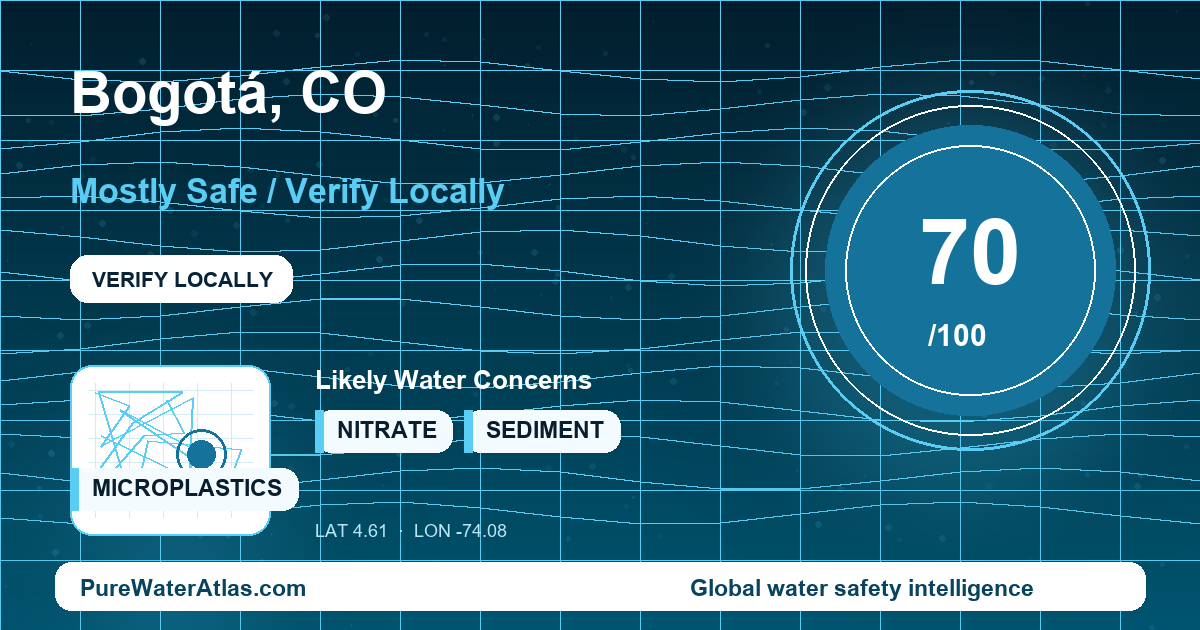
Bogotá’s municipal tap water is generally one of Colombia’s safer large-city supplies, but the practical safety question is often building-specific: storage tanks, old plumbing, pressure interruptions, and recent drought-related operating conditions can change what reaches your tap.
Quick Answer
| Overall safety status | Mostly Safe / Verify Locally. PureWaterAtlas score: 70/100. Bogotá’s EAAB municipal supply is generally treated and regulated, but final tap safety can vary by building and recent service conditions. |
|---|---|
| Can travelers drink it? | Many travelers in standard hotels, established restaurants, and formal urban areas can usually use tap water for brushing teeth and may drink it. Cautious travelers, infants, pregnant travelers, immunocompromised visitors, and anyone with a sensitive stomach should use sealed bottled water or properly filtered water. |
| Resident advice | EAAB-connected homes generally have a reasonable municipal drinking-water source, but residents should verify building tanks, older plumbing, discoloration, sediment, pressure changes, and recent repairs. |
| Main water source | High-Andean surface-water systems, especially the Chingaza system, with additional supply from Tibitoc/northern reservoirs and southern sources such as Chisacá and La Regadera. |
| Water authority | Empresa de Acueducto y Alcantarillado de Bogotá, commonly EAAB or Acueducto de Bogotá. |
| Filter recommendation | A filter is not automatically required for every EAAB-connected home. Consider activated carbon for chlorine taste, sediment filtration for particles, NSF/ANSI 53-certified systems for lead reduction, UV for microbiological barriers in stored water, or reverse osmosis where broader dissolved contaminant reduction is desired. |
Why Bogotá Is Different
Bogotá is not a groundwater-dominated or desalination-dependent city. It sits on a high Andean plateau at roughly 2600 meters above sea level and relies heavily on mountain watersheds and páramo ecosystems. That local geography matters: source-water protection in high-altitude catchments is directly connected to the reliability of the city’s drinking-water system.
The city’s municipal water is generally considered among the safer large-city supplies in Colombia because it is served by a major regulated utility and relies substantially on protected high-Andean source waters from the Chingaza system. However, this does not mean every tap in every building is automatically safe at every moment. The main risk in Bogotá is often not the central treatment plant, but the conditions after water leaves the municipal network: apartment-building tanks, rooftop or internal cisterns, older fixtures, stagnant plumbing, pressure changes, intermittent service events, and post-outage sediment.
This is why the best Bogotá-specific answer is nuanced. A local may reasonably say that Bogotá tap water is drinkable, especially in central formal-service areas. But a more precise question is whether the specific building receives normal EAAB service, whether it uses an internal storage tank, whether that tank is cleaned and disinfected, and whether there have been recent cuts, repairs, pressure losses, or visible changes in water color or odor.
Where Does Bogotá’s Tap Water Come From?
Bogotá is primarily supplied by high-altitude Andean surface-water systems operated by Empresa de Acueducto y Alcantarillado de Bogotá. The most important supply system is Chingaza, which captures water from the Chingaza páramo and associated basins. Water is stored and transferred through major infrastructure including Chuza Reservoir and San Rafael Reservoir before treatment, especially at the Francisco Wiesner water treatment plant.
Additional supply comes from the northern Tibitoc system, associated with the upper Bogotá River basin and reservoirs such as Sisga, Neusa, and Tominé. Southern sources in the Tunjuelo basin, including Chisacá and La Regadera reservoirs, also contribute to operating flexibility and redundancy. Bogotá’s historical water development expanded from local eastern-hill and southern catchments toward larger regional systems, with Chingaza becoming central to modern water security.
Key infrastructure includes the Chingaza system and Chuza Reservoir, San Rafael Reservoir, the Francisco Wiesner water treatment plant, the Tibitoc water treatment plant, the northern reservoir system associated with Sisga, Neusa, and Tominé, southern system sources such as Chisacá and La Regadera, and EAAB’s transmission, distribution, storage, and pressure-management network.
This diversified structure means Bogotá is not dependent on a single neighborhood wellfield. It also means the city is exposed to regional hydrology, reservoir levels, páramo ecosystem protection, and the performance of large transmission and treatment infrastructure. Recent drought and El Niño-related stress made this visible when low reservoir levels contributed to water-saving measures and rationing in Bogotá and nearby municipalities. That situation was primarily a quantity and reliability issue, not proof that treated water was unsafe, but it shows why supply stress can still affect household water practices.
Who Manages Drinking Water in Bogotá?
The main municipal water and sewer utility serving Bogotá is Empresa de Acueducto y Alcantarillado de Bogotá, commonly known as EAAB or Acueducto de Bogotá. EAAB operates the city’s major water-service infrastructure, including treatment, transmission, distribution, storage, and customer-facing service information.
Drinking-water quality in Colombia is governed through a national sanitary framework that includes Decreto 1575 de 2007 and Resolución 2115 de 2007. Surveillance is supported by health authorities and the Instituto Nacional de Salud’s SIVICAP water quality surveillance portal, including IRCA risk-classification reporting. In Bogotá, the district health authority also has a surveillance role.
Public-service regulation and oversight also involve national institutions such as the Comisión de Regulación de Agua Potable y Saneamiento Básico and the Superintendencia de Servicios Públicos Domiciliarios. These official systems make Bogotá’s municipal supply more verifiable than informal or nonstandard sources. However, publicly accessible data do not provide a simple real-time safety result for every address, building storage tank, pipe material, or neighborhood pressure event.
Main Local Water Concerns
- Drought and reservoir-level stress: Low levels in Chingaza-related reservoirs can trigger conservation measures, pressure changes, rationing, or operational shifts among supply systems. Official city information on water rationing is provided by the Alcaldía Mayor de Bogotá. These events mainly affect reliability, but they can indirectly affect household storage and building-level hygiene.
- Turbidity after intense rainfall, landslides, or raw-water disturbances: Bogotá’s mountain surface waters can experience turbidity spikes. Treatment plants are designed to manage turbidity, but unusual events may lead to advisories or changes in taste, color, or sediment at the tap.
- Building storage tanks: Many multi-unit buildings use internal tanks or cisterns. Treated municipal water can be re-contaminated if tanks are dirty, uncovered, cracked, or poorly disinfected.
- Older plumbing and premise-plumbing metals: Lead risk is usually a building-plumbing issue rather than a raw-water issue. Older fixtures, solder, service materials, or stagnant pipes can increase metals exposure at the tap.
- Chlorine taste or odor: A mild chlorine taste can be expected in a disinfected piped municipal system and is not automatically a safety problem. A sudden strong chemical odor should be avoided and reported until checked.
- Peripheral or nonstandard supply situations: Areas or buildings not receiving normal continuous municipal service, or relying on trucked water, tanks, or temporary connections, require more caution than the general citywide assessment.
For Travelers
In formal urban Bogotá, municipal tap water is often treated and commonly consumed by residents. PureWaterAtlas rates it as mostly safe with local verification. If you are staying in a reputable hotel, modern apartment, or established urban area using normal EAAB service, the risk is lower. If you are in an older building, budget lodging, rural edge area, hostel, small rental, or any place with an unknown storage tank, use sealed bottled water or a reliable filter for drinking.
Brushing teeth: Tap water is generally acceptable in standard hotels and formal serviced buildings. Use bottled water for brushing if you have a sensitive stomach, are immunocompromised, are traveling with infants, or notice cloudy, yellow, brown, earthy, sewage-like, or strongly chemical water.
Ice: Ice in established hotels, restaurants, and cafés is usually lower risk if made from treated water. Avoid ice from informal street vendors or places where water storage and hygiene are uncertain.
Hotels and restaurants: Ask whether the building receives EAAB municipal water and whether drinking water or ice is filtered. Higher-end hotels and established restaurants often use filtered or treated water practices. In small rentals, hostels, or older apartment buildings, ask about tank cleaning and recent water cuts.
For a short trip, the simplest cautious plan is to drink sealed bottled water or filtered water, use tap water for showering and brushing in reputable accommodations, avoid drinking from bathroom taps in old buildings, and switch to bottled water immediately if the water is discolored, has sediment, smells unusual, or follows a service interruption. Travelers who want a conservative health framework can also review the CDC’s Colombia Traveler View.
For Residents
For residents connected to EAAB municipal service, tap water is usually a reasonable drinking-water source. The most important resident question is whether the building introduces avoidable risk after treatment. This is especially relevant in apartment buildings, older properties, buildings with rooftop or underground storage tanks, and homes with unexplained taste, color, sediment, or pressure changes.
A home filter is not automatically required for every EAAB-connected home. It can be useful for taste, chlorine reduction, sediment control, or added protection where plumbing or tank maintenance is uncertain. Choose the filter based on the actual issue: activated carbon for chlorine taste and some organic compounds; sediment prefilters for visible particles; NSF/ANSI 53-certified systems for lead reduction; UV systems as a microbiological barrier for stored water; and reverse osmosis where broader dissolved contaminant reduction is desired. PureWaterAtlas has a broader guide to choosing water treatment systems.
Residents should test tap water if the building is old, has unknown pipe materials, or has never been checked for metals such as lead. Testing is also sensible after major plumbing replacement, pipe repairs, pressure-loss events, repeated discoloration, or persistent sediment. If a building uses rooftop or underground tanks, request documented cleaning and disinfection records from building administration and consider microbiological testing if maintenance is uncertain.
Older buildings can create tap-specific risks that citywide water reports may not show. Stagnant water, corroded plumbing, old fixtures, and legacy materials can contribute metals or sediment. Let cold water run after long stagnation, use only cold water for cooking and drinking, and consider lead testing if plumbing age is uncertain. Private building tanks are a key Bogotá-specific concern: treated water can be re-contaminated if tanks are dirty, uncovered, cracked, or poorly disinfected.
Relevant Contaminants and Water-Quality Issues
For Bogotá, the most relevant issues are not a single citywide contaminant claim, but the conditions that can affect high-Andean surface water, large distribution systems, and building-level storage.
- Turbidity in Drinking Water: relevant after intense rainfall, landslides, or raw-water disturbances in mountain catchments.
- Sediment in Drinking Water: useful after pressure changes, pipe work, storage-tank disturbance, or post-outage flushing.
- Chlorine in Drinking Water: explains why a mild chlorine taste can be part of microbial protection in municipal water.
- Lead in Drinking Water: most relevant to old fixtures, solder, service materials, and stagnant premise plumbing rather than Bogotá’s raw water.
- E. coli in Drinking Water: important for understanding storage-tank hygiene and post-treatment microbial contamination risks.
Residents in older buildings can also use Lead in Drinking Water: Testing and Detection Methods. During official advisories, suspected microbial contamination, or uncertain post-outage water, review Boiling Water Purification: Complete Guide. Households considering microbiological barriers for stored water can review UV Water Purification: Complete Guide.
How to Verify Your Water Quality
Because public sources do not provide a real-time potability result for every Bogotá address, verification should combine official information with building-specific checks. Start with EAAB notices and building administration records. Ask whether the building receives normal municipal service, whether it has rooftop or underground tanks, how often those tanks are cleaned, and whether recent water cuts, repairs, or pressure changes occurred.
If your water is persistently cloudy, discolored, earthy, sewage-like, strongly chemical, or full of sediment, do not rely on a citywide reputation for safety. Flush cold taps until clear after outages, avoid drinking visibly abnormal water, and request building or utility follow-up. For structured household testing decisions, use the PureWaterAtlas guide to water testing and analysis.
You can compare Bogotá with other destinations using the Global Water Quality Checker. To research specific issues such as chlorine, lead, turbidity, sediment, or microbial indicators, use the Contaminants Search Engine. For a broader decision framework, see Drinking Water Safety: How to Know If Your Tap Water Is Safe to Drink and the PureWaterAtlas guide to water microbiology.
Official and Technical Sources
- Empresa de Acueducto y Alcantarillado de Bogotá official website — primary local utility source for Bogotá water service, supply operations, customer notices, and institutional information.
- SIVICAP water quality surveillance portal — Instituto Nacional de Salud system used for drinking-water quality information and IRCA risk classification reporting in Colombia.
- Resolución 2115 de 2007 — core Colombian drinking-water quality resolution for water intended for human consumption.
- Decreto 1575 de 2007 — national decree establishing the system for protection and control of water quality for human consumption.
- Racionamiento de agua en Bogotá — official Bogotá information on rationing and supply management during low-reservoir conditions.
- CDC Colombia Traveler View — traveler health guidance useful for conservative visitor advice.
- Comisión de Regulación de Agua Potable y Saneamiento Básico — national regulatory body for water and sanitation public services.
- Superintendencia de Servicios Públicos Domiciliarios — national oversight body for public utility service providers, including water utilities.
Bottom Line
Bogotá’s municipal tap water is generally treated, regulated, and more reliable than many informal supply situations because EAAB serves the city using major high-Andean surface-water systems, especially Chingaza. For most residents in normal EAAB-connected buildings, it is usually a reasonable drinking-water source. For travelers, tap water is often acceptable in reputable hotels and formal urban areas, but sealed bottled or filtered water is the safer choice for sensitive stomachs, infants, pregnant travelers, immunocompromised people, and anyone staying in older or tank-dependent buildings. The main Bogotá-specific cautions are drought-related service stress, post-outage stagnation, turbidity events, internal storage tanks, and older plumbing. Verify locally before assuming a specific tap is safe.
Read the full guide: Global Water Quality Guide
Explore more in this category: Global Water Quality Articles