Dongguan’s tap water is generally treated within China’s municipal drinking-water framework, but real-world safety depends heavily on district conditions, building plumbing, secondary tanks, and current local notices.
Quick Answer
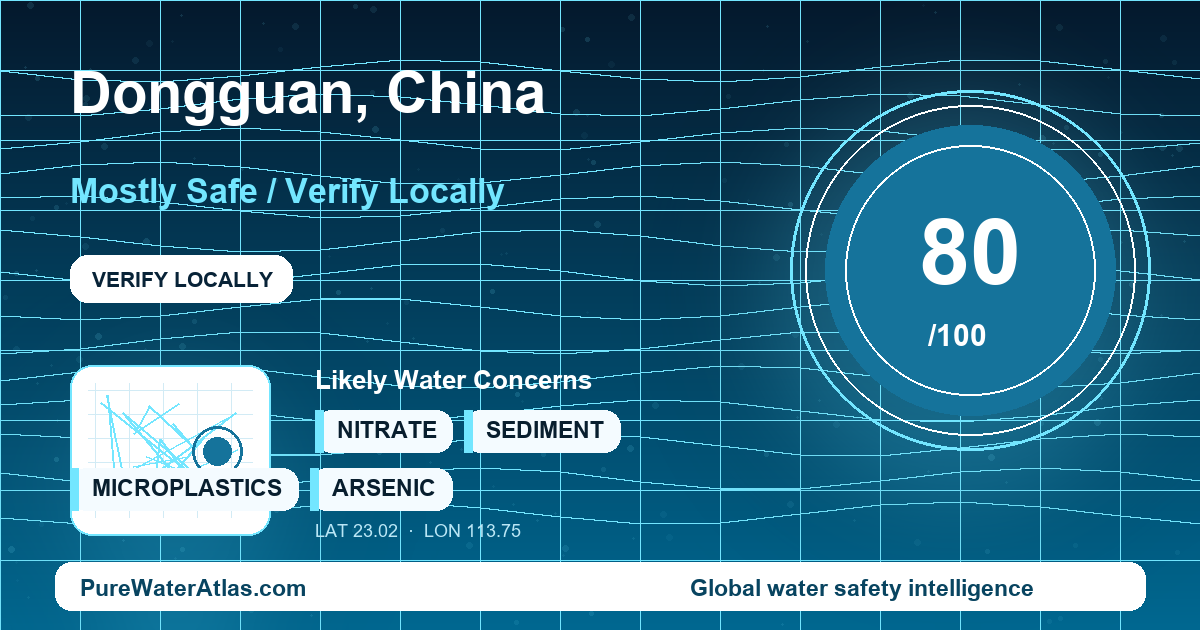
| Overall status | Mostly Safe / Verify Locally — PureWaterAtlas safety score: 80/100. |
|---|---|
| Can you drink it? | Not recommended as the default for direct drinking by short-term visitors. Bottled water or freshly boiled tap water is the lower-risk choice. |
| Traveler advice | Use bottled or boiled water for drinking. Brushing teeth is usually acceptable in modern hotels if the water is clear and no advisory is in place. |
| Resident advice | Treated municipal water is generally usable after boiling, but check old pipes, building tanks, sediment, chlorine taste, and property-management records. |
| Main raw-water context | Dongjiang, also called the East River, and the wider Pearl River Delta river-reservoir and transfer network. |
| Key authorities | Dongguan Water Affairs Bureau, Dongguan Water Group and affiliated suppliers, plus health and environmental authorities. |
| Filter recommendation | A filter is not automatically required everywhere, but many households benefit from certified carbon for taste and chlorine, or reverse osmosis where metals, dissolved salts, or multiple contaminants are a concern. |
Dongguan has a modern municipal supply system, and treated tap water is expected to be disinfected and managed under China’s national drinking-water standards. The most practical question is not only whether the central system is treated, but whether the water remains clean after passing through a specific building’s storage tanks, pumps, internal pipes, and fixtures.
Why Dongguan Is Different
Dongguan sits in the Pearl River Delta between Guangzhou, Shenzhen, and Huizhou. Its water safety profile is therefore different from a city supplied mainly by an isolated mountain catchment. Dongguan’s water security is linked to the Dongjiang basin, the tidal and highly urbanized delta river network, and regional water-transfer and reservoir operations.
The city’s built environment also matters. Dongguan contains dense high-rise housing, industrial parks, older urban villages, newer residential developments, and factory dormitories. That mix creates wide variation at the tap. Water leaving a treatment plant may be properly disinfected, but its quality can change after it passes through a high-rise booster system, rooftop or basement tank, older galvanized pipework, long internal pipe runs, or poorly maintained fixtures.
This is why a single citywide “safe” or “unsafe” label is too blunt for Dongguan. A modern hotel in Nancheng, Dongcheng, Songshan Lake, or a newer compound may have better-maintained internal systems than an older rental block, village apartment, or factory dormitory. For visitors, the safest practical approach is bottled or boiled water. For residents, the most useful approach is building-level verification.
Where Does Dongguan’s Tap Water Come From?
Dongguan’s municipal raw-water system is closely tied to the Dongjiang, also known as the East River. The Dongjiang is a strategic regional water source for Dongguan and nearby Shenzhen and Hong Kong. Dongguan also uses local reservoirs, municipal waterworks, distribution mains, interconnections, and emergency storage arrangements that support treatment, blending, and resilience across districts.
The wider regional context includes the Dongshen Water Supply Project, the Dongjiang water-supply system best known for supplying Hong Kong and Shenzhen. While that does not mean every Dongguan tap has the same operating path, it shows why Dongjiang protection is central to the city’s water-security picture. The regional source is shared, intensively managed, and important for multiple Pearl River Delta cities.
Historically, Dongguan’s towns and districts relied more on local rivers, reservoirs, smaller waterworks, and localized supply arrangements. Rapid industrialization and urban growth increased the need for larger, professionally managed treatment plants and stronger raw-water protection. Today, the relevant infrastructure includes Dongjiang-sourced supply, local reservoirs and protected source-water areas, municipal treatment plants, distribution mains, and secondary water-supply systems in buildings.
For tap users, the final step is often the most variable: secondary water supply. In Dongguan high-rises and compounds, water may pass through roof tanks, basement tanks, pumps, pressure systems, and property-managed pipework before reaching the faucet. Those systems require cleaning, disinfection, inspection, and maintenance.
Who Manages Drinking Water in Dongguan?
Dongguan’s water sector is overseen by the Dongguan Water Affairs Bureau, while Dongguan Water Group and affiliated water-supply companies are key public water-service operators. The Dongguan Municipal People’s Government is the official city portal for municipal notices, policy context, and department information.
Drinking water in Dongguan is expected to be managed under China’s national Standards for Drinking Water Quality, currently GB 5749-2022. The official national standards search platform is provided through the National Standards Information Public Service Platform. Environmental protection and source-water quality are also connected to provincial and national regulators, including the Guangdong Provincial Department of Ecology and Environment and China’s Ministry of Ecology and Environment.
Public-health supervision is also relevant because drinking-water hygiene monitoring is not just an engineering issue. However, public citywide data do not prove conditions at every apartment, hotel, restaurant, school, dormitory, or factory building. PureWaterAtlas rates the citywide institutional and source-water picture with medium-high confidence, but confidence falls to medium for an individual tap unless the building’s plumbing and storage conditions are known.
Main Local Water Concerns
- Chlorine taste or odor: Dongguan’s treated municipal water is disinfected, and residual chlorine taste or smell is a common reason residents boil or filter water. Learn more about chlorine in drinking water.
- Sediment and discoloration: Yellow, brown, cloudy, or particle-laden water can occur after pipe repairs, pressure changes, building-tank cleaning, or disturbances in older internal plumbing. See PureWaterAtlas guides to sediment and turbidity.
- Secondary water-supply tanks: High-rise tanks, basement reservoirs, booster pumps, and property-managed pipes are a major Dongguan-specific concern because maintenance quality varies by building.
- Industrial and urban source-water pressure: Dongguan’s Pearl River Delta setting means source-water protection matters. Upstream development, wastewater discharge, runoff, shipping, and construction activity can add pressure to river systems.
- Old internal plumbing: Older buildings may have aging fittings, pipes, valves, solder, or stagnant branch lines that can affect taste, clarity, and metals exposure. For older units, review lead in drinking water.
- Seasonal stress: Heavy rain, typhoons, and summer storm runoff can increase raw-water turbidity and organic load. Dry-season low flows can increase water-resource pressure in parts of the Pearl River Delta, and residents should follow official advisories during unusual raw-water conditions.
For Travelers
For most short-term visitors to Dongguan, direct tap-water drinking is not the best default. The municipal system is generally treated, but a traveler usually cannot verify the condition of building tanks, hotel plumbing, dormitory pipes, or recent district notices. Bottled water, sealed jugs, or freshly boiled tap water are the safer practical options.
Drinking: Use bottled water or boiled water for routine drinking, especially during hot weather. Hotels commonly provide bottled water, and boiled water is widely used for tea and coffee.
Brushing teeth: In modern hotels and serviced apartments, brushing teeth with clear tap water is usually acceptable if there is no water advisory. Travelers with sensitive stomachs, infants, elderly people, pregnant people, or immunocompromised travelers may prefer bottled or boiled water.
Ice: Use caution. Ice from reputable hotels, chain restaurants, and major malls is usually lower risk, but avoid ice from street stalls or venues where the water source and handling are unclear.
Hotels and restaurants: Good hotels may use commercial filtration for kitchens and beverage service, but do not assume bathroom tap water is intended for direct drinking. Ask whether drinking water is filtered or boiled. After storms, roadworks, pipe repairs, or outages, follow hotel, building, utility, or district notices and let taps run until clear if advised.
For Residents
Residents in newer buildings connected to the municipal network can usually rely on treated tap water after boiling, but the building remains the weak link. If your water has chlorine odor, visible particles, intermittent discoloration, low pressure, or a history of tank problems, treat the issue as local until confirmed otherwise.
Filters: A filter is not mandatory for every Dongguan household. However, many residents benefit from a maintained point-of-use system. A certified carbon filter can reduce chlorine taste and odor and improve acceptability. Reverse osmosis is more appropriate where there are concerns about metals, dissolved salts, or multiple contaminants, but it must be maintained correctly with scheduled cartridge and membrane changes.
Old buildings: If you live in an older apartment, urban village building, factory dormitory, or unit with unknown pipe materials, consider laboratory testing of both first-draw and flushed samples for lead and other metals. First-draw samples help identify stagnation and premise-plumbing effects, while flushed samples help indicate water after the line has run.
Visible sediment or color: If water is yellow, brown, cloudy, or particle-laden, test for turbidity, iron, manganese, and basic physical indicators. Ask the property manager whether tanks or pipes were recently cleaned, repaired, or disturbed.
Storage tanks: For rooftop tanks, basement tanks, booster systems, and compound-level secondary supply, request cleaning schedules, disinfection records, and inspection information. Consider microbiological testing if there are odors, slime, illness clusters, long stagnation periods, or repeated outages. For microbial context, see E. coli in drinking water.
After vacancy or plumbing work: Flush taps thoroughly, clean or replace faucet aerators, and replace or disinfect point-of-use filter cartridges. Homes with infants, pregnant residents, elderly residents, or immunocompromised people should use boiled or appropriately filtered water and periodic lab testing rather than relying only on taste and appearance.
Relevant Contaminants and Water-Quality Issues
The most relevant Dongguan issues are not a single confirmed citywide contaminant claim, but a set of practical water-quality pathways: disinfection taste, turbidity during storms or pipe works, sediment from building systems, metals from old plumbing, and microbial risk where secondary tanks are poorly maintained.
- Chlorine in Drinking Water — relevant to the disinfectant taste and odor many residents notice in treated urban tap water.
- Turbidity in Drinking Water — relevant during typhoon rain, storm runoff, pressure changes, and cloudy-water episodes.
- Sediment in Drinking Water — relevant to older pipes, tank deposits, and discoloration after maintenance.
- Lead in Drinking Water — relevant for household-level testing in older buildings or units with unknown plumbing materials.
- E. coli in Drinking Water — relevant where secondary storage tanks, private plumbing, or post-flood contamination are suspected.
PFAS is a research topic in industrialized regions, but Dongguan-specific public PFAS tap-water data are limited. If that is a concern, use the PureWaterAtlas guide to PFAS testing and detection methods as a general testing reference, not as proof of a local finding.
How to Verify Your Water Quality
Because Dongguan’s key uncertainty is often building-level water quality, verification should focus on your actual tap. Start with the PureWaterAtlas complete guide to water testing and analysis. If your concern is an older building or unknown plumbing, review lead testing and detection methods. For general safety principles, use Drinking Water Safety: How to Know if Your Tap Water Is Safe to Drink.
If you need treatment rather than only testing, compare carbon, reverse osmosis, UV, and combined systems in Water Treatment Systems: Choosing the Right Solution. For short-term microbial risk reduction, the boiling water purification guide is especially relevant because boiling is common local practice. Where storage tanks or microbial risk are a concern, the UV water purification guide may also be useful.
For quick lookup, use the Contaminants Search Engine, the Global Water Quality Checker, and the PureWaterAtlas hubs for Drinking Water Safety, Water Testing, and Water Purification.
Official and Technical Sources
- Dongguan Municipal People’s Government — official city portal for municipal information, departments, public notices, and policy context.
- Dongguan Water Affairs Bureau — municipal authority for water resources, water affairs, flood control, and local water management.
- Dongguan Water Group Co., Ltd. — key local water-service enterprise and source for service and supply information.
- Hong Kong Water Supplies Department: Dongjiang Water — high-authority explanation of the Dongjiang regional water system and Dongshen supply context.
- Guangdong Provincial Department of Ecology and Environment — provincial authority for environmental quality and water-environment reporting.
- Ministry of Ecology and Environment of the People’s Republic of China — national environmental regulator for surface-water quality and pollution-control context.
- National Standards Information Public Service Platform — official standards platform for national standards including GB 5749-2022.
- World Health Organization drinking-water fact sheet — international public-health reference for safely managed drinking water and microbial risk.
Data limitation: Dongguan has official municipal, provincial, utility, and regional water-context sources, but easily accessible English-language tap-by-tap compliance data are limited. Citywide information should not be treated as a guarantee for a specific hotel, apartment, school, factory dormitory, restaurant, or high-rise storage tank.
Bottom Line
Dongguan’s tap water is best described as mostly safe but locally variable. The city uses a modern municipal supply system connected to the Dongjiang and Pearl River Delta water network, and treated water is expected to follow China’s national drinking-water standards. The main risk is usually not the central treatment plant, but what happens inside districts, buildings, secondary tanks, old pipes, and fixtures. Visitors should use bottled or freshly boiled water for drinking and be cautious with ice outside reputable venues. Residents should pay attention to chlorine taste, sediment, discoloration, tank maintenance, and older plumbing. For high-risk households or older buildings, lab testing and a maintained filter are reasonable safeguards.
Read the full guide: Global Water Quality Guide
Explore more in this category: Global Water Quality Articles