
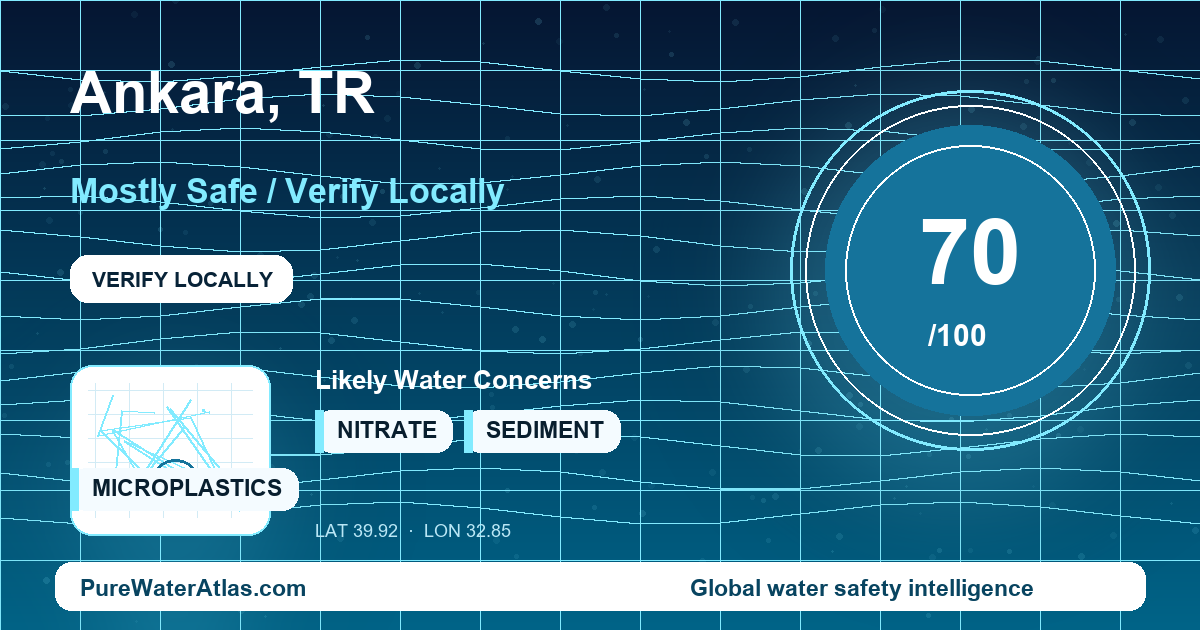
Ankara’s tap water is treated by the municipal utility, but final safety and taste can depend on reservoir conditions, source blending, drought pressure, building plumbing, and storage-tank maintenance.
Quick Answer
| Overall safety status | Mostly Safe / Verify Locally — Ankara’s municipal tap water is treated and disinfected, and it is generally usable in the central serviced network. The practical concern is variation from drought-prone source supplies, mineral character, taste, and building-level conditions. |
|---|---|
| Water safety score | 70 / 100 |
| Traveler advice | For most short-term visitors in central Ankara, tap water is usually acceptable for brushing teeth and hot drinks after boiling. For direct drinking, sealed bottled water or a verified filter is the lower-risk choice if you have a sensitive stomach, are traveling with infants, or are staying in an older building or budget rental. |
| Resident advice | Residents connected to the ASKİ network can generally rely on municipal treated water, but should check current ASKİ notices and water-quality information, especially after outages, local repairs, or visible discoloration. |
| Main water source | A multi-reservoir surface-water system, including major sources such as Çamlıdere, Kurtboğazı, Eğrekkaya, Akyar, Çubuk II, Kavşakkaya, and supplemental Kızılırmak/Kesikköprü infrastructure during water-stress periods. |
| Water authority | Ankara Su ve Kanalizasyon İdaresi Genel Müdürlüğü, known as ASKİ. |
| Filter recommendation | A filter is not automatically required for every household. Activated carbon can improve chlorine taste and odor; sediment filtration can help with particles; reverse osmosis is most relevant only where testing confirms high dissolved solids, salinity, sulfate, nitrate, arsenic, or similar dissolved issues. |
Why Ankara Is Different
Ankara is an inland, high-elevation capital on the Central Anatolian plateau. Unlike cities that draw from a single abundant nearby river or a simple groundwater field, Ankara depends on a managed regional surface-water system: reservoirs, transmission lines, treatment works, distribution reservoirs, pressure zones, and customer connections. This makes the city’s drinking-water profile strongly tied to reservoir storage, winter snow and rain, drought cycles, and operational source blending.
The key local context is not a confirmed citywide contaminant crisis. Ankara’s municipal water is treated and disinfected. The reason the city is rated “Mostly Safe / Verify Locally” is the combination of drought-prone supplies, historically controversial use of Kızılırmak/Kesikköprü water, variable taste and hardness, and the possibility that final water quality changes inside older buildings. A clean municipal sample does not always guarantee identical quality at an apartment tap if the building has old pipes, rusty risers, neglected rooftop or basement tanks, or stagnant internal plumbing.
The Kızılırmak/Kesikköprü issue is especially city-specific. During the 2007 drought period, Ankara relied on emergency or supplemental water from the Kızılırmak system, which became a major public concern because Kızılırmak water can have higher dissolved mineral content and salinity-related taste issues compared with some reservoir sources. That history helps explain why many Ankara residents discuss bottled water, filtering, hardness, chlorine odor, and taste even when there is no official citywide boil-water warning.
Where Does Ankara’s Tap Water Come From?
Ankara’s drinking water is primarily supplied through a multi-reservoir surface-water system operated through ASKİ and related state water infrastructure. Reservoirs commonly associated with the capital’s raw-water supply include Çamlıdere Dam, Kurtboğazı Dam, Eğrekkaya Dam, Akyar Dam, Çubuk II Dam, Kavşakkaya Dam, and connected reservoirs feeding the metropolitan treatment and transmission system. The raw-water mix can change depending on storage, rainfall, snowmelt, demand, and operational decisions.
The İvedik Drinking Water Treatment Plant is the main large-scale treatment facility serving Ankara’s municipal system. From treatment, water moves through transmission lines, service reservoirs, distribution zones, and customer connections across the metropolitan municipality area. Ankara’s system also includes the Çamlıdere transmission and reservoir system and the Kesikköprü-Kızılırmak transfer infrastructure, which is relevant as a supplemental or drought-resilience source.
Because Ankara uses treated surface water, raw-water conditions matter. Heavy rain, snowmelt, reservoir turnover, low storage, and changes in source blending can influence turbidity, mineral character, taste, and public concern before treatment. Treatment and disinfection are therefore central to the city’s water-safety profile. At the same time, final tap quality can still be affected after treatment by local pipe work, pressure interruptions, apartment tanks, and premise plumbing.
Who Manages Drinking Water in Ankara?
Ankara’s municipal drinking-water service is managed by ASKİ, the Ankara Su ve Kanalizasyon İdaresi Genel Müdürlüğü. ASKİ is responsible for drinking-water supply, treatment, distribution, wastewater services, and public water-service information in the metropolitan area. Residents should use ASKİ as the first official source for local water notices, dam storage information, and published water-quality information.
Turkey’s national drinking-water framework is set by the İnsani Tüketim Amaçlı Sular Hakkında Yönetmelik, with public-health oversight by the Ministry of Health and local health authorities. The Devlet Su İşleri, DSİ, and its 5th Regional Directorate are relevant for dams, water resources, and major hydraulic infrastructure affecting Ankara’s reservoir-based supply.
One important limitation: city-level institutional and source-water information is available, but public data are not always easy to use for independent neighborhood-by-neighborhood trend analysis at the customer tap. Reservoir levels and some utility information may be easier to find than long-term distribution-network data for every district or building. This is why household verification matters in older properties and for vulnerable users.
Main Local Water Concerns
- Chlorine taste or odor: Ankara’s treated municipal water is disinfected, and residual chlorine can be noticeable, especially to visitors who are not used to the taste of Turkish municipal water.
- Hardness and scaling: Ankara residents commonly discuss mineral taste, scaling, and hardness. These characteristics can shift when the raw-water blend changes, especially when higher-mineral Kızılırmak-derived water is relevant.
- Turbidity, sediment, or discoloration: Temporary cloudiness, particles, or rusty water may occur after pipe repairs, pressure changes, local construction, service interruptions, heavy rainfall, snowmelt, or sediment disturbance.
- Building storage tanks: A rooftop or basement tank can create microbial risk if it is uncovered, cracked, dirty, poorly disinfected, or hydraulically stagnant, even when ASKİ’s distributed water is treated.
- Old plumbing and metals: Lead, iron, copper, manganese, and galvanized-pipe corrosion are premise-plumbing concerns. They should not be assumed citywide, but they also cannot be ruled out for an individual old building without testing.
- Drought and low reservoir storage: Late summer and autumn can be higher-concern periods because demand may be high and reservoirs may be lower after dry months. Drought years can change source selection, blending, taste, and public perception.
For Travelers
In central Ankara, municipal tap water is generally treated and chlorinated, so it is not comparable to untreated water. For most visitors, using tap water for brushing teeth in central hotels and serviced buildings is usually reasonable. Hot drinks made with boiled water are also generally a lower-risk use. However, direct drinking from the tap is not the lowest-risk option for every traveler.
If you have a sensitive stomach, are immunocompromised, are traveling with a very young infant, or are staying in an older apartment, budget rental, or building with unknown tank maintenance, use sealed bottled water or a verified filter for drinking. Use bottled water for brushing teeth if the tap water is visibly cloudy, brown, contains particles, has a sewage-like smell, or appears to come from a poorly maintained storage tank.
Ice in reputable hotels, cafes, and restaurants is usually lower risk if made from treated water, but sensitive travelers can avoid ice or ask whether it is made from packaged or filtered water. Avoid ice from informal sources where storage and hygiene are unclear. In large central hotels and established restaurants, plumbing and water practices are more likely to be maintained, but building-level tanks still matter. If water looks rusty or has particles, ask for bottled water and report the issue to the property.
Carry bottled water during summer, long bus trips, and visits to outlying areas. After a service interruption or major repair, check ASKİ announcements and avoid drinking water that is discolored or sediment-heavy until it clears. Boiling can reduce microbial risk, but it does not remove salts, hardness, metals, arsenic, or nitrate.
For Residents
Residents connected to the ASKİ network can generally rely on municipal treated water, but local verification is sensible. Start by checking ASKİ’s current water-quality information and any outage, flushing, or maintenance notices. If the concern appears only in one building or one apartment line, the problem may be premise plumbing rather than the citywide supply.
A home filter is not automatically necessary for every Ankara household. Many residents may still benefit from treatment for taste, odor, or particles. Activated carbon is appropriate for improving chlorine taste and odor. A sediment prefilter can help when visible particles, rust, or discoloration appear. Reverse osmosis should be considered only when testing or reliable local data show high dissolved solids, salinity, sulfate, nitrate, arsenic, or related dissolved contaminants at the tap. Poorly maintained filters can become a microbial problem, so cartridge replacement and sanitation matter.
Older Ankara buildings deserve extra attention. Internal corrosion, galvanized pipe scale, rusty risers, older fixtures, solder, or service-line materials can affect final tap water. If water is discolored after stagnation, flush until clear and test rather than relying only on citywide claims. Use cold water for cooking and drinking, not hot tap water from building systems.
Apartment storage tanks are another practical risk point. Residents should ask the building manager for documented cleaning and disinfection dates, inspect tank covers and vents, and consider microbiological testing if maintenance is uncertain. If residents report odor, slime, turbidity, intermittent supply, or illness patterns, test for E. coli, total coliform, and turbidity.
Relevant Contaminants and Water-Quality Issues
The most relevant Ankara water-quality topics are best understood as a combination of treated surface-water management and building-level conditions. Chlorine is important because residual disinfection can create taste or odor while helping control microbial risk. Turbidity matters in a reservoir-fed surface-water system, especially after heavy rain, snowmelt, pipe work, or reservoir changes. Sediment is relevant for residents seeing particles, rust, or discoloration after local plumbing or network disturbance.
Lead should not be described as a proven citywide Ankara problem based on this dataset, but it is a legitimate old-building and premise-plumbing risk. Residents in older buildings should consider first-draw and flushed sample testing for lead, copper, iron, and manganese. Arsenic and nitrate are relevant for broader laboratory verification, vulnerable households, and any situation involving non-municipal water, private wells, tanker water, or source-water concerns.
How to Verify Your Water Quality
The first step in Ankara is to verify official local information. Check ASKİ dam storage and reservoir information to understand the local supply context, and use ASKİ water analysis and water-quality information for current utility data. If there has been an outage, repair, pressure change, or discoloration event, wait for local guidance and flush cautiously before using water for drinking.
For household testing, Ankara residents in older buildings should collect both first-draw and flushed samples when evaluating metals from plumbing. If water tastes salty, bitter, or leaves heavy scale, test conductivity, total dissolved solids, hardness, sulfate, chloride, and sodium. For infants, pregnant residents, immunocompromised people, or homes outside reliable municipal service, consider a certified laboratory panel including nitrate, arsenic, and microbiological indicators.
PureWaterAtlas resources that fit Ankara’s situation include the Water Testing guide, Lead in Drinking Water: Testing and Detection Methods, Arsenic in Drinking Water: Testing and Detection Methods, and Nitrate Contamination in Drinking Water: Testing and Detection Methods. For treatment decisions, see Water Treatment Systems. For travel comparison, use the Global Water Quality Checker, and for parameter lookups use the Contaminants Search Engine. The Boiling Water Purification guide is especially useful because boiling helps microbial risk but does not remove dissolved salts, hardness, metals, arsenic, or nitrate.
Official and Technical Sources
- ASKİ, Ankara Su ve Kanalizasyon İdaresi Genel Müdürlüğü — municipal water authority for Ankara’s drinking-water supply, treatment, distribution, wastewater, and public service information.
- ASKİ dam storage and reservoir information — supports Ankara’s reservoir-dependent supply context.
- ASKİ water analysis and water-quality information — official place for residents to verify current water-quality results.
- Turkey Ministry of Health drinking-water regulation — national framework for water intended for human consumption.
- Devlet Su İşleri, DSİ — national water resources authority relevant to dams and major hydraulic infrastructure.
- DSİ 5th Regional Directorate — regional water-resources context for Ankara and surrounding provinces.
- CDC Travelers’ Health: Turkey — conservative travel-health context for food and water precautions.
- WHO Guidelines for Drinking-water Quality — general public-health basis for evaluating microbial safety, disinfectant residual, turbidity, metals, and source protection.
Bottom Line
Ankara’s tap water is treated and disinfected by ASKİ and is generally usable in the central municipal network, but it deserves local verification rather than a blanket “always safe” claim. The city’s water profile is shaped by reservoir dependence, drought pressure, possible source blending, and the long-running public concern around higher-mineral Kızılırmak/Kesikköprü water. For travelers, bottled or filtered water is the safer direct-drinking choice in older or uncertain buildings, while brushing teeth is usually reasonable in serviced central hotels. For residents, the most realistic risks are often at the building level: old plumbing, stagnant lines, and poorly maintained storage tanks. Check ASKİ notices, test when conditions warrant, and choose filters based on confirmed problems rather than assumptions.
Read the full guide: Global Water Quality Guide
Explore more in this category: Global Water Quality Articles