
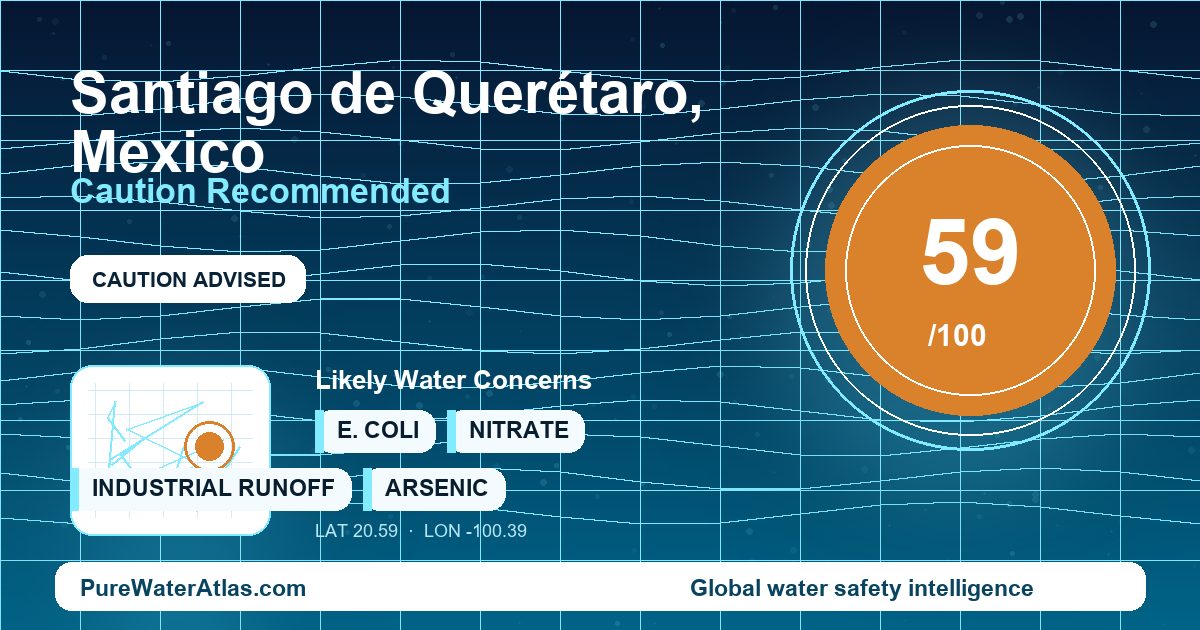
Santiago de Querétaro has a managed municipal water system, but direct tap drinking deserves caution because the city relies on stressed groundwater, imported Acueducto II water, and building-level storage that can vary from one property to another.
Quick Answer
| Water safety score | 59 / 100 |
|---|---|
| Risk level | Caution Recommended |
| Can tourists drink the tap water? | Not recommended as a default. Use sealed bottled water, purified garrafón water, hotel-provided purified water, or a verified filter. |
| Resident guidance | Treat municipal tap water as a managed supply that may still need point-of-use treatment for drinking, especially where cisterns, rooftop tinacos, old plumbing, infants, pregnant people, or immunocompromised residents are involved. |
| Main water source | A blended system of deep groundwater from the Valle de Querétaro aquifer and imported water through the Acueducto II system from the Sierra Gorda/Moctezuma basin area. |
| Water authority | Comisión Estatal de Aguas de Querétaro, commonly called CEA. |
| Filter recommendation | For drinking water, a point-of-use system is prudent unless you have recent lab results for your exact tap. Carbon can improve chlorine taste and odor, but lab results should guide choices such as reverse osmosis, UV, or other certified treatment. |
Overall verdict: Caution is recommended. Santiago de Querétaro is not an unmanaged water environment: it has a formal municipal/state system operated by CEA and is regulated under Mexico’s national drinking-water framework. The main uncertainty is what happens between the treated system and the glass: pressure changes, service interruptions, repairs, household cisterns, rooftop tanks, older internal plumbing, and limited public neighborhood-level monitoring data.
Why Santiago de Querétaro Is Different
Santiago de Querétaro’s water profile is shaped by the geography of the semi-arid Bajío region. The city sits at high elevation in the Querétaro valley, where rainfall is seasonal and natural surface-water availability is limited. This local setting helps explain why the modern city depends on a combination of groundwater and imported water rather than a simple nearby river or reservoir source.
The city’s water identity also has a long historical pattern: water importation has mattered for centuries. Querétaro’s famous 18th-century aqueduct, Los Arcos, historically brought spring water from the La Cañada area into the city. Today Los Arcos is a historic landmark, not the modern drinking-water supply. The modern parallel is Acueducto II, a major transfer system developed to supplement local groundwater for the growing metropolitan area.
This matters for tap-water safety because Santiago de Querétaro’s risk is not best described by one single contaminant or one single treatment plant. The practical issue is variability. Water may leave the utility system under controlled conditions, but tap quality can change inside the distribution network and within buildings, especially where water is stored in cisterns or rooftop tinacos before reaching the kitchen.
Where Does Santiago de Querétaro’s Tap Water Come From?
Santiago de Querétaro is supplied by a blended system. A key local source is groundwater from wells associated with the Valle de Querétaro aquifer, which is identified in federal groundwater-management materials as an important local groundwater source. The city also receives imported water through the Acueducto II system, which conveys water from the Sierra Gorda/Moctezuma River basin area toward the Querétaro metropolitan area.
That combination is important. Querétaro is not simply a “surface-water city,” and it is not simply a “well-water city.” Its drinking-water system reflects both groundwater stress and the need for imported supply reliability. Long-term planning and public debate around additional imported-water infrastructure reflect the same water-stress context.
Key parts of the city’s drinking-water infrastructure include the CEA urban distribution network, deep groundwater wells, the Valle de Querétaro aquifer, the Acueducto II bulk-water transfer system, potabilization facilities, storage, pumping, pressure zones, household cisterns, and rooftop tinacos. In practical terms, that means the safety of water at a kitchen faucet depends not only on source water and utility treatment, but also on pressure management, repairs, household storage, and building maintenance.
Who Manages Drinking Water in Santiago de Querétaro?
The principal drinking-water operator for Santiago de Querétaro is the Comisión Estatal de Aguas de Querétaro, commonly called CEA. CEA is the local authority to check for service information, public notices, and infrastructure context. CEA also provides information on Acueducto II, the imported-water system that supplements the metropolitan supply.
At the federal level, water-resource oversight is handled by CONAGUA. CONAGUA provides national context for aquifers and groundwater management, including aquifer availability and stress, and also publishes national material on water quality in Mexico. Drinking-water sanitary quality is governed nationally through Secretaría de Salud and COFEPRIS frameworks, including NOM-127-SSA1-2021, Mexico’s official standard for water for human use and consumption.
A key limitation for consumers is transparency at the neighborhood tap level. Public information is sufficient to identify the water authority, the source-water context, the aquifer dependence, the role of Acueducto II, and the regulatory framework. However, a recent, easily searchable, neighborhood-level consumer report with tap-specific results for microbiology, metals, disinfection residual, turbidity, nitrate, arsenic, fluoride, and household storage conditions was not found in a single public source. For that reason, this guide does not claim that every tap in Santiago de Querétaro is safe or unsafe.
Main Local Water Concerns
The most important local concern is the long-term stress of the Valle de Querétaro aquifer. Groundwater dependence matters because overexploitation can affect supply planning and can increase the importance of imported water, pumping, storage, and pressure management. It also makes local testing important in homes or buildings using private sources or where groundwater-related taste, scaling, or mineral issues are suspected.
Groundwater-derived supplies can have practical issues such as hardness, scaling, mineral taste, or elevated dissolved solids, although the exact level at any tap should be confirmed by testing rather than assumed. Regional central-Mexico groundwater can contain geogenic contaminants such as fluoride or arsenic in some areas, so residents using private wells or uncertain sources should test rather than assume presence or absence.
Distribution and building-level factors are also central in Santiago de Querétaro. Rapid urban expansion places pressure on wells, pumping, storage, and pressure zones. Turbidity or sediment can appear after pipe repairs, pressure changes, or service interruptions. Microbial risk can increase after loss of pressure, flooding, repairs, or when household cisterns and tinacos are not cleaned and disinfected. Older buildings may also have internal plumbing risks, including metal leaching, solder, fixtures, or accumulated scale. That is a building-specific issue, not a verified citywide lead claim.
Seasonal conditions can compound these concerns. Dry-season demand can increase pressure on supply and pumping systems. Rainy-season storms can increase turbidity and runoff in source areas and can stress urban drainage around damaged pipes. Warm weather and stagnant household tanks can encourage biological growth if storage tanks are poorly sealed or not cleaned.
For Travelers
Short-term visitors should not rely on unfiltered tap water as their primary drinking water in Santiago de Querétaro. The risk is better described as moderate and variable rather than extreme, but travelers often have more sensitive stomachs than residents, and they may not know how a hotel, apartment, or rental property maintains its cisterns, tinacos, and internal plumbing.
Use sealed bottled water, purified garrafón water, or water treated through a reliable filter or purifier. Better hotels, cafés, and restaurants commonly provide bottled or purified water. Ask for agua purificada or agua embotellada. Do not assume bathroom tap water in a hotel room is the same as the purified water served for drinking.
Many travelers brush their teeth with tap water without incident, but cautious visitors, families with small children, and anyone with a sensitive stomach should use bottled or purified water for brushing. Tap water is generally acceptable for showering and handwashing; avoid swallowing shower water if you are newly arrived or gastrointestinally sensitive.
Use ice only in established hotels, cafés, and restaurants that use purified commercial ice. Avoid ice from informal sources if you cannot verify that it was made from purified water. During hot, dry weather, carry bottled water with you, and use bottled or purified water for infant formula. For broader travel health context, see the CDC Travelers’ Health guidance for Mexico.
For Residents
Residents should treat Santiago de Querétaro tap water as a managed municipal supply that may still need point-of-use treatment for drinking. The right approach depends on your exact building, storage system, plumbing, and lab results. A kitchen-tap test is more useful than assumptions based only on the citywide supply, because the water may pass through a cistern, rooftop tinaco, old pipes, fixtures, and stagnant plumbing before you drink it.
At minimum, many households use activated carbon to reduce chlorine taste and odor. Carbon alone, however, is not a complete solution for microbes, arsenic, fluoride, nitrate, or high dissolved solids. If testing shows dissolved minerals, nitrate, arsenic, fluoride, salinity, or other inorganic concerns, reverse osmosis or another certified system may be more appropriate. If microbial risk is the concern, disinfection-focused treatment such as certified UV may be relevant, but it should be matched to the test results and maintained correctly.
Test at the kitchen tap after water has passed through your building plumbing and storage. For apartments and older homes, test lead and other metals if the plumbing age or materials are unknown. Test total coliform and E. coli if you use a cistern, tinaco, private well, or have had low pressure, flooding, repairs, or recurring gastrointestinal illness. If taste, scaling, staining, or groundwater influence is a concern, test turbidity, total dissolved solids, hardness, chloride, sulfate, nitrate, fluoride, arsenic, iron, and manganese.
Cisterns and rooftop tinacos should be covered, sealed, cleaned, and disinfected on a regular schedule. A dirty or uncovered tank can introduce sediment, insects, biofilm, and bacteria even when incoming municipal water is chlorinated. After installing any filter, retest finished water and follow cartridge replacement schedules; an old cartridge can become a contamination source.
Relevant Contaminants and Water-Quality Issues
Santiago de Querétaro’s most relevant water-quality issues are linked to disinfection, turbidity, sediment, microbial risk, groundwater chemistry, and building plumbing. For taste and odor complaints, start with chlorine in drinking water, since residual disinfectant can affect flavor even when it is serving an important sanitary purpose.
If water appears cloudy, gritty, or discolored after repairs or pressure changes, review turbidity in drinking water and sediment in drinking water. If you have a cistern, tinaco, private well, or recent low-pressure event, microbial testing is important; see E. coli in drinking water and the PureWaterAtlas guide to water microbiology.
Older buildings should consider plumbing-related metals, including lead in drinking water, while residents using private or uncertain groundwater sources should understand testing for arsenic and nitrate. These are not claims that every tap in Santiago de Querétaro has those contaminants; they are the issues most relevant to the city’s source-water context and building-level variability.
How to Verify Your Water Quality
The best way to move from general caution to a confident decision is to test your exact tap. Start with the PureWaterAtlas guide to water testing, then choose a certified lab panel that matches your situation: municipal tap with storage tank, private well, old building, recent repairs, taste complaints, or infant use.
For filter selection, use the PureWaterAtlas guide to water treatment systems. If you need short-term emergency disinfection, review boiling water purification; if microbial control is the main issue, compare it with UV water purification. For specific testing methods, see the guides to lead testing, arsenic testing, and nitrate testing.
You can also explore the PureWaterAtlas Contaminants Search Engine, compare locations with the Global Water Quality Checker, and review the main Drinking Water Safety resource for broader decision-making.
Official and Technical Sources
- Comisión Estatal de Aguas de Querétaro — local water operator for Querétaro.
- CEA Querétaro: Acueducto II — infrastructure source describing the system that supplements the metropolitan supply.
- CONAGUA: Aguas subterráneas and aquifer information — federal aquifer and groundwater-management context.
- CONAGUA: Calidad del Agua en México — national water-quality monitoring context.
- Diario Oficial de la Federación: NOM-127-SSA1-2021 — Mexico’s drinking-water sanitary standard.
- CDC Travelers’ Health: Mexico — travel health guidance for food and water precautions.
- INEGI: Querétaro geographic information — official geographic and administrative context.
Bottom Line
Santiago de Querétaro has a formal water system operated by CEA and regulated under Mexico’s NOM-127-SSA1-2021 framework, but caution is still the right default for drinking directly from the tap. The city depends on a stressed blend of Valle de Querétaro groundwater and imported Acueducto II water, while tap quality can vary because of pressure changes, repairs, cisterns, rooftop tinacos, and older building plumbing. Tourists should use bottled or purified water for drinking and consider it for brushing teeth. Residents should test their kitchen tap, maintain storage tanks, and choose filtration based on results rather than assumptions. The available public data supports a “managed but variable” verdict, not a blanket safe-or-unsafe claim for every property.
Read the full guide: Global Water Quality Guide
Explore more in this category: Global Water Quality Articles