
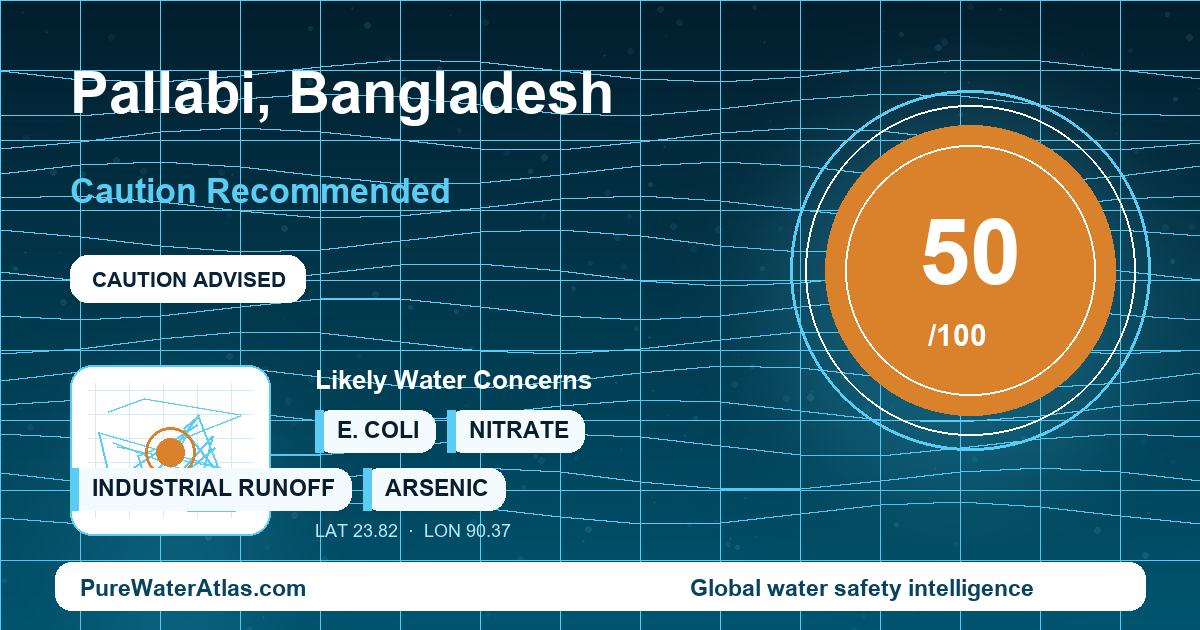
Pallabi, a dense northern Dhaka thana near Mirpur, receives water through the Dhaka WASA metropolitan system rather than a separate local utility. The main safety question is often what happens between the city main and the tap: pressure changes, building tanks, booster pumps, internal plumbing, and household treatment.
Quick Answer
| Water safety score | 50 / 100 |
|---|---|
| Risk level | Caution Recommended |
| Is Pallabi tap water safe to drink? | Do not assume it is safe untreated. Dhaka WASA disinfects and distributes treated water, but Pallabi-specific public tap-level compliance data are limited, and building-level storage tanks and plumbing can change water quality before it reaches the glass. |
| Traveler advice | Use sealed bottled water, or water that has been boiled, UV-treated, or passed through a well-maintained purifier. Visitors should be conservative because hotel or apartment tank hygiene is hard to verify. |
| Resident advice | Use point-of-use treatment for drinking unless recent testing at your actual tap, after the building tank, confirms microbiological and chemical safety. |
| Main water source | Dhaka WASA metropolitan supply: a mix of deep groundwater production wells and treated surface water from major Dhaka plants and transmission systems, with the exact mix at a Pallabi tap varying by zone and operations. |
| Water authority | Dhaka Water Supply and Sewerage Authority, commonly Dhaka WASA. |
| Filter recommendation | For most Pallabi homes: sediment prefilter plus activated carbon and UV disinfection or boiling. Add reverse osmosis only when testing shows dissolved contaminants, salinity, arsenic, nitrate, or metals that carbon and UV do not remove. |
Why Pallabi Is Different
Pallabi is not an isolated town with its own small waterworks. It is a densely urbanized thana area in northern Dhaka, adjacent to Mirpur, and is supplied as part of Dhaka’s large interconnected water-supply system. That matters because a Pallabi tap may reflect several layers of risk: the quality of water produced by Dhaka WASA, conditions in the metropolitan distribution network, and the condition of the building’s underground reservoir, rooftop tank, booster pump, and internal plumbing.
The practical concern in Pallabi is therefore not only whether water leaving a treatment plant or deep production well is treated. A modern flat, hotel, or commercial building may still store water before use. Even if incoming water is chlorinated, poor tank cleaning, stagnant rooftop storage, cross-connections, old plumbing, or pressure changes can create microbial risk at the tap. Clarity is not proof of safety.
PureWaterAtlas rates Pallabi as Caution Recommended because Dhaka’s utility system is well documented, but publicly available, recent, Pallabi-specific tap results for homes, streets, and storage tanks are sparse. This page should not be read as a claim that every Pallabi tap fails or passes a particular standard; conditions can vary substantially from one building to the next.
Where Does Pallabi’s Tap Water Come From?
Pallabi is supplied through the Dhaka WASA metropolitan network. Dhaka’s raw-water system is a combination of deep groundwater from production tube wells tapping the regional aquifer and treated surface water from major plants and transmission systems. Important Dhaka infrastructure includes the Saidabad Water Treatment Plant, which uses Shitalakhya River water; the Padma/Jashaldia surface-water supply from the Padma River system; and the older Chandnighat Water Treatment Plant, historically associated with the Buriganga River intake.
The exact source mix at a Pallabi tap can vary by distribution zone, system pressure, operations, local reservoirs, and pumps. A household may not be able to identify its immediate source simply by location or taste. Dhaka historically relied heavily on groundwater abstraction from deep tube wells. Official development sources describe that dependence as a driver of groundwater-level decline, which is why Dhaka WASA has been expanding treated surface-water schemes.
That transition is important for Pallabi. Treated surface water can support long-term sustainability by reducing pressure on aquifers, but it also makes river source-water protection and treatment performance critical because Dhaka’s surrounding rivers face pollution pressure. In Pallabi and the wider Mirpur area, bulk supply still interacts with neighborhood distribution pipes and building-level storage systems before residents or visitors drink it.
Who Manages Drinking Water in Pallabi?
Drinking water in Pallabi is managed by Dhaka Water Supply and Sewerage Authority, commonly known as Dhaka WASA. Pallabi does not have a separate municipal drinking-water utility. Dhaka WASA is the public utility responsible for piped water supply and sewerage services in Dhaka, including areas within Dhaka North and Dhaka South service coverage.
The regulatory context is national and metropolitan rather than Pallabi-only. Urban water supply in Dhaka is operated under Bangladesh’s local-government framework. Drinking-water quality expectations are shaped by Bangladesh national standards and public-health guidance, with institutional roles involving the Ministry of Local Government, Rural Development and Cooperatives, Dhaka WASA, the Department of Public Health Engineering, the Department of Environment, and public-health authorities.
No official Pallabi-only compliance dashboard was identified in this review. For a neighborhood like Pallabi, that limitation is important: system-level Dhaka data and project documentation help explain the supply system, but they do not prove the condition of a specific apartment tap after water has passed through a building tank and internal pipework.
Main Local Water Concerns
The most important Pallabi concern is possible microbial contamination after distribution leakage, low pressure, pipe repair, flooding, or contaminated household storage. Dhaka WASA water may be disinfected, but point-of-use safety depends on whether a disinfectant residual survives through the network and storage tanks. Learn more about why chlorine residual matters in piped systems.
Monsoon rain and urban waterlogging can increase the chance of sewer or drain intrusion where pipes, service connections, underground reservoirs, or storage tanks are compromised. Dry-season low river flow can concentrate pollutants in source rivers and increase treatment challenges for surface-water plants. Hot weather can accelerate loss of disinfectant residual in rooftop tanks and stored water. Power cuts or pump interruptions can also cause pressure fluctuations that increase intrusion risk in leaky lines or building plumbing.
Other practical signs in Pallabi include turbidity, sediment, discoloration, or metallic taste after pipe works, pump cycling, or tank disturbance. Turbidity is not just an appearance issue; particles can interfere with disinfection and may signal disturbed sediment or contamination pathways.
Bangladesh has a major national history of groundwater arsenic. Dhaka’s municipal deep wells are different from many rural shallow wells, so it is not accurate to assume a Pallabi-wide arsenic problem from municipal supply alone. However, any private borehole, caretaker-operated deep tube well, or unverified groundwater source in or around Pallabi should be tested for arsenic rather than assumed safe. Iron and manganese can occur in groundwater-influenced supplies and may cause staining, taste, or deposits. Lead is not documented here as a Pallabi-wide utility contaminant, but older building plumbing, brass fixtures, solder, or service connections can create household-level risk.
For Travelers
Visitors should not drink untreated Pallabi tap water. The safest routine for a short stay is sealed bottled water from reputable brands, with the seal checked before opening, or water that has been boiled, UV-treated, or passed through a well-maintained purifier. This advice is especially important for travelers who are not acclimated, are immunocompromised, are pregnant, or are traveling with children.
Use bottled or treated water for brushing teeth if you cannot verify the building’s tank hygiene and filtration system. Avoid judging safety by whether water looks clear. A clear glass of water can still contain microbial contamination if it has passed through a dirty rooftop tank or compromised plumbing.
Avoid ice unless the hotel or restaurant can confirm that it is made from purified water. Ice made from untreated tap or tank water can preserve microbial risk even when served in a clean-looking drink. In hotels and restaurants, ask specifically whether drinking water and ice come from bottled water or a maintained purification system. Higher-end hotels and some restaurants may use filtration, but that should be confirmed rather than assumed.
For tea and coffee, use water that has reached a proper boil. If you are sensitive to gastrointestinal illness, be cautious with raw foods washed in unknown tap water. Carry oral rehydration salts and use them promptly if diarrhea or vomiting occurs. Conservative traveler food and water precautions for Bangladesh are consistent with guidance from the U.S. Centers for Disease Control and Prevention.
For Residents
For Pallabi residents, the most practical approach is to treat drinking water at the point of use unless recent testing at the actual tap, after the building storage tank, confirms safety. A typical setup is a washable sediment prefilter, activated carbon for taste and chlorine-related compounds, and UV disinfection or boiling for microbial control. Reverse osmosis should be added when testing shows dissolved contaminants or metals that carbon and UV will not remove, such as elevated salinity, arsenic, nitrate, or specific metals.
Testing should be done after the building storage tank, not only at the utility connection. At minimum, residents should test for E. coli or thermotolerant coliforms, total coliforms, turbidity, pH, electrical conductivity or TDS, free residual chlorine, iron, and manganese. If the building is old, has metallic taste, or has unknown fixtures or service lines, test first-draw and flushed samples for lead.
If your building uses any private borehole, caretaker-operated deep tube well, or non-Dhaka WASA source, test for arsenic, nitrate, iron, manganese, salinity or conductivity, and microbial indicators. Retest after pipe repairs, flooding, sewage backflow, tank cleaning, new plumbing installation, or a noticeable change in color, odor, or taste.
Older Pallabi and Mirpur buildings may have corroded internal pipes, unlined tanks, old valves, or fixtures that affect water after it leaves the municipal main. Flush stagnant water in the morning, do not use hot tap water for cooking or infant formula, and test for lead if children or pregnant people live in the home. Underground reservoirs and rooftop tanks should be tightly covered, screened against insects and animals, protected from drain or sewer seepage, and cleaned on a regular schedule. If tank cleaning is not documented, treat the tap as higher risk.
Relevant Contaminants and Water-Quality Issues
The most relevant acute-health issue for Pallabi is microbial contamination, especially from sewage intrusion or dirty storage tanks. The key indicator is E. coli. If E. coli is detected, the water should not be consumed untreated, and the building tank, plumbing, and disinfection practices need investigation.
Turbidity is relevant when water looks cloudy, carries sediment, or changes after pump cycling or pipe work. Chlorine matters because municipal safety depends partly on maintaining a disinfectant residual through the network and building storage. If residual chlorine is absent at the tap, microbiological protection may be reduced.
For chemical concerns, Pallabi residents should understand the difference between municipal Dhaka WASA water and private or unverified groundwater. Bangladesh’s national groundwater context makes arsenic testing important for private boreholes. Iron and manganese can affect taste, staining, and treatment choices. Lead is mainly a household plumbing concern in this dataset, especially for older buildings or fixtures.
How to Verify Your Water Quality
The only reliable way to judge a specific Pallabi tap is to test that tap under real conditions. Use the PureWaterAtlas Water Testing guide to plan sampling, and prioritize samples after the building tank because that is a major risk point in Pallabi apartments and commercial buildings.
For treatment decisions, see Water Treatment Systems, Boiling Water Purification, and UV Water Purification. If old plumbing is suspected, use Lead in Drinking Water: Testing and Detection Methods. If any private groundwater source is used, review Arsenic in Drinking Water: Testing and Detection Methods and Nitrate Contamination in Drinking Water: Testing and Detection Methods.
For broader reference, use the Contaminants Search Engine, the Global Water Quality Checker, and the PureWaterAtlas guides to Drinking Water Safety and Water Microbiology.
Official and Technical Sources
- Dhaka Water Supply and Sewerage Authority official website — official utility source for Dhaka water and sewerage services.
- Asian Development Bank: Dhaka Environmentally Sustainable Water Supply Project — documents Dhaka’s groundwater dependence and shift toward treated surface-water supply.
- World Bank: Dhaka Water Supply and Sanitation Project — describes infrastructure and service-improvement challenges in Dhaka’s water and sanitation system.
- CDC Bangladesh travel health guidance — supports conservative food and water precautions for travelers.
- WHO Guidelines for Drinking-water Quality — global reference for microbial and chemical drinking-water risk management.
- WHO/UNICEF Joint Monitoring Programme Bangladesh WASH data — national household water, sanitation, and hygiene context.
- Department of Public Health Engineering — Bangladesh public-health engineering authority relevant to water supply and testing context.
- Department of Environment — national environmental authority relevant to source-water pollution context.
- UNICEF Bangladesh: Arsenic in Bangladesh — background on the national groundwater arsenic issue, especially relevant for private or unverified boreholes.
Bottom Line
Pallabi tap water should be treated with caution, not because Pallabi has a separate failed utility, but because it depends on Dhaka WASA’s metropolitan system plus neighborhood and building-level infrastructure. The water may come from a changing mix of deep groundwater and treated surface-water sources, but the final risk often depends on distribution pressure, leaks, rooftop tanks, underground reservoirs, booster pumps, and internal plumbing. Visitors should use sealed bottled, boiled, UV-treated, or reliably filtered water and avoid unverified ice. Residents should test water at the tap after the storage tank and maintain sediment filtration, carbon, and UV or boiling for drinking water. Private groundwater sources require additional testing for arsenic, nitrate, metals, salinity, and microbes.
Read the full guide: Global Water Quality Guide
Explore more in this category: Global Water Quality Articles