
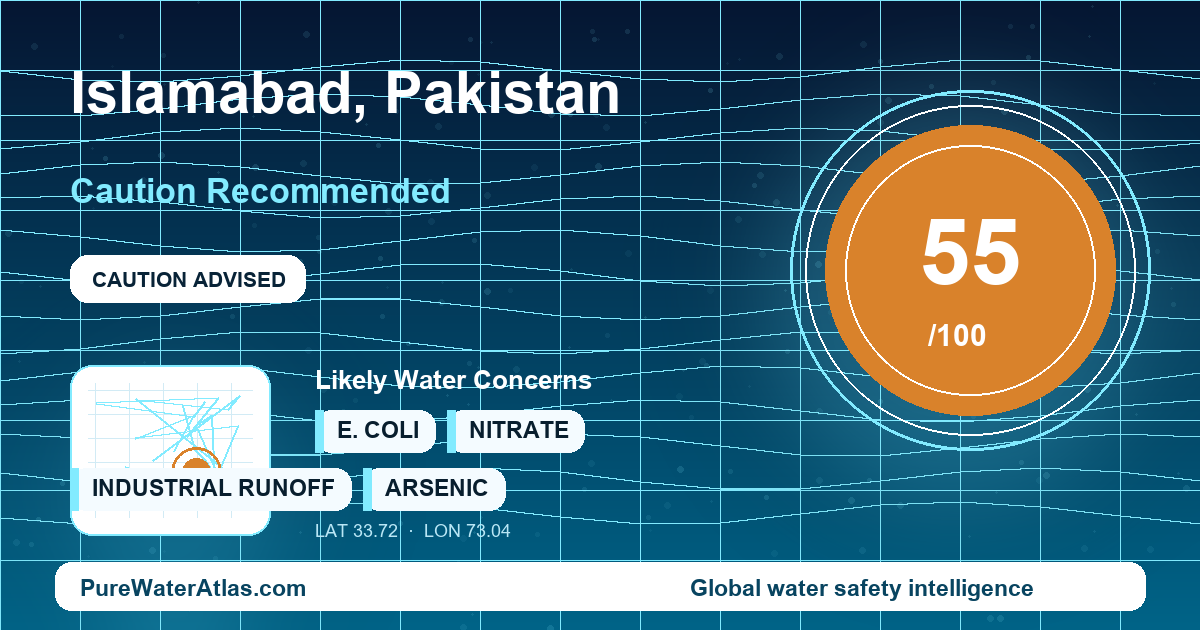
Islamabad has a formal municipal supply built around reservoirs, tube wells, treatment, chlorination, and sector-based distribution, but tap-water safety can change by building, storage tank, supply source, and season.
Quick Answer
| Overall safety status | Caution recommended. Islamabad’s water safety score is 55/100. The city has better-managed public infrastructure than many places in Pakistan, but safety is not consistently verifiable at the household tap. |
|---|---|
| Can tourists drink the tap water? | Not recommended untreated. Visitors should use sealed bottled water, hotel-provided water from a maintained filtration system, or water that has been boiled or otherwise disinfected. |
| Resident guidance | Treat tap water as source-dependent. CDA-supplied water may be manageable with household safeguards, but borehole, tanker, private filtration plant, and stored building water should be tested and treated based on results. |
| Main water sources | Simly Dam, Khanpur Dam supply, and CDA-operated tube wells, with household underground and rooftop storage tanks often determining the water quality actually delivered at the tap. |
| Main authority | Capital Development Authority, commonly abbreviated CDA, is the primary public body associated with Islamabad’s municipal water supply infrastructure and operations. |
| Filter recommendation | Usually advisable. For municipal supply, consider sediment prefiltration plus a maintained UV or certified microbiological barrier. For borehole or tanker water, test first before choosing RO, UV, or other treatment. |
Why Islamabad Is Different
Islamabad is not a simple “safe” or “unsafe” tap-water city. It is Pakistan’s planned capital, located on the Potohar Plateau at the foot of the Margalla Hills, and its water system is tied to nearby hill and river catchments, reservoir storage, and local groundwater. That gives the city a more formal water-supply identity than many fast-growing urban areas, but it does not make every kitchen tap equally safe.
The practical question in Islamabad is often not just “is the tap water safe?” but “what is the building’s actual water source?” A household may receive CDA municipal water, private borehole water, tanker water, water from a filtration plant, or a mixture depending on neighborhood, season, storage capacity, and service continuity. Apartment buildings and houses commonly depend on underground or rooftop storage tanks, and these tanks can become the decisive point of contamination if they are unsealed, poorly cleaned, or connected through compromised plumbing.
This is why PureWaterAtlas gives Islamabad a Caution Recommended rating rather than a simple approval. The city has identifiable sources, treatment infrastructure, and a recognized municipal authority, but recent, granular, public tap-level data are limited. Conditions can vary sharply between a CDA-served sector, a private housing scheme, an institution, a borehole-dependent residence, a tanker-supplied building, and a hotel with a well-maintained filtration system.
Where Does Islamabad’s Tap Water Come From?
Islamabad’s municipal drinking-water supply is managed principally through a combination of surface-water reservoirs and groundwater abstraction. The main raw-water sources commonly associated with the CDA system are Simly Dam, Khanpur Dam supply, and CDA-operated tube wells.
Simly Dam stores water from the Soan River catchment east of Islamabad. Khanpur Dam, on the Haro River, supplies parts of the Islamabad-Rawalpindi urban region. Tube wells are used as supplementary groundwater sources, especially when reservoir levels, transmission capacity, or demand pressure limit the surface-water system. This mix means water chemistry and operational risk can vary depending on which source is feeding a given area at a given time.
Key infrastructure includes raw-water storage and transmission from Simly Dam, the Khanpur bulk-water component, CDA tube wells, municipal treatment and chlorination systems, service reservoirs, and distribution mains. However, the final stage is often private or building-level infrastructure: underground storage tanks, rooftop tanks, pumps, internal pipes, and point-of-use filters. In Islamabad, these end-point systems are not minor details. They are often where treated water becomes re-contaminated or where sediment accumulates.
The city was originally planned with sector-based distribution and municipal control, but population growth, institutional expansion, unplanned settlements, and expanding private housing have increased demand beyond the original design assumptions. Long-discussed augmentation schemes for Islamabad and Rawalpindi reflect the pressure on the surface-water and tube-well mix.
Who Manages Drinking Water in Islamabad?
The Capital Development Authority is the main public body associated with Islamabad’s municipal water supply, infrastructure, and operations. Local-government functions have also involved the Metropolitan Corporation Islamabad, but CDA remains the key authority generally referenced for the capital’s water infrastructure.
Pakistan’s drinking-water quality context includes national standards and public-health guidance, with relevant roles for the Pakistan Council of Research in Water Resources, the Pakistan Environmental Protection Agency, and the Pakistan Standards and Quality Control Authority. Internationally, the World Health Organization Guidelines for Drinking-water Quality provide a risk-assessment framework where local reporting is incomplete.
The main limitation for Islamabad residents and visitors is not that the system is unknown. The limitation is that routine, recent, sector-by-sector tap-water compliance data, chlorine residual maps, private borehole chemistry, storage-tank conditions, and filtration plant performance are not consistently available to the public. Safety therefore cannot be assumed solely because a building is inside Islamabad or connected to a formal municipal network.
Main Local Water Concerns
The most important short-term concern in Islamabad is microbial contamination, especially where water pressure is intermittent, pipes are depressurized, lines are leaking, storage tanks are dirty, or disinfection residual has fallen by the time water reaches a building. Total coliforms and E. coli are the key warning organisms because they indicate possible fecal contamination and higher gastrointestinal illness risk.
Turbidity and sediment can increase after monsoon rain, pipe repairs, construction disturbance, reservoir changes, or tank cleaning. Cloudy or dirty water is not only unpleasant; it can also interfere with disinfection and reduce the effectiveness of UV systems if not prefiltered.
Variable chlorine residual is another issue. Chlorine may be applied in the municipal system, but the relevant question is whether enough residual remains at the household tap after distribution, storage, and pumping. Network extremities, long residence times, and building tanks can reduce this protection.
For households using private boreholes, the risk profile changes. Groundwater quality can vary by depth, location, and nearby sanitation conditions. Relevant concerns include hardness, salinity, nitrate, iron, manganese, and general mineral content. Nitrate is especially important where sewage leakage, septic systems, poor drainage, or sanitation failures may affect groundwater. Arsenic should not be treated as a confirmed citywide Islamabad tap-water problem, but private groundwater users in Pakistan should include arsenic in a broad laboratory panel because groundwater geochemistry can vary regionally.
Finally, building plumbing can create its own risks. Older buildings, brass fixtures, pumps, solder, or unknown plumbing materials can contribute lead or other metals even when the original source water is treated.
For Travelers
Short-term visitors should not rely on untreated Islamabad tap water for drinking. Use sealed bottled water, hotel-provided filtered water from a maintained system, or water that has been boiled or otherwise disinfected. The main traveler risk is gastrointestinal illness from microbial contamination that may occur after water leaves the treatment plant, especially through storage tanks, ice, or inconsistent building filtration.
For brushing teeth, bottled, boiled, or filtered water is the safer choice, particularly for travelers who are immunocompromised, pregnant, traveling with young children, or staying in budget accommodation where tank maintenance is unknown. Avoid ice unless you are confident it was made from treated water. In restaurants, ask for drinks without ice if the staff cannot clearly confirm that the ice is made from bottled, filtered, or otherwise treated water.
Better hotels and restaurants in Islamabad may use RO, UV, or commercial filtration systems, but this should not be assumed automatically. Ask whether drinking water and ice come from a maintained system. When in doubt, choose sealed bottled water and check that the seal is intact. Avoid refilled bottles. Freshly boiled tea or coffee is generally a safer option than unverified cold drinks with ice.
Travelers should also be more cautious after heavy rain, flooding, pipe repairs, long outages, or visible discoloration. If staying in Islamabad for more than a short visit, treat the accommodation like a resident water system: ask about the water source, inspect the storage tank if possible, ask when it was last cleaned, and consider testing if you will drink from the tap regularly.
For Residents
For Islamabad residents, a home treatment system is usually advisable, but the right system depends on the source. For CDA municipal supply, a practical setup often starts with sediment prefiltration followed by UV or another certified microbiological barrier, provided the system is maintained and the water is not too turbid for effective UV treatment. See the PureWaterAtlas guide to UV water purification for how UV fits into a household barrier strategy.
For borehole, tanker, or uncertain mixed-source water, do not choose treatment blindly. Test first for total coliforms, E. coli, turbidity, pH, electrical conductivity or TDS, hardness, nitrate, iron, manganese, and arsenic. RO may be useful where TDS, nitrate, arsenic, salinity, or certain dissolved contaminants are elevated, but RO requires maintenance and post-treatment hygiene. A poorly maintained system can create a false sense of safety.
Testing should be done at the actual kitchen tap, not only at the building inlet, because the storage tank, rooftop tank, pump, and internal plumbing can change the water quality. Repeat microbiological testing after monsoon flooding, pipe repair, long outages, tank cleaning, household illness clusters, or any change in taste, odor, or color. Borehole users should retest at least annually and after nearby sewer, septic, construction, or drainage incidents.
Storage tanks are one of the most important Islamabad-specific control points. Underground and rooftop tanks should be sealed against insects, dust, rodents, and rainwater entry; cleaned and disinfected on a schedule; and protected from sewage or drain cross-contamination. A clean municipal supply can become unsafe in a dirty tank.
Older houses and apartment blocks should also consider plumbing-related metals. Flush stagnant water before use, avoid using hot tap water for cooking or infant formula, and test for lead and other metals if the building has old pipes, brass fittings, soldered joints, or unknown pump and storage fittings.
Relevant Contaminants and Water-Quality Issues
The most relevant Islamabad contaminant profile is E. coli in drinking water, because microbial contamination is the main short-term health concern where distribution leakage, depressurized pipes, unclean tanks, or poor disinfection affect tap water.
Turbidity and sediment are also important in Islamabad because monsoon runoff, pipe repairs, construction disturbance, and tank cleaning can cause cloudy or particle-laden water. Turbidity matters because it can shield microorganisms and reduce treatment effectiveness.
Chlorine is relevant because residual chlorine helps indicate whether municipal water remains disinfected at the point of use. For private boreholes, nitrate should be tested where sewage leakage or sanitation issues may affect groundwater. Lead is mainly a building-plumbing concern, while arsenic should be included in broad groundwater testing even though it should not be assumed to be a citywide Islamabad tap-water problem without lab results.
How to Verify Your Water Quality
The most reliable way to verify Islamabad household water is to test the water you actually drink. Start with the PureWaterAtlas guide to water testing and analysis, especially if your building uses a borehole, tanker deliveries, old tanks, or an unknown filtration plant.
For residents comparing different treatment options, the guide to choosing a water treatment system explains when sediment filtration, UV, RO, and other systems are appropriate. For suspected short-term contamination or emergencies, see boiling water purification. If an old building is a concern, use the PureWaterAtlas guide to lead testing and detection. Borehole users should also review nitrate testing and arsenic testing.
For broader context, compare Islamabad with other destinations using the Global Water Quality Checker, and research any lab-report terms in the PureWaterAtlas Contaminants Search Engine. The general frameworks on drinking water safety and water microbiology are especially relevant for Islamabad because household storage and intermittent supply can change water safety after treatment.
Official and Technical Sources
- Capital Development Authority, Islamabad — primary public authority associated with Islamabad municipal water supply and infrastructure.
- Pakistan Council of Research in Water Resources — national research body for drinking-water quality monitoring, testing, and water-quality reporting.
- Pakistan Environmental Protection Agency — federal environmental agency relevant to national environmental and drinking-water quality policy context.
- Pakistan Standards and Quality Control Authority — national standards body relevant to bottled water, drinking-water standards, and product quality regulation.
- World Health Organization: Guidelines for Drinking-water Quality — international reference for microbial and chemical risk assessment.
- CDC Travelers’ Health: Pakistan — traveler health guidance supporting conservative food and water precautions for visitors.
- UNICEF Pakistan: Water, Sanitation and Hygiene — national WASH context for sanitation-linked water risks in Pakistan.
Bottom Line
Islamabad tap water should be approached with caution, not automatic rejection and not automatic trust. The city has formal CDA-linked municipal infrastructure drawing on Simly Dam, Khanpur Dam supply, and tube wells, but the safety of water at the household tap depends heavily on distribution condition, supply intermittency, chlorine residual, building plumbing, and underground or rooftop storage tanks. Travelers should avoid untreated tap water and use sealed bottled, boiled, or reliably filtered water. Residents should identify their actual source, keep storage tanks sealed and disinfected, and test at the kitchen tap. For municipal supply, sediment filtration plus a maintained microbiological barrier may be appropriate; for borehole or tanker water, test before selecting treatment.
Read the full guide: Global Water Quality Guide
Explore more in this category: Global Water Quality Articles