
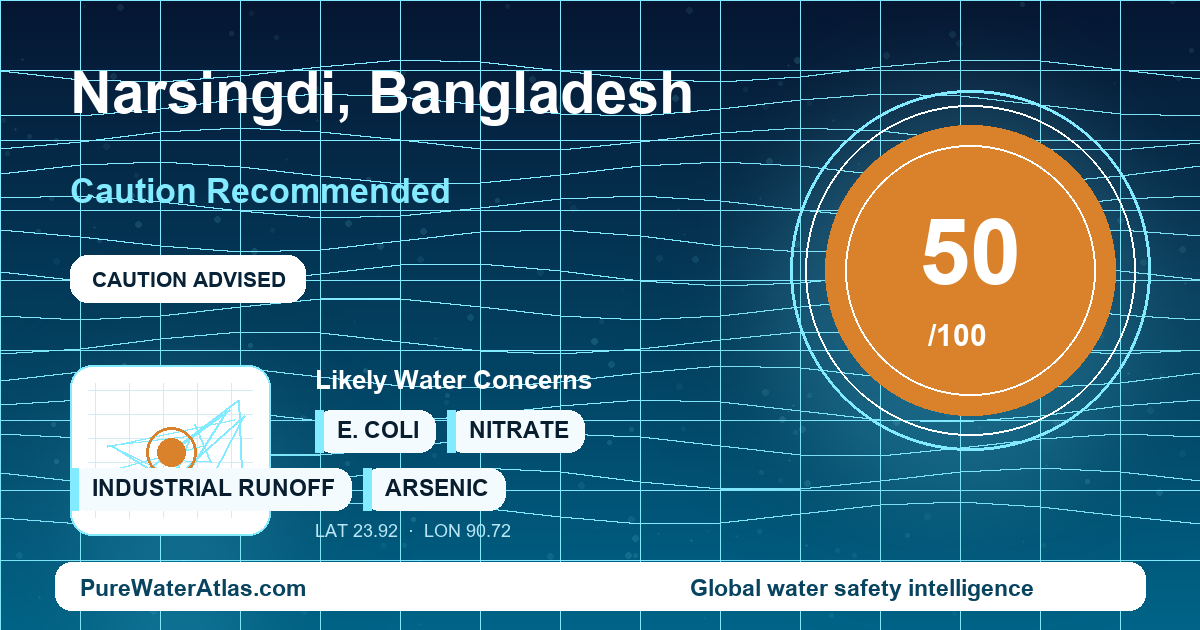
Narsingdi, Bangladesh: groundwater-based municipal and private supply with caution recommended for drinking unless water is tested and treated.
Quick Answer
| Overall safety status | Caution recommended. PureWaterAtlas assigns Narsingdi a water safety score of 50/100. Do not assume tap water is safe to drink untreated. |
|---|---|
| Can visitors drink tap water? | No, not without treatment. Use sealed bottled water, properly boiled water, or water treated with a reliable purifier. Avoid uncertain ice. |
| Resident guidance | Residents using municipal taps or private tube wells should treat water for microbes and test the specific source for arsenic and basic chemistry. |
| Main water source | Narsingdi’s drinking-water supply is best characterized as a groundwater-based urban system, using municipal production wells or deep tube wells and many private tube wells. |
| Local authority | Narsingdi Pourashava is the local municipal authority for urban services, including municipal water supply where available. The Department of Public Health Engineering supports water supply and sanitation nationally outside major WASA utilities. |
| Filter recommendation | Use sediment prefiltration plus disinfection by boiling, UV, or chlorination for microbial protection. If arsenic is detected, use an arsenic-capable system such as appropriate adsorption media or reverse osmosis and verify performance with follow-up testing. |
Data limitation: No recent publicly accessible Narsingdi municipal consumer water-quality report, distribution-zone test series, or compliance dashboard was found. This page therefore reflects known local infrastructure patterns, Bangladesh groundwater risks, and practical risk pathways rather than proof that every tap, well, hotel, or neighborhood has the same quality.
Why Narsingdi Is Different
Narsingdi is an inland riverine district town northeast of Dhaka in central Bangladesh. Its drinking-water risk profile is not the same as a coastal salinity-affected city, and it is not described by the available evidence as a large surface-water treatment-plant city. The best characterization is a groundwater-based urban supply, with municipal production tube wells or deep tube wells, private tube wells, pumping systems, local storage, and distribution pipelines serving the pourashava area where municipal water is available.
This matters because groundwater can be relatively protected from the obvious fecal contamination often found in ponds, canals, and rivers, but it can also contain naturally occurring contaminants that cannot be judged by taste, color, or smell. In Bangladesh, the national experience with arsenic has shown that tube-well water must be treated as source-specific. A safe-looking well near an unsafe one may have a different contaminant profile because arsenic and other groundwater chemistry can vary sharply by well and aquifer.
The practical Narsingdi concern is therefore not one single known treatment-plant failure. It is the combined risk of groundwater extraction, intermittent or low-pressure distribution, leaking pipes, unsafe household storage, monsoon flooding around wells and tanks, and naturally occurring contaminants such as arsenic, iron, and manganese. Narsingdi is also an industrial and textile-associated district, so private drinking-water wells near dyeing activity, workshops, drains, fuel storage, or waste-disposal areas deserve broader chemical screening if they are used for drinking.
Where Does Narsingdi’s Tap Water Come From?
Narsingdi’s drinking-water system is best understood as a municipal and private groundwater system. The likely primary raw-water sources are municipal production wells or deep tube wells, along with private tube wells and hand pumps in areas not continuously supplied by the municipality. The surrounding river systems, including the Meghna and old Brahmaputra river system, are important to Narsingdi’s hydrology and pollution setting, but no high-confidence public evidence was found showing that Narsingdi town’s routine piped drinking water is supplied by a large conventional surface-water treatment plant.
Key local infrastructure can include electric pumps, local pumping stations, elevated or overhead reservoirs where present, municipal distribution pipelines, private wells, household roof tanks, ground tanks, jars, and other storage containers. Commercial bottled and jar water is also used by many travelers and households, but quality depends on the supplier. Sealed, reputable bottled water is safer than refilled containers of uncertain origin.
The most important risk pathway after water leaves the ground is contamination during pumping, distribution, or storage. If a pipe network is intermittent or operates at low pressure, contaminated water can enter through leaks during pressure drops. If tanks are uncovered, dirty, or exposed to insects, birds, dust, or hands and cups, water that was relatively safe at the source can become microbiologically unsafe at the point of use.
Who Manages Drinking Water in Narsingdi?
Narsingdi Pourashava is the local municipal authority for urban services, including municipal water supply where available. At the national level, the Department of Public Health Engineering, under Bangladesh’s Local Government Division, is the technical agency supporting water supply and sanitation outside the major WASA utility areas. The Local Government Division provides the broader local-government institutional context, and the Narsingdi District Portal provides official district context and local public-service information.
For residents, the key point is that small-city water systems in Bangladesh do not typically publish consumer-confidence-style water-quality reports in the same way that some larger utilities in other countries do. National standards and institutions exist, but a household deciding whether its tap, tube well, or stored water is safe should not rely only on general statements about municipal supply. Testing the specific source remains essential, particularly for arsenic, E. coli or thermotolerant coliforms, iron, manganese, turbidity, pH, electrical conductivity, and total dissolved solids.
Main Local Water Concerns
- Microbial contamination: The most immediate health risk for untreated water is fecal contamination introduced through unsafe storage, roof tanks, leaky pipes, low-pressure distribution, flooding around wells, or unhygienic handling. Learn more about E. coli in drinking water and broader water microbiology risks.
- Arsenic: Bangladesh’s groundwater arsenic history makes well-specific testing essential. Narsingdi residents cannot assume a municipal well or private tube well is safe based on appearance. See arsenic in drinking water and arsenic testing methods.
- Iron and manganese: These are common groundwater concerns in many Bangladesh supplies. They can cause staining, taste issues, sediment, and filter fouling. Review iron in drinking water and manganese in drinking water.
- Turbidity and sediment: Heavy rain, pipe repairs, pressure changes, and disturbed distribution systems can increase visible particles or cloudy water. Turbidity can interfere with disinfection and signal disturbance. See turbidity in drinking water.
- Industrial-area well risk: Because Narsingdi is an industrial and textile-associated district, wells near dyeing operations, workshops, drains, fuel storage, or waste-disposal areas should be considered for broader testing beyond basic potability indicators.
- Building and plumbing contamination: Older buildings, brass fittings, repaired plumbing, stagnant pipes, and storage tanks can add point-of-use contamination. If metal exposure is a concern, review lead in drinking water and lead testing methods.
Season also matters. Monsoon flooding and waterlogging can increase fecal contamination around shallow wells, hand pumps, septic systems, and storage areas. Dry-season demand can worsen low-pressure or intermittent supply, increasing the chance of intrusion through leaking pipes. After floods, heavy rain, repairs, or unusual turbidity, Narsingdi households should boil or disinfect drinking water until clarity and safety are verified.
For Travelers
Visitors should treat Narsingdi tap water as caution-grade. Do not drink bathroom tap water unless it has been properly boiled, filtered, and disinfected. Use sealed bottled water for drinking, oral medications, and brushing teeth. This is especially important for short-stay visitors, children, pregnant travelers, older adults, and immunocompromised people.
For ice, the safest approach is to avoid it unless the restaurant or hotel can clearly confirm that it was made from treated water. Street-vendor ice and ice from small shops should be considered uncertain. In restaurants, ask for drinks without ice if the source is unclear.
Better hotels may provide bottled or filtered water, but travelers should still check bottle seals and should not assume bathroom taps are potable. Table water, jug water, and refilled bottles should be accepted only when the treatment source is reliable. Carry sealed water during local travel, and avoid rinsing fruit, baby bottles, toothbrushes, or medicine cups with untreated tap water. If bottled water is unavailable, boiling is the simplest microbial safety step; the PureWaterAtlas boiling water purification guide explains how boiling fits into drinking-water treatment.
For Residents
For Narsingdi residents, the safest approach is source-specific verification. Municipal tap water and private tube wells should both be tested if used for drinking or cooking. At minimum, test for arsenic and microbial indicators such as E. coli or thermotolerant coliforms. Testing is especially important after floods, pipe repairs, new well installation, illness clusters, pump-depth changes, visible changes in water color, or changes in taste or odor.
A household treatment system is recommended unless recent testing confirms both microbial and chemical safety at the tap. For many households, a practical baseline is sediment prefiltration followed by disinfection using boiling, UV, or chlorination. UV can be effective for microbial control when water is clear and the unit is maintained correctly; see the PureWaterAtlas UV water purification guide. If arsenic is present, microbial disinfection alone is not enough. Use a treatment system designed for arsenic removal, such as suitable adsorption media or reverse osmosis, and verify removal with follow-up testing. The guide to arsenic filters and treatment systems explains this distinction.
Residents should also test iron, manganese, turbidity, pH, electrical conductivity, and total dissolved solids to understand staining, taste, sediment, and filter-fouling issues. Homes near industry, workshops, dyeing operations, drains, fuel storage, or waste disposal should consider broader chemical testing. For infants, pregnant people, and medically vulnerable residents, do not rely on taste, clarity, or long-term habit; use tested water or a verified safe alternative.
Household storage is a major point-of-use risk. Roof tanks, ground reservoirs, jars, and buckets should be covered, cleaned, and disinfected regularly. Protect tanks from insects, birds, dust, and floodwater. Avoid dipping hands, cups, or ladles directly into stored drinking water. In older buildings, flush stagnant taps before use, and consider first-draw and flushed-sample testing if lead or other metal exposure is a concern.
Relevant Contaminants and Water-Quality Issues
The most relevant PureWaterAtlas contaminant profiles for Narsingdi are E. coli, arsenic, turbidity, iron, manganese, and lead. These do not mean every Narsingdi tap contains these contaminants. They are the issues most consistent with the city’s groundwater-based supply, household storage conditions, older plumbing risks, monsoon effects, and Bangladesh’s known groundwater context.
For broader background, see PureWaterAtlas guides on drinking water safety, water testing, and water treatment systems.
How to Verify Your Water Quality
Because recent public city-level compliance data for Narsingdi were not found, verification should happen at the household, building, hotel, or well level. Start by identifying the source: municipal tap, private tube well, shared hand pump, stored tank water, bottled water, or jar water. Then test the water actually used for drinking, not only the source before storage.
- Test arsenic first for groundwater sources. Use DPHE, a recognized laboratory, or a credible field-testing program when available.
- Test microbes. E. coli or thermotolerant coliform testing is especially important after monsoon flooding, pipe repairs, new wells, tank cleaning lapses, or illness clusters.
- Check basic chemistry. Iron, manganese, turbidity, pH, electrical conductivity, and total dissolved solids help determine treatment needs and whether the water is likely to foul filters.
- Consider broader testing near industry. Private wells near dyeing activity, workshops, drains, fuel storage, or waste disposal should be screened more broadly if used for drinking.
- Retest after changes. A new well, changed pump depth, changed taste or color, or replacement of a treatment system should trigger retesting.
PureWaterAtlas tools can help you interpret next steps: use the Global Water Quality Checker, search individual hazards in the Contaminants Search Engine, and browse the Water Testing, Drinking Water Safety, Global Water Quality, and Water Contamination sections.
Official and Technical Sources
- Department of Public Health Engineering, Government of Bangladesh — national technical agency for water supply and sanitation outside major WASA utility areas.
- Local Government Division, Government of Bangladesh — parent government division for local-government water and sanitation institutions.
- Narsingdi District Portal, Government of Bangladesh — official local government portal for Narsingdi district context and public-service information.
- CDC Travelers’ Health: Bangladesh — traveler guidance supporting use of bottled, boiled, or treated water and avoidance of unsafe ice.
- WHO/UNICEF Joint Monitoring Programme WASH Data: Bangladesh — national water, sanitation, hygiene, and drinking-water service context.
- British Geological Survey and DPHE: Arsenic contamination of groundwater in Bangladesh — foundational evidence on Bangladesh groundwater arsenic risk and the need for well-specific testing.
- UNICEF Bangladesh: Water, sanitation and hygiene — country-level WASH context for safe drinking water, sanitation, and hygiene.
- World Health Organization: Guidelines for drinking-water quality — international reference for microbial and chemical drinking-water hazards when local city compliance data are limited.
Bottom Line
Narsingdi tap water should be treated with caution. The city’s drinking water is best understood as a groundwater-based municipal and private-well system, not a publicly documented large surface-water treatment system. That means the main practical risks are microbial contamination after pumping, unsafe storage, intermittent or low-pressure distribution, and groundwater contaminants such as arsenic, iron, and manganese that vary by source. Visitors should use sealed bottled, boiled, or properly treated water and avoid uncertain ice. Residents should test municipal taps or private tube wells for arsenic and microbial indicators, then choose treatment based on results. Because no recent public Narsingdi city-level water-quality report was found, household-level verification is essential.
Read the full guide: Global Water Quality Guide
Explore more in this category: Global Water Quality Articles