
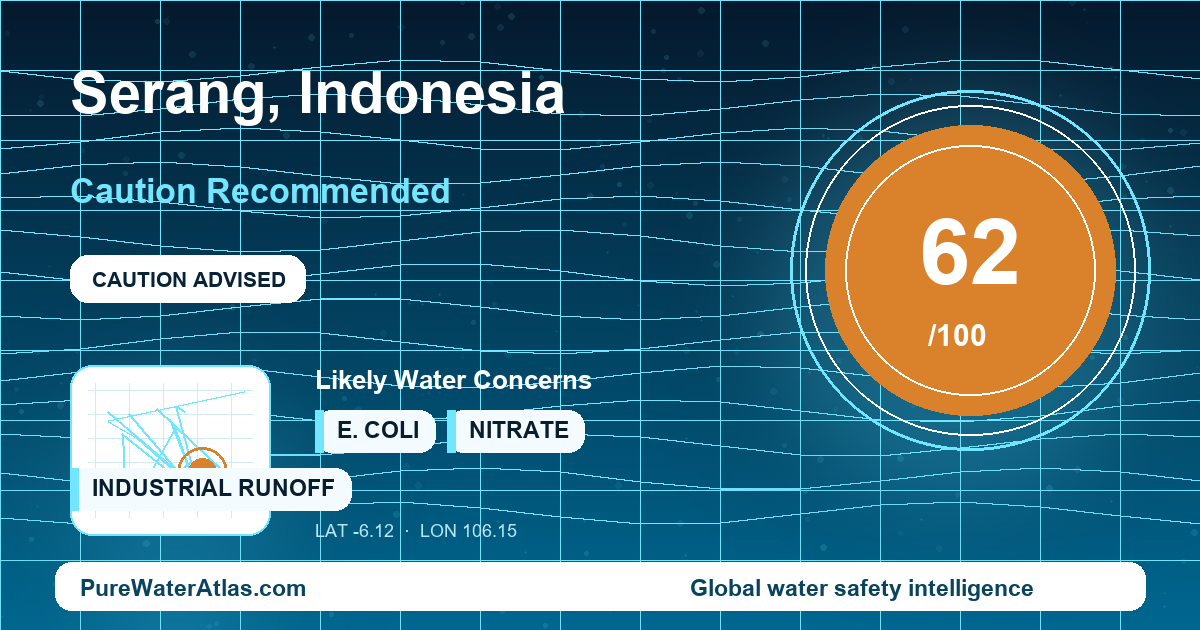
Serang, the capital of Banten Province, has a municipal piped-water utility and important raw-water infrastructure, but untreated tap water should not be assumed safe to drink at the household tap without boiling, filtration, or verification.
Quick Answer
| Water safety score | 62 / 100 |
|---|---|
| Risk level | Caution Recommended |
| Can visitors drink the tap water? | No for routine travel use. Use sealed bottled water, boiled water, or properly filtered water for drinking. |
| Resident guidance | Utility water from Perumdam Tirta Madani Kota Serang is generally a better baseline than untreated shallow wells, but household treatment and periodic testing are prudent. |
| Main local water context | Serang’s urban supply is associated with the Cibanten River basin and regional raw-water infrastructure, including the Sindangheula Dam system in Serang Regency. |
| Local authority | Perumdam Tirta Madani Kota Serang is the municipal drinking-water company serving Serang City customers. |
| Filter recommendation | For drinking and cooking, use a treatment approach matched to the source: sediment prefiltration, activated carbon, and boiling, UV, ultrafiltration, or reverse osmosis where appropriate. |
Overall verdict: Caution recommended. Serang has an official piped-water utility and recognized raw-water supply infrastructure, but recent public, address-level finished-water compliance reporting is limited. Actual safety can vary by supply source, pressure continuity, building plumbing, storage tanks, season, and whether the water is taken directly from the utility network, a well, a refill depot, or a household tank.
Why Serang Is Different
Serang is not a city where the drinking-water question can be answered by looking only at a national statistic. It is the capital city of Banten Province on western Java, with inland urban areas and lower-lying northern areas toward Banten Bay. That geography makes both river-fed raw water and local groundwater conditions relevant to household water decisions.
The city has a recognized municipal piped-water provider, Perumdam Tirta Madani Kota Serang, but many households in Indonesian cities use mixed water arrangements. A home may receive utility water, draw from a private well, store water in rooftop or ground tanks, buy refill-station water, use bottled water, or combine several of these sources. For Serang residents, the practical safety question is often not only whether water is treated by the utility, but whether it remains safe after passing through distribution pipes, pumps, building plumbing, storage tanks, and household containers.
Historically, before wider piped-water development, many households in and around Serang relied on shallow groundwater, local wells, springs, and purchased water. Those non-network sources remain important in areas with limited coverage or intermittent pressure. This is why a household connected to the municipal system and a household using a shallow well in the same city can face very different drinking-water risks.
Where Does Serang’s Tap Water Come From?
Serang’s urban water supply is associated with the Cibanten River basin and regional raw-water infrastructure in Serang Regency. The Sindangheula Dam system, developed by Indonesia’s Ministry of Public Works and Housing, has been identified as supporting raw-water supply, irrigation, and flood control benefits for the Serang area. This makes source-water reliability a specific local infrastructure issue, not just a generic national concern.
Key water infrastructure relevant to Serang includes the municipal utility network operated by Perumdam Tirta Madani Kota Serang, the Cibanten River basin surface-water system, the Sindangheula Dam in Serang Regency, and the many household-level components that affect water at the point of use. These household components include rooftop tanks, ground tanks, booster pumps, internal plumbing, refill containers, and private wells.
For households connected to the utility network, the starting point may be treated piped water. However, water quality at the kitchen tap can still be affected by intermittent distribution, low pressure, leaks, illegal connections, old internal pipes, and storage tanks. For households using private wells, the risk profile can be entirely different and may include microbial contamination, salinity indicators, nitrate, iron, manganese, turbidity, or other site-specific problems that require testing.
Who Manages Drinking Water in Serang?
Perumdam Tirta Madani Kota Serang is the local drinking-water utility for Serang City. Broader oversight involves the Serang City government, Banten provincial agencies, Indonesia’s Ministry of Health for drinking-water health standards, and the Ministry of Public Works and Housing for water-supply infrastructure.
Indonesia’s drinking-water health requirements are set nationally by the Ministry of Health, including current environmental health and drinking-water quality provisions under Permenkes No. 2 Tahun 2023. Local utilities and local health or environmental agencies are responsible for operational monitoring and implementation. However, public reporting at city, neighborhood, and household-tap scale is not always easy for consumers to access.
This page therefore does not claim that Serang tap water is universally compliant or universally unsafe. The better interpretation is caution: the city has a formal utility and identifiable raw-water infrastructure, but publicly accessible finished-water monitoring data for specific neighborhoods, residual disinfectant levels, pipe-network condition, and household storage contamination are limited. For consumers, point-of-use treatment and testing remain practical safeguards.
Main Local Water Concerns
Wet-season turbidity and runoff: Rainy-season runoff can increase turbidity, suspended sediment, microbial loading, and drainage overflow into local waterways. In a river-fed raw-water context, this can make treatment more challenging and may affect taste, color, sediment, and consumer confidence.
Microbial risks in wells and stored water: Shallow wells in dense urban or peri-urban areas may be vulnerable to septic leakage, drainage contamination, and microbial contamination, especially where sanitation or well construction is poor. Flooding or drainage backups can also contaminate shallow wells and household storage systems.
Coastal groundwater salinity: Northern and coastal lowland areas of Serang and nearby Banten Bay communities can face higher salinity risk in shallow groundwater. This concern is more relevant to private wells than to properly managed treated utility water, but residents using wells should include conductivity, TDS, chloride, or other salinity indicators in testing.
Intermittent pressure and distribution intrusion: Intermittent pressure, leaks, aging distribution components, and illegal connections can increase the chance of intrusion or post-treatment contamination in many urban water systems. Where water service is interrupted and then restored, dirty-water events or temporary turbidity should be treated cautiously.
Household tanks and internal plumbing: Rooftop and ground tanks can become major risk points if they are uncovered, rarely cleaned, or refilled during low-pressure events. Older buildings, schools, clinics, boarding houses, and rental properties may also have corroded pipes, brass fittings, solder, galvanized iron, stagnant plumbing, rust, sediment, or microbial regrowth.
Trace contaminants: There is no strong publicly available evidence that PFAS, arsenic, or lead are dominant citywide tap-water problems in Serang. However, individual wells, industrially influenced sites, and old premise plumbing cannot be ruled out without testing.
For Travelers
Short-term visitors should not drink untreated Serang tap water as a routine practice. Use sealed bottled water, boiled water, or properly filtered water for drinking. Check bottle seals, especially when buying water from small shops or roadside vendors.
For brushing teeth, risk-tolerant travelers in reputable hotels may use tap water, but cautious travelers should use bottled or boiled water. Children, pregnant travelers, elderly visitors, and immunocompromised travelers should avoid untreated tap water for brushing teeth.
Avoid ice from street vendors or small establishments unless you can confirm it was made from treated, packaged, or commercial ice. In hotels and higher-end restaurants, the risk is lower, but it is still reasonable to ask whether drinking water and ice are from packaged or filtered sources. Do not assume bathroom tap water is potable.
Hot beverages are generally safer when served boiling hot. Use boiled water for infant formula. Avoid swallowing water while showering. If gastrointestinal illness occurs, oral rehydration salts can be useful. A travel filter for Serang should address microbial risk; microfiltration or ultrafiltration plus disinfection is more appropriate than a carbon-only bottle, which is not enough for bacteria and viruses.
For Residents
For Serang residents, household treatment is often advisable for drinking and cooking, especially when water is stored, when supply is intermittent, or when the source is a private well. A practical setup for utility water may include sediment prefiltration for visible particles and activated carbon for taste, odor, and chlorine-related issues, followed by boiling, UV, ultrafiltration, or reverse osmosis depending on test results and household risk tolerance.
Private wells should be tested at least for E. coli or thermotolerant coliforms, total coliforms, nitrate, pH, conductivity or TDS, chloride or other salinity indicators, iron, manganese, turbidity, and hardness. These tests are especially important in dense urban or peri-urban areas, flood-prone locations, and northern or coastal lowland settings where shallow groundwater may be more vulnerable.
If your home uses a rooftop or ground storage tank, test water from the kitchen tap, not only from the incoming pipe. Tanks and internal plumbing can change the result. Clean and disinfect tanks regularly, keep covers sealed, prevent mosquito and animal entry, avoid cross-connections with wells, and flush tanks after dirty-water events. Stored water should not be considered safe for drinking without treatment if tank hygiene is uncertain.
After flooding, nearby septic failure, unusual odor, sudden turbidity, or long service interruptions, disinfect and flush the household system and retest before using the water untreated. If infants, pregnant people, elderly residents, or immunocompromised people live in the home, prioritize microbial testing and use boiled or appropriately filtered water until results are known.
Older buildings should be treated as a separate risk point. Even if incoming utility water is treated, premise plumbing may add metals, rust, sediment, or microbial regrowth. If the building is old or plumbing materials are unknown, consider lead and copper testing using both first-draw and flushed samples.
Relevant Contaminants and Water-Quality Issues
Serang’s most practical drinking-water concerns are tied to microbial safety, turbidity, sediment, storage, shallow wells, and seasonal changes. Learn more about turbidity in drinking water and sediment in drinking water, both of which are relevant when rainy-season runoff or pipe disturbance affects appearance and clarity.
For wells, tanks, and post-treatment contamination, E. coli in drinking water is one of the most important indicators because it points to fecal contamination and potential pathogen risk. Residents using private wells should also understand nitrate in drinking water, especially where sanitation or drainage conditions are uncertain.
Serang households may also encounter aesthetic or operational issues such as iron in drinking water, manganese in drinking water, hardness, taste, odor, or color changes. Utility customers using carbon filters should understand chlorine in drinking water, because residual disinfectant can protect water in distribution but may affect taste. In older buildings, lead in drinking water is not established as a citywide Serang problem, but premise plumbing can justify targeted testing.
How to Verify Your Water Quality
The most reliable way to answer the Serang household question is to test the water actually used for drinking. Start with the PureWaterAtlas complete guide to water testing and compare your situation with the broader drinking water safety framework.
If the main concern is bacteria, viruses, wells, tanks, or intermittent supply, review water microbiology and microbial risks. For choosing treatment after testing, use the water treatment systems guide, plus specific resources on boiling water purification and UV water purification.
For wells near sanitation or drainage risk, see nitrate testing and detection methods. For older buildings or unknown plumbing, use lead testing and detection methods. You can also explore the Global Water Quality Checker and search individual issues in the Contaminants Search Engine. Related PureWaterAtlas categories include Drinking Water Safety, Global Water Quality, Water Testing, and Water Purification.
Official and Technical Sources
- Perumdam Tirta Madani Kota Serang — official municipal drinking-water utility information for Serang City.
- Pemerintah Kota Serang — official Serang City government portal and administrative context.
- Badan Pusat Statistik Kota Serang — city-level geography, population, and household infrastructure context.
- Ministry of Public Works and Housing, Indonesia — public works information supporting the role of Sindangheula Dam and Cibanten basin infrastructure.
- Balai Besar Wilayah Sungai Cidanau Ciujung Cidurian — basin-level water-resource management context for Banten river systems.
- Ministry of Health, Indonesia: Permenkes No. 2 Tahun 2023 — national environmental health and drinking-water quality requirements.
- WHO/UNICEF Joint Monitoring Programme: Indonesia WASH data — national context on household water, sanitation, and hygiene access.
- CDC Indonesia travel health advice — safe food and water guidance for travelers.
- World Health Organization drinking-water fact sheet — public-health context on safe drinking water and microbial contamination.
Bottom Line
Serang’s tap water deserves a cautious rating rather than a simple “safe” or “unsafe” label. The city has a municipal drinking-water utility, Perumdam Tirta Madani Kota Serang, and its raw-water context includes the Cibanten River basin and Sindangheula Dam system. However, recent public neighborhood-level finished-water results are limited, and household conditions can strongly affect actual safety. Travelers should use sealed bottled, boiled, or properly filtered water. Residents should prefer treated utility water over untreated shallow wells where available, but should still test wells, maintain storage tanks, and treat drinking water when supply is intermittent, plumbing is old, or household members are medically vulnerable.
Read the full guide: Global Water Quality Guide
Explore more in this category: Global Water Quality Articles