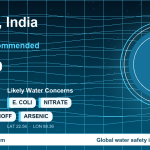
Delhi tap water safety depends not only on treatment by Delhi Jal Board, but also on intermittent distribution, local storage tanks, source mixing, and building plumbing.
Quick Answer
| Overall safety status | Caution recommended. Delhi’s treated municipal water may be potable at the treatment-plant or network level, but point-of-use safety should not be assumed without filtration, boiling, or testing. |
|---|---|
| PureWaterAtlas score | 68 / 100 — risk level: Caution Recommended |
| For travelers | Do not drink ordinary Delhi tap water directly. Use sealed bottled water, boiled water, or water from a verified hotel or restaurant purification system. |
| For residents | Use household controls: clean storage tanks, maintain filters, test at the point of use, and choose UV, UF, or RO based on actual water quality. |
| Main water sources | Yamuna-derived water, Ganga water via the Upper Ganga Canal system, Bhakra/Ravi-Beas linked canal supplies, and a smaller groundwater component. |
| Water authority | Delhi Jal Board is the primary municipal water supply and sewerage authority for the National Capital Territory of Delhi. |
| Filter recommendation | For many DJB-supplied homes with normal TDS, sediment prefiltration plus activated carbon and UV or UF may be appropriate. RO should be selected when testing indicates high TDS, salinity, nitrate, fluoride, arsenic, or other dissolved contaminants. |
Why Delhi Is Different
Delhi is not a city where tap-water safety can be judged only by asking whether a central treatment plant exists. It does: Delhi has a large formal municipal water system, major treatment plants, trunk mains, reservoirs, booster stations, and a public utility. The harder question is what reaches the glass inside a home, hotel, guesthouse, market, or apartment building.
The city lies across the Yamuna floodplain and the Delhi Ridge in a semi-arid climate with high seasonal demand. It is not self-sufficient in dependable local freshwater, so it relies heavily on inter-state raw-water allocations and canal systems linked to the Yamuna, Ganga, and Bhakra sources. That dependence makes Delhi vulnerable to raw-water variability, low-flow conditions, and operational stress when demand rises.
The most Delhi-specific risk is post-treatment variability. Intermittent supply, pressure drops, leaks near drains or sewers, unauthorized connections, old distribution lines, and poorly maintained underground or rooftop tanks can allow microbial contamination or sediment to appear after water has already left the treatment system. Many households also mix municipal water with tanker water, borewell water, or building-level stored water. Two apartments on the same street can therefore have different water quality depending on source mixing, plumbing, tank hygiene, and filtration.
Where Does Delhi’s Tap Water Come From?
Delhi’s drinking-water system is based mainly on imported and river-derived surface water, supported by a smaller groundwater component. Important raw-water sources include Yamuna water through the Wazirabad and related intake system, Ganga water brought through the Upper Ganga Canal system for eastern and southern Delhi treatment plants, Bhakra/Ravi-Beas system water conveyed through inter-state canal arrangements, and local groundwater from tubewells and Ranney wells where available.
Major Delhi Jal Board water treatment plants include Wazirabad, Chandrawal, Haiderpur, Bhagirathi, Sonia Vihar, Nangloi, Bawana, and Okhla. These plants form the backbone of treated surface-water supply. The Wazirabad pond and upstream Yamuna canal systems are especially critical raw-water points. When upstream flow is low or pollution loads rise, treatment operations can be challenged, including during ammonia episodes in Yamuna raw water.
The Upper Ganga Canal and Muradnagar conveyance system are also important because they carry Ganga water to treatment plants including Sonia Vihar and Bhagirathi. After treatment, water moves through trunk mains, zonal reservoirs, underground reservoirs, overhead tanks, booster pumping stations, local household tanks, and private building plumbing. Each stage can affect what arrives at the tap.
Historically, Delhi relied on the Yamuna River, wells, stepwells, tanks, and local groundwater. Modern Delhi outgrew those local sources, and parts of local groundwater are saline or otherwise quality-constrained. Groundwater is still used through DJB and private borewells in some areas, but its quality and legality of extraction vary. It should not be generalized as safe without testing.
Who Manages Drinking Water in Delhi?
Delhi Jal Board is the primary municipal water supply and sewerage authority for the National Capital Territory of Delhi. Its role includes municipal treatment and distribution, but Delhi’s water-quality picture also involves source-water pollution, groundwater quality, building-level storage, and private treatment practices.
Drinking-water quality in India is generally benchmarked against BIS IS 10500 drinking-water standards, available through the Bureau of Indian Standards. Source-water and environmental oversight involve institutions such as the Central Pollution Control Board, the Delhi Pollution Control Committee, and the Central Ground Water Board. These institutions are relevant to the Yamuna, drains, groundwater, and environmental conditions that influence drinking-water risk.
However, there is an important data limitation: public, current, ward-by-ward point-of-tap results are not uniformly available for every neighborhood, hotel, household, borewell, tanker supply, or apartment storage system. Delhi has documented utility infrastructure and known raw-water sources, but those facts do not certify every individual tap. Point-of-use testing remains important.
Main Local Water Concerns
- Microbial contamination after treatment: Intermittent supply, pressure loss, leaks, storage tanks, and unsafe handling can create risk even when centrally treated water is adequate.
- Turbidity, sediment, and discoloration: These can occur during monsoon runoff, pipe repairs, pressure changes, or reservoir and tank cleaning events.
- Yamuna raw-water stress: Low-flow and pollution events can contribute to ammonia episodes and treatment challenges at raw-water intakes.
- Groundwater variability: In parts of Delhi, groundwater can be brackish or high in total dissolved solids. Localized concerns may include nitrate, fluoride, iron, manganese, and salinity depending on aquifer and location.
- Premise-plumbing metals: Lead is not the defining citywide contaminant, but older building plumbing, brass fixtures, solder, pumps, fittings, and stagnant water can contribute lead or other metals in individual buildings.
- Chlorine taste or odor: Residual chlorine is used to protect treated water in a long and complex distribution network, so some taste or odor may occur.
- Tanker and borewell uncertainty: Tanker water and private borewell water are more variable than treated municipal supply and should be treated as unverified unless tested.
Season also matters. Monsoon rains can increase raw-water turbidity, surface runoff, sewer overflow risk, and contamination risk in low-lying or flood-affected areas. Summer heat increases demand, storage time, low-pressure risk, and the chance of intermittent supply. After flooding, major pipe repair, reservoir cleaning, or a long supply interruption, assume elevated microbial risk until water runs clear and is disinfected or tested.
For Travelers
For most travelers, the practical answer is no: do not drink unfiltered Delhi tap water directly. This is not a claim that all municipal water is untreated or unsafe everywhere. It is a caution about point-of-use reliability in a city where storage tanks, plumbing, local pressure, and source mixing can vary widely.
Use sealed bottled water, boiled water, or water from a credible purification system. Check bottle seals and avoid refilled bottles. In reputable hotels, ask whether drinking water and ice are produced by RO, UV, or another maintained purification system. In smaller guesthouses, do not assume bathroom tap water is drinkable.
Visitors with sensitive stomachs, children, pregnant travelers, and immunocompromised people should use bottled, boiled, or reliably filtered water for brushing teeth. Avoid ice from street vendors or uncertain sources. Ice in higher-end hotels and reputable restaurants is often made from filtered water, but ask if unsure.
Delhi’s heat also changes the practical risk calculation. Carry sealed water in hot weather, use safe water for oral rehydration salts and infant formula, and use boiled or filtered water during stomach illness, local flooding, or supply-disruption periods. If you are highly vulnerable, avoid swallowing water while showering.
For Residents
A household treatment barrier is strongly advisable for most Delhi homes. For treated Delhi Jal Board water with normal TDS, many households may be well served by a sediment prefilter, activated carbon, and UV or UF, provided the system is maintained. UV can be a useful microbial barrier where water is already reasonably clear; see the PureWaterAtlas UV Water Purification Guide. Boiling remains a practical short-term option during supply interruptions or suspected microbial contamination; see Boiling Water Purification: Complete Guide.
RO should not be chosen automatically. It is appropriate when testing confirms high TDS, salinity, nitrate, fluoride, arsenic, or other dissolved contaminants. Unnecessary RO use wastes water and can strip minerals. If your household uses borewell or tanker water, testing is especially important because taste and clarity do not prove safety.
Residents should test at the point of use, not only at the building inlet. At minimum, consider total coliform and E. coli, turbidity, pH, TDS or electrical conductivity, residual chlorine, hardness, nitrate, fluoride, chloride, iron, and manganese. In old buildings or homes with unknown plumbing, brass fixtures, pumps, or long stagnation times, test first-draw and flushed samples for lead and other metals. If using borewell or tanker water, add arsenic and broader metals screening where feasible.
Old buildings can introduce risk even when utility water is adequately treated. Corroded galvanized iron pipes, old valves, brass fittings, pump connections, rooftop tank plumbing, and stagnant internal pipes can add rust, sediment, metals, or microbial contamination. Flush stagnant water before drinking or cooking, especially where children or pregnant people live.
Storage tanks are one of the most important Delhi-specific control points. Underground and overhead tanks should be covered, screened, cleaned, and disinfected on a regular schedule, commonly every 3 to 6 months, or sooner after flooding, repairs, contamination, visible slime, or heavy sediment. A good filter cannot fully compensate for a dirty storage tank.
Relevant Contaminants and Water-Quality Issues
Delhi’s most practical drinking-water concerns are closely tied to microbial risk, turbidity, sediment, groundwater chemistry, and premise plumbing. For post-treatment contamination from intermittent supply and storage tanks, start with E. coli in Drinking Water and the broader PureWaterAtlas guide to Water Microbiology.
For monsoon runoff, cloudy water, pipe disturbances, and reservoir or tank-cleaning events, see Turbidity in Drinking Water and Sediment in Drinking Water. For disinfectant taste and odor, see Chlorine in Drinking Water.
Where borewell water, tanker water, or groundwater influence is suspected, Nitrate in Drinking Water is especially relevant, along with Nitrate Contamination in Drinking Water: Testing and Detection Methods. In older buildings, use Lead in Drinking Water and Lead in Drinking Water: Testing and Detection Methods to plan first-draw and flushed sampling.
How to Verify Your Water Quality
The most reliable way to decide whether Delhi tap water is safe in your specific home or building is to test the water you actually drink. Use a NABL-accredited laboratory or a government-recognized water testing facility where possible. Home kits can help screen for simple indicators, but they should not be treated as confirmation of microbiological safety or trace metals.
Retest after flooding, sewer work, pipeline repair, new borewell installation, major change in taste or smell, unexplained illness clusters, repeated sediment episodes, or a long supply interruption. Test both first-draw and flushed samples if metals from plumbing are a concern.
For a step-by-step testing framework, use the PureWaterAtlas Water Testing Guide. For choosing treatment, compare sediment filtration, carbon, UV, UF, and RO in Water Treatment Systems. To compare Delhi with other destinations, use the Global Water Quality Checker. If your lab report lists a contaminant you do not recognize, search the PureWaterAtlas Contaminants Search Engine. For general decision-making, see Drinking Water Safety.
Official and Technical Sources
- Delhi Jal Board official website — primary municipal authority for Delhi water supply and sewerage.
- Government of NCT of Delhi, Economic Survey of Delhi 2023-24 — official context on water supply, external raw-water dependence, treatment infrastructure, and urban service pressures.
- Central Pollution Control Board, Water Quality Criteria — national surface-water quality criteria relevant to rivers and source-water management.
- Central Pollution Control Board, National Water Quality Monitoring Programme — national monitoring data and water-quality information for surface-water context.
- Delhi Pollution Control Committee — local environmental regulator relevant to pollution control, drains, and Delhi water bodies.
- Central Ground Water Board — groundwater occurrence and quality information, including salinity and localized chemical concerns.
- Bureau of Indian Standards — official portal for BIS IS 10500 drinking-water specification access and updates.
- World Health Organization: Water, sanitation, hygiene, water safety and quality — public-health guidance on drinking-water safety and microbial risk.
Bottom Line
Delhi has a major formal water system operated by Delhi Jal Board and supplied from Yamuna, Ganga, Bhakra-linked, and limited groundwater sources. The concern is not that all municipal water is untreated, but that safety at the tap can vary after treatment because of intermittent supply, pressure loss, leaks, old plumbing, tanker or borewell mixing, and underground or rooftop storage tanks. Travelers should avoid drinking ordinary tap water unless it is boiled or reliably filtered. Residents should maintain storage tanks, use appropriate filtration, and test point-of-use water, especially after flooding, repairs, taste or odor changes, sediment events, or when using borewell or tanker water.
Read the full guide: Global Water Quality Guide
Explore more in this category: Global Water Quality Articles