Moscow tap water is supplied by a large treated surface-water system serving the Russian capital, but the water at an individual kitchen tap can depend heavily on apartment-block plumbing, pipe age, stagnation, and current local notices.
Quick Answer
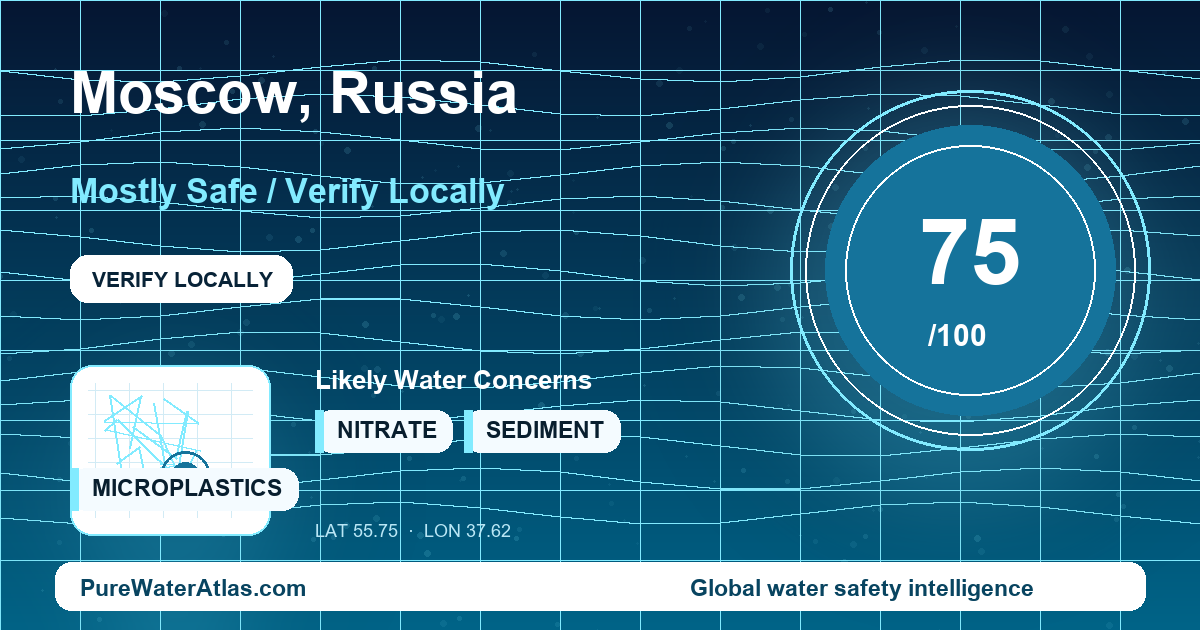
| Safety status | Mostly Safe / Verify Locally. PureWaterAtlas score: 75/100. Moscow has a centralized, professionally operated drinking-water system, but building-level plumbing can change the quality experienced at the tap. |
|---|---|
| Can tourists drink it? | Healthy adults in modern central hotels or well-maintained apartments can usually use cold tap water for brushing teeth and hot drinks after boiling. For direct drinking, bottled water is a conservative choice, especially in older buildings or rentals. |
| Resident guidance | Treat utility water as generally usable, but verify at the apartment tap if water is rusty, cloudy, metallic-tasting, stagnant, or affected by plumbing work. |
| Main water source | Primarily treated surface water from the Moskva River basin and Volga basin source systems, including reservoirs and canals. |
| Water authority | Mosvodokanal JSC, with sanitary oversight by Rospotrebnadzor and its Moscow office. |
| Filter recommendation | A certified activated-carbon filter is reasonable for chlorine taste, odor, and some organic compounds. Use reverse osmosis or targeted treatment only after testing confirms a specific issue such as metals, nitrate, or unusual dissolved solids. |
Why Moscow Is Different
Moscow is not a city where tap-water safety can be judged only by looking at the urban stretch of the Moskva River. The modern capital is supplied through a regional reservoir-and-canal system tied to both the Moskva River basin and the Volga basin. Official Mosvodokanal materials describe the city’s source-water structure through the Moskvoretsko-Vazuzskaya and Volzhskaya water-source systems, rather than one simple river intake.
This matters because the treated water leaving a Moscow water treatment station is only one part of the safety picture. The water delivered through the municipal network may be adequately treated and disinfected, while the water coming from a particular kitchen tap may still be affected by old internal risers, galvanized or corroded pipe, fixtures, repair history, stagnant sections in large apartment blocks, or building pressure equipment. Moscow’s many Soviet-era apartment buildings, renovated historic properties, large hotels, and private rentals can therefore have different point-of-use conditions even when they are connected to the same central supply.
A particularly important Moscow-specific distinction is cold tap water versus centralized hot water. Residents and visitors should use only cold tap water for drinking or cooking, ideally after brief flushing if it has been sitting overnight. Centralized hot water from district heating or building systems is not intended for drinking.
Where Does Moscow’s Tap Water Come From?
Moscow’s drinking water is mainly treated surface water drawn from two engineered source-water systems: the Moskva River basin system and the Volga basin system. Historically, Moscow developed around the Moskva River, but the modern megacity depends on a much larger regulated water system. Volga-basin water reaches Moscow through the Moscow Canal and associated reservoirs, while the Moskva River basin and Vazuzskaya system provide additional regulated source water.
This regional design helps buffer local shortages and supports a population far larger than the natural local river could reliably supply on its own. It also means raw-water quality can be influenced by upstream catchment conditions, reservoirs, snowmelt, runoff, and seasonal biological activity. Spring snowmelt can increase color, turbidity, and natural organic matter in source waters. Heavy rainfall can increase stormwater and catchment runoff. Warm-season reservoir conditions can contribute to biological activity and taste-and-odor challenges. These are treatment-demand issues, not automatic evidence that finished tap water is unsafe.
Key Moscow water infrastructure includes Mosvodokanal’s major surface-water intakes, the Moscow Canal and upstream reservoirs, extensive distribution mains, and large treatment stations identified in official materials as Rublevskaya, Severnaya, Vostochnaya, and Zapadnaya water treatment stations. Treatment processes described for the system include coagulation, clarification, filtration, and disinfection, with advanced processes such as ozonation, activated-carbon sorption, or membrane-related upgrades reported for parts of the system.
Who Manages Drinking Water in Moscow?
The principal drinking-water utility for Moscow is Mosvodokanal JSC, the municipal water and wastewater enterprise responsible for centralized water supply and wastewater services in the city. Mosvodokanal publishes consumer-facing water-quality information and infrastructure information about water supply and treatment.
Drinking-water quality is regulated under Russian sanitary rules and hygienic standards, with public-health oversight by Rospotrebnadzor and the Rospotrebnadzor Moscow office. The Moscow city government portal may also publish public-service or emergency information relevant to infrastructure events.
The main data limitation is point-of-use visibility. Moscow has identifiable official sources for the utility, treatment infrastructure, and public-health oversight, but open data do not reliably show what is happening at every apartment tap. Detailed English-language access to current compliance tables, incident history, emerging-contaminant data, and building-by-building plumbing conditions is limited. For that reason, this profile treats the central supply as generally treated and professionally managed, while recommending local verification where visible water-quality issues or vulnerable users are involved.
Main Local Water Concerns
The most common Moscow concern for visitors is taste rather than immediate evidence of unsafe central treatment. Disinfected water can have a noticeable chlorine or disinfectant odor, especially to people accustomed to a different water profile or to water that has been stagnant in building pipes. Learn more about this issue in the PureWaterAtlas guide to chlorine in drinking water.
Rust-colored water, sediment, or metallic taste is more building-specific. Aging internal pipes, old fixtures, recent pipe work, pressure changes, flushing, or main breaks can release corrosion products and particles. Cloudiness that does not clear, visible brown water, black particles, staining, or a persistent metallic taste should not be ignored. These conditions can be related to sediment, iron, manganese, or other plumbing-related issues.
Lead should be handled carefully: Moscow should not be described as having a confirmed citywide lead problem based on this dataset. However, older building plumbing, solder, fixtures, or service components can create a possible point-of-use metals risk. If the building is old, recently renovated, or has recurring discoloration, testing is the correct way to evaluate lead in drinking water.
Microbial risk is usually most relevant after the water leaves the public main: building storage tanks, dead-end pipe sections, poorly maintained filters, pressure losses, outages, and private plumbing can all affect microbiological quality. If there has been a recent outage or storage-tank concern, treat unusual odor, particles, or slime as a reason to verify before drinking. See PureWaterAtlas background on E. coli in drinking water and water microbiology.
For Travelers
For healthy adults staying in modern hotels or well-maintained central apartments, Moscow cold tap water is generally treated and may be drinkable. In practice, many visitors still choose bottled water for direct drinking because of taste, unfamiliar mineral profile, and uncertainty about building plumbing. Bottled water is the more conservative choice for people with sensitive stomachs, infants, pregnant travelers, immunocompromised travelers, or anyone staying in an old building or rental with visibly rusty water.
Use cold tap water, not centralized hot tap water. Let the cold tap run briefly after overnight stagnation. Boiling tap water for tea, coffee, or extra caution is a reasonable step for travelers; however, boiling is mainly a microbial precaution and does not remove metals or sediment. For more detail, see Boiling Water Purification: Complete Guide.
Brushing teeth with cold tap water is usually reasonable in central hotels and maintained apartments. Use bottled water for infants, immunocompromised travelers, or if the tap water is brown, cloudy after settling, has a strong unusual odor, or the building has posted maintenance notices.
In reputable hotels, restaurants, and cafes, ice is usually a lower concern because plumbing maintenance and water-handling practices are more likely to be managed. Cautious travelers should avoid ice from informal venues, unknown rentals, or places where hygiene is uncertain. Large hotels and established restaurants are generally safer than unknown private rentals, but ask staff about recent water outages or pipe work if water appears rusty or cloudy.
For Residents
Moscow residents should think in two layers: the city supply and the apartment tap. The centralized supply is treated and disinfected, but actual tap quality can be affected by building risers, internal plumbing age, pressure equipment, stagnant sections, filters, or local storage. If your building has recurring rusty water, black particles, fixture staining, low-pressure events, or a metallic taste, do not rely only on the utility’s general citywide information.
A home filter is not automatically required for every residence. For many apartments, a certified activated-carbon filter is a practical first step to improve chlorine taste, odor, and some organic compounds. If testing identifies specific metals or unusual dissolved solids, a more targeted system such as reverse osmosis may be appropriate. Choose equipment based on results rather than assumptions; the PureWaterAtlas guide to water treatment systems explains this decision process.
Testing is sensible in older buildings, recently renovated apartments, homes with recurring discoloration, or after major plumbing replacement, riser work, prolonged vacancy, pressure losses, or water-main incidents. A useful test panel at the kitchen cold-water tap can include lead, iron, manganese, copper, turbidity, color, odor, pH, hardness, and basic microbiology if outages or tank concerns have occurred. For plumbing metals, collect both first-draw and flushed samples, because first-draw water can reveal stagnation-related leaching. Use a certified laboratory rather than relying only on taste or inexpensive visual strips for metals.
If your building uses local storage, booster pumps, dead-end pipe sections, or poorly maintained filters, water can deteriorate after it leaves the public main. Ask the building manager about tank cleaning, pump maintenance, and recent outages if you notice odor, particles, slime, or recurring low pressure.
Relevant Contaminants and Water-Quality Issues
For Moscow, the most relevant PureWaterAtlas contaminant profiles are those connected to disinfected surface water, seasonal turbidity, and building plumbing. Start with chlorine for taste and odor, turbidity for cloudy water and runoff-related treatment demand, and sediment for particles released during pipe work or from aging internal plumbing.
For older apartments or renovated buildings, review lead, iron, manganese, and the article Lead in Drinking Water: Testing and Detection Methods. If testing confirms lead or another plumbing-related metal concern, compare options in Lead in Drinking Water: Best Filters, Systems and Solutions.
Emerging contaminants require caution in interpretation. This dataset does not establish a confirmed Moscow tap-water problem for PFAS or microplastics, but it also notes limited independent public data. Readers who want to understand the data gap can review PFAS in drinking water and PFAS testing and detection methods.
How to Verify Your Water Quality
First, check official notices from Mosvodokanal water-quality information, Rospotrebnadzor Moscow, and the Moscow city government portal. This is especially important after visible discoloration, local maintenance, pressure loss, or suspected building-wide issues.
Second, evaluate the water at the point of use. If the cold water clears after brief flushing and there are no notices or odors, risk is usually lower. If it remains brown, cloudy, metallic, strongly odorous, or particle-laden, avoid drinking it until verified. The PureWaterAtlas guide How to Test Drinking Water explains sampling and lab selection. Use the Contaminants Search Engine to look up specific issues and the Global Water Quality Checker to compare Moscow with other destinations. For broader decision-making, see Drinking Water Safety and Global Water Quality.
Official and Technical Sources
- Mosvodokanal official website — Moscow’s centralized water-supply and wastewater utility.
- Mosvodokanal water quality information — consumer-facing water-quality and monitoring context.
- Mosvodokanal water supply and treatment information — source systems and treatment infrastructure.
- Rospotrebnadzor — Russian public-health and sanitary oversight authority.
- Rospotrebnadzor Moscow office — city-level public-health and consumer protection information.
- Moscow city government official portal — municipal public-service and emergency information.
- World Health Organization drinking-water fact sheet — general drinking-water safety principles.
- CDC Travelers’ Health: Russia — conservative traveler health context.
- WHO/UNICEF Joint Monitoring Programme — country-level water and sanitation context, not a substitute for Moscow tap testing.
Bottom Line
Moscow tap water comes from a large treated surface-water system drawing on the Moskva and Volga basin source systems, and the central supply is professionally managed by Mosvodokanal under Russian sanitary oversight. For many healthy adults in modern hotels or well-maintained apartments, cold tap water is usable, especially for brushing teeth and hot drinks after boiling. The main uncertainty is the tap itself: old apartment plumbing, stagnant internal pipes, storage or booster equipment, repairs, and discoloration can create building-specific risks. Use only cold tap water, flush after stagnation, avoid drinking centralized hot water, and switch to bottled water if water is rusty, cloudy, strongly odorous, or needed for vulnerable people. Residents in older buildings should consider certified lab testing and choose filters based on results.
Read the full guide: Global Water Quality Guide
Explore more in this category: Global Water Quality Articles