Seoul’s Arisu tap water is a treated Han River municipal supply that is generally reliable, but the safety of the water at an individual tap depends heavily on building plumbing, storage tanks, stagnation, and localized maintenance conditions.
Quick Answer
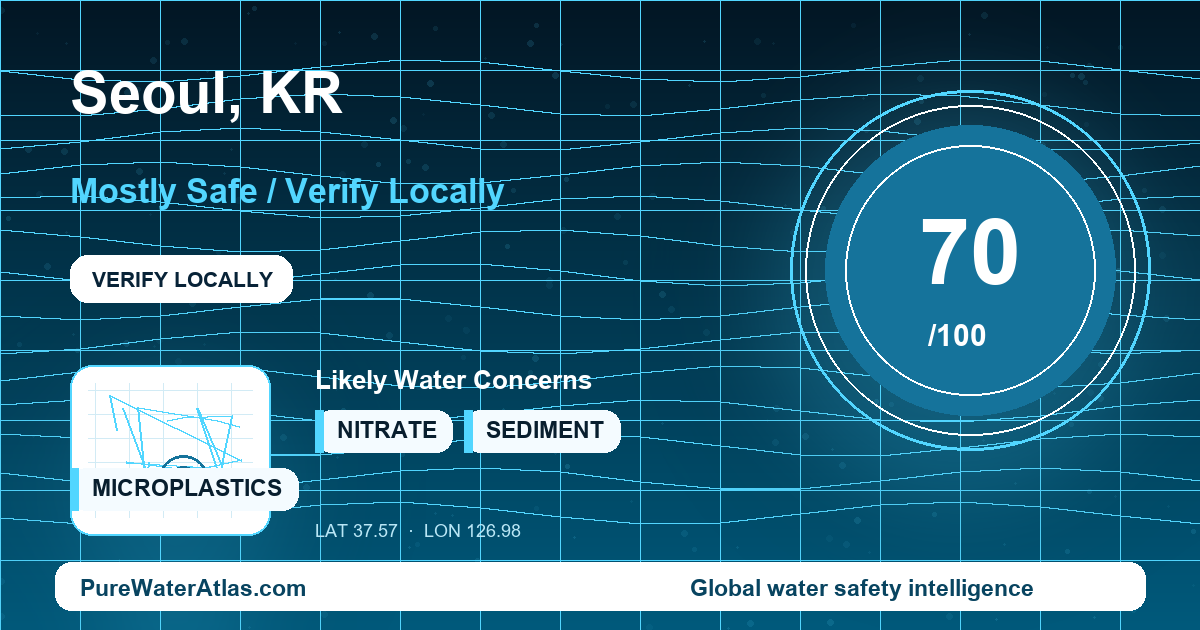
| Overall status | Mostly safe / verify locally. Seoul’s centrally supplied tap water, branded Arisu, is generally treated and monitored as a municipal surface-water supply. The main uncertainty is not usually the treatment plant, but what happens inside buildings before the water reaches the tap. |
|---|---|
| Water safety score | 70 / 100 |
| Can visitors drink it? | Usually yes in modern hotels, restaurants, airports, transit hubs, and newer buildings. Use bottled water or a certified point-of-use filter if staying in an older guesthouse, basement unit, very old building, or any place with questionable storage tanks or visible water-quality problems. |
| Resident guidance | Residents should treat the municipal supply as a reliable starting point, then verify the “last meters”: building age, internal pipe condition, water-tank maintenance, recurring discoloration, metallic taste, sediment, and stagnation after absence. |
| Main source | Primarily treated surface water from the Han River system, including raw-water sources associated with the Paldang and Jamsil sections of the river system. |
| Water authority | Seoul Metropolitan Government, Office of Waterworks, which operates and communicates about Seoul tap water under the Arisu brand. |
| Filter recommendation | A filter is not automatically required everywhere in Seoul. Use activated carbon for chlorine taste and odor, particulate filtration for rust or sediment, and a certified lead-reduction filter if older plumbing or test results indicate lead risk. |
Why Seoul Is Different
Seoul is not a city where the main drinking-water question is simply “treated or untreated.” The city has a large centralized waterworks system and a named public tap-water brand, Arisu. Its raw water comes from the Han River basin and is processed through major purification infrastructure before distribution. That makes Seoul very different from places where travelers must assume that municipal tap water is untreated or unreliable.
The practical issue in Seoul is more local and building-specific. A guest in a modern hotel connected to well-maintained plumbing has a different risk profile from someone staying in an older villa, officetel, basement accommodation, guesthouse, or apartment building with aged internal pipes or an infrequently cleaned rooftop or underground water tank. Citywide water quality reports and Arisu public information can describe the municipal system, but they cannot prove the condition of every faucet, fixture, storage tank, or internal pipe.
Seoul also has a public-trust gap around tap water. The city has promoted Arisu, public water-quality information, household inspection programs, and tap-water communication, yet many locals still prefer bottled or filtered water for taste, habit, or confidence reasons. For travelers, that can be confusing: seeing locals choose bottled water does not automatically mean the city supply is unsafe, but it does show why building-level verification and personal tolerance for taste and odor matter.
Where Does Seoul’s Tap Water Come From?
Seoul’s municipal drinking water is primarily treated surface water from the Han River system. The Han River runs through the city and is central to Seoul’s water identity. Raw water is drawn from the Han River basin through major intake and conveyance infrastructure, including sources associated with the Paldang and Jamsil sections of the river system, then purified before entering the distribution network.
The city’s modern public waterworks developed around the Han River, and the Ttukdo area is historically important in Seoul’s water-supply history. Seoul identifies Ttukdo as an early modern water purification site. The basic dependence on the Han River remains, but the treatment, monitoring, and distribution system has been modernized over time.
Key infrastructure includes the Arisu municipal drinking-water system, major Han River raw-water intakes, water purification centers, distribution reservoirs, pumping stations, transmission mains, neighborhood distribution pipes, and finally building-level plumbing. Seoul’s purification centers commonly identified by the city include facilities such as Ttukdo, Guui, Amsa, Yeongdeungpo, Gangbuk, and Gwangam. Once treated water leaves the municipal network, the quality at the glass can still be affected by private or building-managed components such as service lines, internal apartment pipes, faucets, and storage tanks.
Who Manages Drinking Water in Seoul?
Seoul’s tap water is managed locally by the Seoul Metropolitan Government Office of Waterworks, which operates and communicates about the municipal supply under the Arisu brand. This authority is responsible for production, distribution, monitoring, customer communication, and public information about Seoul’s drinking-water system.
Nationally, drinking water in South Korea is regulated under the Ministry of Environment and related water supply and drinking-water laws and standards. This national context is important because Seoul’s municipal system operates within South Korean drinking-water regulation, not as an unregulated local service.
However, one limitation matters for anyone making a tap-level decision: official city and national information cannot fully capture conditions inside every building. Older internal plumbing, stagnant water, private storage tanks, solder, fixtures, and building maintenance practices may change water quality after the water has left the municipal system. Publicly available English information may also be less detailed than Korean-language official pages, and current neighborhood-level incidents require checking Seoul Waterworks notices or contacting the building manager or waterworks authority directly.
Main Local Water Concerns
The main Seoul-specific concerns are not the same as in a city without centralized treatment. They are mostly about source-water pressures that treatment must manage, and building-level conditions after treatment.
- Premise plumbing: Older building pipes, service materials, fixtures, or solder can contribute metals, rust, sediment, discoloration, or metallic taste even when water leaving treatment facilities is acceptable.
- Storage tanks: Some buildings may use rooftop or underground tanks. If tanks are poorly maintained, they can introduce sediment, taste, odor, or microbial concerns after the water has already passed through the municipal system.
- Chlorine taste and odor: Residual chlorine can be noticeable in Seoul tap water. This is usually a sign of disinfection, not automatically a health hazard, but it is a common reason residents or visitors prefer filtered water.
- Turbidity and sediment: Short-term cloudiness, particles, brown water, or sediment may occur after water-main work, plumbing repairs, pressure changes, firefighting flows, or stagnant water being flushed from internal pipes.
- Seasonal Han River pressures: Summer monsoon rains can increase turbidity and runoff in the Han River basin. Warm months can increase algae and taste-and-odor pressures in surface-water sources, requiring treatment adjustment and monitoring.
- Lead risk: Lead is not best judged by citywide averages. It depends on the specific building’s service materials, fixtures, solder, and internal plumbing. First-draw testing is more useful for identifying stagnant-water exposure at a particular tap.
For Travelers
Drinking: Most short-term visitors in modern Seoul hotels, established restaurants, airports, transit hubs, and newer buildings can usually drink tap water. If you are highly cautious, immunocompromised, traveling with infants, or staying in an older or poorly maintained accommodation, bottled water or a certified point-of-use filter is a reasonable precaution.
Brushing teeth: Tap water is generally acceptable for brushing teeth in Seoul. If the water is visibly discolored, contains sediment, comes from a questionable storage tank, or the accommodation tells you not to drink it, use bottled water until the issue is clarified.
Ice: Ice from established restaurants, cafes, hotels, and convenience stores is generally low concern because it is usually made from treated water or commercial ice. Avoid ice in unhygienic street settings or places where water handling is unclear.
Hotels and restaurants: Modern hotels and major restaurants usually have reliable treated municipal water, although many serve filtered or bottled water because of taste preferences and customer expectations. In older guesthouses or small buildings, ask whether the drinking water is direct tap, filtered, or supplied through a storage tank if you have health concerns.
On arrival: Run the cold tap for 30 to 60 seconds if the water has been standing, especially in older accommodation. Do not drink hot tap water. If water is brown, cloudy after settling, metallic, or has visible particles, report it to the host or building manager and use bottled water while the plumbing is checked.
For Residents
For Seoul residents, the key decision is not whether every household automatically needs a filter. The better question is: what problem are you trying to solve at your specific tap?
An activated carbon filter can help with chlorine taste and odor. A certified particulate filter can help with rust and sediment. If older plumbing, unknown service materials, or testing suggests lead risk, use a filter certified for lead reduction rather than a generic taste filter. PureWaterAtlas explains broader selection principles in Water Treatment Systems.
Residents in older apartments, villas, officetels, basement units, or buildings with unknown pipe materials should consider testing if there are recurring taste, odor, discoloration, sediment, or metallic issues. Useful parameters may include lead, copper, iron, turbidity, residual chlorine, pH, and general microbiological indicators where tank or hygiene concerns exist.
Use both first-draw and flushed samples when investigating plumbing metals. A first-draw sample helps identify water that has been stagnant inside household plumbing, while a flushed sample helps distinguish building plumbing from incoming municipal water. After pipe repairs, nearby construction, or a long absence, flush cold water until temperature and appearance stabilize before using it for drinking or cooking.
If your building uses rooftop or underground storage tanks, ask the building manager for tank cleaning and inspection records. Poorly maintained tanks can create sediment, odor, taste, or microbial concerns after municipal treatment. Infants, pregnant residents, and immunocompromised people should not rely on appearance or taste alone; use official test results, laboratory testing, or an appropriate certified treatment device if there is uncertainty.
Relevant Contaminants and Water-Quality Issues
Several PureWaterAtlas contaminant profiles are especially relevant to Seoul because they connect directly to the city’s known practical issues.
- Chlorine in Drinking Water: relevant because residual chlorine taste and odor are common reasons people avoid otherwise treated municipal water.
- Turbidity in Drinking Water: relevant to Han River source-water changes during heavy rain and to localized pipe disturbance.
- Sediment in Drinking Water: relevant to older building plumbing, water tanks, and temporary discoloration after pipe work.
- Lead in Drinking Water: relevant as a premise-plumbing concern, especially in older buildings or where pipe materials are unknown.
- E. coli in Drinking Water: relevant for understanding why storage-tank maintenance and microbiological testing matter even in cities with treated water.
For deeper lead-specific guidance, see Lead in Drinking Water: Testing and Detection Methods and Lead in Drinking Water: Best Filters, Systems and Solutions. Travelers considering emergency treatment should also understand the limits of boiling: boiling can address many microbial concerns, but it does not remove metals or sediment.
How to Verify Your Water Quality
Start with official Seoul Waterworks or Arisu information for your district and any current notices. If the issue appears only at your building or faucet, treat it as a premise-plumbing investigation rather than assuming a citywide problem.
For structured decision-making, use the PureWaterAtlas Drinking Water Safety guide and the Water Testing guide. To compare Seoul with other destinations, use the Global Water Quality Checker. To look up specific issues such as chlorine, turbidity, lead, sediment, and microbial indicators, use the Contaminants Search Engine.
Related PureWaterAtlas hubs include Global Water Quality, Drinking Water Safety, Water Testing, and Water Contamination.
Official and Technical Sources
- Seoul Arisu official website — Seoul Metropolitan Government Office of Waterworks.
- Seoul Metropolitan Government English information — city public information, including environmental and waterworks policy pages when available.
- Office of Waterworks, Seoul Metropolitan Government — local authority information on the Arisu system; page structure may redirect.
- Water supply and drinking water policy — Ministry of Environment, Republic of Korea.
- Water Supply and Waterworks Installation Act information — Korea Law Translation Center.
- Drinking Water Management Act information — Korea Law Translation Center.
- Hangang River Basin Environmental Office — Ministry of Environment, Republic of Korea.
- Korea Water Resources Corporation — national water-resources and Han River basin context.
- WHO Guidelines for Drinking-water Quality — international benchmark for interpreting drinking-water risks.
- CDC Yellow Book: Water Disinfection for Travelers — traveler-focused guidance on boiling, filtration, and bottled water decisions.
Bottom Line
Seoul tap water is generally a treated municipal Han River supply, distributed as Arisu and managed by the Seoul Metropolitan Government Office of Waterworks. For most visitors in modern hotels, restaurants, airports, and newer buildings, it is usually acceptable for drinking and brushing teeth. The main reasons to verify locally are older internal plumbing, storage tanks, stagnation, visible discoloration, sediment, metallic taste, or unusual odor. Residents should not assume every concern is citywide; many Seoul tap issues are building-specific. Check official Arisu information, ask about tank maintenance where relevant, flush stagnant cold water, and test if you live in older housing or have vulnerable household members.
Read the full guide: Global Water Quality Guide
Explore more in this category: Global Water Quality Articles