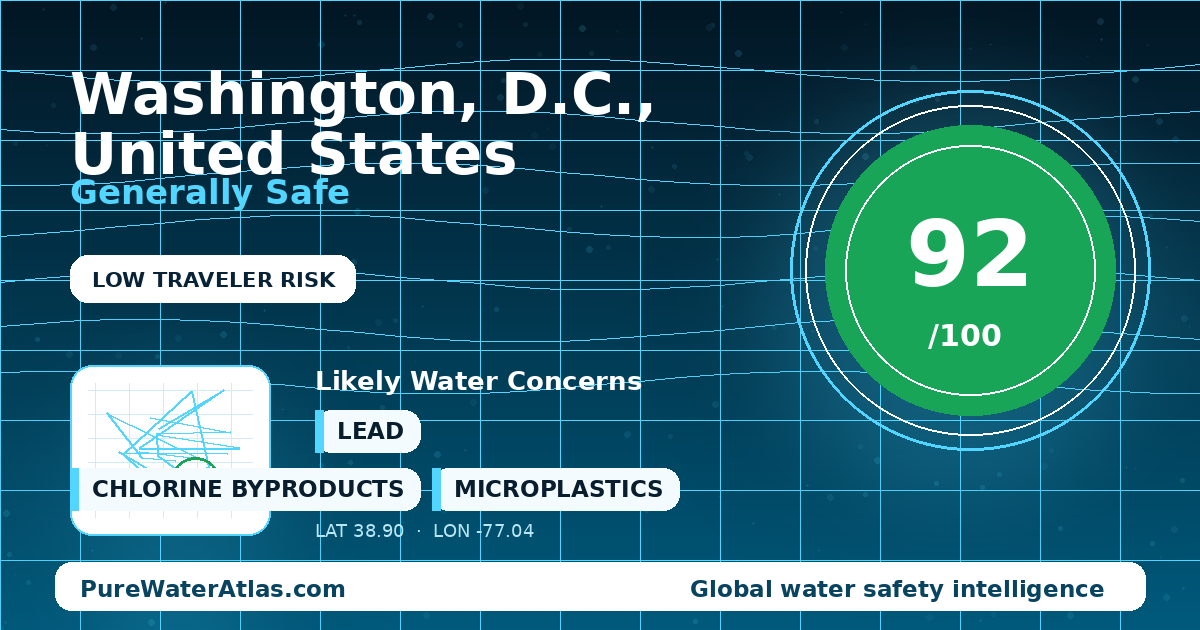
Washington, D.C.’s municipal drinking water comes from the Potomac River, is treated by the U.S. Army Corps of Engineers’ Washington Aqueduct, and is distributed by DC Water. The latest official report, covering 2025, says sampled water met all federal drinking-water standards. That is strong evidence for the public system, but it is not a guarantee about every faucet. The District still has many lead or potentially lead-bearing service lines, and water quality can change inside older homes, hotels, offices, and apartment buildings.
For most people, the practical conclusion is that Washington tap water is ordinarily suitable for drinking. The main qualification is property-specific plumbing. A compliant citywide result describes the monitored system overall; it cannot establish the material of a particular service line, the condition of a building’s pipes, or what happened while water sat unused at one faucet.
Quick Answer
| Overall safety status | Generally suitable for drinking based on the latest system-wide compliance data, but lead remains an important address-specific risk from service lines and building plumbing. |
|---|---|
| Can visitors drink the tap water? | Usually yes, unless a current DC Water advisory applies to the property or the building has a known plumbing, stagnation, or lead problem. |
| Resident advice | Check the service-line inventory, request DC Water‘s free lead test, use cold water for consumption, and use a properly certified lead-reduction filter when lead plumbing is present or uncertain. |
| Main water source | Potomac River surface water, withdrawn at Great Falls and Little Falls. |
| Responsible authority | The Washington Aqueduct treats the water; DC Water distributes and monitors it within the District; EPA Region 3 is the regulator. |
| Filter recommendation | No universal filter is indicated by current system-wide results. For known or suspected lead, use a filter certified for NSF/ANSI 53 lead reduction and NSF/ANSI 42 particulate reduction until lead sources are removed. |
Where Does Washington, D.C.’s Tap Water Come From?
The District’s normal municipal supply is Potomac River surface water. The Washington Aqueduct withdraws water at Great Falls and Little Falls and treats it at the Dalecarlia and McMillan plants. DC Water then purchases the finished water and moves it through approximately 1,300 miles of city water mains.
The documented process includes screening, coagulation, sedimentation, anthracite-sand-gravel filtration, fluoridation, pH adjustment, orthophosphate corrosion control, chlorine disinfection, and chloramine residual disinfection. These steps address different parts of water treatment: physical material is removed through clarification and filtration, disinfection manages microbial hazards, and corrosion control is intended to reduce the interaction between finished water and lead-bearing plumbing.
For a short period in spring, the Aqueduct temporarily uses free chlorine instead of chloramine. Customers may notice a stronger chlorine odor during that period. A temporary taste or odor change does not by itself establish that water is unsafe, but an unusual condition accompanied by discoloration, particles, low pressure, or an official notice deserves closer attention.
DC Water describes the Potomac as its single surface-water source. Giardia and Cryptosporidium were found in some untreated river samples during 2025, but these were source-water detections—not tap-water detections. Filtration and disinfection are specifically used to manage such microbial hazards. Source-water findings should therefore be distinguished from results for treated water delivered into the distribution system.
Who Manages Drinking Water?
Responsibility is divided. The U.S. Army Corps of Engineers’ Washington Aqueduct operates the intakes and treatment plants. DC Water stores, pumps, distributes, and monitors the finished water within the District. EPA Region 3 directly administers the District’s public-water supervision program.
This division matters when interpreting records or reporting a problem. Treatment information may concern the Aqueduct, while a main break, pressure loss, service-line record, or neighborhood alert generally concerns DC Water’s distribution responsibilities. Conditions within a privately managed apartment, hotel, office, or other building may instead require action by the property operator.
EPA’s calendar-year 2024 District compliance report listed no violations for DC Water itself. The violations identified in that report belonged to Joint Base Anacostia-Bolling, which is a separate consecutive public water system. Those findings should not be generalized to the entire DC Water network. Public-water-system names and boundaries matter when reading a compliance document.
Main Local Water Concerns
Lead is primarily an address-specific plumbing issue
Lead is Washington’s clearest local tap-water concern. Water is reported to be essentially lead-free when it leaves treatment, but it can contact lead service lines, galvanized iron affected by lead, solder, brass, or fixtures before reaching a glass. This is why two properties receiving the same treated supply can have different lead results.
During January–June 2025, the lead 90th percentile was 1 ppb, with two of 105 samples above the 15 ppb action level and an individual maximum of 243 ppb. During July–December, the 90th percentile was 2 ppb, with two of 106 samples above the action level and a maximum of 123 ppb. The system therefore did not exceed the federal action level, but the isolated high results show why system compliance cannot rule out a problem at a particular property.
The 90th-percentile figure is useful for evaluating the monitored system, while an individual household needs to understand its own plumbing and test result. A low citywide percentile should not be treated as proof that every tap is low in lead, just as one elevated property result should not be presented as the normal result across Washington.
DC Water’s FY2025 program summary estimated 31,016 lead service lines remaining as of September 30, 2025. Inventory records can be verified, suspected, estimated, or unknown. A map category is therefore an important starting point, not always a final physical confirmation. Residents should check the live inventory and request testing rather than rely only on a citywide statistic. See the Lead in Drinking Water: Complete Guide for additional context.
Outages and pressure losses can create temporary exceptions
Annual compliance does not cover every operational event. DC Water issued localized boil-water advisories after pressure losses in December 2024 and June 2025. A broader precautionary advisory was issued in July 2024 after a Washington Aqueduct supply reduction associated with turbidity and plant operations. These events were temporary, but they illustrate why a current alert can temporarily take priority over the conclusions in an annual report.
Residents and visitors should check current notices after an outage, main break, or unusual loss of pressure. The affected area and instructions in the active notice are more relevant than general citywide advice. Once an advisory is lifted, follow any final directions issued for affected customers.
Water can change inside a building
Water quality can deteriorate after it leaves the public main. Stagnation can reduce disinfectant protection and support microbial growth, while internal plumbing can contribute lead, copper, sediment, or discoloration. A building that has had little water use may consequently need more attention than a nearby property with regular occupancy.
DC Water advises commercial-building operators to flush after extended low use, maintain filters, clean aerators, and inspect backflow-prevention equipment. These measures concern the building’s own plumbing and do not imply a failure at the treatment plant. No current citywide dataset was found for potable-water storage tanks inside individual buildings, so tank and booster-system maintenance must be assessed property by property.
For Travelers
Visitors can ordinarily drink Washington tap water, use it for ice, brush their teeth with it, and order tap-water drinks. Check the Global Water Safety Checker for broader destination context, but use DC Water’s live alerts for an actual Washington address.
- If a hotel or rental has low pressure, discolored water, or a posted notice, ask management whether an advisory or internal plumbing problem applies.
- After prolonged stagnation, run the cold tap until the temperature becomes noticeably colder before filling a glass.
- If only one faucet has an issue, building staff may need to inspect that fixture or aerator. If multiple fixtures are affected, ask whether the condition involves the building or surrounding area.
- During a boil-water advisory, follow the current notice for drinking, ice, cooking, and toothbrushing rather than relying on routine travel advice.
- Do not use ordinary tap water for nasal rinsing. Use distilled, sterile, or properly boiled and cooled water.
Bottled water is not routinely necessary merely because a traveler is staying in Washington. It becomes a practical temporary alternative when an applicable advisory directs customers not to use untreated tap water, or when building management identifies a property-specific problem that has not yet been resolved.
For Residents
Start by checking the property’s service-line material and ordering DC Water’s free annual lead test. If lead is present or the material is uncertain, use only cold water for drinking and cooking, flush after stagnation, clean faucet aerators every three months, and use a correctly maintained filter certified for lead reduction.
Follow the test-kit sampling instructions exactly. Lead results can be affected by how and when a sample is collected, so changing the requested procedure can make the result less useful. Testing the water complements the service-line inventory: one provides information about the sampled tap, while the other provides information about known or estimated pipe material.
Full lead-service-line replacement is the long-term solution. Flushing and filtration can reduce exposure, but neither removes the pipe. Filters also require the correct cartridge and replacement schedule; an installed device should not be assumed to provide continuing protection without maintenance. The lead home safety checklist provides a practical set of household steps.
Private wells and tanker water are not documented as routine components of the city’s municipal supply. A property using a separate private source cannot rely on the DC Water consumer report and needs source-specific testing. Residents should first confirm which supply actually serves the property before applying municipal results to it.
Relevant Contaminants and Water-Quality Issues
PFAS
DC Water’s 2025 monitoring reported average PFOA of 0.5 ppt and average PFOS of 1.1 ppt. The highest reported results were 2.4 ppt for PFOA and 3.1 ppt for PFOS, below the 4 ppt federal MCLs. PFNA, PFHxS, and GenX were not detected at the stated reporting limit, while some currently unregulated short-chain PFAS were detected.
These data support continued monitoring, not a claim that the water is PFAS-free. “Not detected” is tied to the stated analytical reporting limit, while a detection does not automatically mean that a federal limit was exceeded. The reported results also do not support universal household PFAS treatment at present. Readers with a separately measured concern can review PFAS removal and treatment options.
Disinfection byproducts
The highest 2025 locational running averages were 50 ppb for total trihalomethanes and 34 ppb for HAA5, below the federal limits of 80 and 60 ppb. These are system-monitoring results rather than predictions of the exact concentration at every faucet at every moment.
Chloramine provides lasting distribution-system protection but must be removed for dialysis and aquariums. People managing those specialized uses should not assume that ordinary drinking-water suitability makes untreated chloraminated water appropriate for them.
Hardness and aesthetic issues
The latest report lists hardness from 84 to 194 mg/L as calcium carbonate. This can influence scaling, soap performance, and appliance maintenance, but it was not reported as a health-standard violation. Mineral residue or scale should therefore not automatically be interpreted as evidence of lead, PFAS, or microbial contamination.
Taste, odor, visible particles, and discoloration can still justify investigation, especially when persistent or associated with pressure changes. The appearance of water alone cannot identify a contaminant, so treatment should not be selected from appearance alone. Explore related topics through the water contamination resources.
How to Verify Your Water Quality
- Check the current DC Water annual report and live service alerts. The report provides system-wide context; alerts identify temporary operational exceptions.
- Look up the property’s service-line material, remembering that suspected, estimated, or unknown records require verification.
- Order DC Water’s free lead test and follow the sampling instructions exactly.
- For persistent discoloration, particles, odor, or low pressure, determine whether the issue affects one faucet, the whole building, or the neighborhood before selecting a laboratory panel.
- Ask a landlord, hotel, condominium manager, or commercial operator about internal plumbing, filters, storage, flushing, and recent low-use conditions when the problem appears building-specific.
- Use an accredited drinking-water laboratory for health-related decisions. Consumer strips are not a substitute for laboratory lead, PFAS, or microbiological analysis.
A useful test plan begins with a defined question. A lead concern calls for appropriate lead sampling; an active boil-water notice concerns microbial safety; and a recurring aesthetic issue may require investigation of the fixture, building, or distribution conditions. Ordering every available analysis is not always the clearest way to identify the source of a problem.
The PureWaterAtlas Contaminants Search Engine, complete guide to water testing and analysis, and water testing resources can help interpret what a test can and cannot establish.
Choosing treatment
Do not select reverse osmosis, ultraviolet treatment, boiling, or carbon filtration merely because each is a water-treatment method. Treatment should match an identified problem. A device intended for one contaminant should not be assumed to address unrelated chemicals, metals, particles, or microorganisms.
For lead, DC Water recommends a filter certified for NSF/ANSI 53 lead reduction and NSF/ANSI 42 particulate reduction. Cartridge replacement is essential, and the device should be operated according to its instructions. See lead filter and system options.
Boiling is appropriate when an active advisory identifies a microbial concern. It does not remove lead, PFAS, nitrate, salts, or most dissolved chemicals and can concentrate some contaminants through evaporation. Conversely, a lead-reduction filter should not be substituted for the boiling instructions in a microbial advisory unless the current notice specifically permits that approach.
Official and Technical Sources
- 2026 Drinking Water Quality Report — Summarizing 2025 Water Quality Test Results — DC Water
- Annual Water Quality Reports — DC Water
- From the Potomac to your Pipes — DC Water
- PFAS and Drinking Water — DC Water
- Lead Free DC Program Status Dashboard — DC Water
- DC Water's Lead Service Line Replacement Plan — FY2025 Summary — DC Water
- Do You Have Lead Pipes? Let Us Help You Find Out — DC Water
- Filtering Your Drinking Water — DC Water
- Commercial Buildings May Need to Take Extra Steps to Improve Water Quality — DC Water
- 2024 Annual Drinking Water Compliance Report for the District of Columbia — U.S. Environmental Protection Agency Region 3
- Annual Drinking Water Compliance Report of District of Columbia — U.S. Environmental Protection Agency
- Lead Pipe Replacement and Safer Drinking Water — District Department of Energy and Environment
- DC Water Issues Precautionary Boil Water Advisory for Upper Northwest Neighborhoods — DC Water
- DC Water Lifts Precautionary Boil Water Advisory for Affected Customers in Upper Northwest DC — DC Water
- Service Alerts — DC Water
- Drinking Water — U.S. Centers for Disease Control and Prevention
- Food and Water Precautions for Travelers — U.S. Centers for Disease Control and Prevention
Related Contaminant Profiles
Related City Water Guides
Bottom Line
Washington, D.C.’s treated municipal water met federal standards in the latest official reporting year, and most residents and visitors can ordinarily drink it. The most important qualification is lead: the citywide 90th percentile was compliant, but individual taps produced elevated results and many lead or potentially lead-bearing service lines remain.
Use citywide reporting for system context and property-specific information for household decisions. Check the service-line inventory, test the tap, use cold water for consumption, maintain filters and building plumbing, and follow live advisories after pressure losses or outages. Full replacement—not indefinite flushing or filtration—is the long-term answer for a lead service line. For a broader decision framework, see the drinking-water safety guide.
Read the full guide: Global Water Quality Guide
Explore more in this category: Global Water Quality Articles