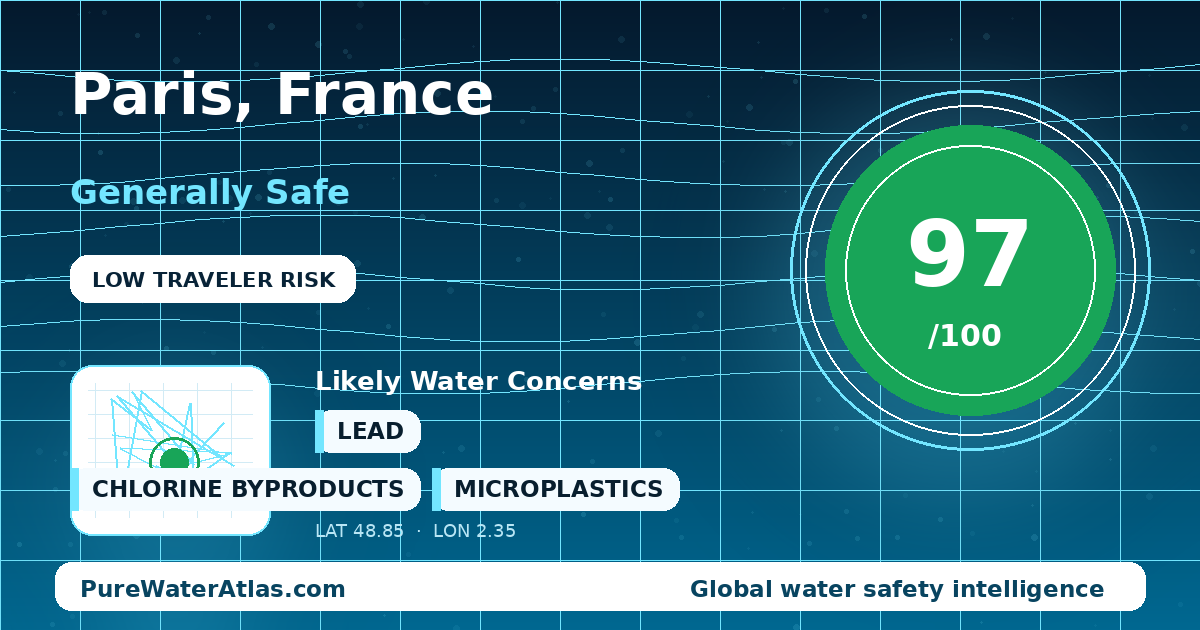
Paris has a large, diversified municipal drinking-water system supplied by treated water from the Seine and Marne and by groundwater collected as far as roughly 150 kilometres from the capital. Water is treated, stored and monitored before entering an extensive public distribution network. The most recent Eau de Paris activity report states that water monitored in 2025 achieved 100% microbiological compliance and 99.9% physicochemical compliance.
For most visitors and residents, cold water from a normal drinking-water tap can be consumed without additional treatment. The main household-level qualification is the plumbing within individual properties. Although public lead service connections have been replaced, private pipes inside some older buildings can still add lead or contribute colour, deposits or metallic taste after water leaves the public network. System-wide compliance therefore provides strong reassurance about municipal water, but it cannot describe the condition of every tap in every Paris building.
Quick Answer
| Overall safety status | Generally safe within the regulated municipal system. Eau de Paris reported 100% microbiological and 99.9% physicochemical compliance in 2025. That system-wide result does not guarantee every individual building tap. |
|---|---|
| Can visitors drink the tap water? | Yes, under normal conditions. Use a cold-water drinking tap and observe any temporary official, accommodation or building notice. |
| Resident advice | Check results for the correct distribution zone and investigate private plumbing in older buildings. After overnight or longer stagnation, run the cold tap until the water is fresh and cool. |
| Main water source | A variable mix of groundwater and treated Seine and Marne water. In 2025, production was 56.1% river water and 43.9% groundwater. |
| Responsible authority | The City of Paris oversees the service, Eau de Paris operates it, and ARS Île-de-France conducts regulatory health oversight. |
| Filter recommendation | No filter is routinely required for compliant municipal water. Match any treatment to a confirmed building-specific issue rather than assuming that all Paris water needs filtration. |
Where Does Paris’s Tap Water Come From?
Paris uses a mixed supply of groundwater from 102 collection points and river water from the Seine and Marne. Some groundwater is collected far beyond the city and transported through the Avre, Vanne and Loing supply routes. In 2025, Eau de Paris produced 184.2 million cubic metres of drinking water: 56.1% came from the two rivers and 43.9% from groundwater.
Those annual percentages describe total production, not a permanent recipe delivered uniformly to every address. The source mix can vary with operating conditions, and water-quality information should be read for the relevant distribution zone. A result for one zone or source should not automatically be applied to the whole city.
River water is treated at Orly and Joinville using clarification, ozonation, granular activated carbon, ultraviolet treatment and chlorination. These stages address different aspects of raw-water quality before distribution. Groundwater treatment varies by source and facility rather than following one identical process for every collection point. Once treated, the water is stored in five principal reservoirs and distributed through roughly 2,000 kilometres of potable-water mains.
This diversified arrangement is important when interpreting Paris water. The city is not dependent on one river intake, one groundwater field or one treatment route. At the same time, a varied source system requires continuing source protection, treatment control and monitoring. Annual production figures and citywide compliance rates provide a useful overview, while zone-specific reports provide the more appropriate local comparison.
Who Manages Drinking Water?
The City of Paris organizes and oversees the public drinking-water service. Eau de Paris manages abstraction, protection of source areas, treatment, transport, storage, distribution and operational monitoring. ARS Île-de-France conducts regulatory health control using approved laboratories.
These responsibilities should be distinguished from those of a property owner or building manager. The public authorities and utility are responsible for the regulated system, but plumbing inside a privately managed building can affect water between the building connection and the kitchen tap. When only one apartment or one building reports a problem, the investigation may therefore need to include internal pipes and fixtures as well as public-network information.
Main Local Water Concerns
Lead inside older buildings
The City reports that public lead connections have been replaced, but private pipes can still add lead inside a building. This is an address-specific premise-plumbing concern, not evidence of citywide contamination. It is especially relevant when assessing an older property, unexplained metallic characteristics or water that has remained in contact with internal plumbing during a long period of stagnation.
A municipal compliance figure cannot rule out lead introduced after the water enters private plumbing. Residents should ask an owner or building manager what is known about the building’s pipe materials and whether replacement work has occurred. Where uncertainty matters, accredited sampling is more informative than judging water by appearance or taste: lead cannot be reliably assessed through a simple visual check. See the lead overview and home safety checklist.
Nitrates and pesticides
Nitrates and pesticides remain important source-protection parameters because several groundwater catchments overlap agricultural areas. The finalized 2024 ARS Centre-zone summary reported a nitrate average of 38 mg/L and a maximum of 45 mg/L, below the 50 mg/L limit. Tested pesticides and relevant metabolites in that summary were compliant.
Those results are reassuring for the Centre zone covered by the document, but they should not be transferred to every Paris address or treated as a fixed description of every source. Their practical significance is that agricultural-source parameters remain part of regulatory surveillance even when reported distributed water is compliant. Residents looking for local information should first identify the applicable distribution zone rather than relying on a result quoted for another part of Paris.
PFAS and TFA
All 16 Paris samples listed in the ARS exploratory 20-PFAS campaign were below the 0.1 µg/L sum limit. The campaign covered Paris distribution-zone samples and provides useful city-specific evidence for the regulated group of 20 PFAS.
Eau de Paris separately detected TFA at a mean of 2.09 µg/L in 2024, with results ranging from 0.38 to 3.70 µg/L. TFA was not part of the regulated 20-PFAS sum, so the TFA figures and the 20-PFAS compliance result should not be combined or presented as if they were the same measurement. Together, the findings support continued monitoring and source-protection attention; they do not establish that Paris tap water was noncompliant or that every household needs PFAS treatment.
Hardness, scale and taste
Paris water is commonly moderately hard to hard. Hardness can produce scale in household equipment and visible mineral residue, but scale is mainly an operational or aesthetic issue rather than proof that the tap water is unsafe. Because the source mix is variable, consumers may also notice differences in taste or mineral character without those differences necessarily indicating a health failure.
Refrigerating water in a clean container can reduce a noticeable chlorine taste. That simple taste measure should not be used to dismiss persistent discolouration, debris or an unusual chemical smell. Those signs warrant investigation, particularly if they are confined to one outlet, appeared after building or network work, or continue after appropriate flushing. A filter should not be used merely to hide an unexplained change.
For Travelers
Visitors can normally drink Paris tap water, brush their teeth with it, make ice and refill reusable bottles. In a hotel, rental or other accommodation, use the cold-water drinking tap and follow any notice supplied by the host, accommodation operator, building manager, Eau de Paris or the health authority. A temporary local notice takes priority over general city guidance.
Public drinking outlets should be used only when they are identified as potable. Do not drink from ornamental fountains or from the city’s separate non-potable network. If a fountain or outlet is not clearly intended for drinking, choose a normal potable tap or another identified drinking-water point instead.
Three special public fountains supplied by the Albien aquifer are not recommended for infants because of fluoride. This limited advice concerns those specific fountains and should not be misread as applying to ordinary Paris tap water. Travelers do not ordinarily need to bring a filter solely because they are visiting Paris.
For Residents
- Use cold water for drinking and cooking. This provides a consistent practical approach when drawing water from household plumbing.
- Flush after stagnation. After overnight or longer non-use, run the cold tap until the water becomes fresh and cool before using it for drinking or food preparation.
- Ask about internal plumbing. Owners and building managers may have information about remaining lead-bearing materials, previous replacement work or recurring corrosion problems.
- Check the correct distribution zone. Do not assume that a result reported for the Centre zone or another sampling location describes every Paris address.
- Respond appropriately after works. Follow flushing or interruption instructions issued after network work, building plumbing work or pressure loss.
- Investigate persistent changes. Ongoing colour, particles, chemical odour or metallic taste deserves assessment rather than indefinite flushing or masking with a filter.
- Separate private systems from municipal results. A private borehole, tanker delivery or building storage tank must be assessed on its own; municipal compliance does not automatically validate those supplies.
If a concern affects every outlet in a building, the building connection and shared plumbing may need attention. If it occurs at only one tap, the outlet or nearby internal plumbing may be more relevant. Comparing locations can help define the problem, although laboratory testing is needed when a contaminant such as lead is suspected.
Relevant Contaminants and Water-Quality Issues
Eau de Paris reported 100% microbiological and 99.9% physicochemical compliance in 2025. The City’s detailed 2024 report recorded 100% compliance for both categories among 1,352 regulatory samples of distributed water. These results provide strong system-level evidence that treated and distributed municipal water met the reported requirements. They cannot exclude a fault within one building, one private tank or one outlet.
Lead is the leading address-specific testing priority in older premises because it may be introduced by private plumbing. Available Paris-zone PFAS results were below the applicable sum limit, so routine citywide PFAS filtration is not supported by the supplied evidence. Nitrates and pesticides remain relevant to catchment protection and monitoring. Iron, copper, nickel, colour and deposits may become relevant where corrosion, staining or metallic taste points toward a local plumbing issue.
How to Verify Your Water Quality
- Start with official local information. Check Eau de Paris and ARS material for the correct distribution zone, paying attention to the reporting period and geographic scope.
- Define whether the concern is citywide or building-specific. Ask whether neighbours or other outlets are affected and whether the change followed plumbing work, closure, flooding or pressure loss.
- Compare sampling points where appropriate. When a building problem is suspected, comparing a sample near the building connection with one from the indoor tap can help distinguish incoming water from an internal plumbing contribution.
- Use an accredited laboratory for lead. The sampling plan should include an appropriate stagnation and flushed-water protocol so that the result can be interpreted in relation to premise plumbing.
- Add plumbing-related metals when justified. Copper, nickel and iron may be useful where corrosion, staining, deposits or metallic taste is present.
- Consider microbiological testing after a specific event. Test E. coli and enterococci after flooding, private-tank contamination, prolonged closure, a suspected cross-connection or pressure loss.
- Reserve specialist panels for supported concerns. PFAS, pesticide or solvent testing is most useful when an exposure history, source issue or official notice supports it, rather than as an indiscriminate household screen.
Use the PureWaterAtlas water-testing guide, contaminants search engine and global water-quality checker. Additional background is available in the drinking-water safety guide and drinking-water safety category.
Treatment Guidance
No additional treatment is routinely required for compliant Paris municipal water. Treatment should follow evidence: first identify whether the issue is taste, scale, a temporary network event, private plumbing or a laboratory-confirmed contaminant. Buying a broad filter without identifying the problem can obscure the original warning sign and does not correct defective building pipes.
If lead is confirmed, replacement of lead-bearing private plumbing is the permanent solution. A filter specifically certified for lead reduction can provide interim protection when correctly installed and maintained; compare lead filtration options. Boiling does not remove lead, so it is not a substitute for plumbing correction or suitable lead treatment.
If future testing confirms PFAS, certified granular activated carbon or reverse osmosis may be appropriate depending on the compounds detected and the product’s performance claim; see PFAS treatment options. Current Paris findings do not establish a citywide need for either system. Routine treatment decisions should not be based on TFA and the regulated 20-PFAS sum as though they were interchangeable results.
Boil water only when authorities issue a microbial or precautionary notice. Boiling is not a general response to lead, hardness, scale or chemical concerns. During a temporary incident, follow the exact official or building instructions, including any flushing guidance after service is restored.
Official and Technical Sources
- Rapport d’activité 2025 : performance durable et service public d’avenir — Eau de Paris
- Rapport d’activité 2025 — Eau de Paris
- Rapport annuel 2024 sur le prix et la qualité du service public d’eau potable et d’assainissement — City of Paris
- La qualité de l’eau — Eau de Paris
- D’où vient l’eau de Paris ? — Eau de Paris
- Produire l’eau — Eau de Paris
- Quelle eau buvez-vous ? Zone de distribution Centre, 2024 — ARS Île-de-France
- Campagne exploratoire ARS Île-de-France sur les 20 PFAS dans les eaux destinées à la consommation humaine — ARS Île-de-France
- Eau de Paris s’engage contre les polluants éternels — Eau de Paris
- À Paris, la gestion municipale de l’eau est source d’économies — City of Paris
- Les travaux sur nos réseaux — Eau de Paris
- Prestations d’analyses d’eau — Eau de Paris
Related Contaminant Profiles
Bottom Line
Paris municipal tap water is generally safe to drink. Recent evidence shows strong microbiological and physicochemical compliance, diversified groundwater and river sources, multi-stage treatment and extensive monitoring. Visitors can normally drink cold tap water and use identified potable fountains without additional treatment, subject to any temporary notice.
The most meaningful uncertainty often occurs after the public connection. Old private plumbing can add lead or contribute local corrosion and microbial problems even when the municipal supply is compliant. Residents in older buildings should check what is known about internal pipes, flush cold water after stagnation and arrange accredited testing when there is a specific reason for concern. Filtration should be selected for a confirmed issue, not applied automatically to all Paris water.
Read the full guide: Global Water Quality Guide
Explore more in this category: Global Water Quality Articles