Baghdad tap water is treated municipal water sourced mainly from the Tigris River, but safety at the tap depends heavily on the local distribution network, building plumbing, pressure reliability, and household storage tanks.
Quick Answer
| City | Baghdad, Iraq |
|---|---|
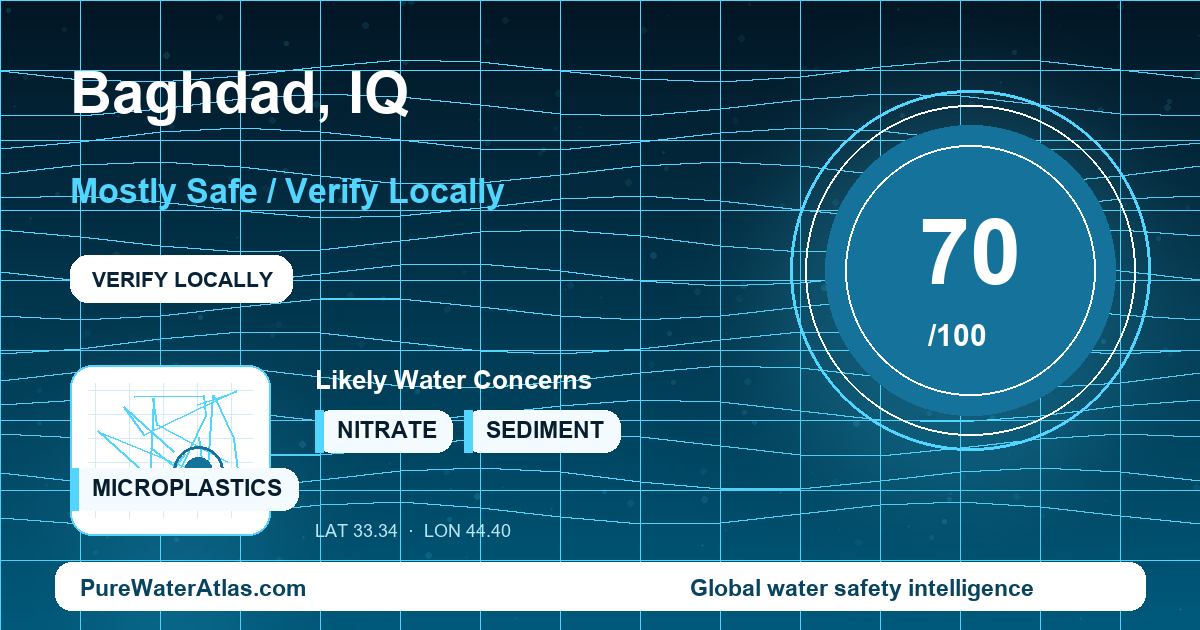
| Water safety score | 70 / 100 |
| Risk level | Mostly Safe / Verify Locally |
| Can you drink the tap water? | Not as a universal default. Baghdad has treated municipal water, but tap safety is locally variable because of distribution-side risks, building storage tanks, intermittent pressure, and older plumbing. |
| Traveler advice | Short-term visitors should use sealed bottled water, boiled water, or properly filtered and disinfected water for drinking. Do not assume every tap is safe. |
| Resident advice | Use a household-level strategy: maintain tanks, check local conditions, test when risks appear, and choose filtration based on actual water problems. |
| Main raw water source | The Tigris River, treated at municipal water-treatment plants before distribution across Karkh and Rusafa. |
| Local authority | Baghdad Mayoralty / Amanat Baghdad, with national ministries and public-health bodies involved in water resources, oversight, and standards. |
| Filter recommendation | Often prudent, but problem-specific: sediment filtration for particles, activated carbon for taste and some organics, UV for microbial protection when water is clear, and reverse osmosis for dissolved salts, nitrate, or some metals. |
Why Baghdad Is Different
Baghdad’s drinking-water profile is inseparable from the Tigris River. The river runs directly through the city and divides Baghdad into the Karkh and Rusafa sides. It is the dominant raw-water source for the municipal system, so the city is sensitive to upstream flow reductions, drought, source-water pollution, turbidity events, and the wider water-scarcity pressures affecting Iraq.
The central issue in Baghdad is not simply whether water is treated at a plant. The more practical question is what happens after treated water leaves the plant. Old mains, leakage, intermittent pressure, improvised or illegal connections, pumping interruptions, and household or rooftop storage tanks can all affect final tap quality. A building with clean, sealed tanks and well-maintained internal plumbing may have a very different risk profile from an older building with stagnant lines, corroded fixtures, or poorly protected storage.
Baghdad also has a historical infrastructure context that matters. Iraq’s urban water systems have been affected by conflict, sanctions-era underinvestment, rapid population growth, and climate stress. As a result, the existence of municipal treatment plants does not guarantee uniform tap-water safety across every neighborhood, pressure zone, building, and storage setup.
Where Does Baghdad’s Tap Water Come From?
Baghdad’s municipal drinking-water supply is primarily based on surface-water abstraction from the Tigris River. Raw river water is treated at municipal water-treatment plants, then pumped into distribution networks serving both sides of the city. Major Baghdad water-supply planning commonly references large municipal treatment works such as Al-Karkh and other city treatment facilities.
The infrastructure chain includes Tigris River intakes, treatment plants, pumped distribution networks, local reservoirs, pressure zones, booster pumping, and household or building-level storage tanks. Each stage matters. A treatment plant can produce disinfected water, but water quality may deteriorate if pipes leak, pressure drops, tanks are dirty, or disinfectant residual declines before the water reaches the kitchen tap.
Storage is especially important in Baghdad. Many households and buildings rely on private tanks, rooftop tanks, booster pumps, or point-of-use treatment to manage continuity. These systems can be helpful where supply is intermittent, but they can also create microbial risk if tanks are uncovered, unsealed, dusty, contaminated by insects, rarely cleaned, or connected to plumbing with backflow problems.
Seasonal conditions can increase these risks. Hot summer weather raises demand and can reduce chlorine residual more quickly in tanks and pipes. Low river flows and drought can concentrate dissolved salts and pollutants in source water. Heavy rain, flooding, or drainage backups can raise contamination risk if sewerage and water-supply infrastructure are damaged or if pressure is interrupted. Construction, pipe repairs, dust, and flushing can also temporarily increase sediment, discoloration, or turbidity at taps.
Who Manages Drinking Water in Baghdad?
The primary local municipal authority is the Baghdad Mayoralty, also known as Amanat Baghdad. It is responsible for major municipal services in Baghdad, including water and sewerage functions. National ministries and public-health bodies also play roles in water resources, environmental oversight, and drinking-water standards.
Iraq uses national drinking-water standards and public-health oversight, with reference to international norms such as the WHO Guidelines for Drinking-water Quality. However, recent, detailed, public compliance results for Baghdad by neighborhood, distribution zone, or building type are not consistently available in easily verifiable public reporting. That data limitation is important: it means this guide should not be read as a guarantee that every Baghdad tap meets health-based standards at all times.
International development and public-health sources provide useful context for Baghdad and Iraq. The World Bank Emergency Baghdad Water Supply and Sanitation Project documents the need for major rehabilitation and investment in the city’s water and sanitation systems. UNICEF Iraq’s Water, Sanitation and Hygiene program provides national WASH context, while the WHO/UNICEF Joint Monitoring Programme provides Iraq household drinking-water and sanitation data at a national level. These sources help explain the system context, but they do not replace local tap testing in a specific Baghdad building.
Main Local Water Concerns
The most important Baghdad-specific drinking-water concerns are distribution-side and building-level risks. Microbial contamination can become more likely during low-pressure events, pipe breaks, flooding, drainage backups, or poor storage-tank hygiene. When pressure drops, contaminated water can enter compromised mains or building plumbing, especially where sewerage and water-supply infrastructure are close or damaged.
Turbidity and visible particles are also relevant. River-water changes, pipe disturbance, old mains, storage-tank sediment, construction, and repairs can cause cloudy, colored, or particle-laden water. Turbidity is not only an appearance issue; suspended particles can interfere with disinfection and may signal disturbed water conditions.
Chlorine taste or odor can occur where water is disinfected, but the opposite problem is also possible: chlorine residual may decline before water reaches distant taps or after water sits in household tanks. Loss of disinfectant residual is more concerning during hot weather, long storage, or when tanks are not sealed and cleaned.
Salinity and high dissolved solids are wider Iraq river-system concerns, especially during dry periods when river flow is low and upstream water management affects raw-water quality. Lead and other metals are not presented here as a uniform citywide claim, but they are plausible building-plumbing concerns in older premises, unknown internal pipe materials, old solder, or brass fixtures. Nitrate may also be relevant where sewage impact, agricultural runoff, private wells, informal supplies, or mixed water sources are suspected, but neighborhood-specific claims require testing rather than assumption.
For Travelers
For most travelers, untreated tap water should not be the default drinking source in Baghdad. Use sealed bottled water, boiled water, or water treated by a reliable purifier, especially on short visits when you cannot evaluate the building’s plumbing, storage-tank maintenance, or the local network condition.
Check that bottled water caps are sealed before drinking. Avoid drinking from taps after outages, pressure problems, visible discoloration, cloudiness, sewage-like odors, or visible particles. If you need a backup, boiling is a practical microbial safety step; see PureWaterAtlas’ Boiling Water Purification: Complete Guide for details on when boiling helps and when it does not address non-microbial contaminants.
For brushing teeth, cautious travelers should use bottled or treated water. This is especially important for children, pregnant travelers, immunocompromised people, and anyone with a sensitive stomach. Healthy adults may choose tap water for brushing in reputable hotels if staff confirm it is safe and the water is clear, odorless, and recently flowing, but that is a local judgment rather than a citywide rule.
Avoid ice unless it is made from bottled or treated water by a reputable hotel or restaurant. Freezing does not reliably disinfect contaminated water. Higher-end hotels and international restaurants may use additional filtration or bottled water for guests, but ask directly. Do not assume bathroom tap water and served drinking water come from the same treatment setup.
For Residents
Baghdad residents often need a household-level water-safety strategy. The first step is to understand whether the main problem is particles, microbial risk, taste and odor, dissolved salts, nitrate, metals, or storage-tank hygiene. A filter can help, but it should not be used as a substitute for tank cleaning, safe plumbing, or local verification after pressure outages and repairs.
Sediment prefilters are useful where water carries particles, discoloration, or tank sediment. Activated carbon can improve taste, reduce chlorine taste and odor, and help with some organics, depending on the system and cartridge quality. UV can add microbial protection if the water is already clear enough for UV light to work effectively; the PureWaterAtlas UV Water Purification: Complete Guide explains the role and limitations of UV. Reverse osmosis can reduce dissolved salts, nitrate, and some metals where testing shows those are concerns.
Testing is especially important after pressure outages, flooding, pipe work, repeated gastrointestinal illness in the household, or changes in taste, odor, color, or turbidity. Test for total coliform and E. coli if water is stored in rooftop or household tanks or if microbial contamination is suspected. Basic checks such as turbidity, free chlorine residual, total dissolved solids, electrical conductivity, and pH can help show whether treatment and distribution are stable.
Older buildings need extra caution. Internal plumbing can change water quality between the street main and the tap. Stagnant water, corroded pipes, unknown pipe materials, old fixtures, brass components, or old solder can raise the need for lead and metals testing. PureWaterAtlas has a dedicated guide to Lead in Drinking Water: Testing and Detection Methods. If nitrate is suspected because of private wells, sewage influence, agricultural runoff, or mixed supplies, see Nitrate Contamination in Drinking Water: Testing and Detection Methods.
Storage tanks should be covered, sealed against dust and insects, cleaned and disinfected on a schedule, and protected from cross-connections. In Baghdad’s hot climate and intermittent-supply context, a dirty tank can make otherwise treated municipal water unsafe.
Relevant Contaminants and Water-Quality Issues
The most relevant Baghdad water-quality topics are practical rather than theoretical. Turbidity matters because river-water changes, pipe repairs, old mains, and tank sediment can reduce clarity and affect disinfection. Sediment is common after pipe disturbance, tank buildup, or old plumbing. E. coli is the key indicator to test when fecal contamination is possible after low pressure, flooding, leaks, or poor tank hygiene.
Chlorine is important because Baghdad municipal water should rely on disinfection, but disinfectant residual can decline in long distribution networks and stored water. Lead is mainly a building-plumbing issue, especially in older or unknown premises. Nitrate should be considered when private wells, sewage influence, agricultural runoff, or mixed supplies are possible.
How to Verify Your Water Quality
Because routine, neighborhood-level Baghdad compliance data are not consistently available in accessible public sources, verification should be local. Start with current conditions: recent outages, nearby pipe work, flooding, tank cleaning history, visible particles, odor, color, and whether the water has been sitting in pipes or tanks.
Use an accredited laboratory where possible for health-significant contaminants, especially bacteria, lead, other metals, and nitrate. Home strips can be useful for screening some basic parameters, but they should not be treated as definitive for microbial safety or metals. For a broader testing framework, use PureWaterAtlas’ Water Testing guide and the Drinking Water Safety decision guide.
For treatment selection, see Water Treatment Systems. For microbial context, see Water Microbiology. Travelers can also compare city-level guidance using the Global Water Quality Checker, and residents can look up specific issues through the Contaminants Search Engine.
Official and Technical Sources
- Baghdad Mayoralty / Amanat Baghdad — local municipal authority for Baghdad urban services, including water and sewerage functions.
- World Bank: Emergency Baghdad Water Supply and Sanitation Project — documents the need for rehabilitation and investment in Baghdad water and sanitation systems.
- UNICEF Iraq: Water, Sanitation and Hygiene — national public-health and WASH context.
- WHO/UNICEF Joint Monitoring Programme: Iraq household WASH data — national drinking-water and sanitation monitoring context.
- FAO AQUASTAT Iraq Country Profile — Iraq water-resources context and dependence on the Tigris and Euphrates river systems.
- World Bank Climate Change Knowledge Portal: Iraq — climate, heat, drought, and water-stress context.
- WHO Guidelines for Drinking-water Quality — international benchmark for interpreting microbial risk, disinfection, turbidity, and health-based water safety.
Bottom Line
Baghdad tap water should be viewed as treated municipal water with locally variable safety at the tap. The city’s supply is primarily based on the Tigris River and municipal treatment plants, but the practical risk often comes later: aging mains, low pressure, pumping interruptions, old building plumbing, and household or rooftop storage tanks. Travelers should usually choose sealed bottled water or properly treated water for drinking and be cautious with ice and toothbrushing. Residents should maintain tanks, test after outages or visible changes, and choose filters based on actual problems rather than assumptions. Because detailed public neighborhood-level compliance data are limited, local verification is essential.
Read the full guide: Global Water Quality Guide
Explore more in this category: Global Water Quality Articles