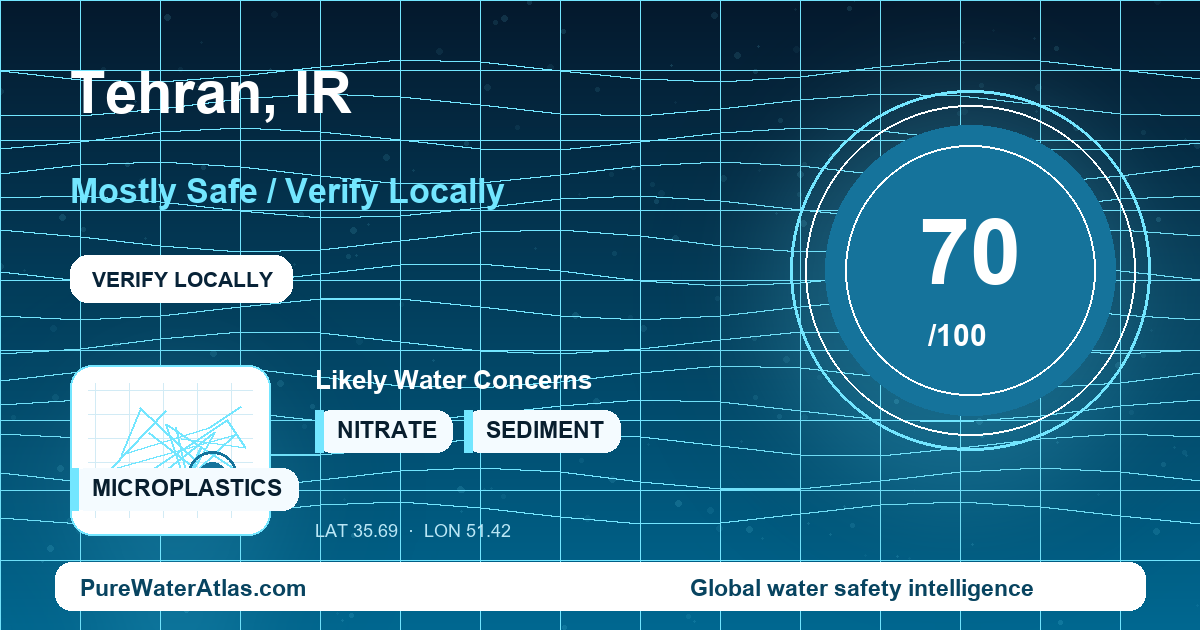
Tehran tap water is generally treated and widely used, but household safety depends on the municipal connection, drought-related source blending, building plumbing, and the condition of rooftop or underground storage tanks.
Quick Answer
| Overall status | Mostly Safe / Verify Locally. Tehran’s municipal tap water is generally treated, disinfected, and commonly used by residents, but safety can vary at the tap because of old building plumbing, private tanks, pressure interruptions, and local source blending. |
|---|---|
| Water safety score | 70 / 100 |
| Traveler advice | Healthy adults in reputable central hotels can usually use tap water for brushing teeth and hot drinks. For drinking, sealed bottled water or properly filtered water is the safer choice for short stays, sensitive stomachs, infants, pregnancy, immune suppression, older buildings, or tank-stored water. |
| Resident advice | Treat the municipal supply as disinfected, but test at the kitchen tap if the building is old, water has sediment or salty taste, tanks are used, or pressure interruptions occur. |
| Main water sources | Mixed supply from Alborz mountain catchments and major reservoirs, blended with groundwater wells from the Tehran plain aquifer when needed. |
| Water authority | Tehran Province Water and Wastewater Company, with raw-water and reservoir roles connected to Tehran Regional Water Company under Iran’s Ministry of Energy framework. |
| Filter recommendation | A filter is not automatically required for every household. Choose treatment based on testing: carbon for chlorine taste, sediment filtration for particles, and reverse osmosis only where high TDS, nitrate, salinity, or specific dissolved contaminants are confirmed. |
Why Tehran Is Different
Tehran is not a simple single-source water city. It sits on the southern slopes of the Alborz Mountains and relies heavily on mountain runoff, snowmelt-fed reservoirs, and groundwater from the Tehran plain. That geography gives the city a large treated municipal supply, but it also makes water reliability sensitive to drought, winter snowpack, and reservoir storage.
The safest answer for Tehran is therefore conditional. Where water comes directly from the municipal network and the building’s internal plumbing and storage tanks are well maintained, tap water is generally treated, disinfected, and widely used. At the same time, the water arriving at an individual apartment tap can be affected by local distribution conditions, old internal pipes, rooftop or basement tanks, pressure fluctuations, and maintenance practices inside the building.
This is especially important for visitors. A newer hotel connected to a well-maintained municipal line may have very different point-of-use quality from an older apartment building where water sits in a roof tank or passes through aging plumbing. Tehran’s water profile is therefore best understood as a treated municipal system with building-level verification needs.
Where Does Tehran’s Tap Water Come From?
Tehran’s raw-water system is a mixed system dominated by surface water from the Alborz mountain catchments and major reservoirs, with groundwater wells from the Tehran plain aquifer used for blending and resilience when needed. Commonly cited surface-water sources for the metropolitan system include the Karaj or Amir Kabir Dam system west of Tehran, Latyan Dam northeast or east of the city, Lar Dam from the Alborz catchment, the Taleghan transfer system, and Mamloo Dam southeast of Tehran.
These sources feed municipal treatment plants, transmission mains, service reservoirs, pressure zones, and the large urban distribution network. Groundwater wells in and around the Tehran plain remain part of the supply mix, especially during dry years or periods of high demand. This blending can affect taste, hardness, salinity, and in some local circumstances may make nitrate testing more relevant, particularly where groundwater influence is suspected.
Historically, Tehran depended more heavily on qanats, springs, local surface streams, and groundwater. Rapid population growth pushed the city toward a multi-reservoir supply network and large inter-basin transfers, but groundwater has not disappeared from the picture. It remains an important backup and blending source in a water-stressed metropolitan region.
Who Manages Drinking Water in Tehran?
The main municipal drinking-water and wastewater service provider is Tehran Province Water and Wastewater Company. Raw-water infrastructure and regional reservoirs are connected to the responsibilities of Tehran Regional Water Company. These institutions operate within Iran’s national water-sector framework, including the Iran Ministry of Energy and the National Water and Wastewater Engineering Company of Iran.
Public-health oversight involves Iran’s Ministry of Health and Medical Education and national drinking-water standards. However, a major limitation for public interpretation is that recent, easily accessible, neighborhood-level drinking-water quality results and full English-language compliance summaries are limited. For that reason, this guide does not claim that every Tehran neighborhood tap meets a specific legal limit, nor that every private building tank or internal plumbing system is safe. The official system is identifiable; the final water quality at a specific kitchen tap still needs local verification when risk factors are present.
Main Local Water Concerns
- Drought and source blending: Low reservoir storage and high summer demand can increase reliance on groundwater wells. Groundwater influence may change hardness, mineral taste, salinity, and, in some settings, the need to check nitrate.
- Hardness and mineral taste: Hard or salty taste is a common practical complaint in parts of Tehran. It is often aesthetic or plumbing-related rather than an acute health risk, but it can indicate groundwater influence and is worth testing if persistent.
- Turbidity and sediment: Cloudiness, brown water, or particles can appear after pipe repairs, pressure changes, tank cleaning, or distribution disturbances. Visibly discolored or particle-laden water should not be consumed until cleared or verified.
- Chlorine taste or odor: Tehran’s municipal water is disinfected, so residual chlorine taste may be noticeable. Chlorine can indicate treatment, but strong odor or sudden change should be checked.
- Old building plumbing: Legacy fixtures, solder, brass components, internal corrosion, or stagnant plumbing can introduce metals such as lead at the building level, even if treated water leaving the plant is acceptable.
- Rooftop and underground tanks: Many buildings use storage tanks to manage pressure and outages. Unsealed, poorly cleaned, warm, cracked, or rarely maintained tanks can become microbial risk points.
- Tehran plain aquifer stress: Long-term over-extraction and urban pollution pressures affect source-water vulnerability. This is not proof that all tap water is unsafe, but it is a reason to avoid overgeneralizing citywide safety.
For Travelers
For healthy adults, Tehran tap water from a reliable municipal connection is often considered usable. Many residents drink it, and short-term visitors in established central hotels can generally use tap water for brushing teeth and for hot drinks. Water used for tea, coffee, and cooked foods is lower risk because it is heated.
For drinking during a short stay, the more cautious option is sealed bottled water or properly filtered water, especially in summer, in older buildings, budget accommodation, or any place using private storage tanks. Travelers with sensitive stomachs, infants, pregnancy, immune suppression, or a very short trip should be more conservative because even a minor local difference in water chemistry or storage hygiene can cause problems.
Use bottled water for brushing teeth if the tap water is cloudy, brown, has visible particles, smells unusual, or comes from a questionable storage tank. Be cautious with ice from small shops or informal vendors because the water source and storage hygiene are difficult to verify. Ice in reputable hotels and restaurants is lower risk, but not guaranteed for medically vulnerable travelers.
If you do use tap water, let the cold tap run briefly after stagnation, avoid visibly discolored water, and prefer boiled water for tea. Boiling is useful for many microbial concerns, but it does not remove salts, nitrate, metals, hardness, or other dissolved chemical contaminants.
For Residents
Tehran residents should treat the city supply as a disinfected municipal source, but not assume that every apartment tap has identical quality. The most important question is not only what leaves the treatment plant, but what happens in the distribution line, the building tank, and the internal plumbing before water reaches the kitchen tap.
A home filter is not automatically required for every household. It becomes more relevant when there is hard taste, sediment, old plumbing, tank storage, visible discoloration, or vulnerable occupants. Activated carbon can improve chlorine taste and some organic compounds. Sediment filters can improve clarity and protect appliances. Reverse osmosis may be considered where testing confirms high total dissolved solids, nitrate, salinity, or specific dissolved contaminants. Buying a generic filter without testing can miss the real problem or create maintenance issues.
Testing should be done at the kitchen tap, not only at the building inlet. If the building is old or the plumbing history is unknown, test for lead and other metals using a certified laboratory or validated sampling method. If water tastes salty, bitter, or very hard, test total dissolved solids, electrical conductivity, hardness, chloride, sulfate, and nitrate. If water is stored in rooftop or underground tanks, periodically test for total coliform and E. coli, especially after tank cleaning, repairs, or pressure interruptions.
Older apartments deserve special attention. Lead risk is a building-level issue and cannot be ruled out by broad citywide statements. First-draw and flushed samples can help distinguish stagnant internal plumbing effects from incoming water quality. Tanks should be covered, screened, cleaned, and disinfected on a schedule. An old filter cartridge or unserviced reverse-osmosis unit can itself become a microbial or taste problem.
Relevant Contaminants and Water-Quality Issues
Several PureWaterAtlas contaminant profiles are especially relevant to Tehran’s point-of-use risks. Chlorine in drinking water is relevant because Tehran’s municipal water is disinfected and some users notice chlorine taste or odor. Turbidity in drinking water and sediment in drinking water are relevant after storms, reservoir turbidity events, pipe repairs, pressure changes, or poorly maintained tanks.
Lead in drinking water is a building-level concern for older plumbing, fixtures, solder, and stagnant internal lines. E. coli in drinking water is relevant where rooftop or underground tanks are poorly sealed, poorly cleaned, or affected by pressure interruptions. Nitrate in drinking water is relevant where groundwater influence is suspected, especially for infant safety and households using water with unusual mineral or salty taste.
How to Verify Your Water Quality
The most reliable way to verify Tehran tap water is to test the water you actually drink. Start with the kitchen cold-water tap. If you live in an older building, compare first-draw and flushed samples for metals. If the building uses tanks, include microbial indicators such as total coliform and E. coli after maintenance events or pressure interruptions. If mineral taste is the issue, test TDS, conductivity, hardness, chloride, sulfate, and nitrate.
PureWaterAtlas resources can help match the test to the risk. Use the Water Testing guide for sampling strategy, the lead testing guide for older buildings, and the nitrate testing guide where groundwater influence or infant safety is a concern. The boiling water guide explains when boiling helps and when it does not, while the UV purification guide is useful for microbial control after filtration in tank-stored water.
For broader research, use the Contaminants Search Engine, the Global Water Quality Checker, the Drinking Water Safety framework, and the Water Treatment Systems guide. Tehran-specific decisions should be based on tap-level results, not only on general city reputation.
Official and Technical Sources
- Tehran Province Water and Wastewater Company – official utility for drinking-water and wastewater services in Tehran Province.
- Tehran Regional Water Company – official water resource authority connected to regional reservoirs and raw-water infrastructure.
- Iran Ministry of Energy – national ministry overseeing Iran’s water and wastewater sector.
- National Water and Wastewater Engineering Company of Iran – national water-sector authority connected to urban water company operations.
- World Health Organization Guidelines for Drinking-water Quality – international public-health guidance for microbial, chemical, and treatment risks.
- WHO/UNICEF Joint Monitoring Programme Iran household drinking-water data – national drinking-water service context, not a Tehran neighborhood-quality dataset.
- FAO AQUASTAT Iran water resources profile – background on national water scarcity and groundwater pressure.
- World Bank Climate Change Knowledge Portal: Iran – climate variability and drought context relevant to source-water reliability.
Bottom Line
Tehran’s tap water is generally a treated, disinfected municipal supply and is widely used by residents, but the safest answer is not a blanket yes for every tap. The city depends on Alborz reservoir systems blended at times with Tehran plain groundwater, and household quality can be changed by drought pressure, old plumbing, storage tanks, sediment, pressure changes, and building maintenance. Healthy travelers in reputable hotels can usually brush teeth and drink hot beverages using tap water, while bottled or properly filtered water is wiser for drinking during short stays or for vulnerable people. Residents should test at the kitchen tap when buildings are old, tanks are used, water tastes hard or salty, or visible sediment appears.
Read the full guide: Global Water Quality Guide
Explore more in this category: Global Water Quality Articles