
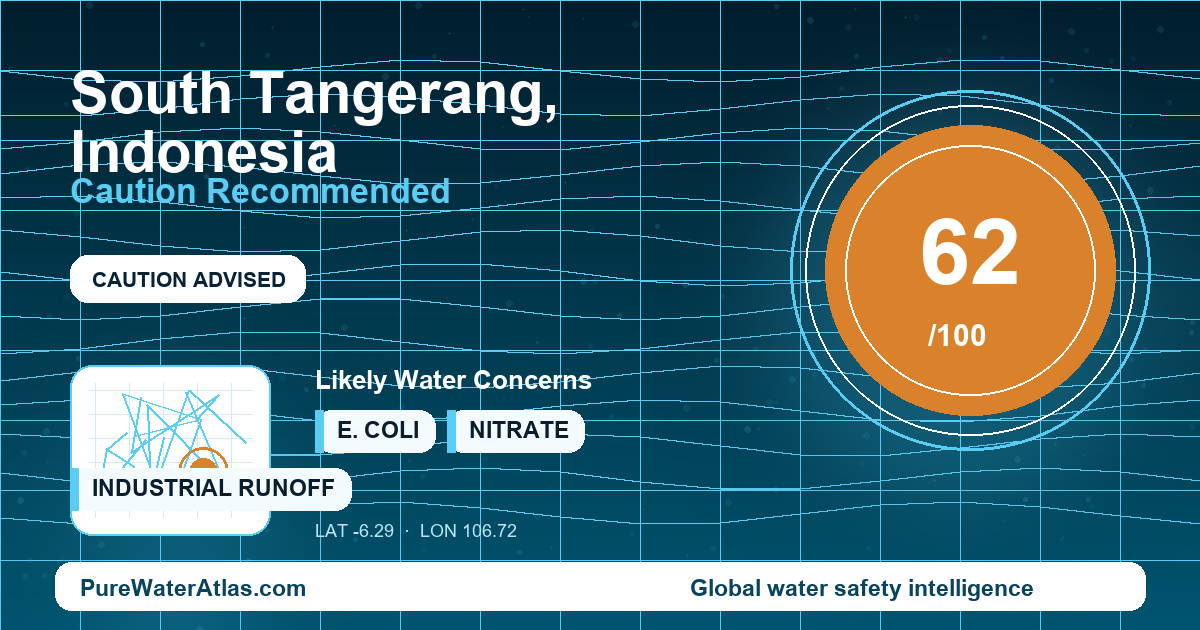
South Tangerang, Indonesia: a mixed-source urban water profile for piped supply, wells, storage tanks, refill water, and household treatment decisions.
Quick Answer
| Overall safety status | Caution recommended. South Tangerang has treated piped-water services and regional water-supply development, but drinking straight from the tap is not the safest default because household water sources and building plumbing vary widely. |
|---|---|
| Water safety score | 62 / 100 — risk level: Caution Recommended. |
| For tourists | Do not drink tap water directly as a default. Use sealed bottled water, reputable gallon water, or water that has been boiled or treated with reliable filtration and disinfection. |
| For residents | Piped water may be suitable for washing and general domestic use, but drinking water should be tested or treated. Well users should test for microbial contamination, nitrate, turbidity, TDS/conductivity, iron, manganese, and other relevant parameters. |
| Main water identity | South Tangerang is not served by one simple source. The city is connected to the wider Tangerang and Greater Jakarta water-supply environment, including Cisadane River basin context and regional bulk-water projects, while many households still use wells, refill depots, bottled gallon water, and storage tanks. |
| Authorities and operators | Local responsibilities involve the South Tangerang municipal government, PT Pembangunan Investasi Tangerang Selatan, regional drinking-water providers such as Perumdam Tirta Kerta Raharja, and national water-resources and health regulators. |
| Filter recommendation | Use a household treatment barrier for drinking and cooking unless your specific tap has been tested and the building tank and plumbing are well maintained. A sediment prefilter plus activated carbon and UV or boiling is often practical; reverse osmosis is useful only where testing shows high TDS, nitrate, metals, or salinity-type problems. |
Why South Tangerang Is Different
South Tangerang is an inland, densely urbanized municipality in Banten within the Jabodetabek metropolitan area. Its water situation is shaped by rapid suburban growth around areas such as Bintaro, Serpong, BSD-adjacent neighborhoods, Ciputat, Pamulang, and Pondok Aren. Unlike a city where most households receive water from one centralized network under one clearly published drinking-water report, South Tangerang has a mixed household reality: some taps are connected to formal piped water, while many homes, apartments, boarding houses, restaurants, offices, and small businesses depend on wells, gallon water, refill-water depots, private pumps, roof tanks, ground tanks, and building-level treatment.
This matters because the water at the kitchen sink may not represent the quality leaving a treatment plant. In South Tangerang, the practical safety question is often building-specific: What is the source? Is it piped water, a shallow well, a deep well, refill water, tanker-supplied water, or a combination? Is the water stored in a roof tank? Is the tank covered, cleaned, and protected from insects, animals, dust, and floodwater? Is residual disinfectant still present at the point of use? These details can make two neighboring homes have very different drinking-water risk.
PureWaterAtlas rates South Tangerang as Caution Recommended, not because every tap is known to be unsafe, but because recent public, neighborhood-level tap-water compliance data are limited and household-level conditions vary sharply. The available information supports caution, testing, and treatment rather than a blanket claim that all South Tangerang tap water is safe to drink directly.
Where Does South Tangerang’s Tap Water Come From?
South Tangerang is tied to the wider Tangerang and Greater Jakarta water-supply network rather than to a single local drinking-water source. Formal piped-water services are associated with regional supply systems, including surface-water context from the Cisadane River basin and the broader Ciliwung-Cisadane water-resources management area. Regional bulk-water development, especially the SPAM Regional Karian-Serpong project, is intended to improve treated water availability for parts of Banten, DKI Jakarta, and West Java.
The city’s older and continuing water-use pattern also includes groundwater. Before fuller expansion of piped systems, many households depended on shallow or deep wells and local distribution arrangements. That legacy remains important. In many parts of the city, households may still use wells for some domestic needs, while using bottled gallon water or refill water for drinking. Local urban water bodies such as Situ Gintung and other situ are important drainage and urban-water features, but they should not be assumed to be household drinking-water sources unless treatment and official confirmation are provided.
Key infrastructure and practical water points for South Tangerang include Perumdam Tirta Kerta Raharja, PT Pembangunan Investasi Tangerang Selatan, the Cisadane River basin, the Ciliwung-Cisadane water-resources system, SPAM Regional Karian-Serpong, and the many household roof tanks, ground tanks, booster pumps, wells, and refill-water depots that influence what people actually consume.
Who Manages Drinking Water in South Tangerang?
Drinking-water responsibility in South Tangerang is distributed across local, regional, and national actors. The South Tangerang municipal government is the local public authority. PT Pembangunan Investasi Tangerang Selatan, often referred to as PT PITS, is a local government-owned company involved in local infrastructure and water-supply development. Perumdam Tirta Kerta Raharja is a regional drinking-water company historically relevant to the Tangerang-area piped supply context.
Water-resources infrastructure is connected to Indonesia’s Ministry of Public Works and Housing through relevant river-basin authorities, including the Balai Besar Wilayah Sungai Ciliwung Cisadane. Health-based drinking-water quality supervision follows Indonesia’s national framework, including Ministry of Health Regulation No. 2 of 2023 on environmental health quality standards. Local operators and health authorities are expected to manage treated drinking-water quality under this framework.
The important limitation is data transparency at the customer tap. PureWaterAtlas found enough public information to identify the water-supply actors, regulatory framework, and regional source-water context, but did not find a recent complete public South Tangerang dataset showing routine tap-water test results by neighborhood, customer zone, building type, or household source. For that reason, this guide does not claim that all South Tangerang taps meet or fail a specific legal limit.
Main Local Water Concerns
The most important concern for South Tangerang is microbial risk in water that is untreated, poorly stored, or affected by sanitation problems. Shallow wells, dirty roof tanks, ground tanks, refill containers, and building plumbing can become contaminated if they are not protected and cleaned. Flooding or drainage backups can increase the risk for wells and low-lying storage systems.
Rainy-season conditions can increase turbidity and microbial pressure in surface water, wells, drains, and poorly sealed tanks. Sediment or turbidity may also appear after heavy rain, pipe repairs, intermittent supply, or tank disturbance. If water has visible particles, cloudiness, or unusual color, disinfection alone may be less reliable unless sediment is first removed.
Variable residual chlorine is another practical issue. Treated piped water may lose disinfectant protection as it travels through long plumbing runs, roof tanks, ground tanks, or stagnant internal pipes. A clean source can become less protected by the time it reaches a bathroom or kitchen tap.
Groundwater users should also watch for iron and manganese, which can cause staining, metallic taste, or discoloration in some Indonesian urban groundwater settings. Nitrate is a concern for shallow wells located near septic tanks, dense housing, drainage channels, or poorly protected wellheads. Lead is not confirmed as a citywide South Tangerang pipe-network problem, but older internal plumbing, brass fixtures, solder, valves, and unknown building materials can create building-specific risk. High salinity or high TDS is not the dominant citywide concern because South Tangerang is inland, but individual deep wells can still have mineral, TDS, or taste issues and should be tested.
For Travelers
Tourists and short-stay visitors should not drink South Tangerang tap water directly as a default. Use sealed bottled water, reputable gallon water, or water that has been boiled or treated with filtration plus disinfection. This advice is especially important for children, pregnant travelers, people with sensitive stomachs, and anyone staying in smaller guesthouses, boarding houses, private rentals, or properties with unknown tank maintenance.
For brushing teeth, bottled or boiled water is the safer choice for short stays. Avoid swallowing shower water, particularly in properties where the water source or storage system is unclear. Hot beverages are generally lower risk when made with water that has been fully boiled.
Be cautious with ice. Ice from street stalls or unclear sources should be avoided. Ice is lower risk in reputable hotels, malls, and established restaurants that use commercial purified ice, but travelers should still ask or use judgment when the source is not obvious.
Large hotels and higher-end restaurants in South Tangerang often provide bottled, gallon, filtered, or commercially supplied water for guests. That is a property-level safety practice, not proof that the municipal tap itself is drinkable. Ask whether drinking water and ice are made from purified water. When eating at informal vendors, be careful with raw foods that may have been washed in untreated water.
For Residents
Residents should treat drinking and cooking water unless the specific tap has been tested and the building’s tank and plumbing are well maintained. For many South Tangerang homes, a practical treatment train may include a sediment prefilter, activated carbon for taste and chlorine-related issues, and UV disinfection or boiling for microbial control. UV works best after sediment has been removed, because cloudy water can reduce disinfection performance. Boiling is useful for short-term microbial risk reduction and emergency use.
Reverse osmosis is not automatically necessary for every home, but it can be appropriate where testing shows high TDS, nitrate, metals, or salinity-type issues. RO systems require careful maintenance, and some households may prefer remineralization for taste after RO treatment.
Private wells should be tested at least annually for E. coli or total coliform, nitrate, turbidity, pH, TDS or conductivity, iron, manganese, hardness, and basic chemistry. Test again after flooding, nearby construction, septic leakage, unusual taste, odor, color, or a period of non-use. Piped-water customers should consider checking residual chlorine at the point of use if water passes through a roof tank or ground tank.
Older homes, schools, clinics, boarding houses, and apartments with unknown plumbing deserve extra caution. Do not assume old internal plumbing is safe simply because the source water is treated. Lead, copper, nickel, or other metals can come from fixtures, solder, valves, and stagnant building plumbing. Let water run after long stagnation and test first-draw and flushed samples if plumbing materials are unknown.
Storage tanks are one of the most important risk points in South Tangerang. Roof tanks and ground tanks should be covered, screened from insects and animals, cleaned periodically, disinfected after contamination events, and protected from floodwater. A safe source can become unsafe inside a dirty or uncovered tank.
Relevant Contaminants and Water-Quality Issues
For South Tangerang, the most relevant PureWaterAtlas contaminant profiles are those connected to wells, storage tanks, tank cleaning, intermittent service, and building plumbing. Start with E. coli in drinking water, because microbial contamination is the highest-priority concern for untreated wells, dirty tanks, and poorly disinfected water.
During rainy periods, pipe disturbance, or tank sediment events, review turbidity in drinking water and sediment in drinking water. These issues affect appearance and can interfere with disinfection if not controlled. For homes using piped water and storage tanks, chlorine in drinking water explains why residual disinfectant matters and why tank storage can reduce protection before water reaches the tap.
Well users should understand nitrate in drinking water, especially where shallow wells are near septic systems or dense housing. Groundwater taste and staining complaints may relate to iron or manganese. For older buildings or unknown internal plumbing, review lead in drinking water; this is a building-specific caution, not a confirmed citywide pipe-network finding for South Tangerang.
How to Verify Your Water Quality
The safest way to make a South Tangerang-specific decision is to test the water you actually drink. A municipal or regional source may be treated, but household wells, roof tanks, refill containers, and internal plumbing can change quality before consumption. Use an accredited local laboratory or a health-office-recognized testing route when results will guide health decisions.
For a broader framework, read the PureWaterAtlas guide to water testing and the pillar guide on how to know if tap water is safe to drink. For treatment decisions, see water treatment systems, boiling water purification, and UV water purification.
If your concern is an older building, use the PureWaterAtlas guide to lead testing and detection. If you use a shallow well near septic systems or dense housing, review nitrate testing and detection. You can also compare city-level guidance with the Global Water Quality Checker and search individual parameters in the Contaminants Search Engine. Related PureWaterAtlas sections include Global Water Quality, Water Microbiology, Drinking Water Safety, Water Testing, and Water Purification.
Official and Technical Sources
- Ministry of Health Regulation No. 2 of 2023 on Environmental Health Quality Standards — Government of Indonesia, Ministry of Health.
- Perumdam Tirta Kerta Raharja — regional drinking-water utility relevant to the Tangerang-area supply context.
- PT Pembangunan Investasi Tangerang Selatan — South Tangerang local government-owned company involved in infrastructure and water-supply development.
- Official Website of South Tangerang City Government — municipal administration and local public-service context.
- Balai Besar Wilayah Sungai Ciliwung Cisadane — Ministry of Public Works and Housing river-basin authority.
- Karian-Serpong Water Supply Project — regional bulk-water supply development reference.
- CDC Indonesia Traveler View — traveler-health guidance supporting caution with untreated water and ice.
- WHO Drinking-water Fact Sheet — global public-health reference on microbial and chemical drinking-water risks.
- BPS Kota Tangerang Selatan — official statistical source for South Tangerang geography, population, and urban context.
Bottom Line
South Tangerang tap water should be approached with caution for direct drinking. The city has formal piped-water services and is connected to wider Tangerang and Greater Jakarta water-supply development, including Cisadane basin context and the Karian-Serpong regional project. However, many households and buildings also use wells, refill water, gallon water, pumps, roof tanks, ground tanks, and internal plumbing that can strongly affect quality at the tap. Tourists should use sealed bottled water, reputable gallon water, or boiled/treated water. Residents should test private wells, maintain storage tanks, and use appropriate household treatment for drinking and cooking unless their specific tap has been verified. Current public data are not sufficient to declare all South Tangerang taps safe to drink untreated.
Read the full guide: Global Water Quality Guide
Explore more in this category: Global Water Quality Articles