
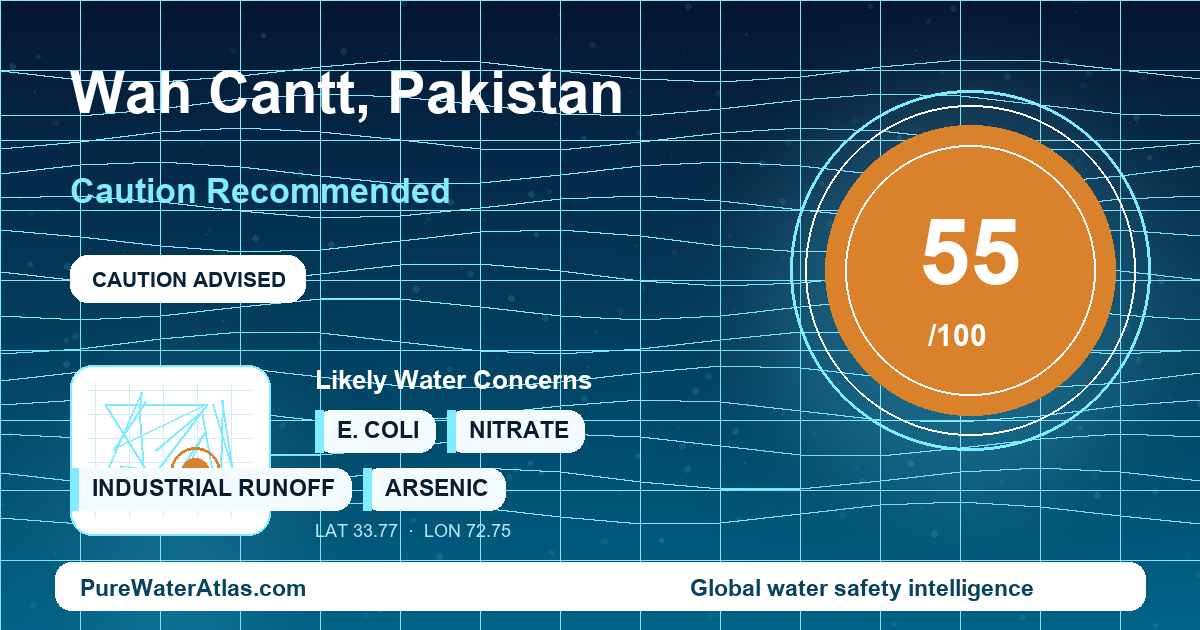
Wah Cantt, Pakistan: a cantonment and industrial-residential water system where household storage, intermittent supply conditions, and building-level testing matter as much as the original water source.
Quick Answer
| Overall safety status | Caution Recommended. Wah Cantt tap water should not be treated as reliably safe for untreated daily drinking unless your specific building supply has recent microbiological and chemical test results. |
|---|---|
| Water safety score | 55 / 100 |
| Traveler advice | Use sealed bottled water from a reputable brand, boiled water, or properly filtered and disinfected water. Do not assume hotel, hostel, or restaurant tap water is safe unless the venue can explain its treatment and storage practices. |
| Resident advice | Assess safety at the household or building level. Testing and a maintained point-of-use treatment barrier are sensible for many homes, especially where water passes through underground or rooftop tanks. |
| Main water identity | Mixed cantonment/municipal piped supply, local groundwater or tube-well abstraction, pumping, service reservoirs, and household storage. The broader Wah-Taxila-Rawalpindi water setting is influenced by the Haro River and Khanpur Dam system, but a current public citywide source split for Wah Cantt is not easy to verify. |
| Local authority | Cantonment Board Wah, under Pakistan’s Military Lands and Cantonments Department. Private institutions, societies, factories, hostels, and compounds may also operate their own boreholes, tanks, or treatment systems. |
| Filter recommendation | For most households: sediment prefiltration plus verified disinfection such as UV or ultrafiltration, with regular maintenance. Consider reverse osmosis only when testing shows high TDS, salinity, nitrate, arsenic, or other dissolved contaminants. |
Why Wah Cantt Is Different
Wah Cantt is not simply a generic urban water-supply area. It is a planned cantonment and industrial-residential city in Punjab near Taxila, northwest of Rawalpindi and Islamabad, close to the Potohar and Margalla foothill catchments and the Khanpur-Haro regional water system. Its development around Pakistan Ordnance Factories and associated cantonment housing means water demand is divided among civic, residential, institutional, and industrial users.
That local identity matters for drinking-water safety. In Wah Cantt, the practical question is often not “is the whole city’s water safe?” but “what is happening in this sector, this building, this borehole, this storage tank, and this tap?” A newer private house with a maintained borehole and filtration system can have a very different risk profile from an older cantonment quarter, hostel, school building, or rental house where water passes through aging internal plumbing and rooftop storage.
The editorial verdict for Wah Cantt is therefore cautious: tap water should not be considered reliably safe for untreated daily drinking without recent testing from the specific supply point. The concern is not a single verified citywide contaminant spike. The more realistic concerns are limited public reporting, intermittent or stored distribution, possible microbial contamination, turbidity or sediment episodes, and household-level plumbing or tank risks.
Where Does Wah Cantt’s Tap Water Come From?
Publicly available, sector-by-sector source information for Wah Cantt is limited. Based on the local water identity available, Wah Cantt appears to function as a cantonment water-supply area under Cantonment Board Wah, with practical dependence on a mixed system: municipal or cantonment piped supply, local groundwater or tube-well abstraction, pumping stations, service reservoirs, overhead or ground storage tanks, and household storage.
The wider Taxila-Wah-Rawalpindi region is influenced by the Haro River and the Khanpur Dam system, a major regional surface-water resource. However, the sources reviewed do not provide a simple, current, public source split showing exactly how much drinking water at each Wah Cantt tap comes from regional surface water, local groundwater, or private/institutional systems. This is an important limitation: residents should avoid assuming that one description applies to every neighborhood, housing block, hostel, school, or compound.
The final part of the water journey may be the most important in daily life. Even if source water is treated or partially treated, water may pass through distribution lines, pumps, underground tanks, rooftop tanks, and internal building plumbing before it reaches a glass. In Wah Cantt, household tanks are common final storage points. If they are uncovered, cracked, contaminated by insects or animals, affected by algae, or not cleaned and disinfected on a schedule, they can dominate the real drinking-water risk.
Who Manages Drinking Water in Wah Cantt?
The local civic authority for Wah Cantonment municipal services is Cantonment Board Wah. Cantonment boards operate under Pakistan’s Military Lands and Cantonments Department, which provides the governance context for civic services in cantonment areas.
Wah Cantt’s water situation can also involve non-civic systems. Private housing societies, schools, hostels, factories, institutions, and individual compounds may use their own boreholes, pumps, storage tanks, or point-of-use treatment. This is one reason a single citywide safety statement is not enough for Wah Cantt.
Drinking-water quality in Pakistan is guided by national standards and standards-related institutions, including the Pakistan Standards and Quality Control Authority, environmental authorities such as the Pakistan Environmental Protection Agency, and national water-quality research and monitoring institutions such as the Pakistan Council of Research in Water Resources. In practice, consumer-facing public reporting for individual Wah Cantt sectors is much less transparent than in many large utilities with online routine water-quality dashboards.
Main Local Water Concerns
The leading practical concern in Wah Cantt is microbial risk. Intermittent pressure, leakage, cross-connections, contaminated storage tanks, or sewage intrusion can allow bacteria into water that may otherwise look clear. Testing for E. coli in drinking water is the most practical first safety check because E. coli indicates fecal contamination and a direct health concern.
Turbidity, sediment, and discoloration are also important. These can occur after pipe repairs, pressure changes, monsoon runoff, or tank disturbance. Cloudy or particle-laden water can reduce disinfection effectiveness and may indicate intrusion or disturbed deposits. Residents seeing visible particles should also review sediment in drinking water.
Chlorine residual can vary at the consumer tap. A chlorine smell does not prove water is safe, and no chlorine smell does not prove water is contaminated. Still, measured residual disinfectant is one useful sign of whether the distribution system has a protective barrier. PureWaterAtlas explains this issue in its guide to chlorine in drinking water.
Groundwater-dependent parts of the region, including private boring situations, may experience hardness, mineral scaling, TDS, taste, or salinity issues. These are not automatically dangerous, but they affect treatment choice and can point to broader chemistry that should be tested.
Lead is best treated as a building-plumbing concern rather than a proven citywide source-water claim. Older fittings, brass fixtures, solder, and stagnant water in old buildings can raise risk, especially for children. Read more about lead in drinking water and consider first-draw and flushed sampling if plumbing age is uncertain.
Arsenic and nitrate are known concerns in parts of Pakistan and Punjab, but the available information is not enough to claim a confirmed Wah Cantt citywide exceedance. Private wells and boreholes should be tested instead of assumed safe. PureWaterAtlas has separate profiles for arsenic and nitrate in drinking water. Iron may also appear as an aesthetic and operational issue in some groundwater or tank situations; see iron in drinking water.
Because Wah Cantt is an industrial and defense-manufacturing city, households using private boreholes near drains, workshops, industrial land, fuel storage, chemical storage, or waste areas should consider expanded laboratory testing for metals and other site-specific contaminants. This is a precautionary recommendation, not a confirmed citywide contamination finding.
For Travelers
Visitors to Wah Cantt should not drink untreated tap water unless it has been boiled, disinfected, or passed through a well-maintained purifier capable of handling microbes. The conservative choice is sealed bottled water from a reputable brand. Bottles should be sealed when received, especially in hotels, restaurants, and during local travel.
For brushing teeth, short-term visitors should use bottled, boiled, or properly filtered water. This is especially important for children, pregnant travelers, immunocompromised people, and anyone prone to stomach illness. Long-term residents may be acclimated to local conditions, but acclimation does not make visibly turbid or suspicious water safe.
Avoid ice unless you are confident it was made from bottled, boiled, RO-treated, UV-treated, or otherwise safe water. Freezing does not reliably make contaminated water safe. In restaurants, prefer sealed bottles opened in front of you, hot beverages served boiling hot, and cooked foods rather than raw salads washed in unknown water.
Higher-end hotels and restaurants may use treatment systems, but practices vary. Ask specifically whether drinking water and ice are made from bottled water, reverse osmosis water, UV-treated water, or boiled water. If you develop diarrhea, use oral rehydration salts prepared only with safe water. This advice is consistent with conservative traveler-health guidance for Pakistan from CDC Travelers’ Health.
For Residents
For many Wah Cantt households, a treatment barrier is advisable. A practical baseline is sediment filtration followed by verified disinfection, such as UV or ultrafiltration. Sediment prefiltration matters because cloudy or particle-laden water can interfere with disinfection and can quickly foul downstream equipment. See PureWaterAtlas guides to UV water purification and broader water purification methods.
Reverse osmosis can be useful in Wah Cantt households where lab testing shows high TDS, salinity, nitrate, arsenic, or certain metals, or where taste and scaling problems are persistent. It should not be installed blindly and then ignored. RO systems require cartridge and membrane maintenance, safe storage after treatment, and attention to mineral balance and wastewater.
Testing is the best way to decide. At minimum, test E. coli and total coliform annually and after monsoon flooding, pipe repairs, sewage backup, unexplained household illness, or suspected tank contamination. Also measure turbidity, pH, electrical conductivity, TDS, hardness, chloride, and residual chlorine to understand the source type and treatment performance.
Private boreholes or wells should be tested for nitrate, arsenic, fluoride, iron, manganese, and basic metals before the water is used for infants, pregnant people, or long-term daily drinking. Older buildings should be checked for lead using first-draw and flushed samples if plumbing age is uncertain. PureWaterAtlas has detailed guides on lead testing, arsenic testing, and nitrate testing.
Storage tanks deserve special attention in Wah Cantt. Underground and rooftop tanks should be covered, screened, locked, cleaned, and disinfected on a schedule. Check for cracks, insects, animal access, algae, sewage seepage, and dirty suction pipes. A clean source can become unsafe in a poorly maintained tank.
Relevant Contaminants and Water-Quality Issues
The most relevant PureWaterAtlas contaminant profiles for Wah Cantt are those connected to intermittent supply, storage tanks, groundwater variability, and older building plumbing. Start with E. coli because microbial contamination is the most immediate health concern where pressure loss, leakage, or tank contamination may occur. Review turbidity and sediment if water becomes cloudy, discolored, or particle-laden after monsoon rain, pipe work, or tank disturbance.
For treatment monitoring, chlorine helps explain residual disinfectant and why odor alone is not a reliable safety test. For older quarters, rental properties, hostels, and schools, lead is relevant at the building level. For private boreholes and groundwater-dependent supplies, arsenic, nitrate, and iron are worth understanding before choosing a filter.
How to Verify Your Water Quality
Because current public sector-by-sector Wah Cantt water-quality results are not easy to verify, the most reliable approach is building-specific testing. Use the PureWaterAtlas complete guide to water testing to plan sampling. If the question is immediate health protection, prioritize E. coli and total coliform. If the supply is a private borehole, expand testing to dissolved chemicals and metals. If the building is old, include first-draw lead testing.
For short-term emergencies or suspected microbial contamination, boiling can be a practical temporary barrier; see Boiling Water Purification: Complete Guide. For choosing a durable household system, consult Water Treatment Systems and the PureWaterAtlas Drinking Water Safety framework.
You can also use the Contaminants Search Engine to look up substances mentioned in this Wah Cantt guide, and the Global Water Quality Checker to compare Wah Cantt with other Pakistan and international city profiles. For background on microbes, see Water Microbiology.
Official and Technical Sources
- Cantonment Board Wah — local civic authority for Wah Cantonment municipal services and public-service functions.
- Military Lands and Cantonments Department, Government of Pakistan — parent federal department for cantonment boards.
- Pakistan Council of Research in Water Resources — national water research authority relevant to drinking-water quality monitoring in Pakistan.
- Pakistan Environmental Protection Agency — federal environmental authority associated with national environmental and drinking-water quality context.
- Pakistan Standards and Quality Control Authority — national standards body relevant to potable and bottled-water standards.
- WAPDA — national water and power authority relevant to major water infrastructure, including the Khanpur Dam regional context.
- CDC Travelers’ Health: Pakistan — traveler guidance supporting conservative safe-water practices.
- WHO Guidelines for Drinking-water Quality — international benchmark for microbial and chemical drinking-water risk management.
- WHO/UNICEF Joint Monitoring Programme: Pakistan — country-level water, sanitation, and hygiene context.
Data limitation: no current, comprehensive, public, sector-by-sector Wah Cantt drinking-water quality dashboard was identified in the reviewed high-authority sources. This page does not claim that every tap in Wah Cantt fails standards, and it does not claim exact arsenic, nitrate, lead, PFAS, industrial-contaminant, or microbial levels without a lab result from the specific source or building.
Bottom Line
Wah Cantt tap water deserves a cautious, building-specific approach. The city’s cantonment governance, mixed piped and groundwater supply context, storage reservoirs, household tanks, and older-building plumbing mean actual safety can vary from one block or compound to another. Travelers should use sealed bottled, boiled, or properly treated water and avoid unsafe ice. Residents should test for E. coli and basic chemistry, clean and secure storage tanks, and use sediment filtration plus verified disinfection where needed. Reverse osmosis is appropriate only when testing shows dissolved-contaminant problems such as high TDS, nitrate, arsenic, salinity, or metals. In Wah Cantt, clear water is not proof of safe water; recent testing and maintained treatment are the strongest basis for confidence.
Read the full guide: Global Water Quality Guide
Explore more in this category: Global Water Quality Articles