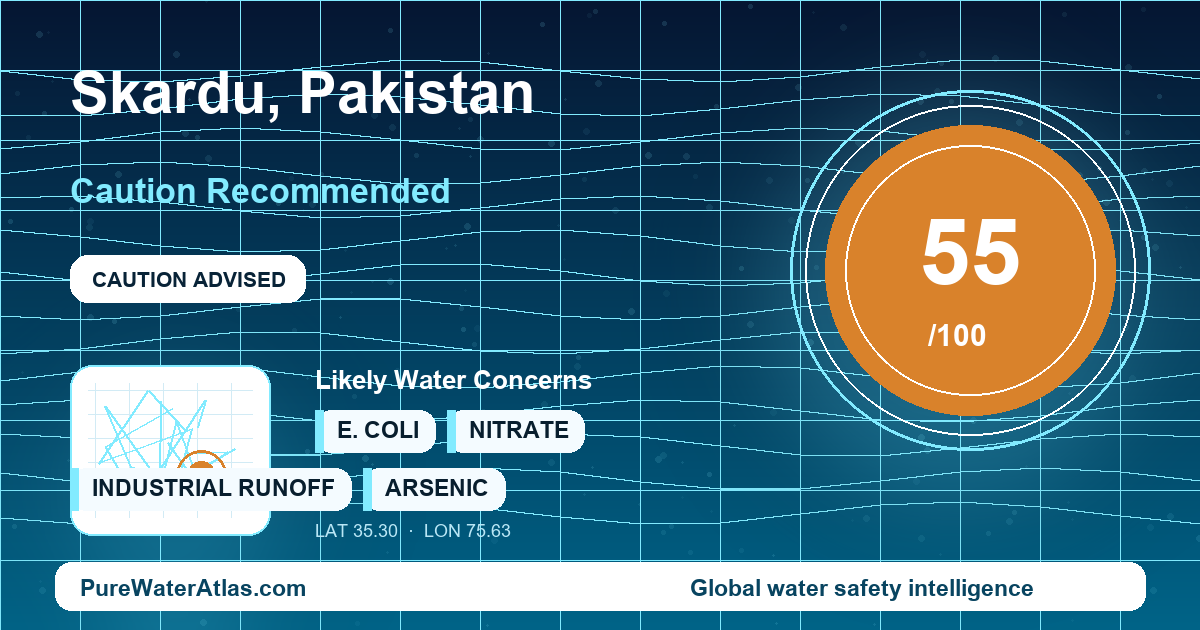
Skardu, Pakistan: mountain-source water from glacier-fed catchments, springs, and the Satpara Lake/Satpara Dam system, with caution recommended because city-level tap-water testing data is limited and building-level storage can change water quality before it reaches the glass.
Quick Answer
| Overall safety status | Caution recommended. Skardu has valuable high-mountain source water, but untreated tap water should not be assumed microbiologically safe at the consumer tap. |
|---|---|
| Water safety score | 55 / 100 — risk level: Caution Recommended. |
| Traveler advice | Use sealed bottled water, boiled water, or water that has been reliably filtered and disinfected. Avoid untreated tap water, especially during summer melt, after heavy rain, or in smaller guesthouses with roof or underground tanks. |
| Resident advice | Treat household drinking and cooking water unless you have recent local test results from your tap and a well-maintained supply. Sediment pre-filtration plus boiling, UV, or another verified disinfection method is a practical baseline. |
| Main water source context | High-mountain surface water and springs, with Satpara Lake and the Satpara Dam system widely identified as important to Skardu’s municipal drinking-water, irrigation, and local hydropower context. |
| Authority context | Public water-supply infrastructure is associated primarily with the Public Health Engineering Department of the Government of Gilgit-Baltistan, with local municipal administration and environmental oversight by GB-EPA relevant to urban services and water pollution control. |
| Filter recommendation | Prioritize sediment removal and microbial disinfection. Reverse osmosis is not automatically necessary for every home, but may be useful if testing shows high TDS, nitrate, arsenic, or other dissolved contaminants. |
Why Skardu Is Different
Skardu is not a typical lowland utility-water case. It is a high-altitude town in Gilgit-Baltistan near the Indus and Shigar river system, surrounded by glaciated mountain catchments. That setting gives the city access to abundant meltwater, springs, and cold mountain flows, but it also creates water-quality variability that can be difficult for visitors to judge by appearance alone. Clear, cold mountain water may still be unsafe if contamination occurs after intake, during storage, or inside a building.
The main issue in Skardu is not that the city lacks natural water. The issue is that source water, distribution water, and tap water are not the same thing. The local supply picture includes public schemes, gravity-fed intakes, service reservoirs, public standposts or house connections, and private or building-level tanks. A hotel, home, or restaurant may receive water from a mountain source, but the final quality depends on pipe condition, pressure continuity, storage-tank hygiene, sediment control, and disinfection.
Data availability also matters. No comprehensive, current, consumer-facing Skardu water-quality report with routine sampling results by source, distribution zone, and household tap was found. This profile therefore gives a cautious, practical risk assessment rather than a claim that every Skardu tap is unsafe or that every tap meets standards.
Where Does Skardu’s Tap Water Come From?
Skardu’s drinking-water supply is tied to high-mountain surface water and springs. The Satpara Lake and Satpara Dam system, south of Skardu, is widely identified as an important source for municipal drinking water, irrigation, and local hydropower. Smaller local supplies also use nallahs, springs, and gravity-fed mountain water channels.
Historically, settlements in Baltistan have relied on glacier-fed streams, springs, and open or semi-open gravity channels for domestic and irrigation water. In and around Skardu, piped schemes and storage reservoirs have expanded, but many households and lodging properties may still depend on local storage tanks, communal taps, or privately managed supply lines. This mixed infrastructure matters because water can pick up sediment or microbial contamination after it leaves a clean source.
Important parts of Skardu’s water system include the Satpara Lake and Satpara Dam catchment, mountain stream and spring intakes, transmission mains, service reservoirs, public standposts, house connections, household roof tanks, underground tanks, hotel storage tanks, and local booster-pump arrangements. Drainage and sanitation infrastructure is unevenly developed compared with tourism and urban growth, which increases the importance of protecting intakes, pipes, and storage tanks from contamination.
Who Manages Drinking Water in Skardu?
Urban drinking-water infrastructure in Skardu is primarily associated with the Public Health Engineering Department of the Government of Gilgit-Baltistan. Local municipal administration is also relevant for urban services, while environmental oversight is linked to the Gilgit-Baltistan Environmental Protection Agency. National drinking-water standards and public-health guidance are set at Pakistan level, with the Pakistan Council of Research in Water Resources and Pakistan-level environmental authorities relevant for testing, standards, and water-quality publications.
Unlike cities where a single metropolitan water utility publishes detailed annual consumer confidence reports, Skardu does not appear to have a routine, consumer-facing water-quality report available online with neighborhood-level results. In practice, verification may require checking with the Public Health Engineering Department, local health authorities, GB-EPA, PCRWR, or a competent certified laboratory. This limited reporting is one reason the PureWaterAtlas verdict is “caution recommended” rather than a simple safe/unsafe declaration.
Main Local Water Concerns
The most important drinking-water concern in Skardu is microbial safety at the tap. Intermittent supply, leaking pipes, open channels, septic influence, contaminated storage tanks, or poor protection of local intakes can allow bacteria or other pathogens to enter water that originally came from a high-quality mountain source. Consumers should pay particular attention after pipe repairs, flooding, heavy rain, visible turbidity, or illness clusters.
Turbidity and sediment are also central Skardu issues. Summer glacier and snowmelt can increase water volume while raising turbidity and fine glacial sediment. Heavy rain, cloudbursts, landslides, and glacial lake outburst flood events in the broader mountain region can disturb intakes and water channels. Turbid water is not just an aesthetic problem: suspended particles can reduce the effectiveness of UV treatment and may indicate greater vulnerability to microbial contamination.
Other documented concerns include variable or undocumented chlorine residual at the consumer tap, sediment accumulation in household tanks and filters, pipe damage or leakage caused by freezing, road works, pressure changes, or aging local distribution infrastructure, and localized nitrate or bacterial contamination where shallow groundwater, springs, or private lines are near latrines, drains, livestock areas, or agricultural runoff. Potential plumbing-related metal exposure is also possible in older buildings, fittings, or tanks, although no verified Skardu-wide lead exceedance dataset was found. Peak tourism periods may further strain hotel tanks, restaurant water handling, and local waste-management systems.
For Travelers
Visitors to Skardu should not drink untreated tap water unless it has been boiled, filtered and disinfected, or the property can show credible recent testing and treatment. The safest default for short-stay visitors is sealed bottled water or properly treated water. This conservative advice is especially important during summer melt, after heavy rain, and in small guesthouses where water may sit in rooftop or underground tanks.
Use bottled, boiled, or filtered water for brushing teeth, especially for children, pregnant travelers, older adults, and anyone with a sensitive stomach. Higher-standard hotels with verified filtration and disinfection may have lower risk, but travelers should still ask what treatment is used. “Filtered” can mean a simple taste or sediment filter, not microbial disinfection.
Avoid ice unless the hotel or restaurant can confirm it was made from bottled or treated water. Ice made from untreated tap water can carry the same microbial risk as the water itself. Be cautious with unsealed refill jugs, rooftop-tank water, raw salads washed in tap water, and drinks diluted with local water.
If trekking or driving outside town, carry a reusable bottle plus a reliable treatment method. For visibly cloudy water, allow sediment to settle and pre-filter before boiling or UV treatment. UV systems are less reliable when water is turbid unless the water is pre-filtered. For background on practical treatment choices, see PureWaterAtlas guides to boiling water purification and UV water purification.
For Residents
For Skardu residents, a home treatment barrier is recommended for drinking and cooking water unless recent test results confirm safety at the household tap. The most practical setup for typical local risks is sediment pre-filtration followed by a reliable disinfection step such as boiling, UV, or another verified method. Reverse osmosis is not automatically necessary for every home, because Skardu’s primary documented concerns are not limited to dissolved salts. However, RO may be appropriate if testing shows high TDS, nitrate, arsenic, or other dissolved contaminants.
Household testing should include E. coli and total coliforms at the tap and after the storage tank, particularly after pipe repairs, flooding, heavy rain, or any cluster of stomach illness. Where chlorination is used, test turbidity, pH, electrical conductivity or TDS, hardness, and residual chlorine. For private springs, wells, or shallow groundwater, include nitrate and a basic sanitary inspection of nearby latrines, drains, livestock areas, and runoff pathways.
Older hotels and homes may have corroded galvanized pipes, older brass fixtures, unknown solder, or neglected internal plumbing. Let stagnant water run briefly before use, avoid using hot tap water for cooking, and test for metals where infants, pregnant people, or long-term residents are exposed. Storage tanks are a major control point in Skardu: clean and disinfect roof or underground tanks on a schedule, keep lids sealed, prevent bird, rodent, dust, and insect entry, drain accumulated sediment, and sample water after the tank rather than only at the supply inlet.
Relevant Contaminants and Water-Quality Issues
Skardu’s local water profile makes several PureWaterAtlas topics especially relevant. Turbidity in drinking water and sediment in drinking water are important because glacier and snowmelt, rainfall, landslides, and disturbed channels can increase suspended solids. Sediment can also accumulate in household tanks and filters, reducing treatment performance.
E. coli in drinking water is a key indicator for microbial contamination from fecal sources, which may enter through sanitation intrusion, leaking pipes, contaminated tanks, or poorly protected springs and shallow groundwater. Chlorine in drinking water is relevant where chlorination is used, because an adequate residual at the tap helps protect water after treatment, while undocumented or inconsistent residuals reduce confidence.
Residents in older buildings should also understand lead in drinking water, especially where old plumbing, solder, brass fittings, or old tanks may be present. For private springs, wells, and shallow groundwater near latrines, livestock, drains, or agricultural runoff, nitrate in drinking water is a relevant testing parameter.
How to Verify Your Water Quality
Because comprehensive Skardu tap-water reporting is not publicly available in a consumer-facing format, the most reliable way to know your household risk is to test the water you actually drink. Sample after the storage tank and at the kitchen tap, not only at the supply inlet. If you use a filter or UV purifier, test both untreated and treated water when possible, and check whether turbidity is low enough for UV to work effectively.
Use PCRWR, a public-health laboratory, a Gilgit-Baltistan government laboratory, or another competent accredited laboratory where available. Home test strips can be useful screening tools, but they are not proof of potability. For a structured testing plan, see the PureWaterAtlas Water Testing guide. For broader interpretation, use the Global Water Quality Checker and the Contaminants Search Engine.
Additional PureWaterAtlas background resources include Drinking Water Safety, Water Microbiology, and Water Purification. If old plumbing is a concern, review lead testing and detection methods. If using a private source near sanitation or agricultural influence, review nitrate testing and detection methods.
Official and Technical Sources
- WAPDA – Satpara Dam Project — official infrastructure source identifying Satpara Dam as a water-storage project connected with Skardu’s water supply, irrigation, and power context.
- Government of Gilgit-Baltistan – Public Health Engineering Department — relevant local government department for public water-supply and sanitation infrastructure in Gilgit-Baltistan.
- Gilgit-Baltistan Environmental Protection Agency — regional environmental authority relevant to water pollution control and environmental monitoring.
- Pakistan Council of Research in Water Resources — national water-quality research authority and reference point for laboratory testing and publications.
- Pakistan Environmental Protection Agency – National Standards for Drinking Water Quality — Pakistan-level standards context for drinking-water quality benchmarks.
- Government of Gilgit-Baltistan ADP 2024-25 — Skardu water-supply schemes — development-sector context on water-supply and sanitation improvement needs in Gilgit-Baltistan urban areas.
- CDC Travelers’ Health – Pakistan — traveler health authority supporting conservative food and water precautions in Pakistan.
- WHO – Guidelines for Drinking-water Quality — global framework for interpreting microbial, chemical, and operational drinking-water risks where local reporting is limited.
- World Bank Climate Change Knowledge Portal – Pakistan — country-level climate-risk context relevant to mountain water systems affected by extreme precipitation, floods, and seasonal variability.
Bottom Line
Skardu’s tap-water risk is shaped by its mountain setting: valuable glacier-fed streams, springs, and the Satpara Lake/Satpara Dam system provide important raw water, but quality at the tap can be affected by sediment, seasonal melt, storms, intermittent supply, pipe leaks, sanitation intrusion, and storage tanks. Because comprehensive Skardu-specific consumer water-quality reports are not publicly available, caution is the safest interpretation. Travelers should use sealed bottled, boiled, or reliably filtered and disinfected water, and avoid untreated tap water and uncertain ice. Residents should treat drinking water unless recent household testing confirms safety, clean tanks regularly, and test for E. coli, turbidity, residual chlorine where applicable, nitrate for private sources, and metals where older plumbing is present.
Read the full guide: Global Water Quality Guide
Explore more in this category: Global Water Quality Articles