
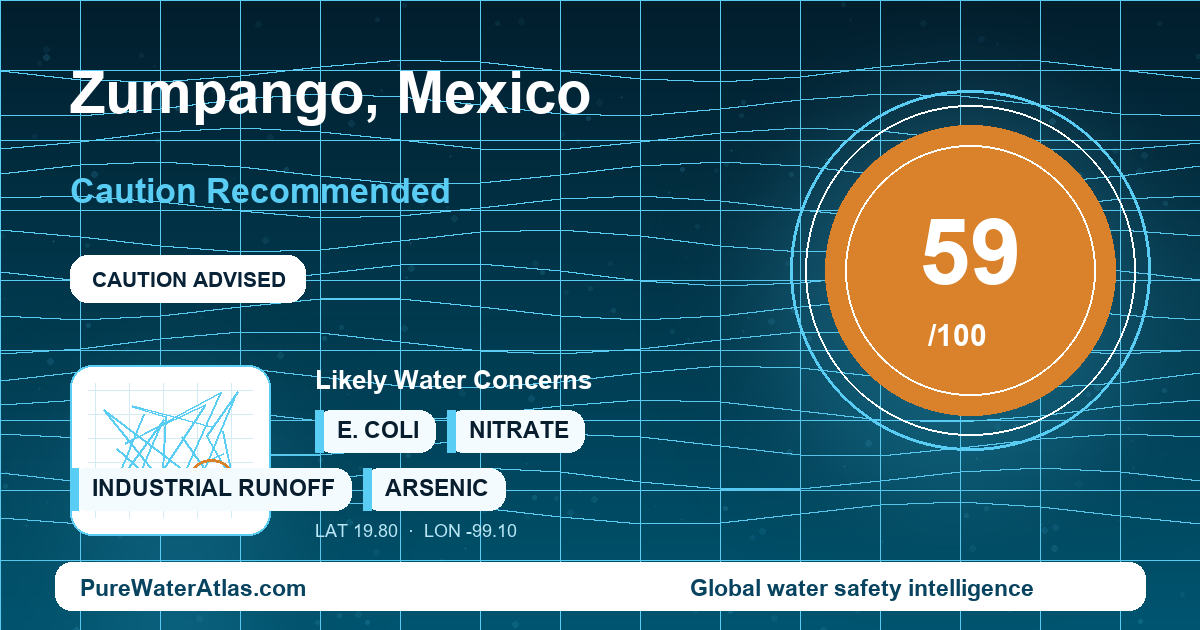
Zumpango, State of Mexico: groundwater-based municipal supply, household storage, and tap-by-tap uncertainty mean caution is recommended for drinking water.
Quick Answer
| Overall safety status | Caution recommended. Zumpango is not a place where visitors should assume untreated tap water is safe to drink directly. |
|---|---|
| PureWaterAtlas score | 59 / 100 — risk level: Caution Recommended. |
| Traveler advice | Use sealed bottled water, commercially purified garrafón water, or water from a clearly maintained purification system. Be cautious with ice unless it is confirmed to be made from purified water. |
| Resident advice | Treat tap water as utility water unless you have recent results from your own tap. Use point-of-use treatment, keep cisterns and tinacos clean, and test periodically. |
| Main water source | Primarily municipal groundwater wells associated with the Cuautitlán-Pachuca aquifer system in the northern Valley of Mexico. |
| Local water authority | Municipal service is commonly associated with ODAPAS Zumpango, with state coordination from the Comisión del Agua del Estado de México and federal water-resource oversight by CONAGUA. |
| Filter recommendation | A sediment prefilter plus activated carbon is useful for particles, taste and chlorine. Reverse osmosis is more appropriate if testing shows high dissolved solids, nitrate, salinity or problematic groundwater minerals. UV can help with microbes only after turbidity is controlled. |
Why Zumpango Is Different
Zumpango’s drinking-water risk profile is shaped by its location in the northern State of Mexico, within the Valley of Mexico basin and close to Laguna de Zumpango. This is a fast-growing urban corridor connected to the broader Mexico City metropolitan region and the Felipe Ángeles International Airport zone. The practical drinking-water issue is not a single publicly documented citywide contaminant event. It is the combination of groundwater dependence, a stressed aquifer setting, variable municipal distribution conditions, intermittent pressure risk, and private storage in cisterns or rooftop tinacos.
The city sits in a former lacustrine environment. Laguna de Zumpango and regional drainage works are important local water features, but they should not be assumed to be the normal potable source for households. The lake-bed history matters because former closed-basin environments can produce groundwater and soil conditions associated with mineralization, salinity, hardness, chloride, sulfate, scaling or unpleasant taste. These are not uniform citywide conclusions; they are reasons to test rather than rely on appearance or taste.
Zumpango is also a place where two buildings on the same street may have very different tap-water quality. Even if both receive water from the same municipal network, the last stage of delivery may be a private cistern, roof tank, hose, building pipework or local pressure zone. A hotel with a maintained purifier can be safer than a household tank that has not been cleaned, while a clear-looking tap can still require microbiological verification.
Where Does Zumpango’s Tap Water Come From?
Zumpango’s public drinking-water supply is primarily associated with groundwater pumped from municipal wells in the Cuautitlán-Pachuca aquifer system of the northern Valley of Mexico. Water is distributed through municipal infrastructure after disinfection, typically involving chlorination or other disinfection points at wells or storage facilities. From there, it moves through municipal distribution mains, storage tanks, elevated tanks and pressure zones before reaching buildings.
This well-and-distribution model is different from a single centralized surface-water treatment plant that delivers one relatively uniform finished water. In Zumpango, water quality depends on well condition, disinfection performance, pressure changes, pipe condition and the cleanliness of household storage. That means the most relevant question is often not only “Is the municipal source treated?” but also “What happens between the well, the network, the cistern, the tinaco and the kitchen tap?”
Household cisterns and rooftop tinacos are especially important. They can protect residents during interruptions, but they can also become points of contamination if covers are loose, screens are missing, sediment accumulates, algae grows, insects enter or chlorine residual declines during storage. This is why a tap-specific test is more meaningful than a general assumption about the municipal system.
Who Manages Drinking Water in Zumpango?
The local service provider is the municipal decentralized water and sanitation operator commonly referred to as ODAPAS Zumpango, or the Organismo Descentralizado de Agua Potable, Alcantarillado y Saneamiento de Zumpango. At the state level, coordination and support may involve the Comisión del Agua del Estado de México. At the federal level, groundwater resources, aquifer availability and national water policy fall under CONAGUA.
Drinking-water quality in Mexico is governed by federal health standards, especially NOM-127-SSA1-2021, the standard for water for human use and consumption. CONAGUA’s aquifer documentation and national water-information systems provide important context for the regional groundwater setting, including the Cuautitlán-Pachuca aquifer availability document and the Sistema Nacional de Información del Agua aquifers portal.
A key limitation is that recent, comprehensive, publicly accessible neighborhood-by-neighborhood tap-water test results for Zumpango were not found in the high-authority sources used for this profile. This assessment should not be read as proof that every Zumpango tap is unsafe, nor as proof that the municipal system violates standards. It is a risk-based guide based on groundwater context, local infrastructure and common distribution and storage vulnerabilities.
Main Local Water Concerns
- Groundwater stress and overexploitation: CONAGUA aquifer documents for the Cuautitlán-Pachuca system identify a stressed groundwater setting. Overexploitation can contribute to deeper pumping, pressure interruptions, higher energy needs and possible changes in mineral quality.
- Mineralization, salinity, hardness and taste: Zumpango’s former lake-basin setting makes hard, salty or mineral-tasting water a plausible regional concern. Electrical conductivity, total dissolved solids, hardness, chloride and sulfate should be tested when residents notice scaling, corrosion, salty taste or unusual mineral flavor.
- Microbial risk after distribution or storage: Even when water is chlorinated in the system, contamination can occur in low-pressure pipes, cisterns, tinacos, hoses or internal plumbing. Total coliform, E. coli and free chlorine residual are the most practical first checks.
- Turbidity and sediment: Cloudy water or visible particles may occur after repairs, outages, pressure changes or tank cleaning. Turbidity can interfere with disinfection, while sediment can indicate disturbed pipes or tanks.
- Nitrate as a potential concern: Peri-urban growth, agriculture, septic leakage and wastewater influence can affect groundwater in many urban-edge settings. Nitrate testing is especially important for infants, pregnant residents and homes using private or poorly characterized wells.
- Lead and premise plumbing: There is no verified public evidence of a Zumpango-wide lead crisis. However, older plumbing, brass fixtures, solder and galvanized materials can create building-specific exposure. Lead testing should use both first-draw and flushed samples in older properties.
Season also matters. During the rainy season, heavy storms can increase turbidity, runoff intrusion and sewer overflow risk where drainage and water lines are close or cistern covers are not sealed. During the dry season, lower supply pressure and stronger reliance on stored water may increase stagnation, chlorine loss and taste problems. After outages or repairs, avoid drinking discolored or sediment-laden water until it has been flushed and, when necessary, treated or tested.
For Travelers
Short-term visitors should not drink untreated tap water in Zumpango. Use sealed bottled water, commercially purified garrafón water or water from a verified filtration and disinfection system. This conservative advice is consistent with the city’s groundwater and storage context and with travel-health guidance that urges caution with food, water and ice in Mexico.
For brushing teeth, bottled or purified water is the safer choice, especially for children, immunocompromised travelers or anyone staying in a house or rental with unknown tank maintenance. Many residents may use tap water for brushing, but travelers are more vulnerable because they may not be accustomed to local microbes or building-specific water conditions.
Use ice only when the hotel, restaurant or store can confirm it is made from purified water or supplied by a commercial ice provider. Avoid informal ice from unknown sources. In restaurants and hotels, ask whether drinking water and ice come from garrafón, a maintained purifier or a commercial supplier. Hot drinks made with fully boiled water are generally lower risk for microbes, but handling, storage and clean cups still matter.
Carry bottled water for drinking and oral medications. Do not rely on clarity, smell or taste as proof of safety. If you are renting a home in Zumpango, ask when the cistern or tinaco was last cleaned and check whether the lid is sealed and screened.
For Residents
Residents should treat Zumpango tap water as utility water unless they have recent test results from their own tap. A home treatment system is advisable if municipal water is used for drinking or cooking. For many households, a sediment prefilter followed by activated carbon can improve particles, taste, chlorine and odors. If testing shows high total dissolved solids, nitrate, salinity or other groundwater-related mineral concerns, reverse osmosis is the more appropriate treatment category. UV disinfection can help with microbial risk, but only if turbidity is controlled first and the lamp is maintained correctly.
Testing should be practical and location-specific. Start with total coliform and E. coli at the kitchen tap. If bacteria are detected, test the cistern or tinaco outlet separately to identify whether the problem is entering from storage. Measure free chlorine residual at the tap, especially after outages or long storage periods. Test turbidity, pH, electrical conductivity, total dissolved solids and hardness to understand mineral quality and treatment needs.
Nitrate testing is important for households with infants, pregnant residents, private wells, nearby septic systems, agriculture or unexplained health concerns. A one-time baseline test for arsenic and other metals is prudent for long-term drinking of well-derived water, but a Zumpango-wide arsenic claim should not be made without local data. Older buildings should also be tested for lead using first-draw and flushed samples.
Cisterns and tinacos should be covered, screened, cleaned and disinfected on a schedule. Dirty tanks can defeat municipal chlorination and create E. coli, sediment, algae, insects and odor problems. A point-of-use filter should not be treated as a substitute for basic tank hygiene.
Relevant Contaminants and Water-Quality Issues
The most relevant Zumpango water-quality checks are microbial indicators, chlorine residual, turbidity, sediment and groundwater chemistry. E. coli is the key fecal indicator for unsafe storage, low-pressure intrusion or contaminated cisterns. Chlorine residual helps show whether disinfection protection is still present at the tap after distribution and storage.
Turbidity and sediment are important when water becomes cloudy after outages, repairs or tank disturbance. Nitrate is a sensible groundwater screening parameter for peri-urban areas, especially where infants or pregnant residents are present. Lead is primarily a building-plumbing concern rather than a verified citywide Zumpango crisis. Arsenic is a prudent one-time groundwater screening parameter, but it should be confirmed by laboratory testing before choosing treatment.
How to Verify Your Water Quality
The most reliable way to know whether your Zumpango tap water is safe is to test the actual water you drink. Start with the PureWaterAtlas guide to water testing, then compare likely contaminants using the Contaminants Search Engine. Travelers comparing destinations can also use the Global Water Quality Checker.
For emergency or short-term microbial risk reduction after an outage, see Boiling Water Purification: Complete Guide. For installed treatment options, review UV Water Purification: Complete Guide and the PureWaterAtlas overview of water treatment systems. For specific testing methods, see the guides on nitrate testing, lead testing and arsenic testing.
Broader background resources include Drinking Water Safety, Water Microbiology and Water Contamination.
Official and Technical Sources
- CONAGUA: Disponibilidad media anual de agua subterránea, Acuífero Cuautitlán-Pachuca — official groundwater availability context for the aquifer system associated with Zumpango.
- CONAGUA Sistema Nacional de Información del Agua aquifers portal — federal reference for aquifer status and groundwater management.
- Diario Oficial de la Federación: NOM-127-SSA1-2021 — Mexican federal drinking-water quality standard.
- Comisión del Agua del Estado de México — state water institution relevant to infrastructure and service coordination.
- Gobierno Municipal de Zumpango — official municipal portal for local government and public-service context.
- Data México profile for Zumpango — official geographic and socioeconomic context for the municipality.
- CDC Travelers’ Health: Mexico — travel-health guidance supporting conservative water and ice precautions.
- World Health Organization Guidelines for Drinking-water Quality — international reference for microbial risk, turbidity and disinfection principles.
Bottom Line
Zumpango’s tap water should be approached with caution, especially by visitors. The city’s supply is primarily linked to municipal groundwater wells in the Cuautitlán-Pachuca aquifer system, followed by chlorination, distribution networks and frequent household storage in cisterns or tinacos. The main risk is tap-by-tap variability: pressure changes, stressed groundwater, mineral quality, old plumbing and dirty storage tanks can all affect the water that actually reaches a glass. Use bottled or purified water for short stays. Residents should test their own tap, maintain tanks, and choose treatment based on results rather than taste alone.
Read the full guide: Global Water Quality Guide
Explore more in this category: Global Water Quality Articles