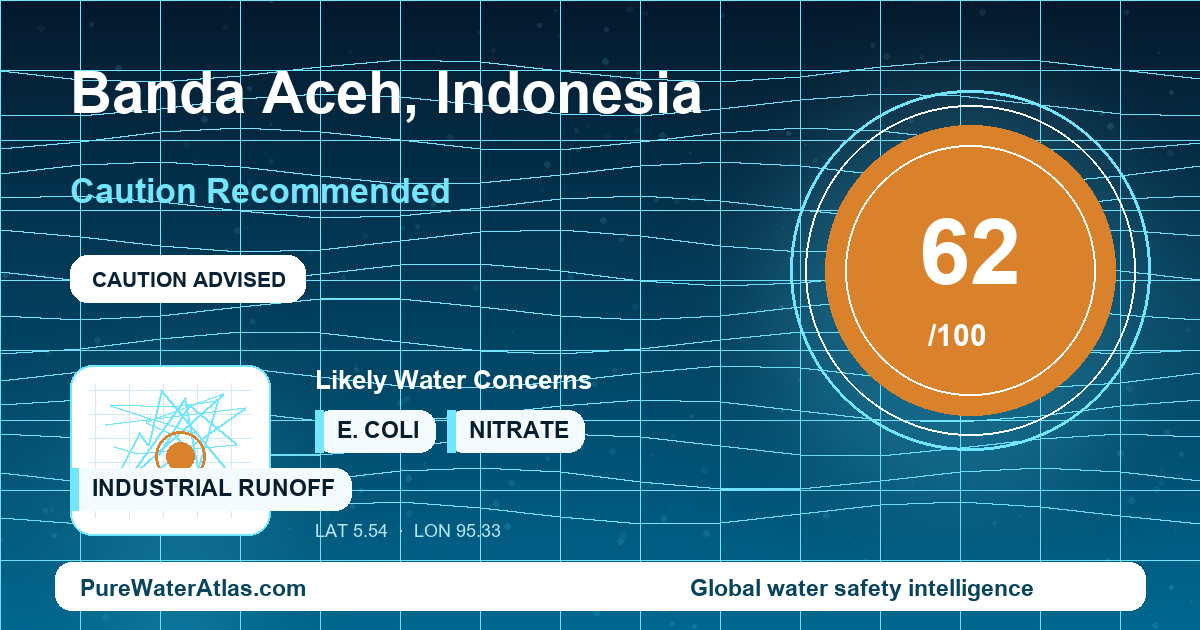
Banda Aceh, Indonesia: treated municipal supply exists, but drinking tap water untreated is not recommended for most visitors because point-of-use safety can vary by neighborhood, building plumbing, storage tanks, wells, and refill-water practices.
Quick Answer
| Water safety score | 62 / 100 |
|---|---|
| Risk level | Caution Recommended |
| Can tourists drink the tap water? | Not recommended untreated. Use sealed bottled water, properly treated refill water, or boiled water for drinking. |
| Resident guidance | Residents connected to Perumda Air Minum Tirta Daroy may receive treated water, but a point-of-use barrier is prudent where water is stored, supply is intermittent, plumbing is old, or household risk is higher. |
| Main municipal source context | Treated surface water associated with the Krueng Aceh river system and related treatment infrastructure serving Banda Aceh and nearby Aceh Besar. |
| Water authority | Perumda Air Minum Tirta Daroy Kota Banda Aceh. |
| Filter recommendation | Sediment prefiltration plus activated carbon and boiling or UV for microbial risk. Consider reverse osmosis only when testing confirms salinity, nitrate, dissolved metals, or similar chemical concerns. |
Overall verdict: Caution is recommended. Banda Aceh has an organized municipal water utility and treated piped supply, but travelers should not assume water is potable at the tap because recent citywide monitoring results, chlorine residual data, and contaminant-by-contaminant public reporting are not easy to verify. Water quality can also change after it leaves the utility system, especially inside building plumbing or storage tanks.
Why Banda Aceh Is Different
Banda Aceh is not a generic inland water-supply case. It is a low-lying coastal city at the northern tip of Sumatra, near the Andaman Sea and the mouth of the Krueng Aceh river system. That geography matters for drinking water because heavy rainfall, river turbidity, flooding, drainage overflow, and coastal salinity pressures can all affect source water, shallow groundwater, wells, tanks, and local distribution conditions.
The city also has a major water-infrastructure history. Banda Aceh’s urban systems were severely affected by the 2004 Indian Ocean tsunami, and major reconstruction followed. That history does not mean today’s municipal water is automatically unsafe, but it explains why the city contains a mix of rebuilt infrastructure, older private plumbing, filled land, shallow groundwater use, and coastal sanitation challenges. In practical terms, the safety question is not only “does Banda Aceh have a water utility?” It does. The more important question is whether the water remains safe after passing through local pipes, building pumps, roof or ground tanks, and taps.
For visitors, this difference is critical. A hotel may be connected to the municipal supply but still store water in tanks before it reaches bathrooms or kitchen areas. If those tanks are not sealed, cleaned, and disinfected, treated water can be recontaminated. For residents, the key issue is building-level control: testing at the actual tap and maintaining tanks can matter as much as knowing the municipal source.
Where Does Banda Aceh’s Tap Water Come From?
Banda Aceh’s municipal piped water is supplied by Perumda Air Minum Tirta Daroy Kota Banda Aceh. The city’s piped supply is understood to rely mainly on treated surface water associated with the Krueng Aceh river system and related treatment infrastructure serving Banda Aceh and the surrounding Aceh Besar area. The local water-supply picture also includes non-municipal sources: some households, businesses, refill-water sellers, and buildings may use groundwater or delivered water depending on connection status and local practice.
The main water infrastructure relevant to tap-water safety includes the municipal utility, surface-water intake and treatment infrastructure linked to the Krueng Aceh raw-water system, the urban distribution network, household and building-level storage tanks, and alternative supplies such as private wells, refill-water depots, and bottled water. Each of these points can change the risk profile. Municipal treatment may reduce pathogens and turbidity at the plant, but low pressure, pipe interruptions, dirty storage tanks, and premise plumbing can introduce different risks at the tap.
Historically, shallow wells and local groundwater were used by many households in coastal Aceh. The 2004 tsunami damaged infrastructure and salinized or contaminated many coastal wells. Post-tsunami reconstruction restored and expanded piped-water assets, but shallow groundwater near the coast can still be vulnerable to salinity, flooding, and sanitation impacts. Residents using wells or mixed water sources should not judge safety by taste alone; brackish water, nitrate, microbial contamination, and metals require testing.
Who Manages Drinking Water in Banda Aceh?
The local municipal drinking-water company is Perumda Air Minum Tirta Daroy Kota Banda Aceh. The Banda Aceh City Government provides official local government context, while BPS Kota Banda Aceh is the official statistics agency for city geography, population, and municipal statistics. River-basin and water-resources context is connected to Balai Wilayah Sungai Sumatera I, which is relevant to the Krueng Aceh basin and regional water management.
Indonesia’s drinking-water quality framework is set nationally, including Ministry of Health Regulation No. 2 of 2023 on environmental health implementing regulations. Local utilities are expected to operate treatment and distribution systems under Indonesian standards. However, this review did not find a current, detailed, public Banda Aceh water-quality report equivalent to a full annual consumer confidence report with neighborhood-level compliance, residual chlorine, E. coli, metals, nitrate, salinity, and other parameter results. That is why the recommendation remains cautious rather than a blanket “safe” rating.
Main Local Water Concerns
- Microbial contamination at point of use: Intermittent supply, low pressure, cross-connections, dirty storage tanks, untreated wells, or poor depot practices can allow bacteria, viruses, or protozoa to enter water after treatment. This is the main reason travelers should not drink untreated tap water in Banda Aceh.
- High turbidity and sediment during rain events: The Krueng Aceh catchment can experience runoff and suspended sediment during heavy rain. Turbidity can reduce disinfection effectiveness and may appear as cloudy or muddy water if treatment or distribution control is stressed.
- Coastal salinity and brackish groundwater: Low-lying coastal districts and shallow wells can be affected by seawater intrusion, tsunami legacy salinity, tidal influence, or dry-period concentration. This is more relevant to private wells than to properly treated municipal surface water, but well users should test conductivity or total dissolved solids.
- Storage-tank hygiene: Roof tanks, ground tanks, hotel tanks, and household reservoirs can accumulate sediment, biofilm, insects, or fecal contamination if they are not sealed and cleaned regularly.
- Old plumbing and premise-level metals: Lead is not identified here as a Banda Aceh source-water issue, but older fittings, solder, brass components, pumps, and internal pipes can contribute metals in individual buildings. This can only be confirmed by testing at the tap.
- Variable refill-water quality: Refill-water depots are widely used in Indonesia, but safety depends on the source water, filtration, UV or ozone maintenance, bottle sanitation, and operator practice. Choose depots with visible maintenance and high turnover.
For Travelers
Drinking: Do not drink Banda Aceh tap water untreated. Use sealed bottled water, properly treated refill water, or water that has been boiled. This is a conservative traveler-safety recommendation based on uncertainty at the tap; it is not a claim that the municipal utility always fails standards.
Brushing teeth: Use bottled, boiled, or reliably filtered water if you have a sensitive stomach, are immunocompromised, are traveling with children, or are staying in budget accommodation where tank hygiene is unknown. Many long-term residents may use tap water for brushing, but short-term visitors should be more cautious.
Ice: Avoid ice from unknown street vendors. In hotels and established restaurants, ask whether ice is made from purified water. Clear factory-made ice is generally lower risk than homemade ice made from tap or tank water, but the source and handling still matter.
Hotels and restaurants: Higher-end hotels and restaurants may use treated water, bottled water, or additional filtration, but do not assume this. Ask for sealed bottled water when uncertain. Be cautious with open jugs, reused bottles, visibly dirty dispensers, or water served after flooding or service interruptions.
Rain and flooding: During monsoon rain, urban drainage events, or service interruptions, avoid any tap water that is cloudy, smells unusual, has visible sediment, or has recently returned after being off. Boiling helps control microbial risk, but it does not remove salinity, metals, nitrate, or chemical contaminants.
For Residents
For Banda Aceh residents, a point-of-use system is advisable for drinking and cooking water, especially in homes with storage tanks, children, elderly residents, immunocompromised people, uncertain plumbing, or mixed water sources. A practical setup is sediment prefiltration followed by activated carbon and then boiling or UV disinfection for microbial control. Reverse osmosis is more appropriate where testing confirms salinity, nitrate, dissolved metals, or similar chemical concerns.
Testing should be done at the actual tap after water has passed through building plumbing and storage tanks, not only at the incoming municipal connection. For microbial safety, test for E. coli or thermotolerant coliforms after flooding, pipe repairs, service interruptions, or tank cleaning. For wells or mixed sources, test electrical conductivity, total dissolved solids, chloride, nitrate, iron, manganese, pH, turbidity, and E. coli. If water is used for infants, pregnant people, or immunocompromised residents, prioritize nitrate and microbial testing.
Older homes, schools, guesthouses, and small commercial buildings may have internal plumbing, pumps, fittings, or storage systems that are more important to tap-water quality than the municipal source. If the building is older or has unknown metal fittings, test first-draw and flushed samples for lead and other metals before relying on the tap for drinking.
Storage tanks should be sealed, screened against insects and animals, drained of sediment, cleaned periodically, and disinfected after maintenance or flooding. A dirty tank can recontaminate treated municipal water and make point-of-use treatment necessary.
Relevant Contaminants and Water-Quality Issues
Banda Aceh’s most relevant water-quality issues are microbial risk, turbidity, sediment, storage-tank hygiene, salinity in shallow wells, and premise-level metals. Learn more about E. coli in drinking water as an indicator of fecal contamination in wells, tanks, and distribution systems. Review turbidity in drinking water and sediment in drinking water if water becomes cloudy or visibly dirty after rain, repairs, or storage-tank disturbance.
For piped systems, chlorine in drinking water is relevant because residual disinfectant helps protect water as it moves through pipes and tanks. For private wells or mixed sources influenced by sanitation or runoff, nitrate in drinking water is important, especially for infants. For older buildings with unknown internal plumbing, review lead in drinking water and lead testing and detection methods.
How to Verify Your Water Quality
The safest way to verify water in Banda Aceh is to test the water you actually drink. Municipal source and treatment information is useful, but it cannot prove safety at a household tap after water has passed through distribution pipes, pumps, tanks, and fixtures. Start with microbial testing if the water is used for drinking, cooking, infant formula, or immunocompromised residents. Add turbidity, pH, electrical conductivity, total dissolved solids, chloride, nitrate, iron, manganese, and metals when using wells, mixed supplies, older buildings, or water with unusual taste, odor, cloudiness, or salinity.
PureWaterAtlas resources that may help include the complete guide to water testing, the drinking water safety guide, the water microbiology guide, and the water purification methods guide. For quick reference, use the Contaminants Search Engine and the Global Water Quality Checker. For treatment choices, see the boiling water purification guide and the UV water purification guide.
Official and Technical Sources
- Perumda Air Minum Tirta Daroy Kota Banda Aceh — local municipal drinking-water company for Banda Aceh’s piped-water service.
- Banda Aceh City Government — official local government context for the city.
- BPS Kota Banda Aceh — official statistics source for geography, population, administrative area, and municipal statistics.
- Balai Wilayah Sungai Sumatera I — regional river basin authority relevant to Krueng Aceh and water-resources management.
- Ministry of Health Regulation No. 2 of 2023 — Indonesian national regulation covering environmental health standards, including drinking-water quality requirements.
- WHO Guidelines for Drinking-water Quality — international guidance on microbial and chemical drinking-water risk management.
- CDC Travelers’ Health: Indonesia — traveler health guidance supporting conservative food and water precautions.
- World Bank Indonesia — background context on Indonesia’s water and sanitation sector.
Data limitation: City-level information is available for Banda Aceh’s utility identity, geography, and infrastructure context, but recent public tap-by-tap monitoring results were not found in a form that supports exact claims about universal potability, neighborhood compliance, residual chlorine, E. coli absence, metals, nitrate, or salinity. Conditions can differ between municipal connections, private wells, refill depots, hotels, and buildings with tanks.
Bottom Line
Banda Aceh has a formal municipal water utility, Perumda Air Minum Tirta Daroy, and treated piped water linked to the Krueng Aceh surface-water system. Still, untreated tap water is not recommended for most travelers because safety at the tap can be affected by intermittent pressure, old or private plumbing, roof or ground tanks, flooding, turbidity after heavy rain, and variable refill-water practices. Residents should treat and test water based on the actual source and building conditions. Boiling or UV plus filtration is most useful for microbial risk, while salinity, nitrate, metals, and other chemical concerns require laboratory testing. The prudent approach in Banda Aceh is cautious: use bottled, properly treated, boiled, or verified filtered water for drinking.
Read the full guide: Global Water Quality Guide
Explore more in this category: Global Water Quality Articles