
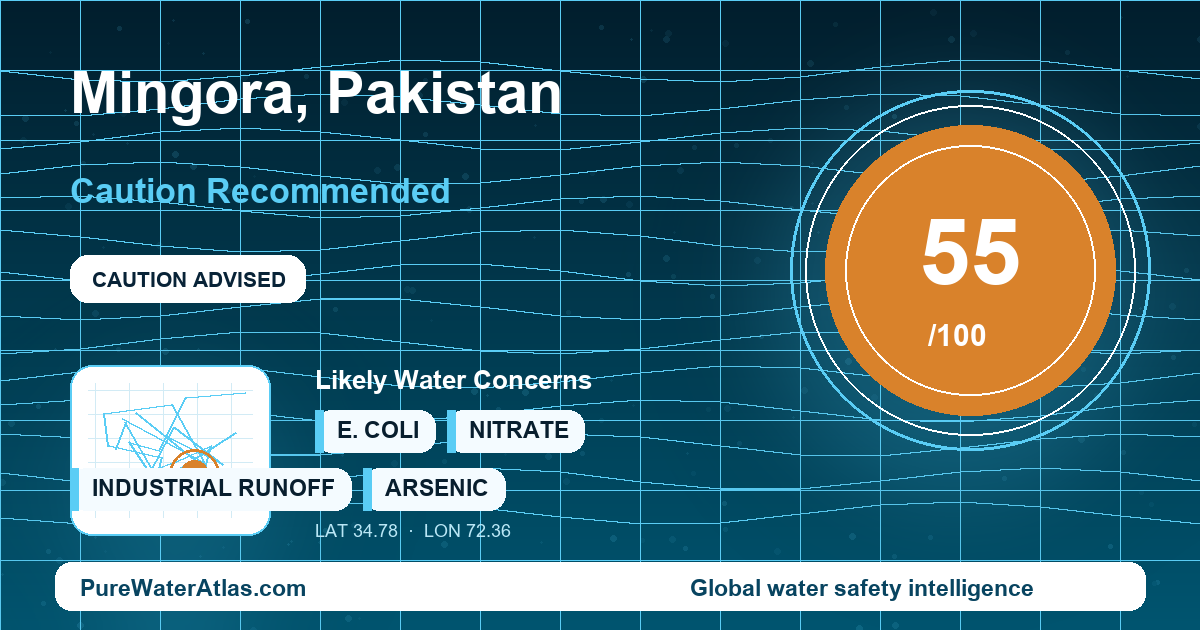
Mingora, Pakistan: a Swat valley water profile focused on municipal supply, private boreholes, storage tanks, monsoon and flood risk, and practical drinking-water precautions.
Quick Answer
| Overall safety status | Caution recommended. Mingora has an organized local water service provider and mixed groundwater and spring-fed supplies, but recent public citywide tap-water compliance data are limited. The practical risk is mainly microbial contamination and turbidity, not high salinity. |
|---|---|
| Water safety score | 55/100 — risk level: Caution Recommended. |
| Short-term visitors | Do not rely on untreated tap water. Use sealed bottled water, hotel-provided treated water, or water that has been boiled, disinfected, or filtered through a properly maintained purifier. |
| Residents | Treat tap, borehole, or stored water before drinking unless you have recent household-specific test results from the actual drinking tap. |
| Main water sources | Mixed local-source system: municipal tube wells, groundwater, upland spring or gravity-fed supplies, service reservoirs, distribution mains, and widespread building storage tanks and private boreholes. |
| Local authority | Water and Sanitation Services Company Swat, commonly referred to as WSSC Swat or WSSCM, is the main urban water and sanitation entity associated with Mingora. |
| Filter recommendation | For most homes: sediment prefilter plus reliable disinfection such as UV, boiling, or correctly dosed chlorination. Use reverse osmosis only when testing shows high TDS, nitrate, arsenic, fluoride, or other dissolved contaminants. |
Why Mingora Is Different
Mingora is the largest urban center in Swat District, Khyber Pakhtunkhwa, and sits in the Swat valley near the Swat River system. Its drinking-water context is shaped by mountain catchments, snowmelt, upland springs, alluvial groundwater, monsoon rainfall, and flood pathways. This means the raw water environment can be very different from arid or coastal parts of Pakistan where salinity is often a dominant concern. In Mingora, the more immediate drinking-water question is whether water remains microbiologically safe after collection, pumping, storage, and distribution.
The city is not best understood as a single, continuously monitored metropolitan treatment-plant system. It is better described as a mixed local-source system using municipal tube wells, spring or gravity-fed source lines where topography allows, reservoirs, distribution mains, building-level tanks, private boreholes, bottled water, and local filtration arrangements. That mixed setup makes water safety highly building-specific. A newer hotel with a maintained purifier and clean storage tank may provide safer water than a guesthouse using untreated municipal or bore water stored in an unclean rooftop tank.
Mingora is also included in the Asian Development Bank-supported Khyber Pakhtunkhwa Cities Improvement Project, with local project context available through KPCIP. That is an important signal: urban water, sanitation, drainage, and municipal services in participating KP cities, including Mingora, are recognized as needing improvement rather than being uniformly modern and low-risk.
Where Does Mingora’s Tap Water Come From?
Mingora’s urban supply is best characterized as a combination of groundwater and upland spring or gravity-fed sources in the Swat valley. Water is conveyed through pump houses, reservoirs, service reservoirs, and local distribution mains. In parts of the city, municipal tube wells serve the piped network. In other areas, spring-fed or gravity-fed lines may contribute where the local topography makes that possible.
This source setting has strengths and weaknesses. Mountain recharge, springs, and groundwater can produce clear and relatively fresh water. However, in a dense urban area, safety can deteriorate after water leaves the source. Distribution pipes, roadside drains, septic systems, stormwater channels, storage tanks, and household plumbing may be close together. If supply is intermittent or pressure is low, leaks and cross-connections can allow contaminated water to enter the system. During pipe repairs, roadworks, long outages, or sudden pressure changes, consumers should flush taps and use treated water until clarity and disinfection are confirmed.
Household storage is especially important in Mingora. Rooftop tanks and underground tanks are common practical links in the water chain. A municipal or borehole source may be acceptable at the point of abstraction, yet the kitchen tap can still be unsafe if a tank is uncovered, cracked, dusty, insect-accessible, or close to sewer leakage. This is why household testing should be done at the actual drinking tap, not only at the borehole or source.
Who Manages Drinking Water in Mingora?
The main urban water and sanitation service entity associated with Mingora is Water and Sanitation Services Company Swat, commonly called WSSC Swat or WSSCM. Provincial roles also involve Khyber Pakhtunkhwa local government institutions and the Public Health Engineering Department for policy, schemes, and sector oversight.
Pakistan’s drinking-water quality framework is generally based on the National Standards for Drinking Water Quality. The Pakistan Council of Research in Water Resources is also relevant for national water-quality monitoring and laboratory context. However, these sources do not create a continuously updated public dashboard showing Mingora neighborhood tap-water results, residual chlorine, E. coli compliance, or contaminant-by-contaminant household data.
That data limitation matters. This profile does not claim that Mingora tap water meets or fails every drinking-water standard. The recommendation is based on the known institutional setting, mixed-source infrastructure, intermittent and storage-related risks, flood and monsoon exposure, and conservative public-health guidance for drinking water in places where recent household tap results are not publicly consolidated.
Main Local Water Concerns
Microbial contamination is the top practical concern. In Mingora, risk can come from intermittent supply, low pressure, leaks, nearby drains, septic influence, sewer cross-contamination, and storage tanks. The key health marker is E. coli, which indicates fecal contamination and possible presence of disease-causing organisms.
Turbidity and sediment can rise seasonally. Monsoon rainfall, snowmelt runoff, landslides, pipe repairs, and flood damage can increase visible particles and cloudiness. Turbidity is important because cloudy water can interfere with disinfection, while sediment can clog filters, settle in tanks, and carry associated contaminants.
Residual chlorine may be variable. In intermittent and decentralized systems, maintaining an effective disinfectant residual through the entire network and into building storage tanks is difficult. Chlorine is not only a treatment chemical; measurable residual chlorine can also be an operational clue that piped water has some continuing disinfection protection.
Private boreholes need chemical testing. Shallow wells or poorly protected boreholes near septic systems, drains, cultivated land, livestock areas, or sanitation sources may have nitrate risk. Pakistan also has regional arsenic concerns in some alluvial aquifers. The reviewed dataset does not support claiming a Mingora-specific arsenic crisis, but arsenic should still be tested at least once in private boreholes because it cannot be detected by taste, smell, or appearance.
Metals can be building-specific. Lead is not documented here as a citywide Mingora contaminant, but older internal plumbing, brass fixtures, solder, galvanized pipes, and stagnant water can create building-level exposure risk. Iron and manganese can occur in groundwater and may cause color, metallic taste, staining, or filter fouling; these are often aesthetic at common levels, but colored water should be tested.
For Travelers
Short-term visitors should not drink untreated tap water in Mingora. A healthy adult may tolerate some local exposure, but visitors are at higher risk of gastrointestinal illness because the safety of building storage tanks, residual chlorine, and internal plumbing is uncertain. Use sealed bottled water from reputable brands, hotel-provided treated water, or water that has been boiled, disinfected, or filtered through a properly maintained purifier.
Use bottled, boiled, or filtered water for brushing teeth, especially for children, pregnant travelers, immunocompromised travelers, and anyone with a sensitive stomach. Avoid ice from street vendors and small restaurants unless you can verify it was made from treated water. In hotels, ask whether ice is made from bottled or filtered water.
When choosing accommodation, ask practical questions: Does the hotel use a maintained filtration or UV system? When were rooftop or underground tanks last cleaned? Is the drinking water separate from general tap water? Hot tea and thoroughly boiled beverages are generally lower risk than unverified cold drinks with ice.
Carry sealed bottled water when traveling around Mingora and the wider Swat valley. Check bottle seals and avoid refilled bottles. During or after heavy rain, flooding, landslides, pipe breaks, or water outages, assume tap water needs boiling or disinfection. For emergency microbial treatment, see the PureWaterAtlas Boiling Water Purification Complete Guide.
For Residents
Most Mingora households should treat drinking water unless recent testing confirms the actual kitchen tap is microbiologically safe. A practical setup is a sediment prefilter followed by reliable disinfection. UV can be effective when water is already low in turbidity or has been prefiltered; see the UV Water Purification Complete Guide. Boiling and correctly dosed chlorination are also practical microbial controls. Activated carbon can improve taste and reduce some odor issues, but it should not be used as a substitute for disinfection.
Reverse osmosis should be selected based on testing, not assumption. RO is useful where TDS, nitrate, arsenic, fluoride, or other dissolved contaminants are high. It should not be treated as a stand-alone answer to microbial risk if the system is poorly maintained or if storage after filtration is unhygienic. Poorly maintained RO units can themselves become microbial reservoirs.
Testing should focus on the water people actually drink. Sample from the kitchen tap after water has passed through the building’s tank, internal pipes, and any household filter. At least annually, and after floods, sewage backups, tank cleaning, pipe breaks, or long outages, test for E. coli or thermotolerant coliforms. Measure turbidity, pH, electrical conductivity, TDS, and residual chlorine as basic operational indicators. For private boreholes, test nitrate and arsenic. Test iron and manganese if water is yellow, brown, black, metallic-tasting, or stains fixtures. Test lead and other metals if the building is old, plumbing materials are unknown, water stands overnight in pipes, or infants and pregnant people drink the water.
Storage tanks deserve special attention in Mingora-style water systems. Keep tanks covered, screened from insects and dust, physically intact, and away from sewer leakage. Clean and disinfect them on a schedule and immediately after flooding, sewage intrusion, visible sediment, odor, or long interruptions. Do not assume that source-water quality equals kitchen-tap safety in older buildings with stagnant pipes, corroded galvanized plumbing, brass fixtures, solder, or informal repairs.
Relevant Contaminants and Water-Quality Issues
The most relevant PureWaterAtlas contaminant profiles for Mingora are E. coli, turbidity, sediment, and chlorine. These match the city’s practical risks: intermittent distribution, variable disinfection, building storage tanks, rain-driven sediment, and post-flood contamination.
For households using private boreholes or shallow groundwater, review nitrate and the guide to nitrate testing and detection. Because arsenic cannot be seen, smelled, or tasted, private-bore users should also read arsenic and arsenic testing methods. For older buildings or unknown plumbing, see lead and lead testing methods. For colored or staining groundwater, iron is also relevant.
How to Verify Your Water Quality
The safest way to make a Mingora-specific decision is to test the water from the actual tap used for drinking. Citywide assumptions are not enough because source water, municipal pipes, private boreholes, rooftop tanks, underground tanks, and internal building plumbing can all change water quality before it reaches a glass.
Start with the PureWaterAtlas guide to Water Testing and the broader Drinking Water Safety guide. For microbial risk, review Water Microbiology. For choosing treatment, compare options in Water Purification. You can also use the Global Water Quality Checker and search specific contaminants in the Contaminants Search Engine. For country and city context, see Global Water Quality.
Official and Technical Sources
- Water and Sanitation Services Company Swat — local utility and municipal service-provider context for Mingora and Swat.
- Asian Development Bank: Khyber Pakhtunkhwa Cities Improvement Project — project source showing Mingora’s inclusion in KP urban infrastructure improvements.
- Khyber Pakhtunkhwa Cities Improvement Project — provincial project implementation context for participating KP cities.
- Pakistan Environmental Protection Agency: National Standards for Drinking Water Quality — national drinking-water quality reference framework.
- Pakistan Council of Research in Water Resources — Pakistan water-quality monitoring and laboratory context.
- WHO Guidelines for Drinking-water Quality — international public-health guidance for microbial risk, turbidity, disinfection, and contaminants.
- WHO/UNICEF Joint Monitoring Programme: Pakistan household WASH data — national and subnational water and sanitation context.
- CDC Travelers’ Health: Pakistan — conservative traveler food and water precautions.
- UNICEF Pakistan: Water, Sanitation and Hygiene — Pakistan-wide WASH and sanitation-linked contamination context.
- UNDP Pakistan: Pakistan Floods 2022 Post-Disaster Needs Assessment — flood-impact context relevant to WASH disruption in vulnerable valleys such as Swat.
Bottom Line
Mingora tap water should be approached with caution. The city has a recognized local water and sanitation provider and relies on local groundwater, tube wells, and spring or gravity-fed sources, but recent public neighborhood-level tap-water results are limited. The main concern is not documented high salinity; it is microbial contamination, turbidity, variable disinfection, intermittent supply, storage-tank hygiene, and flood or monsoon disruption. Visitors should use sealed bottled or properly treated water and avoid unverified ice. Residents should test the actual kitchen tap, maintain storage tanks, and use sediment filtration plus reliable disinfection. Reverse osmosis is useful only when testing shows dissolved contaminants such as nitrate, arsenic, fluoride, or high TDS.
Read the full guide: Global Water Quality Guide
Explore more in this category: Global Water Quality Articles