
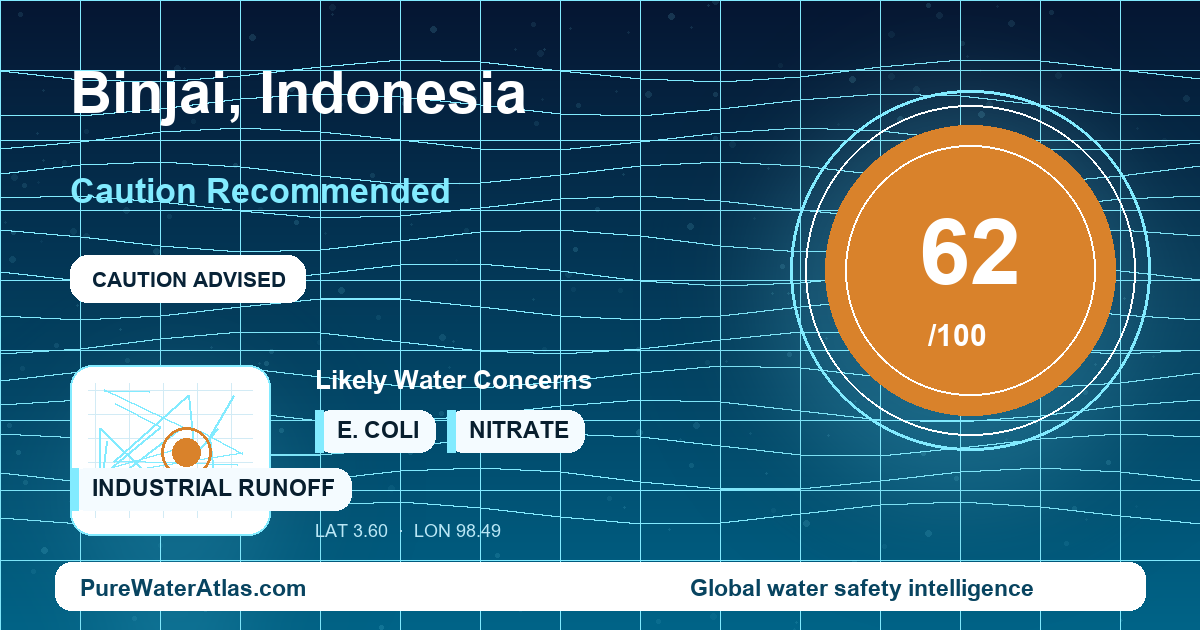
Binjai, North Sumatra: municipal treated water exists, but direct drinking from the tap is not recommended without household treatment or verification.
Quick Answer
| Overall safety status | Caution recommended. Binjai has a formal municipal water utility and treated piped-water service, but public city-level water-quality reporting is limited, and tap safety can vary by connection, pressure, plumbing, and storage tanks. |
|---|---|
| PureWaterAtlas score | 62 / 100 — risk level: Caution Recommended. |
| Can visitors drink the tap water? | Not directly. Short-stay visitors should use sealed bottled water, boiled water, or a reliable purifier for drinking unless the hotel confirms point-of-use treatment and recent maintenance. |
| Resident advice | Residents on the Perumda Air Minum Tirta Sari network should manage tap water at the household level: maintain tanks, flush stagnant plumbing, filter sediment, and use boiling, UV, or another microbial barrier for drinking when risk is uncertain. |
| Main local water context | Binjai is an inland North Sumatra city crossed by local rivers including the Bingai River. Public references associate the municipal system with treated surface-water abstraction from the Bingai River system and treatment infrastructure. |
| Water authority | Perumda Air Minum Tirta Sari Kota Binjai, with local government oversight and national drinking-water standards set by Indonesia’s Ministry of Health. |
| Filter recommendation | Sediment prefiltration plus activated carbon can improve particles, taste, and odor; add boiling, UV, or another microbiological barrier for drinking water, especially where supply is intermittent, stored, or from a private well. |
Why Binjai Is Different
Binjai is not a city where the only question is “tap water versus bottled water.” The more useful question is: what is the water’s path before it reaches your glass? Binjai has a formal municipal drinking-water company, Perumda Air Minum Tirta Sari Kota Binjai, and public references identify treated piped supply associated with the Bingai River system. That is a stronger starting point than relying entirely on informal wells or untreated local sources.
However, the safety of water at a building tap in Binjai can differ from the safety of water leaving a treatment plant or street main. In Indonesian urban water systems, household-level conditions such as intermittent service, low pressure, leaks, cross-connections, old internal plumbing, pumps, and roof or ground storage tanks can influence final tap quality. Treated water can lose disinfectant residual or become recontaminated after treatment if it passes through compromised distribution pipes or poorly maintained building tanks.
Binjai’s geography also matters. The city lies immediately west of Medan in North Sumatra, near the Deli Serdang and Langkat area, and its urban form is closely tied to local rivers including the Bingai River. A river-source context makes heavy-rain turbidity, upstream activity, runoff, and treatment burden especially relevant. This does not mean every Binjai tap is unsafe, but it does mean that direct drinking should be approached with caution unless the specific building’s water is treated, maintained, and verified.
Where Does Binjai’s Tap Water Come From?
Binjai’s municipal water identity is centered on Perumda Air Minum Tirta Sari Kota Binjai, the local drinking-water company. Publicly available references associate the city’s treated supply with surface-water abstraction from the Bingai River system and treatment facilities such as an instalasi pengolahan air, or water treatment plant. The Bingai catchment sits within the broader North Sumatra river-basin management context, commonly linked with the Wampu-Besitang river-basin area administered by national water-resources authorities.
The practical infrastructure picture includes several layers: municipal piped-water mains, surface-water intake and treatment facilities, household and building storage tanks, pumps, internal pipes, and private wells in unserved or partially served households. For many households and buildings, water may not move directly from the municipal main to the kitchen tap without intermediate storage. This makes storage-tank condition a critical part of real tap-water safety.
Binjai also has an older and more mixed water-access history typical of inland cities that grew along river corridors. Before full piped service, or in areas outside reliable service, shallow wells, local groundwater, and household storage would have been more important. Public sources do not provide a complete historical timeline of all Binjai drinking-water intakes, so older-source claims should be treated carefully. The current risk assessment is therefore based on the identifiable municipal utility and river-system context, not on a complete neighborhood-by-neighborhood compliance dataset.
Who Manages Drinking Water in Binjai?
The local drinking-water utility is Perumda Air Minum Tirta Sari Kota Binjai. The Pemerintah Kota Binjai provides official city context and local oversight roles. Broader administrative and infrastructure context can also be checked through BPS Kota Binjai.
Indonesia’s drinking-water quality requirements are set nationally. A key regulatory reference is Ministry of Health Regulation No. 2 of 2023, which covers environmental health quality standards including drinking-water quality parameters. River and raw-water resource management falls under Ministry of Public Works and Housing river-basin institutions, including the North Sumatra context represented by Balai Wilayah Sungai Sumatera II.
The main limitation for consumers is transparency at the tap level. PureWaterAtlas did not find a consistently updated, publicly accessible Binjai-specific report showing routine neighborhood-level results for E. coli, residual chlorine, turbidity, metals, disinfection byproducts, treatment-plant performance, or endpoint monitoring. This page should not be read as a claim that all Binjai taps meet or fail a specific legal limit. It is a risk-managed assessment: because detailed public tap-level data are limited, extra caution is recommended for direct drinking.
Main Local Water Concerns
The most important Binjai-specific concern is the combination of river-source treatment plus distribution and household storage risk. Surface water can become more difficult to treat after heavy rain, when river turbidity and microbial loading may rise quickly. This makes operational control at the treatment plant important, but it also makes household observation important: sudden cloudiness, color, sediment, or unusual odor should not be ignored.
- Rain-related turbidity: Heavy storms can increase river cloudiness and microbial load, placing more pressure on coagulation, filtration, and disinfection.
- Microbial recontamination: If treated water loses disinfectant residual in low-pressure pipes, leaky distribution sections, or storage tanks, organisms such as E. coli can become the main safety concern.
- Sediment and discoloration: Pipe repairs, low-pressure events, tank disturbance, or river-turbidity episodes can cause visible particles or changes in taste and color.
- Private-well vulnerability: Shallow wells may be affected by septic systems, drains, flooding, and urban runoff. Well safety should not be inferred from the PDAM system.
- Old-building plumbing: Lead is not documented as a citywide Binjai problem in the reviewed sources, but older internal plumbing, brass fittings, and stagnant pipes can add metals at the tap.
- Salinity: Salinity is not the primary concern for central Binjai because the city is inland; coastal saltwater intrusion is more relevant to low-lying coastal systems.
Season also matters. Rainy-season flooding or poor drainage can contaminate wells and household tanks, especially where lids, vents, or wellheads are not sealed. Dry-season low river flows can concentrate pollutants by reducing dilution. During service interruptions, households may store water longer, increasing the importance of tank cleaning and safe handling.
For Travelers
Visitors to Binjai should not assume that bathroom tap water is safe to drink untreated. The safer approach is to use sealed bottled water, boiled water, or water treated by a reliable purifier. Tap water that is clear and normally chlorinated is generally acceptable for bathing and handwashing, but drinking directly from the tap is not recommended unless your accommodation can confirm point-of-use treatment and recent system maintenance.
Brushing teeth: Short-stay travelers, people with sensitive stomachs, children, pregnant travelers, elderly travelers, and immunocompromised people should use bottled, boiled, or filtered water for brushing teeth. Some experienced travelers may rinse with tap water, but the lower-risk choice in Binjai is treated water.
Ice: Avoid ice from informal street vendors unless you know it is made from factory-produced safe water. In hotels and established restaurants, ask whether ice is made from treated, dispenser, or bottled water. Do not assume that served ice and bathroom tap water have the same treatment path.
Hotels and restaurants: Higher-end hotels and established restaurants may use bottled water, dispenser water, or in-house filtration for drinking water and ice, but confirm this directly. Ask whether water is filtered, boiled, or supplied separately for drinking. If there is any uncertainty, use sealed bottled water.
Emergency practical step: If bottled water is not available, bring tap water to a vigorous boil before drinking. If water is visibly cloudy, colored, or has particles, let sediment settle, prefilter through a clean cloth or suitable filter if available, and then boil or use a purifier rated for microorganisms. Appearance alone is not a safety test.
For Residents
For Binjai residents, the safest household strategy depends on whether the home is connected to Perumda Air Minum Tirta Sari or uses a private well. Municipal water has treatment infrastructure behind it, but the final tap may still be affected by pipe condition, pressure, internal plumbing, and storage tanks. Private wells require a separate testing and treatment plan because they are not protected by municipal treatment.
A practical municipal-water setup is sediment prefiltration followed by activated carbon for taste, odor, and chlorine-management concerns, with boiling, UV, or another microbiological barrier for drinking water when supply is intermittent, stored, or uncertain. Reverse osmosis may be useful for private wells or where tests show nitrate, metals, high dissolved solids, or other chemical issues, but it should not be purchased as a substitute for testing.
- Test municipal tap water at the kitchen tap after overnight stagnation and again after flushing if you suspect building plumbing contamination.
- For private wells, test at least annually for E. coli or thermotolerant coliforms, pH, turbidity, nitrate, iron, manganese, and basic mineral indicators.
- Retest wells after flooding, repairs, or changes in taste, color, or odor.
- If infants, pregnant people, elderly residents, or immunocompromised people use the water, prioritize microbiological testing and a confirmed disinfection barrier.
- If water is reddish, blackish, metallic, or stains fixtures, test for iron and manganese and inspect tanks and internal plumbing.
- If the home is old or has unknown plumbing materials, consider tap-level lead testing even though a citywide Binjai lead problem has not been documented in reviewed public sources.
Storage tanks deserve special attention in Binjai. Tanks should be sealed, screened, cleaned periodically, protected from roof runoff and animals, and disinfected after suspected contamination. A safe municipal supply can become unsafe if stored in an open, dirty, or rarely cleaned tank. Older buildings also need flushing practices: stagnant pipes, corroded fittings, old galvanized plumbing, and low-use taps can add sediment, metals, and biofilm before water reaches the glass.
Relevant Contaminants and Water-Quality Issues
For Binjai, the most relevant water-quality issues are operational and household-level rather than a single confirmed citywide chemical contaminant. Turbidity is important because river-source water can become cloudy after heavy rain, increasing treatment burden. E. coli is the key indicator for fecal contamination in wells, storage tanks, low-pressure networks, and post-treatment contamination.
Chlorine matters because residual disinfectant helps protect water as it travels through the piped network and into stored water. If residual chlorine disappears before the tap, microbial risk can rise. Sediment is relevant when residents see particles after pipe work, tank cleaning, low-pressure periods, or discoloration events.
For private wells, nitrate should be included in testing because wells may be influenced by septic leakage or agricultural runoff. Lead is not identified as a citywide Binjai issue in the reviewed sources, but it remains relevant for old internal plumbing, brass fittings, and first-draw tap testing in older buildings.
How to Verify Your Water Quality
Because public Binjai neighborhood-level monitoring data are limited, verification should happen as close to the tap as possible. Start with the PureWaterAtlas guide to water testing and the broader framework for drinking water safety. For microbial risk from wells, tanks, and low-pressure events, review Water Microbiology.
If you are choosing equipment, use the Water Treatment Systems guide rather than buying a filter based only on taste. Boiling remains a practical short-term control; see Boiling Water Purification. UV may be useful for households with filtered but microbiologically uncertain stored water; see UV Water Purification.
For test interpretation, use the Contaminants Search Engine. Travelers comparing Binjai with other destinations can use the Global Water Quality Checker. Well users should also read the PureWaterAtlas resources on nitrate testing, and residents in older buildings can review lead testing methods.
Official and Technical Sources
- Perumda Air Minum Tirta Sari Kota Binjai official website — local utility source identifying the municipal drinking-water company serving Binjai.
- Pemerintah Kota Binjai official website — official city context for Binjai’s geography, administration, and urban development.
- BPS Kota Binjai — government statistics source for city background and infrastructure context.
- Kementerian Kesehatan Republik Indonesia, Permenkes No. 2 Tahun 2023 — national regulatory reference for environmental health quality standards including drinking water.
- Balai Wilayah Sungai Sumatera II, Ministry of Public Works and Housing — river-basin and water-resources authority context for North Sumatra.
- WHO and UNICEF Joint Monitoring Programme, Indonesia household water data — national drinking-water service context, not a substitute for Binjai tap-level testing.
- World Health Organization, Guidelines for Drinking-water Quality — technical reference for interpreting microbial, chemical, and operational drinking-water risks.
Bottom Line
Binjai has a municipal water utility and treated piped-water service, but direct drinking from the tap deserves caution because public, recent, neighborhood-level water-quality data are not consistently available. The city’s river-based raw-water context makes rainy-season turbidity and microbial loading relevant, while household factors such as storage tanks, old internal plumbing, low pressure, and private wells can change water quality after treatment. Visitors should use bottled, boiled, or reliably filtered water for drinking and preferably for brushing teeth. Residents should maintain tanks, flush stagnant plumbing, test wells and suspect taps, and use sediment filtration plus a confirmed microbial barrier for drinking when conditions are uncertain.
Read the full guide: Global Water Quality Guide
Explore more in this category: Global Water Quality Articles