
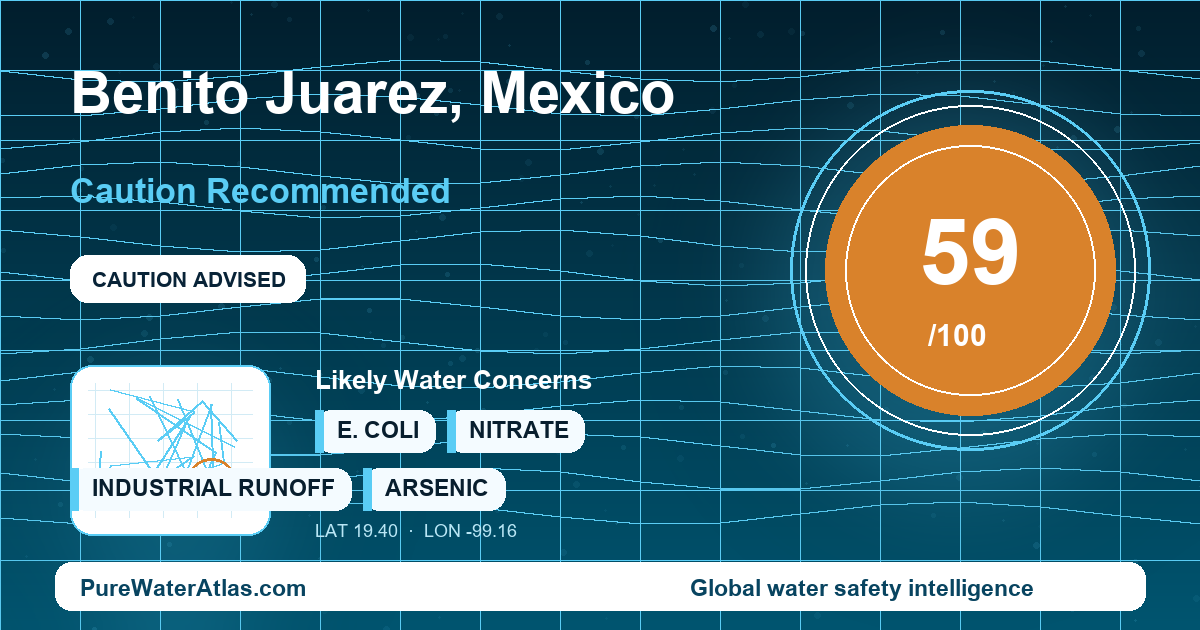
Benito Juarez, Quintana Roo, including Cancun, relies mainly on chlorinated groundwater from a vulnerable coastal karst aquifer; tap-water safety depends heavily on building storage tanks, plumbing, storm conditions, and local treatment.
Quick Answer
| Overall safety status | Caution recommended. PureWaterAtlas score: 59/100. The municipal supply is intended for domestic use, but direct tap drinking is not the best default choice for many visitors or households. |
|---|---|
| Traveler advice | Use sealed bottled water, hotel-provided purified water, or water from a reputable purification system for drinking. This is especially important for sensitive stomachs, infants, pregnant travelers, older adults, and immunocompromised people. |
| Resident advice | Do not judge safety only by the utility supply. In Benito Juarez, the condition of the household cistern, rooftop tank, plumbing, filter maintenance, and recent storm or pressure-disruption history can determine what reaches the tap. |
| Main water source | Groundwater from the Yucatan Peninsula karst aquifer system, abstracted through wells, disinfected, pumped, and distributed locally. |
| Authority and oversight | Water and sewerage service in the concession area is associated with Aguakan, formally Desarrollos Hidraulicos de Cancun, with state oversight involving CAPA Quintana Roo and federal water-resource regulation by CONAGUA. |
| Filter recommendation | A home treatment barrier is advisable for drinking water: sediment prefiltration plus activated carbon at minimum, with reverse osmosis or certified treatment where dissolved solids, salinity, nitrate, or metals are concerns. UV can help with microbes after filtration but requires maintenance and does not remove chemicals. |
Why Benito Juarez Is Different
This profile treats Benito Juarez as the municipality in Quintana Roo that includes Cancun, not the Benito Juarez borough of Mexico City. That distinction matters because Benito Juarez, Quintana Roo sits on the Yucatan Peninsula’s coastal karst aquifer system. The local ground is highly permeable limestone with little natural surface drainage, so groundwater is both the practical drinking-water source and a vulnerable receiving environment for surface contamination, wastewater failures, stormwater movement, and coastal pressure.
The local drinking-water question is therefore not simply “does the city have a water system?” It does. The more useful question is whether water remains suitable by the time it reaches a kitchen glass in a hotel room, rental apartment, residence, restaurant, or older building. Benito Juarez combines centralized utility supply with widespread building-level storage. Cisterns, rooftop tanks, internal pumps, long plumbing runs, poorly sealed tanks, and low disinfectant residual can change water quality after it leaves utility-controlled infrastructure.
Rapid tourism and population growth around Cancun have also placed long-term pressure on groundwater abstraction, sewerage expansion, wastewater treatment, and coastal infrastructure. These pressures are relevant because the aquifer is porous and coastal groundwater systems can be affected by salinity intrusion when pumping, recharge, and coastal conditions are not well balanced. This does not mean every tap is unsafe, but it does mean a cautious, point-of-use approach is appropriate.
Where Does Benito Juarez’s Tap Water Come From?
Benito Juarez relies primarily on groundwater from the Yucatan Peninsula karst aquifer system. Water is abstracted through production wells, disinfected, and moved through pumping and distribution infrastructure before reaching neighborhoods, businesses, hotels, and private properties. The Cancun and northern Quintana Roo urban area developed on a low-relief coastal karst plain where large rivers are absent, making groundwater the practical source rather than surface reservoirs.
Key infrastructure includes groundwater production wells, chlorination and pumping facilities, the municipal distribution network operated in the concession area by Aguakan, and the private storage systems that are locally important in everyday use. Many homes, apartment buildings, hotels, and commercial properties store water in cisterns or rooftop tanks before use. Those storage points can be convenient for pressure management, but they also create opportunities for microbial regrowth, sediment accumulation, insect or animal entry, and loss of chlorine residual if tanks are poorly maintained.
Wastewater infrastructure is part of the drinking-water story in Benito Juarez because the same karst aquifer that supplies water can also receive contaminants rapidly if sewerage, septic systems, or stormwater controls fail. Nitrate and other wastewater-related indicators are not something to assume at every tap, but they are legitimate concerns in karst settings where sewerage or septic controls are incomplete, overloaded, or failing. Site-specific testing is needed to know the condition at a particular property.
Who Manages Drinking Water in Benito Juarez?
The water and sewerage concession for Benito Juarez, Quintana Roo is associated with Aguakan, formally Desarrollos Hidraulicos de Cancun. State-level institutional context and oversight involve the Comision de Agua Potable y Alcantarillado de Quintana Roo, while federal water-resource responsibilities, groundwater rights, aquifer information, and national water statistics involve CONAGUA’s Sistema Nacional de Informacion del Agua and CONAGUA groundwater programs.
Public-health drinking-water quality standards are set nationally under Mexico’s health regulations, including NOM-127-SSA1-2021, the official Mexican standard for water for human use and consumption. In practice, however, Benito Juarez consumers also need to consider what happens after water leaves public infrastructure. A compliant or disinfected supply at one point does not guarantee that stored water in a private cistern, tinaco, hotel plumbing system, or older building remains equally protected at the tap.
Data availability is a limitation. Official sources identify the institutions and regional groundwater-based supply, but recent public neighborhood-level tap-water microbiological and chemical results are not consistently available to consumers. This profile therefore emphasizes known local risk pathways rather than claiming that every individual tap either meets or fails a specific limit.
Main Local Water Concerns
The most important Benito Juarez water-quality concerns are point-of-use risks. Microbial contamination can occur after water is stored in cisterns, rooftop tanks, or poorly maintained plumbing. Loss of disinfectant residual in long building plumbing runs or private storage can allow bacterial regrowth. After pressure interruptions, pipe repairs, tank disturbance, tropical storms, or flooding, residents may notice turbidity, sediment, odor, discoloration, or other changes that should be taken seriously before drinking.
The local geology adds a second layer of concern. Karst limestone can allow rapid movement of contaminants from the surface into groundwater pathways. Wastewater-related indicators, including nitrate, are therefore relevant in areas affected by septic systems, sewerage limitations, or wastewater infrastructure problems. Coastal groundwater systems can also face salinity or elevated total dissolved solids under pumping and sea-level pressure, although conditions vary by well field and location.
Lead is not a signature source-water problem for Benito Juarez in the same way that karst vulnerability or storage-tank microbiology is. However, lead risk can still occur at individual taps through older fixtures, solder, brass components, or building plumbing. For that reason, older buildings, recently renovated spaces, and properties with unknown plumbing materials deserve tap-specific testing rather than assumptions.
Seasonal conditions matter. Hurricane and tropical-storm season can bring flooding, pressure disruptions, power outages, sewer overflows, and damaged water systems. Heavy rains can increase contaminant transport through karst features and affect shallow groundwater or poorly protected storage. During dry-season demand and high tourism occupancy, pumping and operational pressure on water and wastewater systems can increase.
For Travelers
For short stays in Benito Juarez, tap water is generally a caution choice rather than a recommended drinking source. Use sealed bottled water, hotel-provided purified water, or water treated by a reliable purification system. This guidance is precautionary: it reflects local storage, plumbing, storm, and traveler-sensitivity issues, not proof that every tap in the municipality is unsafe.
Most healthy adults may use tap water for brushing teeth without incident, but cautious travelers, families with young children, and anyone with a sensitive stomach should use bottled or purified water, especially in rentals where cistern or rooftop tank maintenance is unknown. Use bottled or purified water for infant formula, medications, and any situation where illness would carry higher risk.
Ice is usually acceptable in established hotels, resorts, and restaurants when it is made from purified water. The practical step is to ask. Many higher-end hotels and restaurants in the Cancun area use in-house purification or commercial purified water for drinking water and ice, but visitors should not assume bathroom tap water is potable. Avoid ice from informal vendors or places that cannot confirm purified-water ice.
After storms, water outages, pipe repairs, or visible water changes, avoid drinking from bathroom or kitchen taps until conditions are clarified. Brown, cloudy, sulfur-smelling, unusually salty, or sediment-heavy water should be reported to the property manager or utility before being used for drinking.
For Residents
Residents should focus on the whole water pathway: supply, storage, plumbing, and point-of-use treatment. A practical home setup often begins with sediment prefiltration followed by activated carbon for taste, chlorine, and some organic compounds. Where there is concern about dissolved solids, salinity, nitrate, or metals, reverse osmosis or another certified treatment technology may be appropriate. UV treatment can be useful after filtration for microbiological control, but it does not remove chemicals and it requires clear water, correct sizing, power, and lamp maintenance.
Testing is strongly advisable where water is stored onsite. Periodically test stored household water for total coliform and E. coli, especially if the property uses a cistern, tinaco, or private storage tank. Test nitrate if the property is outside well-served sewerage areas, near septic systems, or if infants or pregnant people will drink the water. If water tastes salty, leaves heavy scale, or the property is near the coast, test total dissolved solids, chloride, hardness, and conductivity.
Older buildings should not be assumed safe because the municipal supply is clear. Corroded pipes, brass fixtures, solder, dead-end plumbing, internal pumps, and low-use lines can create localized metal or bacterial risks. Test lead and copper at the kitchen tap if the building is older, recently renovated, or has unknown fixtures or plumbing materials.
Storage tanks are a central local risk point. Cisterns and rooftop tanks should be covered, screened from insects and animals, cleaned and disinfected on a schedule, protected from floodwater entry, and inspected after storms or pressure failures. A filter cannot reliably compensate for a contaminated or neglected tank unless the treatment system is correctly designed, installed, and maintained.
Relevant Contaminants and Water-Quality Issues
In Benito Juarez, chlorine in drinking water is important because disinfection protects water in the distribution system, but residual chlorine can decline in private storage tanks and long building plumbing runs. Turbidity and sediment are practical warning signs after repairs, pressure interruptions, storms, or tank disturbance.
Microbiological risk is a key reason for caution. Learn more about E. coli in drinking water and broader microbial risk in the PureWaterAtlas Water Microbiology guide. For karst and wastewater-related concerns, nitrate is relevant, particularly where sewerage or septic controls may be incomplete or failing. For building-level plumbing risk, see lead in drinking water and the guide to lead testing and detection methods.
For treatment decisions, PureWaterAtlas resources on UV water purification, boiling water purification, and nitrate filtration solutions can help match the risk to the correct treatment barrier.
How to Verify Your Water Quality
The best way to verify tap-water quality in Benito Juarez is to test the water that actually comes from the tap or storage system you use. Utility and regulatory information describes the broader system, but household cisterns, rooftop tanks, rental-property plumbing, and hotel treatment systems can create site-specific differences.
Start with microbiological testing for total coliform and E. coli if drinking water is stored onsite. Add nitrate where sewerage or septic influence is plausible, and add total dissolved solids, chloride, hardness, and conductivity where coastal salinity or mineral taste is a concern. In older or renovated buildings, add lead and copper testing at the kitchen tap.
PureWaterAtlas resources can help you plan testing and interpret risk: see the Water Testing guide, the Drinking Water Safety guide, the Water Contamination pillar, and the Water Treatment Systems guide. You can also use the Global Water Quality Checker and search individual issues in the Contaminants Search Engine.
Official and Technical Sources
- Aguakan — local concession operator associated with water and wastewater services in Benito Juarez and the Cancun area.
- Comision de Agua Potable y Alcantarillado de Quintana Roo — state water institution for Quintana Roo and water-service oversight context.
- CONAGUA Sistema Nacional de Informacion del Agua — federal water-resource information, aquifer context, availability, and national statistics.
- CONAGUA Aguas Subterraneas — federal groundwater authority context for aquifer management in Mexico.
- Diario Oficial de la Federacion: NOM-127-SSA1-2021 — official Mexican drinking-water quality standard.
- INEGI Areas Geograficas — official geography reference for Mexican municipalities, including Benito Juarez, Quintana Roo.
- Pan American Health Organization: Water and Sanitation — public-health context for drinking-water safety and sanitation.
- U.S. CDC Travelers Health: Mexico — traveler health guidance, including food and water precautions for Mexico.
Bottom Line
Tap water in Benito Juarez, Quintana Roo, should be treated as a caution choice for drinking. The public supply is based mainly on chlorinated groundwater from the Yucatan Peninsula karst aquifer, but the final risk often depends on cisterns, rooftop tanks, plumbing, pressure interruptions, storms, and property-level treatment. Visitors should use sealed bottled water or confirmed purified water for drinking and be selective about ice. Residents should maintain storage tanks, use an appropriate treatment barrier for drinking water, and test for microbes, nitrate, salinity indicators, and plumbing metals when conditions warrant. Available public data do not support sweeping tap-by-tap claims, so the safest approach is local verification at the point of use.
Read the full guide: Global Water Quality Guide
Explore more in this category: Global Water Quality Articles