
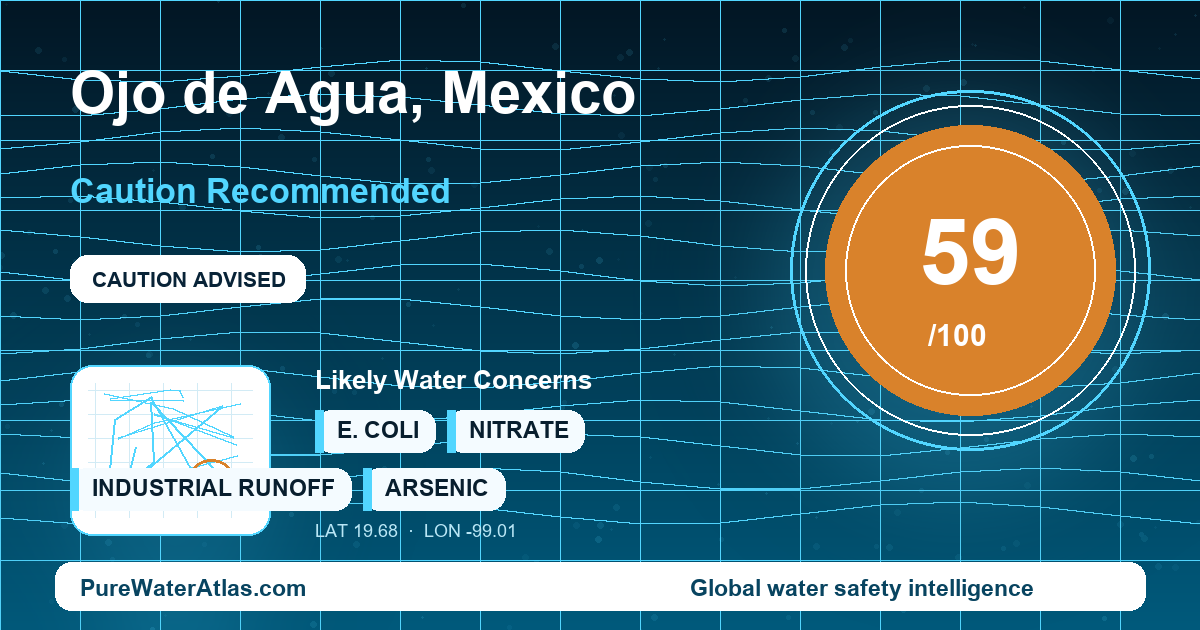
Ojo de Agua, Tecámac: groundwater-dependent municipal supply, household storage risks, and practical drinking-water precautions for residents and visitors.
Quick Answer
| Water safety score | 59 / 100 |
|---|---|
| Risk level | Caution Recommended |
| Can visitors drink the tap water? | Not recommended as a routine drinking source. Use sealed bottled water, garrafón water, or properly filtered water. |
| Resident advice | Use point-of-use protection for drinking and cooking unless recent household tap testing confirms good quality. Maintain cisterns and rooftop tinacos. |
| Main water source | Municipal groundwater wells serving Tecámac, within the broader Mexico Basin aquifer context, especially the Cuautitlán-Pachuca aquifer system. |
| Water authority | ODAPAS Tecámac, with state support from the Comisión del Agua del Estado de México and federal water-resource oversight by CONAGUA. |
| Filter recommendation | Recommended for drinking water. Match the system to test results: carbon for taste and chlorine issues, reverse osmosis for dissolved minerals and some inorganic contaminants, and UV only after clear prefiltered water. |
Overall verdict: caution is recommended. Ojo de Agua is an urban locality in the municipality of Tecámac, Estado de México, inside the northeastern Mexico City metropolitan area. Its public supply is best understood as a groundwater-dependent municipal system rather than a clearly documented city-specific treated surface-water system. Tap water may be chlorinated and usable for domestic purposes when the network and building storage are well maintained, but visitors and sensitive residents should not assume it is consistently safe to drink untreated.
Why Ojo de Agua Is Different
Ojo de Agua is not a remote town with a simple spring-to-tap system. It is a large urban locality in Tecámac, north-northeast of Mexico City, near Ecatepec, Tonanitla, Nextlalpan, and the metropolitan urban corridor. Its water risks are tied to the heavily urbanized Valley of Mexico: groundwater dependence, high demand, pumping infrastructure, distribution pressure, household storage, and building-level plumbing.
The locality’s name, “Ojo de Agua,” reflects a spring or “water-eye” identity, and the area is historically associated with the former Hacienda Ojo de Agua and local spring-water landscape. That history matters culturally, but it should not be confused with the modern drinking-water supply. Today, the practical drinking-water picture is municipal well water, pumping, disinfection, storage tanks, distribution mains, household cisterns, rooftop tinacos, and private plumbing.
This is why two homes in Ojo de Agua can have different tap-water risk even if they are served by the same municipal system. A newer home or apartment with a clean, sealed tinaco and maintained plumbing may have better water at the kitchen tap than an older rental, business, or house with neglected storage. In Ojo de Agua, the condition of the building’s cisterna and tinaco can be as important as the municipal source itself.
Where Does Ojo de Agua’s Tap Water Come From?
Ojo de Agua is supplied within Tecámac’s municipal water service area. Public documentation supports a groundwater-dependent system in this part of Estado de México, with wells drawing from Mexico Basin aquifers, especially the Cuautitlán-Pachuca aquifer system used across northern and northeastern Estado de México. A single, current, Ojo de Agua-only source breakdown is not publicly available in the dataset used for this profile, so the safest wording is that Ojo de Agua is supplied through Tecámac’s municipal groundwater and distribution infrastructure rather than a separately documented neighborhood water source.
The key infrastructure includes municipal groundwater wells operated or coordinated through Tecámac’s water services system, pumping equipment, pressure zones, storage tanks, and distribution mains serving Tecámac neighborhoods including Ojo de Agua. After that, water quality can change inside the property through cisterns, rooftop tinacos, private pipes, fixtures, and filters.
The main practical risk is therefore not only what is in the aquifer. It is the full path from well to tap. Water may leave a well disinfected, but become riskier at the point of use if service is intermittent, pipes lose pressure, repairs disturb sediment, or a household storage tank is dirty, open, cracked, or poorly maintained. After service cuts, pipe repairs, or pressure restoration, first-draw water may contain sediment or discoloration and should be flushed before use.
Who Manages Drinking Water in Ojo de Agua?
The local water service authority for Ojo de Agua is ODAPAS Tecámac, the decentralized municipal water, sewerage, and sanitation provider for Tecámac. State-level water infrastructure and technical support may involve the Comisión del Agua del Estado de México. Federal water concessions, aquifer availability, and national water-resource information are overseen by CONAGUA’s Sistema Nacional de Información del Agua.
Drinking-water quality in Mexico is governed by national health standards, especially NOM-127-SSA1-2021, the Mexican standard for water for human use and consumption. Sanitary surveillance is associated with health authorities such as COFEPRIS and state health services. Locality and municipal geographic context can be checked through INEGI.
Important limitation: recent, publicly accessible, Ojo de Agua-specific drinking-water monitoring results were not found in a form that supports exact claims about contaminant concentrations, compliance status, or neighborhood-by-neighborhood differences. This profile therefore relies on the identifiable utility and regulatory context, the regional groundwater setting, and infrastructure risks that are directly relevant to Tecámac and the Valley of Mexico.
Main Local Water Concerns
- Groundwater dependence: Ojo de Agua is in a region with documented aquifer pressure and overexploitation concerns. The CONAGUA aquifer availability document for the Cuautitlán-Pachuca aquifer provides official regional context.
- Hardness, mineral taste, scale, and dissolved solids: these can occur in some local groundwater supplies. They are not proof of unsafe water, but they are common reasons residents use garrafón water or treatment systems.
- Sediment and turbidity: cloudy or particle-laden water can occur after pipe repairs, pump cycling, low-pressure events, service interruptions, or disturbance of cisterns and tinacos.
- Microbial risk from storage: dirty or unsealed cisterns and rooftop tanks can introduce bacteria, insects, sediment, biofilm, and bad taste even if the municipal water was disinfected before reaching the property.
- Chlorine variability: some users may notice chlorine taste or odor, while others may have inadequate residual chlorine at the household tap after long storage.
- Building-level metals: old plumbing components, solder, brass fixtures, or private service lines can create tap-specific lead concerns. No Ojo de Agua-wide lead claim should be made without household testing.
- Groundwater testing considerations: arsenic, fluoride, nitrate, iron, and manganese are sensible parameters to screen in regional groundwater settings, but should be treated as testing priorities, not assumed neighborhood-wide exceedances.
Seasonal and operating conditions also matter. Rainy-season runoff and drainage stress can increase risk where distribution pressure is low or infrastructure is damaged. Dry-season demand can increase pumping stress and intermittent supply risk. Warm weather can worsen biological growth in poorly maintained rooftop tinacos.
For Travelers
Most visitors should not use Ojo de Agua tap water as a routine drinking source. Use sealed bottled water, garrafón water from a reputable supplier, or water treated through a maintained purifier. This is a precaution based on limited neighborhood-specific data and common distribution and storage risks, not a claim that every tap in Ojo de Agua is unsafe.
For brushing teeth, healthy adults can often use tap water with lower risk, but cautious travelers, children, pregnant travelers, immunocompromised people, and anyone with a sensitive stomach should use bottled or purified water. If the tap water is cloudy, colored, has sediment, smells strongly of sewage or chemicals, or service has just returned after an outage, avoid using it for oral exposure.
Avoid ice from informal vendors or unknown household sources. In hotels, restaurants, and cafés, ask whether the ice is made from purified water or commercially bagged ice. Better hotels and formal restaurants commonly use purified water for drinking and ice, but this should not be assumed in small eateries, street stalls, rented rooms, or private homes. Ask for agua purificada or sealed bottled water.
Carry bottled water during day trips, especially in hot weather. If you are staying in a rental in Ojo de Agua, ask whether drinking water comes from garrafón, a maintained filter, or directly from the tap.
For Residents
For Ojo de Agua residents, drinking-water safety should be managed at the point of use. A home filter or garrafón supply is recommended for drinking and cooking unless reliable recent testing confirms good quality at the household tap. A practical treatment setup depends on test results: activated carbon can improve taste, odor, and chlorine-related issues; reverse osmosis can reduce many dissolved minerals, nitrate, arsenic, fluoride, and some metals; UV can address microbial risk only when water is already clear and properly prefiltered.
Test the water at the kitchen tap, not only at the cistern, because the tap is the water people actually drink. A useful testing panel for Ojo de Agua homes includes total coliform and E. coli, residual chlorine, turbidity, pH, conductivity or TDS, hardness, nitrate, arsenic, fluoride, iron, manganese, and lead if plumbing is older or unknown. Repeat microbiological testing after cistern or tinaco cleaning, plumbing repairs, flooding, sewage backup, or recurring gastrointestinal illness in the household.
Older buildings and renovated homes deserve extra attention. Lead risk is not something that can be settled by Mexico-wide or municipal assumptions. It is best evaluated with first-draw and flushed samples from the specific tap used for drinking. Households with infants, pregnancy, dialysis patients, elderly residents, or immunocompromised people should use purified water until household storage and tap testing confirm safety.
Cisterns and rooftop tinacos should be sealed, screened, and cleaned periodically, and after suspected contamination events. A dirty tank can undo the benefits of municipal disinfection by adding bacteria, sediment, insects, and biofilm before water reaches the faucet.
Relevant Contaminants and Water-Quality Issues
The most relevant water-quality issues for Ojo de Agua are the ones connected to groundwater, municipal distribution, and household storage. Turbidity and sediment matter when water turns cloudy after pipe repairs, pump cycling, low-pressure events, or tank disturbance. E. coli is a key microbial indicator when cisterns, tinacos, or pressure losses are part of the risk picture.
Chlorine is relevant because public supplies are disinfected, but residual chlorine can decline during long storage inside a property. Lead is a building-level concern where old solder, brass fixtures, or unknown private plumbing materials may affect the tap. For a groundwater-dependent area, nitrate and arsenic are reasonable screening parameters, but local exceedances should not be assumed without laboratory results.
How to Verify Your Water Quality
The most reliable way to decide whether your Ojo de Agua tap water is drinkable is to test the water you actually consume. Start with PureWaterAtlas guides on drinking water safety, water testing, water treatment systems, and water microbiology.
For short-term microbial risk after outages or suspected contamination, see Boiling Water Purification: Complete Guide. If considering ultraviolet treatment, read UV Water Purification: Complete Guide, especially the need for prefiltration. For older plumbing questions, use Lead in Drinking Water: Testing and Detection Methods. For groundwater screening, see Arsenic in Drinking Water: Testing and Detection Methods and Nitrate Contamination in Drinking Water: Testing and Detection Methods.
You can also compare destinations with the Global Water Quality Checker or look up unfamiliar results in the Contaminants Search Engine. Related PureWaterAtlas categories include Global Water Quality, Drinking Water Safety, Water Testing, and Water Contamination.
Official and Technical Sources
- ODAPAS Tecámac — municipal water and sanitation service provider for Tecámac service areas including Ojo de Agua.
- Comisión del Agua del Estado de México — state water authority involved in water infrastructure and services support.
- CONAGUA Sistema Nacional de Información del Agua — federal water data system for water availability, aquifers, and water-resource context.
- CONAGUA aquifer availability document for Acuífero Cuautitlán-Pachuca, Estado de México — official regional groundwater context for northern and northeastern Estado de México.
- Diario Oficial de la Federación, NOM-127-SSA1-2021 — Mexican drinking-water health standard.
- COFEPRIS — federal sanitary authority relevant to drinking-water health protection.
- INEGI — national statistics and geography authority for locality and municipal context.
Bottom Line
Ojo de Agua’s tap water should be approached with caution. The modern supply is best understood as part of Tecámac’s groundwater-dependent municipal system, not as a clearly documented neighborhood spring supply. The biggest practical risks are the full path from well to tap: pumping, pressure changes, pipe work, intermittent service, cisterns, rooftop tinacos, and older building plumbing. Visitors should use bottled, garrafón, or purified water for drinking and avoid unknown ice. Residents should maintain storage tanks, use point-of-use treatment or garrafón water for drinking, and test the kitchen tap for microbial indicators, chlorine residual, minerals, nitrate, arsenic, fluoride, metals, and sediment-related issues when conditions warrant.
Read the full guide: Global Water Quality Guide
Explore more in this category: Global Water Quality Articles