
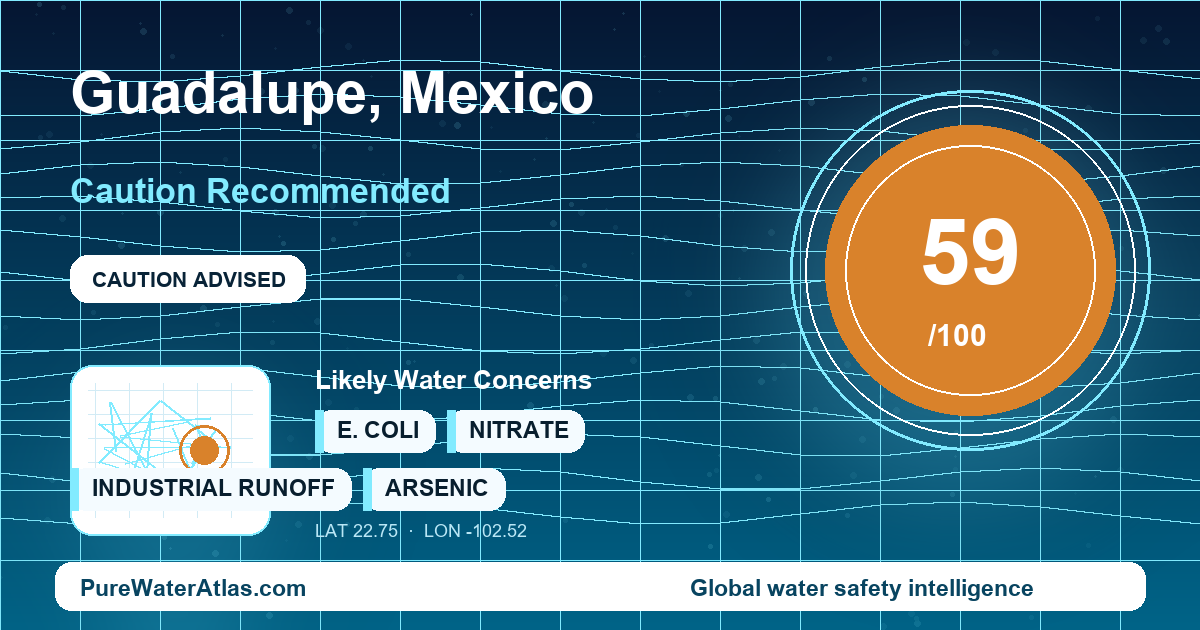
Guadalupe, Nuevo León is served by the Monterrey metropolitan water system, but drought stress, pressure changes, household storage tanks, and building plumbing mean visitors and many residents should use purified or properly treated water for drinking.
Quick Answer
| City | Guadalupe, Nuevo León, Mexico |
|---|---|
| Water safety score | 59 / 100 |
| Risk level | Caution Recommended |
| Is tap water safe to drink? | Not recommended for direct drinking by most visitors. Guadalupe has a treated metropolitan supply, but water at the tap can be affected by pressure interruptions, storage tanks, local plumbing, and limited address-level data. |
| Traveler advice | Use sealed bottled water, purified garrafón water, or water treated with a reliable purifier. Be cautious with ice unless it is made from purified water. |
| Resident advice | Use garrafón water or a maintained point-of-use system for drinking and cooking. Maintain tinacos and cisterns, flush stagnant plumbing, and test when taste, odor, sediment, illness, or old plumbing raises concern. |
| Main supply identity | Integrated Monterrey metropolitan drinking-water network using major reservoirs, aqueducts, wells, treatment plants, pumping, storage, and distribution pressure zones. |
| Water authority | Servicios de Agua y Drenaje de Monterrey, I.P.D. (SADM / Agua y Drenaje de Monterrey). |
| Filter recommendation | For drinking use, consider sediment prefiltration plus activated carbon; reverse osmosis may be useful where dissolved minerals, salinity taste, nitrate, arsenic, or broader contaminant reduction is a concern. UV should be used only after clear-water filtration and does not address chemical contaminants. |
Why Guadalupe Is Different
Guadalupe is not a small town relying on an untreated local supply. It is an urban municipality on the eastern side of the Monterrey metropolitan area in Nuevo León, near Cerro de la Silla and the La Silla river corridor. Its drinking-water situation is tied to the regional Monterrey water network rather than to a standalone Guadalupe-only source.
That regional connection is important, but it does not automatically mean every faucet in Guadalupe should be treated as reliably safe for direct drinking. The metro system has faced drought-driven supply stress, pressure reductions, source-water variability, and increased dependence on household storage. Those factors can affect the practical risk at the tap even when water is treated before entering the distribution system.
The main Guadalupe-specific issue is the difference between treated municipal water at the system level and water as delivered inside a building. A modern hotel or restaurant may use purified water for drinking and ice. A house, older apartment, small business, school, or rental property may rely on a tinaco or cistern whose cleaning and disinfection history is unknown. In that setting, the final safety point is often the building, not the treatment plant.
Publicly available neighborhood-level tap test data for Guadalupe are limited. This profile therefore does not claim exact compliance status, contaminant concentrations, or safety at every address. The assessment is based on the documented regional supply identity, known Monterrey-area drought and pressure context, regulatory framework, and practical risks associated with storage tanks and premise plumbing.
Where Does Guadalupe’s Tap Water Come From?
Guadalupe is supplied through the integrated Monterrey metropolitan drinking-water system operated by Servicios de Agua y Drenaje de Monterrey. The system uses a mix of major surface reservoirs, groundwater wells, and supplemental sources during drought or supply stress. Water is moved through aqueducts, treated, pumped, stored, and distributed across the metropolitan network that serves Guadalupe and other Monterrey-area municipalities.
Major regional surface-water sources include El Cuchillo-Solidaridad, Cerro Prieto, and La Boca. El Cuchillo-Solidaridad and its aqueduct system are among the principal regional sources. Cerro Prieto is also important but highly drought-sensitive. La Boca reservoir in Santiago, Nuevo León has historically been significant, but it is vulnerable to low storage during dry periods. Groundwater wells and supplemental sources have also been used by the Monterrey system, particularly when reservoirs are stressed.
The Monterrey area historically relied on nearby reservoirs, local wellfields, and mountain-zone sources, with La Boca and groundwater playing important roles before the system became more dependent on large regional transfers such as El Cuchillo and Cerro Prieto. Recent droughts pushed authorities to expand supply infrastructure, including the Cuchillo II aqueduct, and to manage pressure and demand across the metro area.
For Guadalupe residents, the relevant infrastructure includes the metropolitan distribution network, treatment plants, pumping stations, storage tanks, pressure zones, and private household storage. Tap-water quality can change between the regional system and the kitchen faucet because building plumbing, cisterns, rooftop tinacos, local pipe condition, pressure fluctuations, repairs, and stagnation all influence delivered water.
Who Manages Drinking Water in Guadalupe?
Drinking water and sewerage service for Guadalupe are handled by Servicios de Agua y Drenaje de Monterrey, I.P.D., commonly known as SADM or Agua y Drenaje de Monterrey. SADM is the public utility responsible for the Monterrey metropolitan area, including Guadalupe. It is the appropriate local authority for service status, outages, supply operations, customer advisories, and available water-quality information.
Mexico’s drinking-water quality framework is governed by federal sanitary standards, principally NOM-127-SSA1-2021, Agua para uso y consumo humano. Water-resource oversight is connected to national agencies such as CONAGUA, while local operation and customer service are handled by SADM. The Sistema Nacional de Información del Agua and CONAGUA’s Monitoreo de Presas provide useful context on water resources and reservoir conditions relevant to Monterrey-area supply reservoirs.
The key limitation is reporting granularity. The existence of a regulated utility and federal drinking-water standard does not provide a complete public, neighborhood-by-neighborhood map of current tap quality inside Guadalupe. For a specific home, school, rental, hotel, clinic, or restaurant, the condition of private storage and internal plumbing may be as important as the regional source system.
Main Local Water Concerns
- Drought-driven supply pressure: Nuevo León and the Monterrey metropolitan area have experienced severe drought and water restrictions, including widely reported pressure reductions and intermittent service in parts of the metro area. These conditions matter for Guadalupe because low pressure and interruptions can disturb sediment and complicate consistent chlorine residual control.
- Intermittent service and pressure reductions: After outages or pressure shifts, water may be discolored, contain particles, or have temporary taste and odor changes. Residents should avoid drinking cloudy, rusty, or particle-filled water until conditions normalize and the water is evaluated if needed.
- Turbidity and sediment: Storm runoff, reservoir-quality changes, pipe work, and distribution disturbance can increase visible particles or cloudiness. Turbidity can also interfere with disinfection if microbial risk is present.
- Household storage tanks: Tinacos and cisterns can become major risk points when they are not sealed, screened, cleaned, and disinfected. A dirty or uncovered tank can turn treated municipal water into unsafe household water.
- Hardness and mineral taste: Hardness, scaling, and mineral taste are common concerns in northern Mexico water systems. These issues are not by themselves proof that water is unsafe, but they often drive residents toward filtration or reverse osmosis for drinking water.
- Older building plumbing: Internal fixtures, valves, solder, corrosion, rust, and stagnant water can contribute metals such as lead even if municipal water is treated. This is especially relevant in older apartments, schools, clinics, and commercial buildings.
- Limited address-level data: Publicly available Guadalupe-specific neighborhood tap data are limited, so safety cannot be guaranteed for every faucet.
Seasonal conditions also matter. Dry-season and drought periods can lower reservoir storage, concentrate minerals, and trigger pressure management. Heavy rainfall and tropical-storm remnants can increase turbidity in surface-water sources. Hot weather increases household storage use and can worsen microbial growth in poorly sealed tanks. Post-repair or post-outage periods are times to watch for discolored water, sediment, or unusual odor.
For Travelers
Short-term visitors should not treat Guadalupe tap water as reliably safe for direct drinking. The safer default is sealed bottled water, purified garrafón water, or water treated with a trustworthy filter or purifier. The concern is not that Guadalupe lacks a municipal water system; it is that travelers usually cannot verify the maintenance of a building’s tinaco, cistern, plumbing, recent pressure history, or local repair conditions.
For brushing teeth, risk is lower than drinking full glasses of tap water, but cautious travelers should use bottled or purified water. This is especially sensible for children, pregnant travelers, older adults, immunocompromised people, and anyone with a sensitive stomach. If using tap water, avoid swallowing it and do not use water that is cloudy, rusty, visibly particle-filled, or has an unusual odor.
For ice, ask whether it is made from purified water or commercial bagged ice. Established hotels, restaurants, and cafés in the Monterrey area often use purified water for beverages and ice, but visitors should not assume this in small venues, private rentals, or informal settings. Bathroom and sink taps in hotels should still be treated as non-potable for travelers unless the property clearly states otherwise.
Carry bottled water during hot months, use sealed containers, and avoid refilled bottles unless you trust the source. If gastrointestinal illness occurs, oral rehydration salts can be useful. Travelers should also consider general Mexico food and water precautions from the U.S. CDC Mexico Traveler View.
For Residents
For most Guadalupe households that drink water at home, a maintained point-of-use system is advisable. A practical setup is sediment prefiltration plus activated carbon to improve taste and reduce chlorine-related taste, odor, and some organic compounds. Reverse osmosis can be considered where dissolved minerals, salinity taste, nitrate, arsenic, or broader contaminant reduction is a concern. UV disinfection can help with microbiological control only when the water is clear and prefiltered; it should not be used as the sole treatment for chemical contaminants.
Residents should test water at the kitchen tap and, when storage tanks are used, after the storage tank—not only at the incoming municipal line. This matters because the household tank and premise plumbing can change water quality after municipal treatment. If the building is old, test for lead and other metals, especially if water sits overnight in pipes. If water becomes cloudy, colored, or sediment-heavy after outages or repairs, consider turbidity and bacteriological testing before drinking it.
Homes with infants, pregnant people, immunocompromised residents, or elderly residents should consider periodic testing for total coliform and E. coli, especially when using a tinaco or cistern. If a household relies on groundwater, a private well, trucked water, or another non-utility source, testing should include nitrate, arsenic, fluoride, total dissolved solids, and microbiology through an accredited laboratory.
Tinacos and cisterns should be sealed, screened against insects, cleaned, and disinfected on a schedule. After a service interruption, inspect stored water for odor, sediment, insects, algae, or slime before using it for drinking. Keep records of filter cartridge changes, tank cleaning, and lab results so changes in water quality can be tracked over time.
Relevant Contaminants and Water-Quality Issues
Several PureWaterAtlas contaminant and water-quality profiles are especially relevant to Guadalupe’s practical risk profile. Chlorine matters because residual disinfectant is important when water travels through a large metropolitan distribution system and then sits in household storage tanks. Turbidity is relevant after storms, reservoir-quality changes, pressure shifts, outages, and pipe repairs. Sediment is useful for residents seeing particles, rusty water, or post-repair discoloration.
For microbiological risk, E. coli is a key indicator for stored water, cisterns, tinacos, and post-outage safety checks. In older buildings, lead may be a premise-plumbing concern even when the municipal supply is treated. Nitrate is especially important for households using private wells or non-standard sources and for infant-health risk screening.
For deeper reading, Guadalupe residents can use PureWaterAtlas guides on lead testing and detection, nitrate testing and detection, boiling water purification, and UV water purification.
How to Verify Your Water Quality
The most reliable way to evaluate a specific Guadalupe address is to combine official information with point-of-use testing. First, check SADM for current service conditions, advisories, outages, and any published water-quality information. Reservoir and drought context can be checked through CONAGUA’s national water information and reservoir monitoring pages, especially during dry periods or after major storms.
Second, test the water that people actually drink. For homes with tinacos or cisterns, collect samples after storage and at the kitchen tap. Useful screening categories include microbiology, turbidity, metals in older buildings, and targeted chemistry where non-utility sources are used. If water changes suddenly in color, odor, taste, or sediment load after a pressure interruption or repair, do not rely on appearance alone.
PureWaterAtlas resources can help structure the next steps: see the complete guide to water testing, the drinking water safety guide, the water treatment systems guide, and the water microbiology guide. You can also use the Contaminants Search Engine and the Global Water Quality Checker for broader research. Relevant categories include Drinking Water Safety, Global Water Quality, Water Testing, and Water Purification.
Official and Technical Sources
- Servicios de Agua y Drenaje de Monterrey — official water and sewer utility for the Monterrey metropolitan area, including Guadalupe.
- SADM Calidad del Agua — appropriate local source for current water-quality and operational information when available.
- Sistema Nacional de Información del Agua — CONAGUA national water information system for water resources, basins, infrastructure, and availability context.
- CONAGUA Monitoreo de Presas — official reservoir monitoring relevant to El Cuchillo, Cerro Prieto, La Boca, and regional supply conditions.
- NOM-127-SSA1-2021 — federal Mexican drinking-water standard for water for human use and consumption.
- Gobierno de Nuevo León — state source for drought, infrastructure, emergency water actions, and public communications affecting the Monterrey metropolitan area.
- CDC Mexico Traveler View — travel health guidance, including food and water precautions.
- World Health Organization: Drinking-water — global public-health reference on safe drinking water, microbial risk, and safe storage.
Bottom Line
Caution is recommended for Guadalupe tap water. The municipality is part of the treated Monterrey metropolitan system operated by SADM, drawing from major reservoirs such as El Cuchillo-Solidaridad, Cerro Prieto, and La Boca, plus wells and supplemental sources during stress. However, recent drought pressure, intermittent service risk, sediment disturbance, household tinacos and cisterns, and older premise plumbing can affect water at the faucet. Visitors should use sealed bottled water, purified garrafón water, or reliably treated water for drinking and be careful with ice. Residents should maintain storage tanks, flush stagnant plumbing, use a maintained point-of-use system for drinking water, and test when conditions change. Public neighborhood-level data for Guadalupe are limited, so address-specific verification is the safest approach.
Read the full guide: Global Water Quality Guide
Explore more in this category: Global Water Quality Articles