
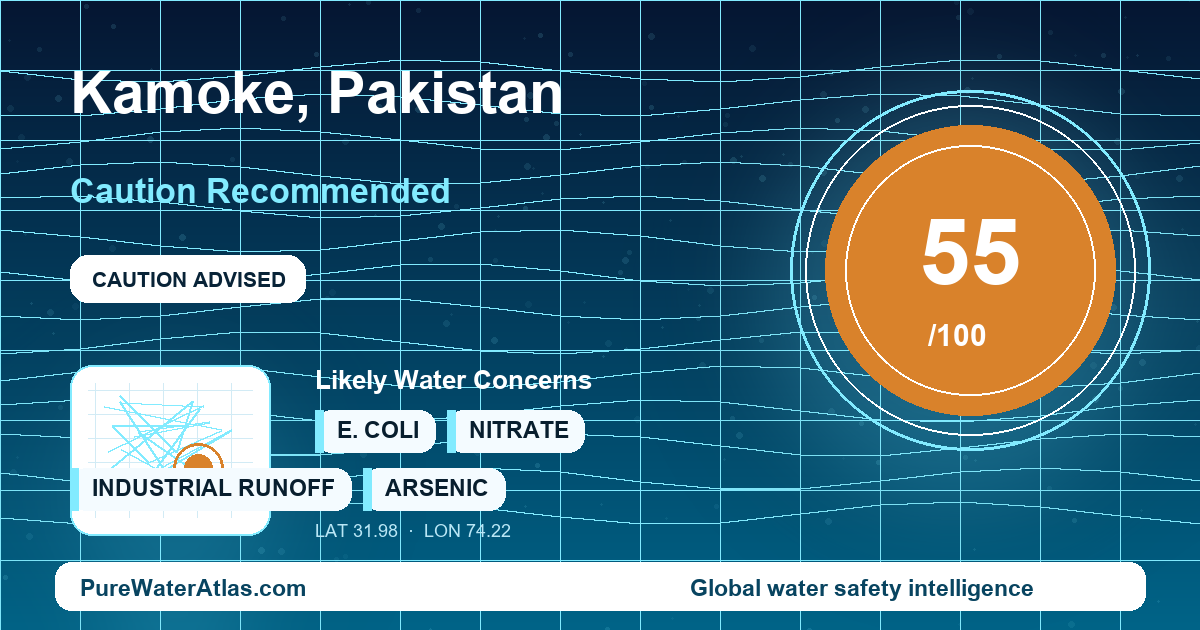
Kamoke, Punjab: groundwater-based supplies, household storage, and limited public tap-water reporting mean caution is recommended before drinking from the tap.
Quick Answer
| Water safety score | 55 / 100 |
|---|---|
| Risk level | Caution Recommended |
| Can visitors drink the tap water? | No, not without treatment. Visitors should use sealed bottled water, boiled water, or water from a well-maintained filtration/disinfection system. |
| Resident advice | Do not rely on taste or clarity. Test the household tap and storage tank, then choose treatment based on results. |
| Main water source | Primarily groundwater from municipal tube wells, private boreholes, local distribution lines, and household or commercial storage tanks. |
| Local authority context | Urban water supply and sanitation functions are generally associated with Municipal Committee Kamoke under Punjab local-government arrangements, with provincial oversight and scheme involvement from Punjab departments. |
| Filter recommendation | At minimum, use a treatment barrier for microbial risk. Consider reverse osmosis or other certified treatment if testing confirms high TDS, nitrate, arsenic, or other dissolved contaminants. |
Kamoke’s tap water should be treated as variable rather than reliably potable. The main verified issue is not a single public contaminant incident for the whole city; it is the combination of groundwater vulnerability, intermittent local infrastructure, sewerage and drain proximity, private bores, and household storage tanks. Publicly available, city-specific compliance reports for Kamoke are limited, so household testing is especially important.
Why Kamoke Is Different
Kamoke is a city and tehsil area in Gujranwala District, Punjab, located on the Lahore-to-Gujranwala corridor along the Grand Trunk Road region. Its surroundings include dense settlement, transport activity, irrigated agriculture, and peri-urban development. That local setting matters because groundwater, drains, sewer lines, stormwater, household tanks, and private bores can all interact in ways that affect the final water reaching a kitchen tap.
Unlike larger metropolitan areas with highly visible water authorities, Kamoke is not known from public sources to be served by a prominent metropolitan utility comparable to WASA Lahore or WASA Gujranwala. The realistic local picture is a mixed water system: municipal supply in some areas, private boreholes in others, local pumping, local pipes, and rooftop or ground-level storage tanks inside individual buildings. As a result, two nearby homes may not have the same water quality.
This city-specific uncertainty is central to the safety verdict. Pakistan-wide and Punjab-wide evidence shows that drinking-water supplies can face microbial contamination, salinity or high TDS, nitrate, arsenic in some groundwater areas, and poor source protection. Those broader findings do not prove that every Kamoke tap has the same contaminant level. They do justify a cautious approach: treat drinking water, maintain storage tanks, and confirm safety through testing rather than assumptions.
Where Does Kamoke’s Tap Water Come From?
Kamoke’s practical drinking-water system appears to be primarily groundwater-based. The main supply components are municipal tube wells and pumps serving parts of the local network, private household and commercial boreholes, local distribution pipes, and storage tanks. No strong public evidence was found of a large centralized surface-water treatment plant serving Kamoke city as the main potable supply.
Historically, and across many peri-urban Punjab settlements, households have used shallow wells, hand pumps, and later electric boreholes or tube wells. This history matters in Kamoke because shallow or poorly sealed groundwater sources are more vulnerable to nearby drains, latrines, leaking sewers, agricultural runoff, and seasonal flooding than properly protected deeper municipal sources.
The most important water-quality point in Kamoke is often not just the source. Water quality can change between the bore or municipal tube well, the distribution pipe, the suction pump connection, the building plumbing, the storage tank, and the final tap. A source that is acceptable at the pump can still become unsafe if the pipe network is depressurized, if a storage tank is dirty or uncovered, or if plumbing allows cross-contamination near drains or sewer lines.
- Municipal tube wells and pumps may supply parts of the local network.
- Local distribution pipes can be affected by leakage points, pressure interruptions, and repairs.
- Private boreholes may be used by homes, schools, mosques, shops, hotels, and commercial premises.
- Rooftop and ground-level storage tanks are common household control points.
- Nearby sewerage, open drains, stormwater channels, and agricultural land can increase risk for shallow groundwater and compromised pipes.
Who Manages Drinking Water in Kamoke?
Local urban water supply and sanitation functions in Kamoke are generally associated with the Municipal Committee Kamoke under Punjab’s local-government framework. Provincial context is important: the Punjab Local Government and Community Development Department is relevant to municipal committees and local urban services, while the Punjab Public Health Engineering Department is associated with water-supply and sanitation infrastructure schemes in Punjab.
Kamoke has also been associated with Punjab secondary-city municipal improvement programming. The Punjab Cities Program and the World Bank’s Punjab Cities Program Project are relevant to understanding the municipal-services context for secondary cities, including infrastructure and service-delivery challenges.
At the national technical level, the Pakistan Council of Research in Water Resources is a key water-quality monitoring and research authority. Pakistan’s reference framework includes the National Standards for Drinking Water Quality. However, no recent, comprehensive, consumer-facing Kamoke municipal tap-water quality report was found in readily accessible official sources. This limits confidence at the neighborhood and household level.
Main Local Water Concerns
The most defensible Kamoke water-safety assessment is risk-based. The concerns below are not presented as confirmed citywide concentrations at every tap. They are the practical risks that fit Kamoke’s groundwater-based, locally distributed, storage-dependent supply context and the broader Pakistan/Punjab water-quality evidence.
- Microbial contamination: Sewer leakage, low-pressure distribution, open drains, unsafe storage tanks, and unprotected private bores can allow fecal contamination. This is the main immediate health concern for travelers and residents.
- Turbidity and sediment: Cloudiness, particles, and disturbed water can occur after pipe repairs, pump restarts, tank cleaning, construction disturbance, or monsoon runoff. Turbid water can also interfere with disinfection.
- High TDS, hardness, or salinity: Some groundwater sources may have elevated dissolved minerals, affecting taste and treatment choices. Testing is needed before choosing a system.
- Nitrate: Shallow groundwater can be influenced by fertilizer, septic seepage, livestock waste, sewer leakage, or agricultural land.
- Arsenic: Arsenic is documented in parts of Punjab’s groundwater system, but no reliable public source was found confirming a current Kamoke-wide arsenic concentration. Testing is recommended rather than assuming safety or contamination.
- Lead: Lead risk is more likely to be building-specific, from older plumbing, brass fixtures, solder, fittings, or stagnant water in pipes, rather than from the groundwater itself.
- Chlorine residual: Residual disinfectant may be absent or inconsistent at household taps if supply is intermittent, if tanks are dirty, or if water comes from untreated private bores.
Seasonal conditions can increase risk. During monsoon rains, flooded drains, sewer overflows, shallow groundwater intrusion, and dirty rooftop tanks can affect water safety. Hot weather increases demand and can worsen storage hygiene if tanks are not cleaned and covered. Power outages or pump interruptions can create pressure drops that draw contaminated water into leaking pipes.
For Travelers
Visitors should not drink untreated tap water in Kamoke. Use sealed bottled water from reputable brands, water boiled to address microbial risk, or water from a well-maintained hotel system that includes appropriate filtration and disinfection. Check bottle caps for tampering, and avoid refilled bottles of uncertain origin.
Use bottled, boiled, or properly filtered water for brushing teeth, especially for children, pregnant travelers, older adults, and anyone with a sensitive stomach or immune compromise. Avoid ice from street vendors and small restaurants unless staff can confirm it was made from treated water; freezing does not reliably make contaminated water safe.
In hotels and restaurants, ask directly how drinking water is treated and whether filters are maintained. Better hotels may use filtration or bottled-water dispensers, but maintenance matters. In small restaurants, choose sealed bottled drinks, hot tea, boiled beverages, and freshly cooked foods rather than uncooked items rinsed in tap water.
Travelers should also follow broader Pakistan food and water precautions from the U.S. CDC Pakistan travel guidance. A travel filter can help only if it is rated for bacteria and protozoa; add boiling or disinfection where virus risk is a concern. For practical emergency treatment, see PureWaterAtlas: Boiling Water Purification: Complete Guide.
For Residents
Residents in Kamoke should treat household water safety as a source-and-building issue. A home treatment barrier is advisable for drinking and cooking water unless recent laboratory testing of the actual tap and storage tank shows acceptable results. A basic sediment plus carbon filter can improve taste and remove particles, but it does not reliably solve microbial contamination, nitrate, arsenic, or high-TDS problems.
UV treatment can disinfect clear water, but it will not remove dissolved chemicals. Reverse osmosis can reduce TDS, nitrate, arsenic, and several dissolved contaminants, but it must be maintained and paired with safe storage. Filter choice should follow test results, not marketing claims. PureWaterAtlas has a broader selection framework here: Water Treatment Systems: Choosing the Right Solution for Safe Drinking Water.
Testing should include the point actually used for drinking, not only the bore or municipal source. At minimum, test for E. coli or thermotolerant coliforms, TDS, electrical conductivity, hardness, pH, turbidity, and residual chlorine. If using a private bore, shallow pump, or source near agricultural land, septic seepage, open drains, or sewer lines, test nitrate. For groundwater-derived drinking water, test arsenic at least once because it cannot be detected by taste, smell, or color.
Older homes, schools, clinics, shops, and rental buildings may have internal plumbing that contributes metals, sediment, biofilm, or contamination through suction pumps and cross-connections. Flush stagnant water before use, but do not rely on flushing as a substitute for testing and treatment. Test lead if the building has old plumbing, unknown metal service lines, brass fittings, soldered joints, or water that sits overnight in pipes.
Storage tanks are a major control point in Kamoke. Keep tanks covered, screened, and above flood entry points. Clean and disinfect them periodically. Prevent birds, rodents, insects, dust, and roof runoff from entering. Test water after the tank, because contamination often occurs after water leaves the source.
Relevant Contaminants and Water-Quality Issues
For Kamoke, the most relevant immediate contaminant category is microbial contamination. Learn more about E. coli because it is the clearest indicator of fecal contamination risk from sewer intrusion, unsafe storage, and intermittent supply. PureWaterAtlas also explains the broader public-health context in Water Microbiology: Bacteria, Viruses, and Microbial Risks in Drinking Water.
Visible particles and cloudy water should be taken seriously. Read about turbidity and sediment, especially if your water changes after monsoon rain, repairs, pump restarts, or tank cleaning. Turbid water may need settling or filtration before UV or chemical disinfection can work properly.
For groundwater-specific risks, review arsenic and nitrate. If testing confirms either, see Arsenic in Drinking Water: Best Filters, Systems and Solutions and Nitrate Contamination in Drinking Water: Best Filters, Systems and Solutions. For older premises, review lead. For municipal or disinfected supplies, chlorine is relevant because a measurable residual can help indicate ongoing disinfection, though it does not guarantee absence of every contaminant.
How to Verify Your Water Quality
Because Kamoke-specific public tap-water data is limited, verification should happen at the household level. Use a recognized laboratory where possible, such as PCRWR-linked facilities, provincial public-health laboratories, university labs, or accredited private labs. Ask for numerical results rather than only “safe” or “unsafe” labels, and compare them with Pakistan’s drinking-water standards.
Repeat microbial testing after monsoon flooding, pipe repairs, sewage incidents, tank cleaning, or any sudden change in taste, odor, color, pressure, or illness pattern. Test both the tap and the storage tank outlet when possible. If results show contamination, treat the water, correct storage or plumbing problems, and retest after corrective action.
For a step-by-step testing framework, use Water Testing: Complete Guide to Water Testing and Analysis. For broader safety decisions, see Drinking Water Safety: How to Know if Your Tap Water Is Safe to Drink. Travelers can compare destination advice with the Global Water Safety Checker, and residents can look up lab parameters in the Contaminants Search Engine. For background on contamination pathways, see Water Contamination in Drinking Water.
Official and Technical Sources
- Punjab Public Health Engineering Department — Government of the Punjab department associated with water-supply and sanitation infrastructure schemes.
- Punjab Local Government and Community Development Department — provincial local-government department relevant to municipal urban services.
- Punjab Cities Program — Punjab Municipal Development Fund Company municipal-services program.
- Punjab Cities Program Project — World Bank project page for Punjab urban local-government service improvement.
- Pakistan Council of Research in Water Resources — national technical authority for water resources and water-quality research.
- Water Quality Status in Pakistan — PCRWR national report documenting Pakistan-wide drinking-water quality concerns.
- National Standards for Drinking Water Quality — Pakistan drinking-water reference standards.
- Pakistan Travel Health Notice and Destination Guidance — U.S. CDC guidance for travelers.
- Drinking-water Fact Sheet — World Health Organization background on drinking-water health risks.
- Water, Sanitation and Hygiene in Pakistan — UNICEF Pakistan WASH context.
Bottom Line
Kamoke tap water is best approached with caution. The city’s drinking-water reality is likely a mixed groundwater system of municipal tube wells, private bores, local pipes, pumps, and household storage tanks, not a single easily verified centralized supply. Public Kamoke-specific tap-water compliance data is limited, so this profile does not claim one citywide contaminant level. For visitors, the safest choice is sealed bottled, boiled, or properly treated water, with no untreated tap water or uncertain ice. For residents, the priority is testing the actual household tap and storage tank for microbial indicators, basic chemistry, nitrate, arsenic, and building-specific lead where relevant. Treatment should match test results, and storage tanks must be cleaned, covered, and protected from drains, insects, animals, dust, and monsoon contamination.
Read the full guide: Global Water Quality Guide
Explore more in this category: Global Water Quality Articles