
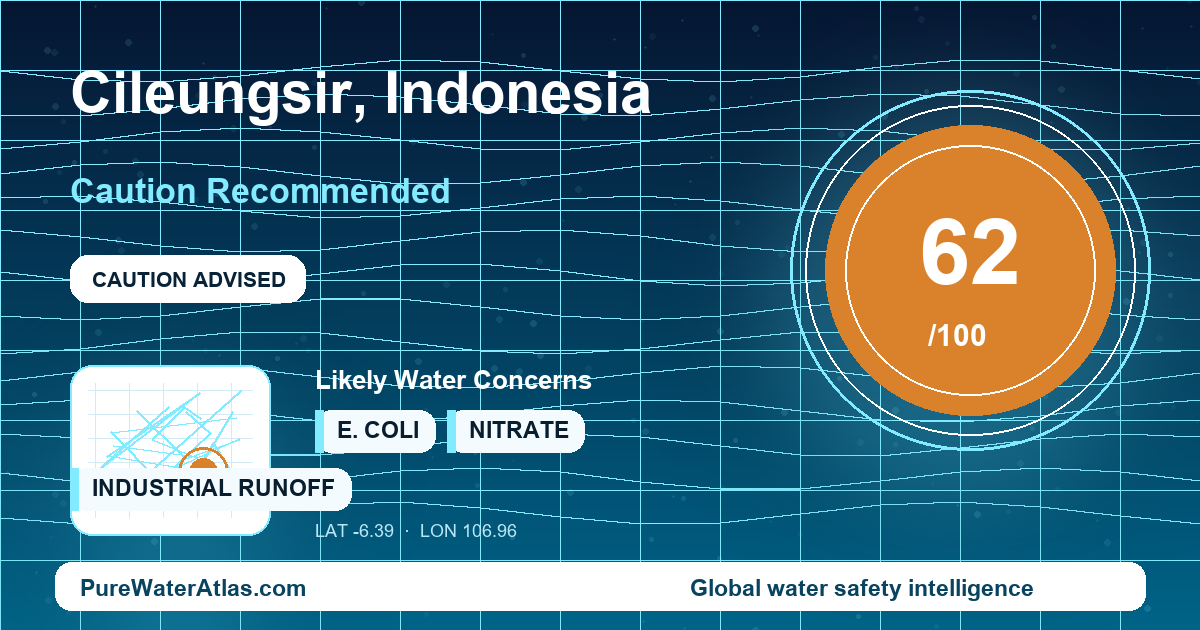
Cileungsir, Indonesia: tap-water caution for a mixed-source eastern Bogor Regency area where utility supply, private wells, roof tanks, refill water, and bottled water may all be part of the real drinking-water picture.
Quick Answer
| Water safety score | 62 / 100 |
|---|---|
| Safety status | Caution recommended. Do not assume untreated tap water in Cileungsir is potable at the faucet without local confirmation or testing. |
| Traveler advice | Use sealed bottled water, reputable refill water, or water that has been boiled or properly filtered. Avoid drinking untreated tap water. |
| Resident advice | Confirm your actual source: Perumda Air Minum Tirta Kahuripan connection, private well, building tank, refill supplier, or a combination. Test wells and stored water, especially after floods or outages. |
| Main local water context | Eastern Bogor Regency/Cileungsi area, with municipal supply associated with Perumda Air Minum Tirta Kahuripan and a local surface-water context tied to the Cileungsi River/Kali Bekasi watershed. |
| Water authority | Perumda Air Minum Tirta Kahuripan Kabupaten Bogor, with public-health oversight by Kabupaten Bogor health authorities and national standards set by Indonesia’s Ministry of Health. |
| Filter recommendation | A point-of-use treatment system is advisable for drinking and cooking unless recent local testing confirms safety. Utility users should consider sediment filtration, activated carbon, and microbial control; well users should test first before choosing treatment. |
PureWaterAtlas rates Cileungsir as Caution Recommended because there is credible information on the local utility, regulatory framework, and watershed pressures, but no consistently published, neighborhood-level finished tap-water compliance dataset was found for Cileungsir. Property-level conditions matter: a clean, well-managed building connected to treated water may have a different risk profile from a house using an old shallow well and roof tank.
Why Cileungsir Is Different
Cileungsir should be understood as a peri-urban eastern Bogor Regency location rather than as a single, uniform city water system with one easily verified tap-water result. In practice, drinking water in the Cileungsir/Cileungsi area may come from a public utility connection, a private shallow or drilled well, a roof or ground storage tank, bottled water, refill water, or a combination of these. This mixed-source reality is the central reason tap safety can vary from one property to another.
The area is inland, so salinity is not the main concern. The more relevant local issues are river pollution pressure, turbidity after rain, flooding impacts, shallow groundwater vulnerability, septic influence, household storage, and final-building plumbing. The Cileungsi River/Kali Bekasi corridor is widely known as a high-pressure watershed passing through dense settlement and industrial zones. Environmental concern about dark, odorous, or polluted river water has been recurrently reported for this corridor. That does not prove that every treated tap is unsafe, but it does mean source-water pressure and treatment reliability are important questions.
For Cileungsir, the most practical question is not simply “does the utility treat water?” It is also “what water reaches this kitchen tap today?” A hotel that provides sealed bottled water or a maintained filtered-water dispenser can be a very different situation from a rented house using a shallow well, a rarely cleaned roof tank, and older internal pipes.
Where Does Cileungsir’s Tap Water Come From?
The main public drinking-water utility context for Cileungsir is Perumda Air Minum Tirta Kahuripan Kabupaten Bogor, the Bogor Regency drinking-water company serving multiple branches and service areas. Cileungsir sits in the broader eastern Bogor Regency/Cileungsi area, where local supply is associated with utility service systems and river-based raw-water treatment. Exact household source can vary by service connection, pressure zone, local distribution conditions, private well use, and refill-water choice.
The most relevant surface-water setting is the Cileungsi River and connected Kali Bekasi watershed, managed within the wider Ciliwung-Cisadane water-resources context. This matters because river systems in urban and industrializing corridors can experience runoff, domestic wastewater inputs, sediment, odor events, and dry-season concentration effects. Treated utility water should be assessed separately from raw river water, but raw-water stress can influence treatment demands and operational risk.
Alongside public supply, many households in peri-urban Bogor Regency have historically used shallow or drilled groundwater wells, roof tanks, vendor or refill water, and small local water networks. This older and parallel source pattern remains important in Cileungsir because well construction, septic proximity, flood exposure, and tank maintenance can determine the safety of water actually consumed. A household may describe its water as “tap water” even when the tap is supplied by a private well and stored in a tank rather than by a fully controlled municipal distribution system.
Key infrastructure to consider in Cileungsir includes Perumda Air Minum Tirta Kahuripan service systems, local intake and water-treatment infrastructure, household storage tanks, booster pumps, private wells, and building-level plumbing. In areas with intermittent pressure or limited piped coverage, the final 10 meters of infrastructure inside the property can be as important as the official supply source.
Who Manages Drinking Water in Cileungsir?
The main local drinking-water utility for Bogor Regency is Perumda Air Minum Tirta Kahuripan Kabupaten Bogor. Local public-service and health context is connected to the Pemerintah Kabupaten Bogor. National drinking-water quality requirements are set by Indonesia’s Ministry of Health, including Permenkes No. 2 Tahun 2023 on environmental health quality standards.
Water-resources management for the relevant river-basin context is under Ministry of Public Works and Housing water-resources agencies, including the Balai Besar Wilayah Sungai Ciliwung Cisadane. Regional statistics and settlement context can be checked through BPS Kabupaten Bogor.
The important limitation is that PureWaterAtlas did not find a regularly updated, public, Cileungsir-specific finished tap-water report showing sampling results by neighborhood. Available sources identify the utility, regulatory framework, and watershed pressures, but they do not allow a verified statement that every tap in Cileungsir is compliant or non-compliant. For a specific home, school, guesthouse, or workplace, on-site testing remains the most reliable way to confirm drinking-water safety.
Main Local Water Concerns
The main Cileungsir concern is variability. A treated utility connection, a private well, a roof tank, and a refill-water container can each have different risks. The following issues are especially relevant for the Cileungsir/Cileungsi setting described in the available data:
- Surface-water pollution pressure: The Cileungsi River/Kali Bekasi watershed receives pressure from urban runoff, domestic wastewater, dense settlement, and industrial-area activity. This is a raw-water and watershed concern, not automatic proof of unsafe finished utility water.
- Turbidity and sediment: Heavy rain can raise suspended solids in river sources, wells, and distribution water. Turbid water can also make disinfection less effective.
- Microbial risk: Shallow wells, poorly sealed wells, flooded areas, dirty storage tanks, and low-pressure plumbing can increase risk from fecal contamination, including E. coli.
- Nitrate: Nitrate is possible in shallow wells near septic tanks, dense housing, animal keeping, or runoff sources. This is especially important for infants and pregnant households.
- Iron and manganese: Iron and manganese are plausible groundwater nuisance parameters in many Indonesian alluvial and volcanic settings. They should be tested locally rather than assumed.
- Chlorine residual: A chlorine taste or odor may occur in treated piped water. However, absence of chlorine at the far tap can also indicate insufficient disinfection residual.
- Building plumbing metals: Lead is not documented as a citywide Cileungsir problem, but older plumbing, brass fittings, solder, and stagnant building pipes can create household-specific metal risks.
Season also matters. During the wet season, floodwater intrusion, septic overflow, turbidity, and suspended sediment are more likely. During the dry season, lower river flow can concentrate pollutants and increase taste, odor, and treatment challenges. After service interruptions, pressure changes can mobilize sediment or increase intrusion risk; flush taps until clear and use treated water for drinking. After flooding, assume private wells and ground-level storage are unsafe until disinfected and tested.
For Travelers
Short-term visitors should not drink untreated tap water in Cileungsir unless an accommodation or host can show that the water is properly treated and safe at the point of use. The safest practical choice is sealed bottled water, reputable refill water, or water that has been boiled or filtered with a purifier suited to microbial risk.
For brushing teeth, most healthy travelers can usually use tap water in higher-standard hotels if the water is clear and not odorous. More cautious travelers, children, pregnant travelers, and immunocompromised people should use bottled or boiled water for brushing as well. For infant formula, use boiled water or another verified safe source.
Avoid ice from street vendors or unknown sources. In hotels and established restaurants, ask whether ice is made from treated water or packaged commercial ice. Do not assume bathroom tap water is drinking water, even in modern buildings. Choose places that provide sealed bottled water or a visible filtered-water dispenser. Carry water during day trips, and avoid drinks diluted with unknown water.
If using a travel filter, choose one that can handle bacteria and protozoa. Where viral risk is a concern, combine filtration with disinfection or boiling. PureWaterAtlas has a practical guide to boiling water purification and a separate guide to UV water purification.
For Residents
Residents should start by identifying the actual source feeding the kitchen tap: Perumda Air Minum Tirta Kahuripan supply, a private well, a shared well, a tank, refill water, or a hybrid system. For utility users, check the current service area, outage notices, water appearance, odor, pressure stability, and free chlorine residual where possible. For private wells, laboratory testing is strongly recommended before relying on the water for drinking.
A point-of-use treatment system is advisable for drinking and cooking unless recent local testing confirms that the tap or well is safe. For utility water, a reasonable household approach is a sediment prefilter, activated carbon for taste and odor, and microbial control through boiling, UV, ultrafiltration, or another suitable purifier. UV works best when the water is already low in turbidity. For private wells, do not choose treatment blindly: reverse osmosis may be appropriate where nitrate, high TDS, or certain metals are confirmed, but testing should come first.
Recommended private-well tests include E. coli or thermotolerant coliforms, total coliforms, nitrate, nitrite, pH, turbidity, conductivity/TDS, iron, manganese, hardness, and odor or color indicators. For utility tap water, test turbidity, free chlorine residual, E. coli/coliforms, pH, and, where plumbing is old, lead and other metals using both first-draw and flushed samples.
Old or poorly maintained buildings can introduce risk after water leaves the utility system. Corroded pipes, brass fittings, old solder, stagnant dead-end lines, and rarely used taps can increase metals, sediment, taste problems, and microbial regrowth. Flush stagnant taps and test if children or pregnant residents drink the water.
Storage tanks are a major practical risk point in Cileungsir. Roof tanks, ground tanks, and refill containers should be covered, screened from insects and animals, cleaned and disinfected periodically, and inspected after floods or pressure outages. A clean source can become unsafe if stored in a dirty tank.
Relevant Contaminants and Water-Quality Issues
The most relevant PureWaterAtlas contaminant profiles for Cileungsir are those tied to mixed sources, stormwater, wells, and storage. Start with E. coli for microbial contamination risk in wells, tanks, and flood-affected systems. Review turbidity and sediment if your water becomes cloudy, brown, or gritty after rain or utility interruptions.
For treated piped water, chlorine is relevant both as a taste issue and as an operational indicator that disinfection residual may be reaching the tap. For private wells, nitrate is important near septic systems, dense housing, and runoff sources; PureWaterAtlas also provides a detailed guide to nitrate contamination testing and detection.
If your well water stains fixtures, tastes metallic, or produces dark particles, review iron and manganese. If your home has older plumbing or unknown fittings, review lead and the guide to lead testing and detection.
How to Verify Your Water Quality
Because no public Cileungsir neighborhood-by-neighborhood finished tap-water compliance dataset was found, verification should be local and property-specific. Use an accredited Indonesian laboratory where possible, and keep results by date, source, and sampling location. A kitchen tap, roof tank, wellhead, and refill container can produce different results.
For a general framework, see PureWaterAtlas guides on Drinking Water Safety, Water Testing, Water Microbiology, and Water Purification. You can also browse the Contaminants Search Engine or compare broader location risk using the Global Water Quality Checker.
Retest after floods, major pipe repairs, long outages, new well drilling, septic-tank problems, or any change to water appearance, odor, or taste. If water becomes cloudy, black, oily, metallic, or sewage-like, avoid drinking it until the source is identified and corrected.
Official and Technical Sources
- Perumda Air Minum Tirta Kahuripan Kabupaten Bogor — official Bogor Regency drinking-water utility.
- Pemerintah Kabupaten Bogor — local-government context for public services, health, environment, and water-service coordination.
- Kementerian Kesehatan Republik Indonesia: Permenkes No. 2 Tahun 2023 — national environmental health quality standards, including drinking-water parameters.
- Balai Besar Wilayah Sungai Ciliwung Cisadane — relevant basin authority for the wider Ciliwung-Cisadane water-resources area.
- BPS Kabupaten Bogor — official regional statistics for Bogor Regency.
- WHO Guidelines for Drinking-water Quality — high-authority reference for interpreting microbial, chemical, and operational drinking-water risks.
- UNICEF/WHO Joint Monitoring Programme: Indonesia drinking-water data — national and household drinking-water service context where city-specific public data are incomplete.
Bottom Line
Cileungsir tap water should be treated with caution. The area’s drinking-water reality is mixed: some households may use Bogor Regency utility water, while others rely on private wells, roof tanks, refill water, or bottled water. The Cileungsi River/Kali Bekasi watershed adds important surface-water pressure, but raw-river pollution does not automatically prove every treated tap is unsafe. The biggest practical risks are source uncertainty, microbial contamination in wells or tanks, turbidity after rain, nitrate in vulnerable shallow wells, and building-level storage or plumbing problems. Travelers should use bottled, reputable refill, boiled, or properly filtered water. Residents should confirm their source, maintain tanks, and test wells or suspect taps before drinking.
Read the full guide: Global Water Quality Guide
Explore more in this category: Global Water Quality Articles