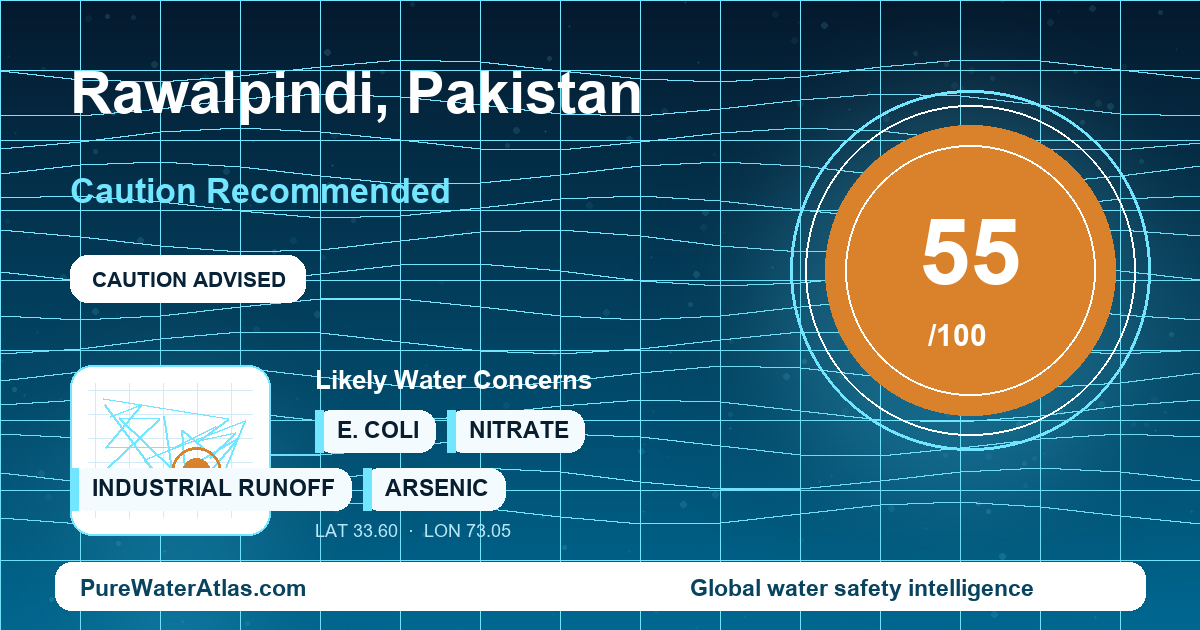
Rawalpindi, Pakistan: mixed surface-water and groundwater supply, intermittent distribution risks, storage-tank concerns, and practical drinking-water guidance for visitors and residents.
Quick Answer
| Water safety score | 55 / 100 |
|---|---|
| Risk level | Caution Recommended |
| Overall verdict | Caution recommended. Rawalpindi has a formal municipal water system, but tap-water safety can vary by source, season, distribution-line condition, building plumbing, and household storage. |
| Traveler advice | Short-term visitors should not treat ordinary tap water in Rawalpindi as reliably safe to drink. Use sealed bottled water, properly boiled water, or water treated by a verified purifier. |
| Resident advice | Residents should manage risk at the household level: clean tanks, maintain plumbing, test periodically, and use treatment matched to the source and test results. |
| Main water sources | Mixed supply: surface-water systems associated with Rawal Dam and Khanpur Dam, plus municipal and private groundwater tube wells. |
| Main authority | Water and Sanitation Agency Rawalpindi, commonly known as WASA Rawalpindi. |
| Filter recommendation | A point-of-use treatment system is advisable for many homes, but selection should depend on actual risk. Boiling or verified disinfection helps microbial risk; it does not remove dissolved chemicals such as nitrate, arsenic, salts, or metals. |
Why Rawalpindi Is Different
Rawalpindi is not a city where one simple statement about tap water fits every household. It sits directly beside Islamabad on the Potohar Plateau and is part of a fast-growing twin-city urban region. Its drinking-water reality is shaped by both regional surface-water reservoirs and local groundwater abstraction, while the final quality at the tap is strongly affected by distribution pressure, pipe condition, household storage, and whether a home uses municipal water, private bore water, tanker water, or a combination.
The practical question in Rawalpindi is often not only whether the water was treated before entering the system. It is also what happens after the water travels through mains, neighborhood pipes, building plumbing, underground tanks, rooftop tanks, and household containers. Intermittent supply and pressure loss can increase contamination risk where pipes are damaged or near drains or sewerage. A clean-looking glass of water can still carry microbiological risk if the distribution line, private connection, or storage tank is compromised.
PureWaterAtlas rates Rawalpindi at 55/100, with Caution Recommended. This rating reflects identifiable formal supply institutions and national drinking-water standards, but also important uncertainty: recent, public, neighborhood-level compliance data are limited, and conditions may differ sharply from one area, building, or water source to another.
Where Does Rawalpindi’s Tap Water Come From?
Rawalpindi’s drinking-water supply is a mixed system. Surface-water supplies associated with Rawal Dam and Rawal Lake, on the Korang River system, are important for the Rawalpindi-Islamabad urban area. Khanpur Dam, on the Haro River system, also supplies water to Islamabad and Rawalpindi through regional bulk-water infrastructure. Alongside these reservoir-fed supplies, municipal tube wells and groundwater pumping remain important, especially where surface-water allocation, pressure, or availability is insufficient.
In practice, many households do not experience water as a single continuous piped service. Some rely on stored municipal water, private bore water, tanker water, or neighborhood filtration points when supply is intermittent. This makes the water pathway longer and more variable. Water may pass through treatment infrastructure, service reservoirs, distribution mains, local pipes, domestic underground tanks, rooftop tanks, and finally a kitchen tap or container. Each step can protect water quality if well managed, or degrade it if poorly maintained.
Rawalpindi’s older supply context also matters. The city has historically depended heavily on groundwater from tube wells and local surface-water reservoirs. Urban population growth has increased demand faster than dependable supply augmentation, encouraging reliance on tube wells, private bores, filtration points, tankers, and household storage. That mix creates very different water-quality outcomes between households.
Leh Nullah and other urban drainage channels are not drinking-water sources, but they are relevant to risk. During sewer leakage, stormwater flooding, monsoon events, or low-pressure conditions, drains and damaged pipes can become contamination pathways. This is why the distribution network and household storage are central to Rawalpindi tap-water safety.
Who Manages Drinking Water in Rawalpindi?
The main urban water supply and sewerage service agency is the Water and Sanitation Agency Rawalpindi, commonly known as WASA Rawalpindi, under the Rawalpindi Development Authority framework. The Rawalpindi Development Authority is relevant for the wider urban infrastructure and institutional context.
Other institutions also matter. WAPDA Pakistan is an authoritative source for major dam and water-resource infrastructure, including information relevant to regional surface-water sources such as Khanpur Dam. The Pakistan Council of Research in Water Resources supports national water-quality research, monitoring publications, laboratory work, and drinking-water quality concerns. The Pakistan Environmental Protection Agency is relevant to Pakistan’s environmental standards framework, including National Standards for Drinking Water Quality.
Pakistan uses National Standards for Drinking Water Quality as the reference framework for potable water. However, Rawalpindi residents should understand the data limitation: Pakistan does not provide the same style of routine, public, city-by-city consumer confidence reports commonly seen in some high-income countries. Public information is sufficient to identify the major institutions, sources, and risk pathways, but current ward-level tap results, continuous residual chlorine data, pipe-condition maps, and routine compliance summaries are not readily available in one transparent public dataset.
Main Local Water Concerns
The leading practical concern in Rawalpindi is microbial contamination. Risk can rise when leaking pipes, low-pressure events, sewage intrusion, unsafe storage, or poorly maintained tanks allow contamination after water leaves a treatment point. This is especially relevant during intermittent supply, after outages, and in buildings with underground or rooftop storage tanks.
Turbidity and sediment are also important local issues. Monsoon runoff, reservoir inflows, pipe repairs, distribution disturbances, and tank disturbance can cause visible particles, discoloration, or cloudy water. Turbid water is not just an aesthetic issue: it can interfere with disinfection and may signal broader contamination pathways.
Residual chlorine can vary at the household tap. Treated water may lose protection at network ends, during long residence time in tanks, or when stored in hot weather. If chlorine residual is absent where chlorinated water is expected, microbial regrowth or recontamination becomes more plausible.
Groundwater quality can vary by bore and aquifer. Possible concerns include high dissolved salts, hardness, nitrate from sanitation or urban runoff, iron, and localized metal or mineral issues. Pakistan has recognized groundwater arsenic concerns, so Rawalpindi households using private bores should verify by testing rather than assuming arsenic is absent. Lead is better treated as a building-plumbing risk rather than a citywide raw-water claim; older pipes, fittings, solder, fixtures, and stagnant premise plumbing can contribute in specific buildings.
Tanker water and private bore water are especially variable unless the source, handling, storage, and disinfection practices are verified. A tanker delivery may solve a shortage problem without solving a drinking-water safety problem.
For Travelers
Visitors should use a conservative approach in Rawalpindi. Ordinary tap water is not recommended for most travelers as a routine drinking source. The main travel risk is gastrointestinal illness from microbial contamination, not simply unpleasant taste. Use sealed bottled water from a reputable brand, properly boiled water, or water treated by a reliable purifier.
Use bottled, boiled, or properly filtered water for brushing teeth, especially for children, pregnant travelers, older adults, and anyone with a sensitive stomach or weakened immune system. Avoid swallowing shower water, and use safe water when taking oral medicines.
Be cautious with ice. Avoid ice unless you are confident it was made from treated water in a reputable hotel or restaurant. Ice from street vendors or unverified shops should be avoided. The same caution applies to fountain drinks, diluted juices, and water served in reused containers.
Higher-end hotels and reputable restaurants may provide bottled or filtered water, but do not assume this automatically means tap water is safe. Ask whether water is bottled, boiled, or filtered. Prefer sealed bottles opened in front of you. For broader travel-health context, see the CDC Travelers’ Health guidance for Pakistan.
If boiling water, remember that boiling is a microbial safety measure, not a dissolved-chemical treatment. See the PureWaterAtlas guide to boiling water purification for practical limits and correct use.
For Residents
Rawalpindi residents should treat water safety as a household-level risk-management issue. A home treatment system is advisable for many households, but it should match the actual source and risk. For municipal water with uncertain microbial safety, consider a verified disinfection barrier such as boiling, UV, ultrafiltration, or another system designed for microbes. A simple taste-improving carbon filter alone is not enough if the concern is unsafe microbiological water.
If your household uses groundwater, a private bore, or tanker water, test before choosing a treatment system. Reverse osmosis may be appropriate for some dissolved contaminants or high TDS situations, but treatment should be selected based on results for microbiological indicators, TDS, hardness, nitrate, arsenic, iron, and other locally relevant parameters. The PureWaterAtlas guide to water treatment systems can help compare boiling, UV, RO, carbon, ultrafiltration, and combined systems.
Storage tanks are a major practical risk point in Rawalpindi. Underground and rooftop tanks should be kept covered, protected from insects and dust, cleaned on a schedule, and disinfected after cleaning. Do not assume water is safe simply because it entered the tank from a municipal line. Intermittent supply and tanker deliveries can both introduce or amplify risk if the tank is dirty or uncovered.
Older buildings need extra caution. Corroded galvanized pipes, old fittings, deposits, and metal-containing fixtures can affect water quality. If water has been stagnant overnight, flush the tap before drinking. If the plumbing is old or unknown, consider testing both first-draw and flushed samples for lead and other metals.
Relevant Contaminants and Water-Quality Issues
The most important immediate health issue to understand is E. coli in drinking water, because E. coli or thermotolerant coliform detection indicates fecal contamination risk. This is especially relevant where distribution leakage, storage tanks, and intermittent pressure may allow microbial contamination.
Rawalpindi residents who see cloudy or discolored water should review turbidity in drinking water and sediment in drinking water. These issues are relevant after monsoon runoff, reservoir inflows, pipe repairs, service interruptions, or tank disturbances.
Chlorine in drinking water is important because residual chlorine helps indicate whether treated municipal water remains protected in the distribution network and storage. Low or absent residual at the point of use can be a warning sign when chlorination is expected.
For groundwater and private bores, nitrate in drinking water is relevant where sanitation, sewage leakage, or urban runoff may affect aquifers. Pakistan’s broader groundwater context also makes arsenic in drinking water a contaminant that should be verified by laboratory testing rather than guessed. In older buildings, lead in drinking water is mainly a premise-plumbing concern involving old pipes, fittings, solder, or fixtures.
How to Verify Your Water Quality
The safest way to understand your Rawalpindi household water is to test at the point of use, not only at the source. Contamination can occur in neighborhood pipes, underground tanks, rooftop tanks, building plumbing, and kitchen fixtures. At minimum, consider testing for E. coli or thermotolerant coliforms, total coliforms, turbidity, pH, electrical conductivity, TDS, residual chlorine if chlorinated supply is used, nitrate, hardness, iron, and arsenic if groundwater is used.
Private bore or well water should be tested before regular drinking use and again after flooding, nearby construction, sewer leakage, a change in taste or odor, or unexplained illness. If infants, pregnant people, elderly residents, or immunocompromised people live in the home, prioritize microbiological testing and nitrate testing. Use a reputable government, university, PCRWR-associated, or accredited private water-quality lab when decisions involve arsenic, nitrate, lead, or other chemical contaminants.
PureWaterAtlas resources can help you plan testing and interpret results: start with the complete guide to water testing, the broader guide to drinking water safety, and the overview of water microbiology. You can also search specific substances in the Contaminants Search Engine or compare city guidance in the Global Water Quality Checker.
If testing confirms a specific issue, use targeted resources such as lead testing methods, arsenic testing methods, nitrate testing methods, and nitrate treatment solutions.
Official and Technical Sources
- Water and Sanitation Agency Rawalpindi — local utility responsible for urban water supply and sewerage services in Rawalpindi.
- Rawalpindi Development Authority — institutional framework connected with WASA Rawalpindi and urban infrastructure planning.
- Pakistan Council of Research in Water Resources — national water research, monitoring, publications, and laboratory-related authority.
- Pakistan Environmental Protection Agency — relevant for Pakistan’s environmental standards framework, including drinking-water quality standards.
- WAPDA Pakistan — authoritative source for major dam and water-resource infrastructure relevant to regional surface-water sources.
- WHO/UNICEF Joint Monitoring Programme — high-level Pakistan WASH context for interpreting drinking-water and sanitation risks.
- World Health Organization drinking-water fact sheet — health-based reference for safe drinking-water principles and microbial contamination.
- CDC Travelers’ Health: Pakistan — travel-health context for food and water precautions.
- Pakistan Meteorological Department — monsoon and flood-season context relevant to runoff, turbidity, and contamination pathways.
Bottom Line
Rawalpindi tap water deserves a cautious, source-specific approach. The city has formal municipal supply through WASA Rawalpindi and relies on a mix of Rawal Dam and Khanpur Dam surface-water systems plus groundwater tube wells. However, intermittent supply, pressure loss, aging or leaking pipes, monsoon effects, tanker use, private bores, and household storage tanks can change water quality before it reaches the glass. Travelers should use sealed bottled, boiled, or properly purified water and avoid unverified ice. Residents should clean tanks, maintain plumbing, test point-of-use water, and choose treatment based on actual results. Boiling helps microbial safety but does not remove dissolved contaminants such as nitrate, arsenic, salts, or metals.
Read the full guide: Global Water Quality Guide
Explore more in this category: Global Water Quality Articles