
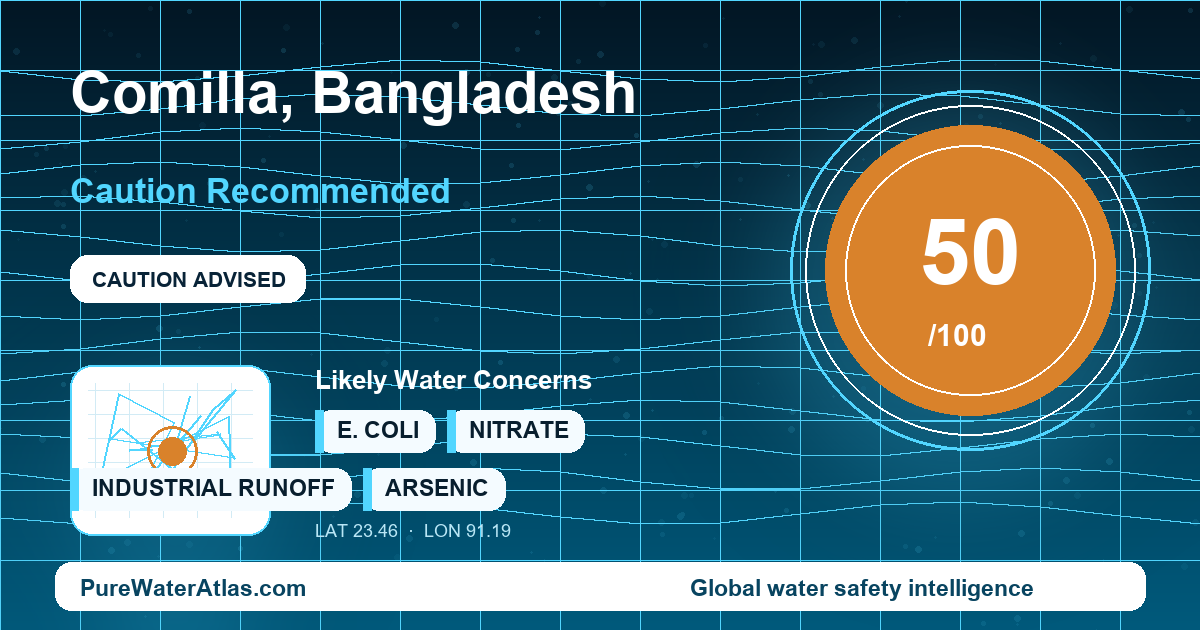
Comilla, also spelled Cumilla, has a groundwater-based urban water profile where municipal supply, private tube wells, building storage tanks, and point-of-use treatment can all affect whether water is safe at the final tap.
Quick Answer
| Overall status | Caution recommended. Comilla’s tap water should not be assumed safe to drink untreated because recent public, city-specific consumer tap-water compliance results were not found in accessible official sources. |
|---|---|
| Water safety score | 50 / 100 |
| Risk level | Caution Recommended |
| Traveler advice | Do not drink untreated tap water. Use sealed bottled water, boiled water, or water treated by a reliable purifier. Be cautious with ice and water in small restaurants unless the source is clearly purified. |
| Resident advice | Test the actual kitchen tap or private well. Municipal water may be safer than an untested shallow private tube well, but tanks, intermittent pressure, old plumbing, and household pumps can change water quality before use. |
| Main water source | Primarily groundwater: municipal production tube wells, private tube wells, pumps, rooftop or underground tanks, and household filtration. |
| Local authority | Cumilla City Corporation is the local urban authority associated with municipal services. National technical support and sector oversight involve the Department of Public Health Engineering under the Local Government Division. |
| Filter recommendation | A household treatment barrier is advisable unless recent tap-specific lab results show safety. Use treatment based on test results; boiling helps with microbes but does not remove arsenic, nitrate, lead, iron, manganese, or dissolved minerals. |
Why Comilla Is Different
Comilla is not best understood as a city with one clearly documented, publicly reported surface-water treatment system that determines safety for every household. The practical drinking-water picture is mixed and highly local. Comilla/Cumilla appears to rely mainly on groundwater-based municipal supply and private tube wells, combined with building-level storage, pumps, rooftop tanks, underground reservoirs, and household filters. That means water quality can vary between neighborhoods, buildings, and even between two taps in the same area.
Geographically, Comilla is an eastern Bangladesh city near the India Tripura border and the Gumti/Gomti River system, within the broader Meghna basin. This matters because its leading water concerns are different from Bangladesh’s coastal salinity hotspots. The dataset reviewed for this guide does not identify salinity as the dominant documented issue for Comilla. The more practical concerns are groundwater quality, sanitation intrusion, tank hygiene, pipe leakage, intermittent pressure, and the absence of easily accessible routine consumer-level reporting.
Comilla also sits within Bangladesh’s broader groundwater history. Across the country, tube wells reduced many risks from direct surface-water use, but they created a need for chemical surveillance, especially for arsenic and other aquifer-related parameters. For Comilla residents, the key question is therefore not simply “municipal or private?” but “what does current testing show at this exact tap or well?”
Where Does Comilla’s Tap Water Come From?
The available evidence points to Comilla’s practical drinking-water system being primarily groundwater-based. Municipal supply is understood to come from groundwater production tube wells and pumping stations serving parts of the city through distribution pipes. Where municipal connections are absent, unreliable, or not preferred for drinking, households and buildings may use private tube wells, pumps, stored water, bottled water, or point-of-use purification.
Historically, Bangladesh towns commonly used ponds, dug wells, shallow tube wells, and local surface-water sources before wider adoption of tube wells and piped supply. In Comilla, the Gumti/Gomti River, ponds, canals, and shallow groundwater remain part of the wider water environment, but this guide does not treat river water as the dominant direct drinking-water source. The main drinking-water reality is municipal groundwater supply plus private groundwater and building-level handling.
The final tap is especially important in Comilla. Water that leaves a production tube well can be affected later by distribution pipes, pressure drops, pipe leaks, rooftop tanks, underground reservoirs, old plumbing, dirty storage tanks, or household filters that are not maintained. During monsoon periods, heavy rain, drain overflow, flooding, or surface runoff can increase contamination risk around shallow wells and damaged pipes. During dry periods, groundwater stress and changing pumping conditions may affect taste, mineral content, and supply reliability.
Who Manages Drinking Water in Comilla?
Cumilla City Corporation is the local urban authority associated with municipal services in Comilla/Cumilla. Nationally, Bangladesh’s water-supply and sanitation sector is supported and overseen through institutions including the Department of Public Health Engineering, the Local Government Division, and related regulatory bodies. These institutions provide the governance and technical context for urban and rural water supply, arsenic mitigation, and public-health-related water programs.
However, a key limitation for Comilla is transparency at the consumer tap level. During the review behind this profile, no regularly updated consumer-confidence-style water-quality report was found in easily accessible official sources for Comilla tap water. That does not prove that every municipal tap is unsafe. It also does not prove that all private wells are contaminated. It means the safest conclusion is a cautious one: current household testing is needed before treating Comilla tap or well water as consistently safe for drinking.
For a general framework on interpreting tap-water safety, see PureWaterAtlas’ guide to Drinking Water Safety and the broader Global Water Quality city-by-city resource.
Main Local Water Concerns
The main water-quality concerns in Comilla are practical and site-specific rather than based on a single confirmed citywide contamination event. The most immediate health concern is microbial contamination. Intermittent supply, damaged pipes, pressure loss, dirty rooftop tanks, underground reservoirs, unsafe handling, and contaminated private wells can allow bacteria or other pathogens to reach household water. This risk is especially relevant after heavy rain, flooding, tank cleaning, pipe repair, or sewage/drain overflow near a property.
Arsenic is also a serious consideration because of Bangladesh’s groundwater context. The reviewed sources do not provide current tap-by-tap arsenic compliance results for Comilla, so it would be inaccurate to claim a citywide arsenic pass or fail. But untested private tube wells, especially shallow wells, should be treated cautiously until tested. Long-term exposure decisions should be based on laboratory results, not taste, color, or boiling.
Other groundwater-related concerns include iron and manganese, which can affect color, taste, staining, filter fouling, and in some cases health relevance depending on concentration. Nitrate can be a concern where shallow groundwater is influenced by septic systems, drains, livestock, fertilizer, or urban runoff. Turbidity and sediment may appear after pipe disturbance, pressure changes, monsoon intrusion, or tank cleaning. Residual chlorine may decline before water reaches the final tap, especially where water is stored for long periods or tanks are poorly maintained.
Lead is not documented in the reviewed dataset as a citywide Comilla problem. Still, premise plumbing can create risk in older or poorly maintained buildings through brass fittings, solder, galvanized components, or stagnant water in pipes. This is why final-tap testing matters.
For Travelers
Short-stay visitors should not drink untreated tap water in Comilla. The practical recommendation is to use sealed bottled water, water that has been boiled, or water treated by a reliable purifier. This caution is based on limited public city-level reporting and realistic distribution and storage risks, not on a verified citywide prohibition.
For brushing teeth, bottled or boiled water is the safer option, especially for children, pregnant travelers, immunocompromised people, and anyone with a sensitive stomach. If you use tap water, avoid swallowing it and prefer places that can confirm the water is purified.
Ice requires special caution. Avoid ice from street vendors and small restaurants unless you can confirm it was made from purified commercial water and handled safely. Factory-made ice is only as safe as its source water and handling chain. In hotels, ask whether drinking water is bottled, reverse-osmosis-treated, UV-treated, or boiled, and whether ice is made from the same treated water.
In restaurants, prefer sealed bottles opened at the table. Hot drinks made with boiled water are generally a better choice for microbial risk than untreated cold tap water. Carry bottled water during local travel, avoid refilled bottles with broken seals, and use boiled water for infant formula if no verified safe water is available. Remember that boiling is useful for microbial risks but does not remove arsenic, nitrate, lead, iron, manganese, or dissolved minerals. For more detail, see the PureWaterAtlas Boiling Water Purification Guide.
For Residents
Comilla residents should treat household water safety as a building-specific question. A municipal connection may reduce some risks compared with an untested private shallow well, but the final quality at the kitchen tap can still be affected by storage tanks, pumps, pressure loss, pipe intrusion, and plumbing materials. A private tube well should be tested before being used for drinking.
For municipal tap water, test at the final kitchen tap, not only at a source point. Prioritize E. coli or thermotolerant coliforms, arsenic, nitrate, pH, electrical conductivity or TDS, turbidity, iron, and manganese. If babies, pregnant people, elderly residents, or immunocompromised people use the water, give special priority to E. coli, arsenic, nitrate, and lead. Repeat microbiological testing after monsoon flooding, tank cleaning, pipe repairs, major pressure loss, or any sewage/drain overflow near the property.
For private wells, test before drinking and retest when conditions change. If the water is red, black, brown, metallic, rotten-smelling, or muddy, add targeted testing for iron, manganese, turbidity, sulfide indicators, and a sanitary inspection of the well and storage system.
A household treatment barrier is advisable unless current lab results show the water is safe. For municipal water, a sediment prefilter plus activated carbon and UV or ultrafiltration can reduce common taste, sediment, and microbial risks if maintained properly. For arsenic, nitrate, lead, high dissolved solids, or metals, choose treatment based on lab results; reverse osmosis or specialized media may be required. UV treatment can be useful for microbes when turbidity is controlled; see the UV Water Purification Guide.
Rooftop and underground tanks are major control points in Comilla homes and apartments. Tanks should be covered, screened, cleaned on a schedule, protected from birds, rodents, insects, and drain backflow, and disinfected after cleaning. Older premises should also be handled cautiously: stagnant water, brass fixtures, solder, galvanized components, and poorly maintained pumps can increase metal and microbial risks. Flush stagnant water before use and test if building plumbing is old or unknown.
Relevant Contaminants and Water-Quality Issues
The most relevant immediate health issue for Comilla travelers and households using stored or intermittently supplied water is E. coli in drinking water, because it indicates fecal contamination and possible pathogen risk. For long-term groundwater safety, arsenic in drinking water is a key Bangladesh-specific concern, especially for untested private wells. Residents who need more detail can also read Arsenic in Drinking Water: Testing and Detection Methods and Arsenic in Drinking Water: Best Filters, Systems and Solutions.
For visible cloudiness, sediment, monsoon disturbance, or tank problems, see Turbidity in Drinking Water. Groundwater users should also understand Iron in Drinking Water and Manganese in Drinking Water, which can occur together and affect color, staining, taste, and treatment maintenance. Where shallow groundwater may be affected by septic systems, drains, fertilizer, or runoff, Nitrate in Drinking Water and the guide to Nitrate Testing and Detection Methods are relevant. In older buildings, review Lead in Drinking Water and Lead in Drinking Water: Testing and Detection Methods.
How to Verify Your Water Quality
The only reliable way to confirm safety for a Comilla household is to test the actual water being consumed. For a private tube well, include arsenic, iron, manganese, nitrate, pH, electrical conductivity or TDS, turbidity, and E. coli or thermotolerant coliforms. For municipal water, test the final kitchen tap because storage tanks and plumbing can change water quality after water enters the building.
If the first sample is from an older building, consider both first-draw and flushed samples for lead and other metals. If the concern is microbial contamination after flooding, pressure loss, or tank cleaning, collect samples after the event and follow laboratory instructions carefully. If water is visibly muddy or discolored, turbidity and sediment should be addressed before relying on UV disinfection.
PureWaterAtlas resources that can help include the Water Testing Guide, the PureWaterAtlas Contaminants Search Engine, the Global Water Quality Checker, the Water Microbiology guide, the Water Purification guide, and the overview of Water Contamination. Related category pages include Drinking Water Safety, Global Water Quality, Water Testing, Water Microbiology, and Water Contamination.
Official and Technical Sources
- Cumilla City Corporation official website — local city government source for municipal services in Comilla/Cumilla.
- Department of Public Health Engineering — Government of Bangladesh technical agency for water supply, sanitation, arsenic mitigation, and water-quality programs.
- Local Government Division — national ministry division overseeing local government water-supply institutions and sector governance.
- WHO/UNICEF Joint Monitoring Programme data for Bangladesh — national WASH service context; not a substitute for Comilla household tap testing.
- WHO Guidelines for Drinking-water Quality — international health-based reference for microbial and chemical drinking-water risks.
- British Geological Survey and DPHE arsenic groundwater reports — authoritative Bangladesh groundwater arsenic evidence base.
- UNICEF Bangladesh: Water, sanitation and hygiene — national WASH challenges relevant to safe drinking water and sanitation.
- Bangladesh WASH Poverty Diagnostic — national context on WASH service quality, inequality, and water-safety challenges.
Bottom Line
Comilla’s tap water deserves a cautious approach. The city appears to rely mainly on groundwater-based municipal supply, private tube wells, pumps, and household storage rather than a clearly documented public surface-water treatment system with routine consumer reports. Travelers should avoid untreated tap water and use sealed bottled, boiled, or reliably purified water, including for brushing teeth if sensitive. Residents should test the actual kitchen tap or private well, with priority for E. coli, arsenic, nitrate, iron, manganese, turbidity, and lead where plumbing is old. A municipal connection may be preferable to an untested shallow well, but tanks, pressure drops, and building plumbing can still create risk. Current local testing is the only dependable confirmation of safety.
Read the full guide: Global Water Quality Guide
Explore more in this category: Global Water Quality Articles