
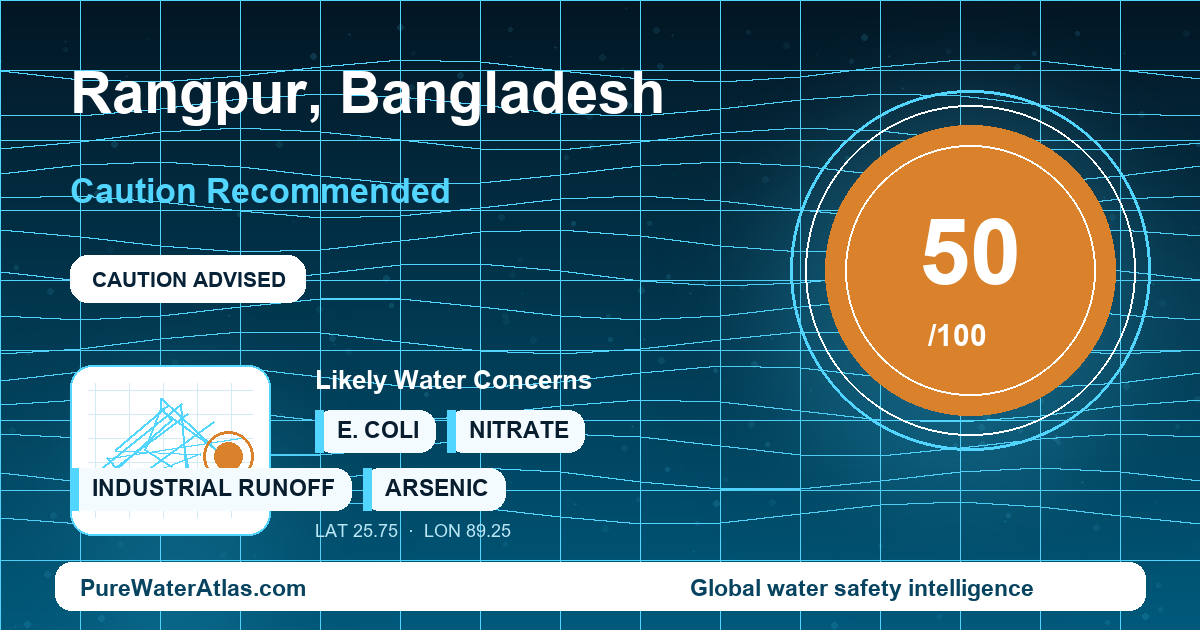
Rangpur, Bangladesh: a groundwater-based drinking water profile where caution is recommended because tap-level monitoring data is limited and safety depends heavily on wells, pipes, storage tanks, and household treatment.
Quick Answer
| Water safety score | 50 / 100 |
|---|---|
| Risk level | Caution Recommended |
| Can visitors drink tap water? | Not recommended untreated. Visitors should use sealed bottled water, boiled water, or water treated through a reliable purifier. |
| Resident advice | Do not assume a tap, tube well, or building supply is safe without recent testing for microbial and chemical risks. |
| Main water source | Primarily groundwater from municipal and private tube wells tapping alluvial aquifers. |
| Relevant authority context | Rangpur City Corporation locally, with national technical water-supply relevance from Bangladesh’s Department of Public Health Engineering. |
| Filter recommendation | A home treatment setup is advisable unless recent lab results confirm safety. Match treatment to the contaminant: microbial disinfection is different from arsenic, nitrate, lead, iron, or manganese removal. |
Caution is recommended in Rangpur. The city’s drinking water is understood to rely mainly on groundwater rather than a large conventional treated surface-water plant. That reduces coastal salinity concerns, because Rangpur is inland in northwestern Bangladesh, but it does not remove risks from E. coli, floodwater intrusion, intermittent distribution, household storage tanks, iron, manganese, nitrate, plumbing metals, or the need for verified arsenic testing.
Why Rangpur Is Different
Rangpur’s drinking-water identity is shaped by its location on the alluvial plains of the Teesta-Ghaghat river region and by Bangladesh’s long reliance on groundwater tube wells. Unlike coastal Bangladeshi cities, Rangpur is far from the sea, so seawater intrusion and coastal salinity are not the primary drinking-water concern. The practical water-safety question is instead whether a specific well, pipe network, storage tank, or household tap is protected from contamination and has been tested for the right parameters.
This matters because Bangladesh’s national drinking-water history is unusual. Tube wells helped reduce exposure to pathogen-rich surface ponds and rivers, but naturally occurring arsenic was later identified in many groundwater areas. Northern Bangladesh is generally not the highest-profile arsenic hotspot compared with some south-central and coastal areas, but no individual Rangpur well should be treated as safe for arsenic without testing. Arsenic cannot be seen, smelled, or tasted.
There are also important data limitations. Recent, public, citywide Rangpur consumer water-quality reports are not readily available. That means this guide cannot claim continuous compliance at every tap. The confidence level is medium-low for exact current compliance, but medium for the general source-water and risk profile because groundwater reliance, microbial safety, arsenic testing, and household water handling are well-recognized Bangladesh water-safety issues.
Where Does Rangpur’s Tap Water Come From?
Rangpur’s drinking water system is primarily groundwater-based. Municipal supply and many household supplies are expected to come from deep or shallow tube wells that tap alluvial aquifers. From there, water may move through local pumps, public standpoints, distribution pipes, institutional systems, landlord-managed building systems, or private household tube wells.
No verified evidence was found that Rangpur city relies mainly on a conventional treated surface-water plant for household drinking water. Nearby surface-water features, including the Ghaghat River system and the wider Teesta basin, are geographically important, but they were not verified as the main treated municipal drinking-water source for the city.
The main infrastructure points that affect Rangpur water quality include municipal groundwater production wells and pumping stations where piped service is available, local distribution pipes, private hand-pumped or motorized tube wells, and building-level underground reservoirs and rooftop tanks. Even if water is acceptable at a production well, it can be contaminated after leaving the source. Low pressure, intermittent service, pipe leaks, pump failures, storage tank sediment, dirty containers, and poor tap hygiene can all change the quality of water that residents actually drink.
Who Manages Drinking Water in Rangpur?
The local urban authority is Rangpur City Corporation. Nationally, the Department of Public Health Engineering, under the Local Government Division, is the principal public-sector technical agency for water supply and sanitation outside the major WASA utility areas.
Rangpur is not known to have a major independent WASA like Dhaka WASA or Chattogram WASA. In practice, a household’s drinking water may come from city corporation systems, institutional wells, landlord-controlled building supplies, or private tube wells, depending on location and building type. This fragmented reality is why tap-level verification is important. A safe source does not automatically guarantee safe water at a kitchen tap, school tap, clinic tap, restaurant tap, or rooftop-tank outlet.
Bangladesh drinking-water safety is governed through national standards, local government responsibilities, and public-health oversight. For household decision-making in Rangpur, however, the absence of easily accessible recent public consumer reporting means residents should rely on recent laboratory testing and careful maintenance rather than assumptions.
Main Local Water Concerns
- Microbial contamination: E. coli and other fecal indicators can enter drinking water through unsafe wells, cracked or depressurized pipes, floodwater intrusion, dirty rooftop tanks, contaminated taps, or poor household handling. This is a high-priority concern for Rangpur because contamination can occur after water leaves a well or municipal supply.
- Arsenic in groundwater: Arsenic is a Bangladesh-wide groundwater issue. Rangpur is not identified here as a highest-risk national hotspot, but individual wells must be tested. Neighboring wells are not proof of safety.
- Iron and manganese: Groundwater can contain iron and manganese that cause reddish, brown, or black staining, metallic taste, sediment, and consumer rejection. Manganese can also matter for health at elevated levels, especially for infants and children.
- Turbidity and sediment: Cloudy or dirty water can follow pipe repairs, well disturbance, tank-bottom sediment, flooding, or construction. Turbidity can reduce the effectiveness of chlorine and UV treatment.
- Nitrate: Rangpur is surrounded by agricultural land and dense settlement. Shallow wells near latrines, drains, livestock areas, or fertilized plots should be tested for nitrate, especially where infants or pregnant people drink the water.
- Lead and building plumbing: Lead is not described as the main aquifer issue in Rangpur, but building plumbing can introduce lead from old components, brass fittings, solder, pumps, or unknown metal materials.
Season also matters. Monsoon rains and localized flooding can increase microbial risk in shallow wells, low-lying pipes, storage tanks, and containers. Pre-monsoon dry conditions and high demand can stress pumps and increase intermittent supply. Pipe repairs, power outages, and construction can disturb sediment and create low-pressure intrusion risks. Hot weather can make poorly maintained rooftop tanks and household containers more vulnerable to microbial regrowth.
For Travelers
Travelers should not drink untreated tap water in Rangpur unless it has been boiled, disinfected, or treated through a reliable purifier. The issue is not that every tap is known to be unsafe; it is that current tap-level verification is limited and contamination can occur in pipes, hotel plumbing, rooftop tanks, restaurant storage, and household handling.
Use sealed bottled water from reputable shops or hotels, and check that the seal is intact. Avoid refilled bottles. For brushing teeth, short-term visitors and people with sensitive stomachs should use bottled, boiled, or properly filtered water. Adaptation by long-term residents is not the same as verified safety.
Ice is a higher-risk exposure when its source is unknown. Avoid ice in street drinks, informal restaurants, and small shops unless you trust that it was made from treated water. In hotels and restaurants, ask for sealed bottled water or hot tea. Do not assume that table water, juice diluted with water, or ice has been treated.
If staying outside the city or where bottled water supply is unreliable, carry an emergency purifier or chlorine dioxide tablets. For infants, use boiled and cooled water unless a safe treated source has been verified.
For Residents
Residents should treat tap water, tube-well water, and building-supplied water as sources that need verification. A home treatment system is advisable unless the household has recent lab results and a well-maintained supply. For microbial risk, boiling, chlorination, or UV treatment with adequate prefiltration can help. For arsenic, nitrate, lead, or high manganese, ordinary carbon filters may not be enough; treatment must be selected for the measured contaminant.
Private wells and building supplies should be tested for E. coli or thermotolerant coliforms at least annually and after flooding, pump work, tank cleaning, pipe repairs, or any sewage or drain intrusion event. Arsenic should be tested before using a new well for drinking and periodically afterward, especially if well depth, ownership, or source changes. Iron and manganese testing is important when water has staining, black particles, reddish sediment, or metallic taste.
Shallow wells should be tested for nitrate where they are near latrines, drains, livestock, or agricultural plots. Basic pH, electrical conductivity, turbidity, and total dissolved solids tests can help diagnose taste, scaling, corrosion, sediment, and treatment suitability. In older buildings, schools, clinics, and rented apartments, first-draw and flushed samples should be considered if lead is a concern.
Storage tanks are a major control point in Rangpur-style water use. Underground reservoirs and rooftop tanks should be sealed, screened, cleaned regularly, protected from sewage drains and floodwater, and disinfected after cleaning. Dirty tanks can recontaminate otherwise acceptable groundwater.
Relevant Contaminants and Water-Quality Issues
For Rangpur, the most relevant PureWaterAtlas contaminant profiles are E. coli in drinking water, arsenic in drinking water, iron in drinking water, manganese in drinking water, turbidity in drinking water, nitrate in drinking water, and lead in drinking water.
These issues match Rangpur’s groundwater and building-distribution profile. Microbial contamination is the immediate safety concern when water is untreated or stored poorly. Arsenic, nitrate, manganese, and lead require testing because taste and appearance are not reliable safety indicators. Iron and turbidity often create visible water-quality complaints, but visible clarity alone also does not prove that water is safe.
How to Verify Your Water Quality
The most reliable way to judge Rangpur tap or tube-well water is to test the actual source and tap used for drinking. Start with microbial testing, arsenic, iron, manganese, nitrate, pH, conductivity, turbidity, and total dissolved solids. Add lead testing for older buildings or unknown plumbing systems.
PureWaterAtlas resources that can help include the complete guide to water testing, the drinking water safety guide, the water microbiology guide, and the water purification methods guide. For specific treatment decisions, see boiling water purification, UV water purification, arsenic testing methods, arsenic filter options, nitrate testing methods, and lead testing methods.
You can also compare issues through the PureWaterAtlas Contaminants Search Engine and use the Global Water Quality Checker for broader traveler context.
Official and Technical Sources
- Rangpur City Corporation official portal — local government context for Rangpur urban services.
- Department of Public Health Engineering, Bangladesh — national technical agency for water supply and sanitation outside major WASA jurisdictions.
- Local Government Division, Ministry of Local Government, Rural Development and Cooperatives — national local-government oversight context.
- UNICEF Bangladesh Water, Sanitation and Hygiene — public-health context for drinking-water safety and hygiene risks in Bangladesh.
- WHO Guidelines for Drinking-water Quality — international reference for microbial and chemical drinking-water risk management.
- British Geological Survey and DPHE Bangladesh arsenic groundwater studies — key evidence base on naturally occurring arsenic in Bangladesh groundwater.
- WHO/UNICEF Joint Monitoring Programme — country-level WASH monitoring context.
- Bangladesh Bureau of Statistics — official demographic and administrative context.
Bottom Line
Rangpur tap water should be approached with caution, not assumed safe or unsafe in every location. The city’s drinking water is primarily groundwater-based, which makes coastal salinity less relevant but makes well-specific arsenic testing, microbial safety, iron, manganese, nitrate, turbidity, and storage hygiene important. Visitors should avoid untreated tap water and use sealed bottled, boiled, or reliably purified water. Residents should test their actual well, building supply, and tap, especially after flooding, repairs, tank cleaning, or changes in water appearance, taste, odor, or flow. Because recent public Rangpur tap-level monitoring data is limited, practical safety depends on verification, maintenance, and treatment matched to the specific contaminant.
Read the full guide: Global Water Quality Guide
Explore more in this category: Global Water Quality Articles