
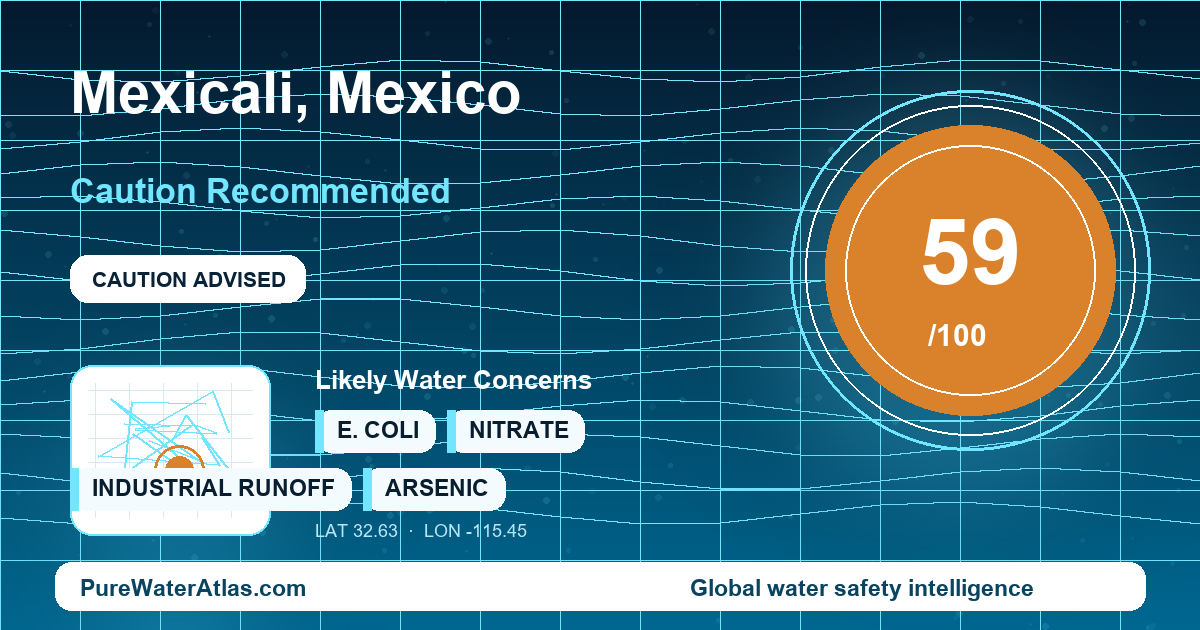
Mexicali tap water is utility-treated, but caution is recommended because the city depends heavily on Colorado River water, desert-canal infrastructure, and building-level tanks, cisterns, and plumbing that can affect water quality at the tap.
Quick Answer
| Water safety score | 59 / 100 |
|---|---|
| Risk level | Caution Recommended |
| Can travelers drink the tap water? | Not recommended as the default. Short-term visitors should use sealed bottled water, professionally purified garrafon water, or water treated by a reliable point-of-use system. |
| Resident guidance | Mexicali residents should treat municipal water as utility-treated but not automatically ideal at the kitchen tap. Filtration, reverse osmosis, reputable garrafon service, and targeted testing are reasonable for routine drinking use. |
| Main raw water identity | Primarily associated with Colorado River water delivered through the Mexicali Valley canal system before treatment and urban distribution. |
| Local water authority | Comision Estatal de Servicios Publicos de Mexicali, commonly known as CESPM. |
| Filter recommendation | Sediment prefiltration plus activated carbon is practical for taste, odor, chlorine, and particles. Reverse osmosis is worth considering where dissolved salts, total dissolved solids, nitrate, arsenic, or broader dissolved contaminants are a concern. |
Editorial verdict: Caution recommended. Mexicali is not a generic groundwater city. Its municipal supply is closely tied to lower Colorado River deliveries, desert conveyance infrastructure, local treatment, distribution conditions, and private building storage. The main question for most users is not whether a formal treated-water system exists, but whether the water remains microbiologically and chemically acceptable after passing through neighborhood distribution lines, cisterns, tinacos, roof tanks, and older plumbing.
Why Mexicali Is Different
Mexicali is a hot desert city at the northern edge of Baja California, directly beside the United States border and the lower Colorado River delta region. That geography matters. Drinking-water security in Mexicali is linked to a transboundary river system under long-term drought and allocation pressure, not simply to a local protected aquifer. The Colorado River is the key raw-water source associated with Mexicali’s public supply, and lower-basin conditions such as salinity and low-flow stress are relevant to the city’s water-quality picture.
Mexicali also has a distinctive “last-mile” water risk profile. Even when municipal water leaves treatment in acceptable condition, the quality at a user’s tap can be changed by distribution pipes, pressure fluctuations, household plumbing, cisterns, aljibes, rooftop tanks, and private storage containers. These local conditions are especially important in a hot climate, where stored water, ice, and bottled or garrafon water are part of daily life.
The New River is another important local context point. It flows north through Mexicali into California and is widely documented as highly polluted from municipal, industrial, and agricultural sources. That is a serious regional environmental-health issue, but it should not be confused with proof that Mexicali’s treated municipal drinking water comes from the New River. The drinking-water assessment here is based on the Colorado River source-water context, the CESPM utility framework, and practical uncertainty at the distribution and building level.
Where Does Mexicali’s Tap Water Come From?
Mexicali’s municipal drinking-water supply is primarily associated with Colorado River water delivered to Baja California through the Mexicali Valley irrigation and canal system near the international border. The lower Colorado River, international delivery infrastructure, diversion points, and Mexicali Valley canals form the key raw-water setting before water is treated and distributed into the city.
This matters because Colorado River water in downstream arid agricultural regions can carry higher dissolved salts than many protected mountain or deep groundwater sources. Drought and reduced flows can concentrate dissolved solids and increase operational pressure on water managers. For consumers, this does not automatically mean every tap is unsafe, but it does make dissolved minerals, salinity, taste, and treatment performance more relevant than in cities with simpler or less stressed water sources.
Mexicali’s water infrastructure includes Colorado River international delivery and diversion systems, the Mexicali Valley canal network, municipal treatment and distribution facilities operated by CESPM, and the private plumbing and storage systems inside homes, apartments, hotels, restaurants, and businesses. Those private components are not minor details. Cisterns, tinacos, rooftop tanks, and building pipes can materially affect water quality after the utility has treated the water.
Historically, Mexicali developed in a desert delta environment shaped by irrigation canals, agricultural drains, groundwater, and border-region water management. Some rural or peripheral users in the Mexicali Valley may rely on wells or local systems. Those users should not assume that municipal-water conclusions apply to private wells, because agricultural activity makes nitrate, pesticides, salinity, and bacteria important well-water concerns.
Who Manages Drinking Water in Mexicali?
The local public utility responsible for potable water, sewerage, and sanitation services in Mexicali is Comision Estatal de Servicios Publicos de Mexicali, CESPM. CESPM is the first place to look for local service information, outage notices, and utility-level context.
At the state level, Baja California water planning and public service oversight involve the Gobierno de Baja California, Secretaria para el Manejo, Saneamiento y Proteccion del Agua. National water resources, concessions, and hydrologic policy are managed by CONAGUA, Comision Nacional del Agua.
Drinking-water quality in Mexico is governed by federal health standards, including NOM-127-SSA1-2021, the official Mexican standard for water for human use and consumption. Health surveillance also involves Mexican health authorities such as COFEPRIS and state-level sanitary authorities. Because Mexicali depends on a transboundary water system, the International Boundary and Water Commission and the U.S. Bureau of Reclamation Lower Colorado Basin provide important broader context for lower Colorado River operations, drought, salinity, and basin management.
Public, recent, easy-to-verify neighborhood-level drinking-water laboratory results for Mexicali are limited. This profile therefore avoids claiming that every neighborhood is safe or unsafe. The caution rating reflects documented source-water stress, the regulatory and utility setting, and the practical risk that local distribution and building plumbing can change quality before water reaches the user.
Main Local Water Concerns
- Colorado River salinity: Lower Colorado River water can accumulate dissolved salts as it moves through arid agricultural regions. Salinity and total dissolved solids are relevant to taste, scaling, treatment decisions, and overall source-water stress.
- Drought and reduced flows: Long-term drought pressure on the Colorado River can concentrate dissolved solids and increase the burden on water managers serving downstream users, including Baja California.
- Turbidity and sediment: Canal operations, treatment changes, distribution disturbances, household tanks, pipe repairs, pressure interruptions, and occasional storms can temporarily increase cloudiness or particles at the tap.
- Premise-level microbial risk: The most plausible microbiological concern for many users is not necessarily the treatment plant, but cisterns, rooftop tanks, aljibes, storage containers, intermittent pressure events, and poorly maintained plumbing.
- Older plumbing metals: Public evidence is insufficient to make a citywide lead claim for Mexicali, but older fixtures, solder, brass components, valves, and corroded pipes can contribute metals in individual buildings.
- Private wells and agricultural areas: Rural and peri-urban supplies in the Mexicali Valley should be evaluated separately. Nitrate, pesticides, bacteria, total dissolved solids, hardness, salinity indicators, and arsenic may be relevant depending on the well location.
- Chlorine taste and residual loss: Chlorination is a key barrier against microbial contamination. In hot conditions and long premise plumbing runs, chlorine taste, odor, or residual decay may become noticeable.
Season also matters. Extreme summer heat increases water demand, accelerates disinfectant decay in building plumbing, and makes stored water less reliable if tanks are not cleaned. Canal maintenance, pipe repairs, localized outages, and pressure interruptions can temporarily increase sediment or microbial intrusion risk. Even infrequent desert storms can mobilize sediment in urban drainage and canals.
For Travelers
Drinking: Tap water is not recommended as the default for travelers in Mexicali. Use sealed bottled water, reputable garrafon water, or water treated by a verified purifier. This is a practical risk judgment, not a claim that every municipal tap is acutely unsafe. Travelers are more vulnerable to unfamiliar microbes and have less control over building storage tanks, restaurant ice, and lodging plumbing.
Brushing teeth: Conservative travelers should use bottled or purified water for brushing teeth, especially children, pregnant travelers, immunocompromised people, and anyone with a sensitive stomach. Some experienced travelers may tolerate tap water for rinsing, but it is not the lowest-risk option.
Ice: Use ice only when it is made from purified water, such as bagged commercial ice or ice from reputable hotels and established restaurants. Avoid ice from street vendors or informal settings if the water source is unclear.
Hotels and restaurants: Better hotels and established restaurants often use purified water or commercial ice, but visitors should ask rather than assume. In budget lodging, older properties, short-term rentals, or buildings with rooftop tanks or cisterns, use bottled or purified water for drinking.
Heat planning: Mexicali’s extreme summer heat makes hydration a safety issue. Carry bottled water during hot months, confirm that garrafon bottles are sealed and from a reputable supplier, avoid drinks mixed with unknown water, and be more cautious after local water outages or repair work. Boiling can reduce microbial risk, but it will not remove salts, metals, nitrate, or many chemical contaminants. For more detail, see Boiling Water Purification: Complete Guide.
For Residents
For routine drinking water in Mexicali, a home treatment system is reasonable. For municipal water, a practical setup is sediment prefiltration plus activated carbon to address particles, taste, odor, and chlorine. Reverse osmosis is worth considering where salinity, total dissolved solids, nitrate, arsenic, or broader dissolved contaminants are a concern. UV treatment can help with microbial control only after adequate filtration and only when the system is properly maintained; UV does not remove dissolved chemicals. See Water Treatment Systems and UV Water Purification: Complete Guide.
Residents should test kitchen tap water if the home has an aljibe, cistern, tinaco, rooftop tank, old plumbing, unexplained taste or odor, recurring sediment, or pressure interruptions. At minimum, laboratory testing for total coliform and E. coli is sensible when water is stored on-site or when plumbing has been repaired. If a reverse-osmosis system is installed, cartridges must be replaced and storage tanks sanitized on schedule; neglected systems can become microbial reservoirs.
Older buildings require special attention. Lead should not be claimed citywide without sampling, but individual fixtures, solder, valves, brass components, and corroded plumbing can contribute metals. If infants, pregnant people, or children live in the home, testing is the only reliable way to evaluate this risk. Helpful background is available in Lead in Drinking Water: Testing and Detection Methods.
Cisterns, aljibes, and rooftop tanks should be treated as part of the drinking-water system. They need covers, insect protection, periodic cleaning, disinfection when appropriate, and protection from heat, dust, animals, and cross-connections. If a tank is dirty, open, cracked, or rarely cleaned, use bottled or properly treated water for drinking until the system is corrected and tested.
Relevant Contaminants and Water-Quality Issues
Several PureWaterAtlas contaminant profiles are especially relevant to Mexicali’s water situation. Chlorine in Drinking Water is important because chlorination is a key microbial barrier, yet hot climates and storage tanks can affect residual behavior and taste. Turbidity in Drinking Water and Sediment in Drinking Water are relevant when users notice cloudiness or particles after outages, repairs, tank disturbances, or distribution changes.
For microbiological risk, E. coli in Drinking Water is a key indicator for fecal contamination in stored water, private wells, or systems affected by pressure-loss events. For rural and peri-urban supplies in the Mexicali Valley, Nitrate in Drinking Water deserves attention because agricultural activity can affect well water. Lead in Drinking Water is relevant as a premise-plumbing concern in older buildings, not as a verified citywide claim.
How to Verify Your Water Quality
The safest way to evaluate a specific Mexicali home, rental, restaurant, or well is to test the water actually being consumed. Utility-level treatment information does not prove what is happening inside a rooftop tank, cistern, old building, or private well. Start with the PureWaterAtlas Water Testing guide for choosing laboratory tests and interpreting results.
If you are comparing Mexicali with other destinations, use the Global Water Quality Checker. To research individual substances mentioned in this assessment, use the Contaminants Search Engine. For a broader decision framework, see Drinking Water Safety and Water Microbiology.
For private wells or non-municipal systems near agricultural areas, testing should include bacteria, nitrate, arsenic, total dissolved solids, hardness, salinity indicators, and any agricultural contaminants relevant to the location. For older buildings, consider first-draw and flushed samples for lead and copper through an accredited laboratory.
Official and Technical Sources
- Comision Estatal de Servicios Publicos de Mexicali, CESPM — local utility for potable water, sewerage, and sanitation services in Mexicali.
- Gobierno de Baja California, Secretaria para el Manejo, Saneamiento y Proteccion del Agua — state water sector authority relevant to Baja California planning and oversight.
- CONAGUA, Comision Nacional del Agua — federal water authority for national water resources, concessions, hydrologic information, and policy.
- Diario Oficial de la Federacion, NOM-127-SSA1-2021 — official Mexican drinking-water health standard.
- International Boundary and Water Commission, United States and Mexico — transboundary authority relevant to Colorado River and boundary water agreements.
- U.S. Bureau of Reclamation, Lower Colorado Basin — technical context on lower Colorado River operations, drought, salinity, and basin management.
- California State Water Resources Control Board, New River water quality information — documentation of the New River pollution issue affecting the Mexicali and Imperial Valley region.
- CDC Travelers’ Health, Mexico — traveler health guidance supporting conservative food and water precautions.
- Pan American Health Organization, Water and Sanitation — regional public-health context for safe drinking water and sanitation.
Bottom Line
Mexicali tap water should be approached with caution, especially by visitors. The city has a formal municipal water system operated by CESPM and is primarily tied to Colorado River water delivered through the Mexicali Valley canal system, not the polluted New River. The practical risk is the combination of lower Colorado River salinity and drought pressure, local distribution uncertainty, extreme heat, and building-level storage in cisterns, tinacos, rooftop tanks, and plumbing. Travelers should default to sealed bottled water, reputable garrafon water, purified ice, and verified treatment. Residents can reasonably use sediment filtration, activated carbon, reverse osmosis where appropriate, and targeted laboratory testing, especially in older buildings, stored-water systems, private wells, or homes with taste, odor, sediment, or pressure problems.
Read the full guide: Global Water Quality Guide
Explore more in this category: Global Water Quality Articles