
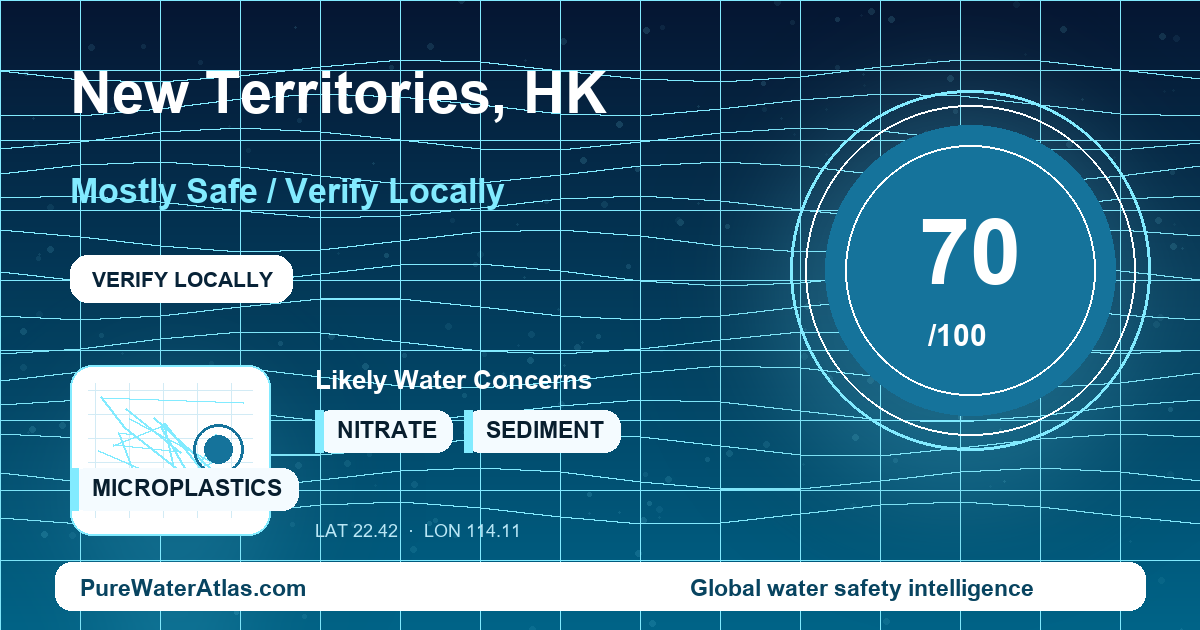
New Territories tap water is generally safe where it comes from Hong Kong Water Supplies Department treated mains and the building’s tanks, pumps, and internal plumbing are properly maintained; the main uncertainty is usually at the property level, not the central treatment works.
Quick Answer
| Overall safety status | Mostly Safe / Verify Locally — PureWaterAtlas score: 70/100. WSD-treated mains water is generally reliable, but New Territories includes many estates, village houses, rural premises, and high-rise buildings where roof tanks, sump tanks, and plumbing can change tap-level quality. |
|---|---|
| Can travelers drink it? | Usually yes in mainstream hotels, malls, serviced apartments, and reputable restaurants connected to WSD mains. Use boiled, bottled, or properly filtered water in older village houses, remote guesthouses, budget accommodation, or any premises with unknown tank maintenance. |
| Resident advice | Residents should verify their own building: check storage-tank cleaning records, flush stagnant taps, investigate discoloration or particles, and test for lead or metals if plumbing is old, undocumented, or recently renovated. |
| Main water source | Hong Kong’s integrated public supply: imported Dongjiang water from Guangdong, supplemented by local catchment water stored in Hong Kong reservoirs. |
| Water authority | Hong Kong Water Supplies Department, Government of the Hong Kong Special Administrative Region. |
| Filter recommendation | A filter is not automatically required for every home. Use activated carbon for taste and chlorine, a certified lead-reduction filter if lead is confirmed or strongly suspected, and reverse osmosis only when broad contaminant reduction is needed and the system can be maintained correctly. |
Why New Territories Is Different
New Territories is not a single compact city centre. It includes large new towns such as Sha Tin, Tai Po, Tuen Mun, Yuen Long, Tsuen Wan, Tseung Kwan O, Fanling-Sheung Shui, and Ma On Shan, as well as rural villages, country-park catchments, coastal settlements, and outlying islands. That mix matters for drinking water safety because the risk at a household tap may depend less on the regional treatment system and more on the building, estate, village house, hotel, or facility where the water is stored and distributed after it leaves the public main.
The central public supply is treated by the Hong Kong Water Supplies Department. However, many New Territories premises use roof tanks, sump tanks, pumps, service reservoirs, and internal pipework after the treated water enters the building. These private components can introduce sediment, discoloration, metallic taste, or microbial concern if covers are broken, tanks are not cleaned, pipework is old, or plumbing has been altered. This is why the practical answer for New Territories is “mostly safe, but verify locally.”
A further New Territories-specific complication is the range of premises. A modern hotel in a major commercial building is not the same risk profile as a vacant village house, a remote guesthouse, a subdivided flat, a school with older plumbing, or a recently renovated estate block. Official public-system data are useful, but they are not a tap-by-tap guarantee for every building, village, restaurant, or household.
Where Does New Territories’s Tap Water Come From?
New Territories is supplied through Hong Kong’s integrated public water-supply system. The raw-water mix is dominated by imported Dongjiang water from Guangdong and supplemented by local catchment yield stored in Hong Kong impounding reservoirs. Raw water is treated by the Water Supplies Department before it enters the distribution network.
Hong Kong historically depended on local reservoirs and catchments, several of which are in or near New Territories. Population growth and periods of water shortage led Hong Kong to rely heavily on Dongjiang imports. Important local water infrastructure in or near New Territories includes Plover Cove Reservoir in Tai Po District, created from a former sea inlet, and High Island Reservoir in Sai Kung. Other reservoirs relevant to the wider New Territories water landscape include Shing Mun Reservoir, Tai Lam Chung Reservoir, Hok Tau Reservoir, and Lau Shui Heung Reservoir.
The supply chain includes the Dongjiang import system and receiving infrastructure near the Hong Kong-Shenzhen boundary, the Muk Wu Pumping Station area for imported raw water reception and transfer, major Water Supplies Department treatment works serving New Territories supply zones, and a network of service reservoirs, pumping stations, distribution mains, building tanks, and internal plumbing. Large WSD works serving New Territories areas include facilities such as Sha Tin, Tai Po, Tuen Mun, Tsuen Wan, and other local treatment facilities. The final step, from building tank to tap, is often the step residents and travelers can most practically verify.
Who Manages Drinking Water in New Territories?
Public potable water in New Territories is supplied and monitored by the Hong Kong Water Supplies Department, Government of the Hong Kong Special Administrative Region. Hong Kong drinking water is managed under the waterworks framework, including the Waterworks Ordinance, and the Hong Kong Drinking Water Standards are based on the World Health Organization Guidelines for Drinking-water Quality.
This regulatory context is important, but it should not be confused with the condition of private internal plumbing and storage tanks. WSD monitoring describes the public supply and official monitoring framework; it does not prove the condition of every roof tank, sump tank, estate pipe, school fitting, hotel plumbing system, or village-house tap in New Territories. The 2015 Hong Kong lead-in-drinking-water incident showed that centrally treated water can be affected by non-compliant solder, fittings, or building plumbing. For New Territories residents, that lesson is directly relevant: tap-level verification matters even when the public supply is treated.
Residents can also look for building-level participation or management practices connected to WSD’s Quality Water Supply Scheme for Buildings, where relevant. For a household decision, the most useful evidence is usually a combination of WSD information, building-management tank records, licensed plumbing information, and targeted testing when there are risk factors.
Main Local Water Concerns
The main New Territories tap-water concerns are building-level and local-condition issues rather than a known failure of the territory-wide treatment system. The most important practical concerns include:
- Storage tanks: Roof tanks and sump tanks that are not cleaned, covered, locked, or inspected regularly can introduce sediment and microbial risk.
- Old or non-compliant plumbing: Older buildings, village houses, public facilities, schools, subdivided flats, and recently renovated premises may have solder, fittings, brass components, or pipework that can contribute lead, copper, nickel, iron, or other metals.
- Discoloration and particles: Brown, black, cloudy, or rusty water can occur after mains works, building pipe repairs, tank cleaning, long stagnation, or pipe disturbance.
- Chlorine taste or odor: Treated Hong Kong water may have a disinfectant taste that is noticeable to travelers not used to chlorinated supplies. This is often a taste issue, not automatically a safety failure.
- Rural and remote premises: Some village houses, rural accommodations, and remote premises may not have the same building-management standards as major hotels, malls, or modern estates.
- Non-potable sources: Untreated streams, wells, catchment runoff, country-park water, and beach-shower water are not equivalent to treated drinking water.
- Separate seawater flushing systems: Hong Kong uses separate seawater flushing systems in many districts. These systems are not drinking water. A salty taste from a drinking tap, suspected cross-connection, or unusual plumbing arrangement should be treated as urgent and reported to building management and WSD.
Season also matters. Typhoons and rainstorms can increase raw-water turbidity in catchments and may cause local flooding, pipe disturbance, power outages, or temporary service interruptions. Hot and humid months increase the importance of clean, covered tanks and avoiding long-stagnant water in vacant flats, schools, village houses, and holiday units.
For Travelers
For most visitors staying in mainstream New Territories hotels, serviced apartments, shopping-mall complexes, and reputable restaurants, tap water from WSD-supplied buildings is generally acceptable for drinking, brushing teeth, and on-site ice. The practical risk is low in well-managed commercial buildings where potable-water systems and storage tanks are maintained.
Use more caution in older walk-up buildings, village houses, remote guesthouses, construction-site accommodation, informal rural event spaces, or any budget premises where the water source and tank maintenance are unclear. On arrival, run the cold tap until the water is clear and cold, especially if the room or flat has been unused. Do not drink from bathroom hot-water taps, garden taps, beach taps, construction taps, or any tap labeled for cleansing or flushing.
Brushing teeth with tap water is generally acceptable in WSD-supplied buildings. If the water is discolored, has an unusual salty or sewage-like odor, or the property advises against drinking it, use bottled or boiled water for brushing teeth as well. Ice is generally acceptable in reputable restaurants, hotels, and chain food outlets, but avoid ice from informal stalls or premises where water handling is uncertain.
Travelers with sensitive stomachs, infants, pregnancy, immune compromise, or short stays in older village houses should choose boiled, bottled, or properly filtered water unless the host can confirm that WSD mains water is used and storage tanks are maintained. During a WSD suspension, brown-water episode, or building instruction not to drink the water, switch immediately to bottled or boiled water.
For Residents
New Territories residents can usually rely on WSD mains water at the supply point, but they should verify their own building. The highest-value resident action is not automatically buying a filter; it is confirming whether the building’s roof tank, sump tank, pumps, and internal pipes are being maintained. Ask building management for tank cleaning and inspection records. Tanks should be covered, locked, cleaned, and inspected on a regular schedule. Dirty tanks, broken covers, bird or insect entry, sediment, and stagnant water can create problems that public-system compliance data may not reveal.
Testing is especially important if a flat is in an older building, has unknown pipe materials, has recently undergone plumbing work, or is occupied by infants, pregnant residents, or young children. In those cases, test first-draw and flushed cold-water samples for lead and other metals. Lead risk is tied to solder, fittings, brass components, and stagnation, not simply to whether the raw water came from Dongjiang or a local reservoir.
If water is brown, black, cloudy, or contains particles, collect evidence, check whether the building recently cleaned tanks or repaired pipes, and investigate whether neighbors are affected. If the issue persists, consider testing for turbidity, iron, manganese, and microbial indicators. If a roof tank or sump tank is suspected to be dirty, use an accredited laboratory for E. coli or other microbial indicators and require building management to inspect and clean the tank.
For filters, match the device to the problem. Activated carbon can improve chlorine taste and odor. A certified lead-reduction filter is appropriate if lead is confirmed or strongly suspected. Reverse osmosis may be considered for broader contaminant reduction, but it requires correct maintenance. A neglected filter can worsen microbiological quality.
Relevant Contaminants and Water-Quality Issues
The most relevant New Territories water-quality topics are linked to treated-water taste, building storage, plumbing materials, and local disturbance events. If you notice a disinfectant taste, see PureWaterAtlas on chlorine in drinking water. If water becomes cloudy after storms, pipe works, or tank cleaning, review turbidity in drinking water. Visible particles, rusty water, or post-maintenance debris are covered in sediment in drinking water.
For older buildings, renovated flats, schools, estates, or premises with undocumented plumbing, lead in drinking water is the key contaminant profile to review. If tanks, private sources, or microbial contamination are suspected, see E. coli in drinking water and the broader PureWaterAtlas guide to water microbiology.
How to Verify Your Water Quality
Because New Territories is a broad region and official data are not published for every tap, verification should be local. Start by checking whether the premises are connected to WSD mains, whether any WSD or building notice is active, and whether storage tanks are maintained. Then decide whether the issue is taste, particles, discoloration, metals risk, or microbial concern.
For lead-specific concerns, use Lead in Drinking Water: Testing and Detection Methods. If lead is confirmed or strongly suspected, review Lead in Drinking Water: Best Filters, Systems and Solutions. For uncertain travel premises, advisories, or vulnerable users, see Boiling Water Purification: Complete Guide.
Residents planning broader testing can use How to Test Drinking Water: Complete Guide to Water Testing and Analysis. For choosing treatment based on measured risks, see Water Treatment Systems: Choosing the Right Solution for Safe Drinking Water. You can also search specific substances in the Contaminants Search Engine, compare destinations with the Global Water Quality Checker, or browse the Drinking Water Safety, Water Testing, and Water Contamination sections.
Official and Technical Sources
- My Drinking Water Quality — Water Supplies Department, Government of the Hong Kong SAR.
- Hong Kong Drinking Water Standards — Water Supplies Department, Government of the Hong Kong SAR.
- Dongjiang Water — Water Supplies Department, Government of the Hong Kong SAR.
- Water Resources — Water Supplies Department, Government of the Hong Kong SAR.
- Water Quality — Water Supplies Department, Government of the Hong Kong SAR.
- Quality Water Supply Scheme for Buildings — Water Supplies Department, Government of the Hong Kong SAR.
- Report of the Commission of Inquiry into Excess Lead Found in Drinking Water — Hong Kong SAR Government Commission of Inquiry.
- Guidelines for Drinking-water Quality — World Health Organization.
Bottom Line
New Territories tap water is mostly safe when it is WSD-treated mains water delivered through a well-maintained building system. The central Hong Kong supply is regulated and treated, with raw water mainly from Dongjiang imports plus local reservoirs, but New Territories covers modern estates, hotels, villages, rural premises, and older buildings. That variety makes building-level verification essential. Travelers can usually drink tap water in reputable hotels, malls, serviced apartments, and restaurants, while vulnerable travelers should use boiled, bottled, or properly filtered water in uncertain premises. Residents should focus on tank maintenance records, flushing stagnant taps, and testing for lead or metals in older or renovated plumbing. Official data are strong for the public system, but not a tap-by-tap guarantee for every New Territories property.
Read the full guide: Global Water Quality Guide
Explore more in this category: Global Water Quality Articles