
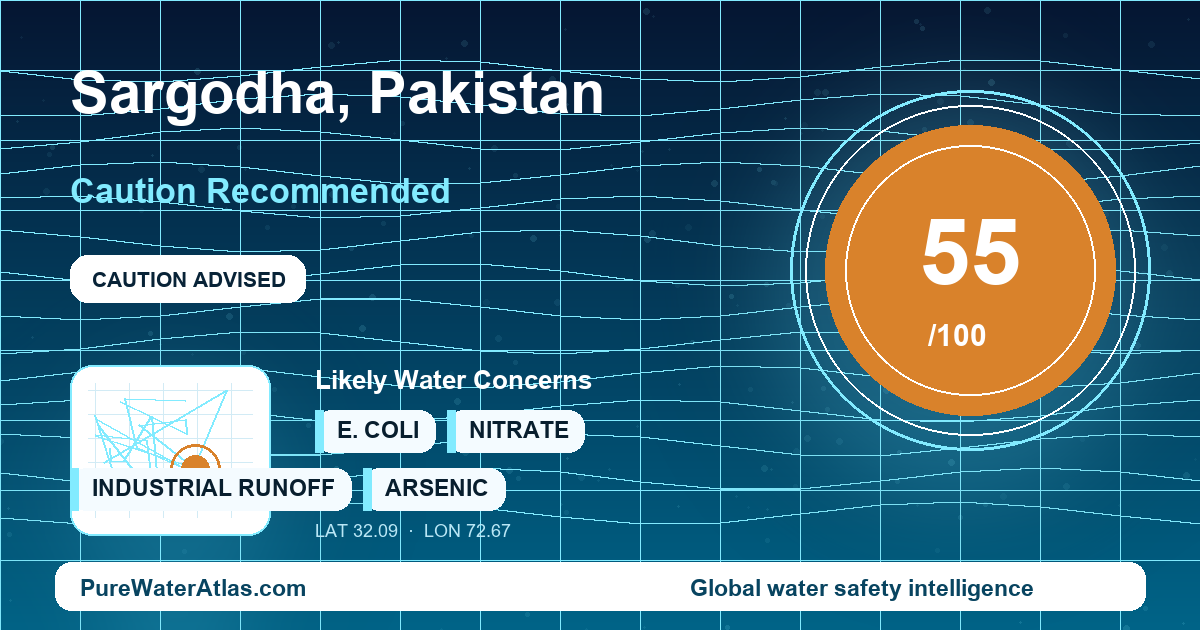
Sargodha, Pakistan: tube-well groundwater, household storage, and variable local conditions mean tap water should be verified and treated before drinking.
Quick Answer
| Water safety score | 55 / 100 |
|---|---|
| Risk level | Caution Recommended |
| Can visitors drink the tap water? | Not recommended unless reliably treated. Short-stay visitors should use sealed bottled water, properly boiled and cooled water, or water from a verified hotel or restaurant filtration system. |
| Resident advice | Conditionally usable after verification and treatment. Test the exact water used for drinking, especially after rooftop or underground storage, then choose treatment based on results. |
| Main water source | Primarily groundwater abstracted through municipal tube wells in the alluvial aquifer of central Punjab. |
| Local authority context | Urban water supply is associated with the Metropolitan Corporation or Municipal Corporation Sargodha under Punjab’s local government framework, with provincial-sector support from agencies such as the Public Health Engineering Department Punjab. |
| Filter recommendation | For many homes: sediment prefiltration plus UV or ultrafiltration for microbial risk, with tank maintenance. Reverse osmosis should be considered only when testing shows high TDS, nitrate, arsenic, fluoride, salinity, or similar dissolved chemical concerns. |
Overall verdict: caution recommended. Sargodha’s drinking-water risk is not best described as one confirmed citywide contaminant. The practical concern is the combination of groundwater variability, intermittent pressure, aging distribution lines, storage-tank hygiene, and limited public release of current ward-level test results.
Why Sargodha Is Different
Sargodha is a central Punjab city in the agriculturally intensive Jhelum-Chenab doab. Its water profile is shaped by alluvial groundwater, canal-irrigated surroundings, urban wastewater pressure, and household storage rather than by a single protected mountain reservoir or a highly visible centralized surface-water treatment plant dedicated to the city.
This matters because two homes in Sargodha can have different drinking-water quality even when they are in the same city. One household may drink direct municipal tube-well supply; another may use water after an underground tank, rooftop tank, suction pump, or private borehole; another may rely on a public or private filtration point. These should be treated as separate water sources for testing purposes.
Sargodha also has an older planned urban core as well as newer colonies and peri-urban areas. Older properties may have aged service lines, corroded internal plumbing, old metal fittings, suction pumps, and long-standing storage tanks. Newer colonies may have private boreholes or society-managed water supplies that are not automatically equivalent to municipal supply.
Where Does Sargodha’s Tap Water Come From?
Sargodha’s public drinking-water supply is understood to rely mainly on groundwater drawn from municipal tube wells in the alluvial aquifer of central Punjab. This groundwater system is influenced by the broader Jhelum-Chenab doab setting, canal-irrigated agriculture, regional recharge, and local urban conditions.
Key infrastructure affecting water quality in Sargodha includes municipal tube wells and pumping stations, distribution mains and service connections, and overhead or storage reservoirs where available. At the household level, underground tanks, rooftop tanks, suction pumps, and internal plumbing can be just as important as the municipal source itself. Water that leaves a tube well in acceptable condition can still be affected by low pressure, pipe leakage, nearby drains or sewer seepage, tank sediment, insects, biofilm, or stagnant plumbing.
Historically and in peri-urban areas, some households have also used private hand pumps, shallow wells, and private boreholes. These sources can differ greatly from municipal tube-well water. A private bore that tastes clear is not necessarily safe, because dissolved contaminants such as nitrate, arsenic, fluoride, salinity, or hardness cannot be ruled out by taste, smell, or appearance.
Who Manages Drinking Water in Sargodha?
Urban water supply in Sargodha is associated with the Metropolitan Corporation or Municipal Corporation Sargodha under Punjab’s local government framework. Provincial support and water-supply and sanitation schemes may involve the Public Health Engineering Department Punjab and other Punjab government bodies. Sargodha does not have the same widely recognized independent WASA-style utility identity as Lahore or Faisalabad.
Drinking-water quality in Pakistan is framed by national drinking-water quality standards and public-health guidance. Implementation involves local government bodies, provincial departments, health and environmental authorities, and testing or surveillance institutions such as the Pakistan Council of Research in Water Resources.
A major limitation for Sargodha residents is transparency of current local data. Some Sargodha-relevant and Punjab water-quality information exists, but there is no consistently accessible, current, neighborhood-by-neighborhood public compliance report comparable to annual consumer confidence reports in some countries. For that reason, this guide identifies practical risk pathways and testing priorities rather than claiming exact citywide compliance or non-compliance percentages.
Main Local Water Concerns
- Microbial contamination: the most immediate drinking-water concern is contamination from intermittent supply, low or variable pressure, leaking distribution lines, cross-connections with drains, or unhygienic household storage. E. coli and related indicator organisms are important tests because they signal fecal contamination risk.
- Storage tanks: underground and rooftop tanks can turn a safer source into unsafe tap water if they are cracked, uncovered, insect-accessible, near sewer seepage, or not cleaned and disinfected routinely.
- Turbidity, sediment, rust, and discoloration: particles can appear after pipe repairs, pump cycling, road works, low-supply periods, or stagnant tank conditions. Learn more about turbidity and sediment.
- Groundwater mineral variability: high TDS, hardness, salinity, or taste issues can occur in some groundwater-dependent Punjab supplies. These issues should be confirmed by testing before installing reverse osmosis.
- Nitrate risk: nitrate is plausible where shallow groundwater is influenced by agriculture, septic leakage, or urban wastewater. It is especially important for private bores and shallow sources.
- Arsenic and fluoride: arsenic and fluoride are recognized groundwater concerns in parts of Punjab. Sargodha households should not assume they are absent without local lab results.
- Disinfectant residual: low or inconsistent chlorine residual can allow microbial regrowth in distribution lines or tanks.
- Building plumbing metals: lead risk is mainly a building-plumbing issue, especially in older fittings, brass fixtures, solder, pumps, or stored water contact materials. There is no public evidence in this dataset of a citywide lead-service-line inventory.
Season also matters. Monsoon rain can increase contamination risk where stormwater, sewage, and low-pressure water lines interact. Very hot summer conditions increase household storage, tank warming, and bacterial regrowth risk. Power outages or pump interruptions can reduce pressure and make intrusion more likely during restart cycles.
For Travelers
Visitors should not rely on untreated tap water in Sargodha. Use sealed bottled water, water that has been properly boiled and cooled, or water from a hotel or restaurant filtration system that can be verified. This is especially important for short-stay travelers who are not acclimatized to local microbial risks.
Use bottled or boiled and cooled water for brushing teeth, especially for children, pregnant travelers, immunocompromised people, and anyone on a short visit. Avoid ice unless the hotel or restaurant can confirm it was made from treated water. Street-vendor ice should be treated as higher risk.
Higher-end hotels and reputable restaurants may use filtration or bottled water, but this should be confirmed rather than assumed. Hot tea, coffee, and freshly boiled beverages are generally safer than unverified cold drinks, diluted juices, or ice-based drinks. In summer, carry bottled water, check that seals are intact, avoid refilled bottles of uncertain origin, and use oral rehydration salts if gastrointestinal illness occurs. Boiling helps with microbes, but it does not remove salts, nitrate, arsenic, fluoride, or other dissolved chemicals. For boiling technique, see Boiling Water Purification: Complete Guide.
For Residents
Residents should treat Sargodha tap water as conditionally usable after verification and treatment. A home treatment barrier is advisable for many households, but the correct system depends on test results and the actual water path inside the home.
For a typical municipal supply with microbial and sediment concerns, a practical approach is sediment prefiltration plus a certified UV or ultrafiltration disinfection stage, combined with strict storage-tank hygiene. UV can be effective only when turbidity is controlled and the unit is maintained; see UV Water Purification: Complete Guide. If lab results show high TDS, nitrate, arsenic, fluoride, salinity, or similar dissolved contaminants, a properly maintained reverse osmosis system or other specialized treatment may be appropriate. Do not install RO only because the water tastes different; first confirm the need by testing.
Test the exact water you drink. If your family drinks water after an underground tank or rooftop tank, collect the sample after that tank, not only from the source line. At least annually, test for E. coli or thermotolerant coliforms, total coliforms, turbidity, pH, electrical conductivity or TDS, hardness, nitrate, arsenic, fluoride, iron, manganese, and residual chlorine if chlorinated municipal water is supplied.
Retest after monsoon flooding, sewer repairs, pipe breaks, new bore installation, new storage-tank construction, or any major change in taste, smell, color, or illness pattern. Use a recognized laboratory where possible, such as PCRWR-linked services, public-health laboratories, university laboratories, or reputable accredited private laboratories.
Older homes, shops, schools, and clinics should not assume municipal source-water quality equals tap quality. Flush stagnant lines, maintain pumps and tanks, and consider first-draw and flushed samples if metal contamination is suspected. Keep underground and rooftop tanks covered, insect-proofed, away from sewer seepage, and cleaned and disinfected on a routine schedule.
Relevant Contaminants and Water-Quality Issues
The most relevant Sargodha contaminant profile is microbial risk, especially E. coli, because intermittent supply, pipe leakage, household tanks, and cross-connections can affect tap safety even when the original groundwater source is better quality. Turbidity and sediment are also important because particles can reduce disinfection effectiveness and indicate pipe, pump, or tank disturbance.
For groundwater and private bore users, nitrate, arsenic, fluoride, TDS, hardness, iron, and manganese should be evaluated through lab testing. For older buildings, lead should be considered a plumbing-related risk rather than a proven citywide source-water issue. Chlorination, where used, should be understood through the role of residual chlorine in preventing microbial regrowth.
How to Verify Your Water Quality
The most reliable next step in Sargodha is source-specific testing. Use the PureWaterAtlas guide to Water Testing to decide what to sample and which parameters to request. For general safety decision-making, see Drinking Water Safety.
If a lab report contains unfamiliar parameters, use the Contaminants Search Engine to look them up. To compare Sargodha with broader city and country risk profiles, use the Global Water Quality Checker. For background on microbial pathways, see Water Microbiology. For choosing treatment based on tested contaminants rather than guesses, see Water Treatment Systems.
Groundwater metals and nutrients require particular care. PureWaterAtlas has detailed guides to arsenic testing and detection, nitrate testing and detection, and lead testing and detection.
Official and Technical Sources
- Pakistan Council of Research in Water Resources: Water Quality Reports — national research body publishing drinking-water quality surveillance and reports for Pakistani cities and provinces.
- Public Health Engineering Department Punjab — provincial department involved in water-supply and sanitation schemes.
- Local Government and Community Development Department Punjab — provincial local-government framework for municipal services.
- Metropolitan Corporation Sargodha listing context — official local-government context for Sargodha’s municipal structure.
- National Standards for Drinking Water Quality — Pakistan drinking-water benchmark for microbiological, chemical, and aesthetic parameters.
- World Bank: Punjab Cities Program — municipal infrastructure and service-delivery context for Punjab cities.
- Punjab Saaf Pani Authority — provincial safe drinking-water and filtration initiative context.
- WHO/UNICEF Joint Monitoring Programme: Pakistan WASH Data — national household drinking-water, sanitation, and hygiene context.
- WHO Guidelines for Drinking-water Quality — international reference for microbial and chemical risk interpretation.
Bottom Line
Sargodha tap water deserves a cautious, source-specific approach. The city relies mainly on groundwater and tube-well supply, and safety at the tap can be affected by intermittent pressure, older pipes, drains or sewer leakage, private bores, suction pumps, and household storage tanks. Visitors should use sealed bottled, boiled, or verified filtered water and avoid unverified ice. Residents should test the exact water they drink, including water after tanks, and choose treatment based on results: sediment plus UV or ultrafiltration for microbial risk, and RO or specialized treatment only when dissolved contaminants such as high TDS, nitrate, arsenic, fluoride, or salinity are confirmed. Public ward-level compliance data are limited, so household verification is essential.
Read the full guide: Global Water Quality Guide
Explore more in this category: Global Water Quality Articles