
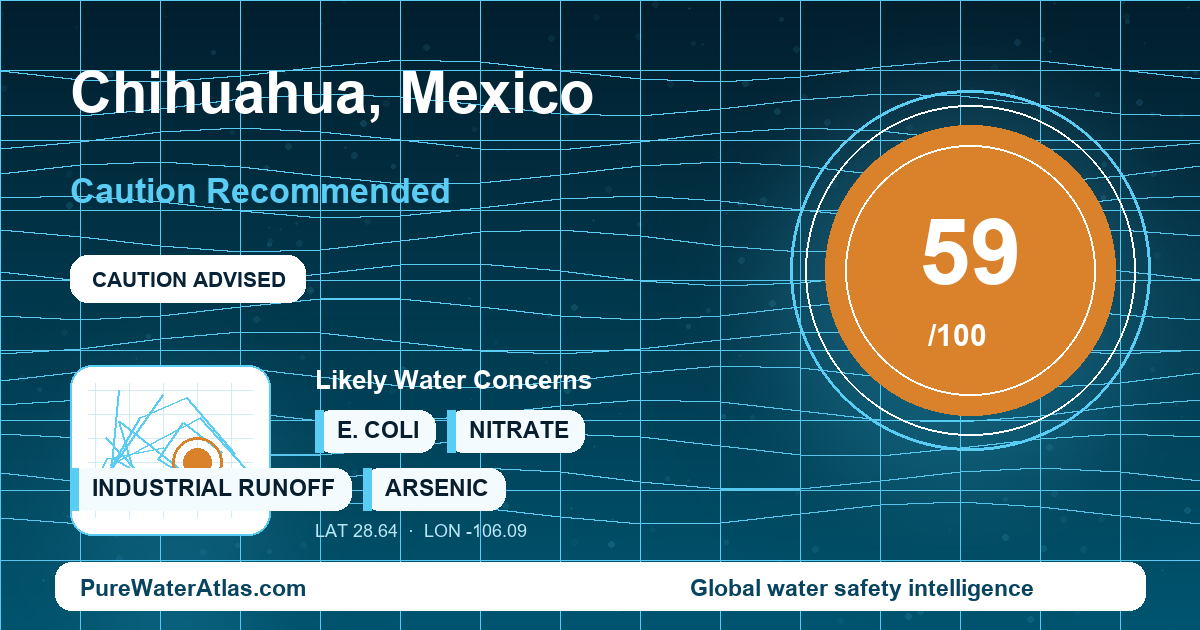
Chihuahua, Mexico has a chlorinated municipal groundwater supply, but drought pressure, aquifer chemistry, distribution interruptions, household storage tanks, and building plumbing make purified or bottled water the safer default for drinking.
Quick Answer
| Water safety score | 59 / 100 |
|---|---|
| Risk level | Caution Recommended |
| Can visitors drink the tap water? | Best answer: do not rely on unfiltered tap water as your main drinking water. Use sealed bottled water, garrafon water, or water from a verified purification system. |
| Resident advice | Municipal water is commonly used for household purposes, but many residents drink garrafon water or use point-of-use treatment. Maintain cisterns and rooftop tanks and consider testing when risk factors are present. |
| Main water source | Primarily pumped groundwater from regional aquifers and well fields serving the Chihuahua area, not a large surface-water treatment system. |
| Local water authority | Junta Municipal de Agua y Saneamiento de Chihuahua, commonly called JMAS Chihuahua. |
| Filter recommendation | A sediment prefilter plus activated carbon is reasonable for taste, chlorine, and particles. Reverse osmosis is the stronger option where mineral content, salinity, arsenic, fluoride, or nitrate are concerns, but it should be selected and maintained based on testing. |
Editorial verdict: Caution is recommended. Chihuahua’s tap water comes from a municipal chlorinated groundwater system, but the city’s high-desert setting, groundwater stress, pressure changes, pipe repairs, household storage, and premise plumbing can affect what actually comes out of a specific tap. For short-term visitors, purified or bottled water is the safest routine choice.
Why Chihuahua Is Different
Chihuahua is not a simple “surface reservoir to treatment plant to tap” city. It is a high-desert city in northern Mexico with limited rainfall, high evaporation, and recurring drought pressure. That geography makes groundwater management central to local drinking-water safety. The city sits in the Chuvíscar basin and has visible reservoirs such as Presa Chihuahua and Presa El Rejón in the urban landscape, but those reservoirs should not be assumed to represent the current potable tap-water source unless JMAS Chihuahua confirms a specific connection.
The practical identity of Chihuahua’s municipal supply is groundwater: wells, pumping, aqueducts or conveyance corridors, storage tanks, pressure management, chlorination, and distribution mains. In a groundwater-dependent system, water quality is shaped by both aquifer chemistry and infrastructure performance. Mineral taste, hardness, salinity, or elevated total dissolved solids can be more noticeable than in some surface-water systems. At the same time, loss of pressure, repairs, or storage-tank hygiene can create short-term microbial or sediment concerns even where the municipal supply is disinfected.
Another city-specific reality is consumer behavior. Visitors may notice that many households and businesses use garrafon water for drinking. That does not prove every municipal tap is unsafe. It does show that taste, hardness, confidence in distribution conditions, and household storage practices lead many people in Chihuahua to separate “water for general use” from “water for drinking.”
Where Does Chihuahua’s Tap Water Come From?
Chihuahua city is supplied mainly by pumped groundwater from regional aquifers and well fields. The municipal system is commonly associated with aquifers serving the Chihuahua-Sacramento, Tabalaopa-Aldama, and El Sauz-Encinillas areas. Water is pumped through well batteries, supply corridors, storage tanks, distribution reservoirs, and pressurized mains before reaching homes, hotels, restaurants, and businesses.
Important water infrastructure for Chihuahua includes municipal well fields operated by JMAS Chihuahua, groundwater conveyance infrastructure such as the El Sauz supply corridor referenced in local water-supply planning, pumping stations, storage tanks, distribution reservoirs, chlorination points, and sanitary control points. Because the city depends heavily on extracted groundwater, pumping reliability and pressure stability matter. If pumps are interrupted, repairs are underway, or a neighborhood experiences low pressure, the risk profile at the tap can temporarily change.
At the building level, private infrastructure can be just as important as the municipal system. Cisterns, rooftop tanks, internal plumbing, fixtures, and point-of-use filters can determine whether disinfected municipal water remains clean at the point of use. A clean municipal supply can be degraded by a dirty rooftop tank; a stable distribution main can still deliver discolored water after old internal plumbing is disturbed.
Who Manages Drinking Water in Chihuahua?
The local drinking-water and sanitation operator is Junta Municipal de Agua y Saneamiento de Chihuahua, commonly called JMAS Chihuahua. The state-level water agency context is the Junta Central de Agua y Saneamiento del Estado de Chihuahua.
Mexico’s drinking-water quality framework is national. Water for human use and consumption is governed by federal sanitary standards, especially NOM-127-SSA1-2021. COFEPRIS is the federal public-health authority relevant to drinking-water sanitary risk, while the Chihuahua state sanitary authority, COESPRIS, is relevant for public-health surveillance. CONAGUA’s national aquifer information and its aquifer availability documents provide the official groundwater-resource context.
Data limitation: city-level institutional and source-water information is available, but current neighborhood-by-neighborhood laboratory results, distribution residual chlorine data, and building-level tank conditions are not consistently available in one easy-to-audit public dataset. This profile therefore does not claim exact compliance percentages or universal safety for every tap in Chihuahua.
Main Local Water Concerns
- Groundwater stress and drought sensitivity: Chihuahua’s arid setting makes groundwater reliability and aquifer management central to safety and supply.
- Mineral content: Hardness, mineral taste, salinity, or elevated total dissolved solids can occur in northern Mexican groundwater systems.
- Geogenic contaminants: Arsenic and fluoride can occur in some northern Mexico aquifers. A citywide exceedance should not be assumed without current test results, but testing is prudent where local data are unavailable or where health-sensitive users are present.
- Pressure and repair events: Turbidity, sediment, discoloration, or microbial intrusion risk can increase after pipe repairs, main breaks, hydrant work, low-pressure events, or service interruptions.
- Household storage: Cisterns and rooftop tanks can become the weak point if covers, vents, cleaning, or disinfection are neglected.
- Old building plumbing: Lead risk is most relevant at the building-plumbing level, especially in older buildings or fixtures, rather than from a documented citywide lead problem.
- Private wells: Nitrate risk is more relevant for private wells or peri-urban groundwater influence than for assuming a citywide municipal exceedance.
Seasonally, hot-weather demand can strain wells, pumps, and storage. Summer monsoon storms can cause localized runoff, flooding, pipe disturbances, and turbidity complaints even in a groundwater-supplied city. Drought years can increase reliance on deeper or more stressed groundwater sources and may worsen mineral taste or supply constraints.
For Travelers
Drinking: Use sealed bottled water, garrafon water, or water from a verified purification system. Chihuahua’s tap water is part of a municipal chlorinated system, but for a short visit, the combination of groundwater chemistry, distribution variability, and building storage makes unfiltered tap water a caution choice.
Brushing teeth: Many healthy adults brush with tap water when it is clear and has no unusual odor, but cautious travelers, children, and anyone with a sensitive stomach should use bottled or purified water.
Ice: Use ice only from reputable hotels, restaurants, and stores where it is made from purified water. Ask for hielo purificado, or choose packaged ice. Avoid uncertain ice from street vendors or informal sources.
Hotels and restaurants: Better hotels and established restaurants commonly use garrafon water or filtration for drinking water and ice, but visitors should confirm. If a restaurant offers agua natural, ask whether it is bottled, filtered, or from a garrafon.
Practical rule: Do not drink from bathroom taps in hotels unless the property confirms filtration. If the tap water is cloudy, brown, has a strong odor, or follows a service outage, do not drink it without appropriate treatment. During suspected microbial events, see PureWaterAtlas’ Boiling Water Purification: Complete Guide.
For Residents
For Chihuahua households, a home filter is reasonable, especially for drinking and cooking water. A practical setup is a sediment prefilter plus activated carbon. Sediment filtration helps with particles and tank debris; activated carbon can improve chlorine taste and odor. Where mineral content, salinity, arsenic, fluoride, or nitrate are concerns, reverse osmosis is the stronger point-of-use option, but it should be chosen based on laboratory results and maintained correctly.
Residents should watch JMAS Chihuahua service notices, especially after repairs, interruptions, low pressure, or unusual color, taste, or odor. If water has been off or pressure has dropped, flush plumbing until water runs clear and avoid drinking questionable water until the situation is resolved or the water is treated appropriately.
Testing is especially important if the home has infants, pregnancy, immune-compromised residents, kidney disease concerns, older plumbing, or a history of storage-tank problems. For municipal tap water at the kitchen tap, useful parameters include bacteriological indicators, residual chlorine, turbidity, total dissolved solids, hardness, nitrate, arsenic, fluoride, iron, manganese, and lead where plumbing is old. If using a private well, do not assume municipal results apply; test for bacteria, nitrate, arsenic, fluoride, salinity, hardness, and locally relevant agricultural or industrial indicators.
Older buildings may have legacy plumbing, old solder, brass fixtures, galvanized sections, or poorly maintained internal lines. Let stagnant water flush before drinking, use cold water for cooking, and test for lead if children or pregnant residents live in the building. Cisterns and rooftop tanks should be covered, cleaned, and disinfected at least annually or after contamination events. Protect vents and access covers from insects and dust, and avoid drinking stored water if chlorine is absent or the tank has sediment, algae, odor, or animal intrusion.
Relevant Contaminants and Water-Quality Issues
For Chihuahua, the most relevant PureWaterAtlas profiles are tied to groundwater chemistry, disinfection, repairs, pressure events, and building-level storage. Chlorine matters because the municipal supply is disinfected and some users notice taste or odor. Turbidity and sediment are relevant after pipe repairs, low-pressure events, storms, or tank disturbance.
Arsenic and fluoride concerns should be evaluated through testing rather than taste or appearance, because some northern Mexico aquifers can contain geogenic contaminants. For more detail, see Arsenic in Drinking Water: Testing and Detection Methods. Nitrate is especially important for private wells, peri-urban groundwater influence, and infants; PureWaterAtlas also has a guide to nitrate testing and detection.
Microbial safety should be considered after pressure loss, storage-tank contamination, or suspected cross-connections. The E. coli profile explains why this indicator is central to drinking-water microbiology. If using a cistern, private well, or UV treatment, review UV Water Purification: Complete Guide, noting that turbidity must be controlled first. For older buildings, see Lead and Lead in Drinking Water: Testing and Detection Methods.
How to Verify Your Water Quality
The most reliable way to evaluate a specific Chihuahua tap is to combine official information with point-of-use testing. Check JMAS Chihuahua communications for service notices, repairs, and local operational updates. For broader groundwater context, review CONAGUA aquifer resources. For health-based standards, compare results with Mexico’s NOM-127-SSA1-2021 and public-health guidance from COFEPRIS.
PureWaterAtlas resources can help interpret results and decide what to test. Start with Water Testing for sampling strategy, lab selection, and interpretation. Use the Contaminants Search Engine to compare contaminants relevant to groundwater and old plumbing. The Global Water Quality Checker is useful for comparing Chihuahua with other destinations.
For background reading, PureWaterAtlas also maintains guides on Drinking Water Safety, Global Water Quality, Water Treatment Systems, and Water Microbiology. Related category pages include Drinking Water Safety, Global Water Quality, Water Testing, and Water Contamination.
Official and Technical Sources
- Junta Municipal de Agua y Saneamiento de Chihuahua — local water and sanitation operator for Chihuahua city.
- Junta Central de Agua y Saneamiento del Estado de Chihuahua — state-level water authority context.
- CONAGUA Sistema Nacional de Informacion del Agua, Acuiferos — official national aquifer information.
- CONAGUA Disponibilidad de acuiferos — groundwater availability documents.
- Diario Oficial de la Federacion, NOM-127-SSA1-2021 — federal Mexican drinking-water standard.
- COFEPRIS, Agua de uso y consumo humano — federal public-health drinking-water authority.
- CDC Travelers’ Health, Mexico — traveler health guidance supporting cautious food and water practices.
- World Health Organization, Guidelines for Drinking-water Quality — international drinking-water risk-management reference.
Bottom Line
Chihuahua’s tap water should be treated as a caution choice for direct drinking, especially for visitors. The city is served mainly by a chlorinated municipal groundwater system operated by JMAS Chihuahua, but local safety depends on aquifer chemistry, drought and pumping conditions, pressure stability, pipe repairs, household cisterns, rooftop tanks, and building plumbing. Use bottled, garrafon, or verified purified water for drinking; use caution with ice unless it is purified. Residents can use municipal water for many household purposes but should maintain storage tanks, monitor service notices, and test when health-sensitive people, old plumbing, private wells, unusual taste, odor, sediment, or pressure changes are present.
Read the full guide: Global Water Quality Guide
Explore more in this category: Global Water Quality Articles