
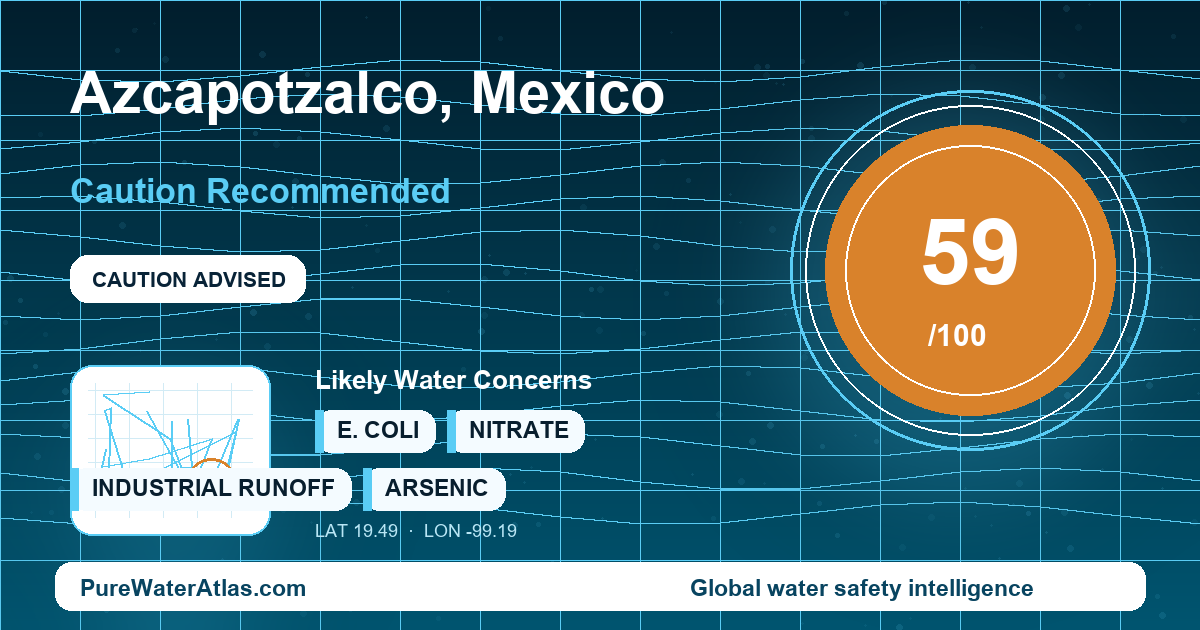
Azcapotzalco, Mexico City: treated metropolitan supply, but caution at the tap because building storage, intermittent service, older plumbing, and limited borough-specific public test data can affect endpoint safety.
Quick Answer
| Overall safety status | Caution recommended. Azcapotzalco is supplied through Mexico City’s integrated public water system, which is disinfected and regulated, but water quality at an individual faucet can be affected by pressure interruptions, aging distribution pipes, building cisterns, rooftop tinacos, and internal plumbing. |
|---|---|
| Water safety score | 59 / 100 — risk level: Caution Recommended. |
| For travelers | Do not use tap water as a routine drinking source. Use sealed bottled water, hotel-provided purified water, or water from a verified purification system. |
| For residents | Treat the municipal supply as usable but not automatically drink-at-the-tap. Use a maintained point-of-use filter, keep cisterns and tinacos clean, and test if water is cloudy, discolored, metallic, earthy, or affected by outages. |
| Main water source | Mixed Mexico City supply: Valley of Mexico aquifer groundwater plus imported water from the Cutzamala and Lerma systems. The blend can vary by pressure zone, season, maintenance activity, and operating conditions. |
| Water authority | Sistema de Aguas de la Ciudad de México, known as SACMEX. |
| Filter recommendation | Recommended for drinking and cooking. Consider sediment filtration, activated carbon, and—where storage tanks, intermittent service, or vulnerable residents are involved—UV disinfection or reverse osmosis with proper maintenance. |
Why Azcapotzalco Is Different
Azcapotzalco is not a standalone city with a separate drinking-water source. It is a northwestern alcaldía of Mexico City, connected to the same complex metropolitan water system that supplies many parts of the capital. That matters because a tap in Azcapotzalco may receive a changing mix of groundwater from the Valley of Mexico aquifer system and imported water from the Cutzamala and Lerma systems, rather than water from a single local reservoir or municipal wellfield.
The practical concern in Azcapotzalco is not only whether the water is treated before entering the public distribution network. The more important question is often what happens after that water moves through an aging urban system and then into a specific building. Many homes and apartment buildings in Mexico City store water in cisterns, pumps, and rooftop tinacos before it reaches the faucet. A clean, covered, and periodically disinfected tank can preserve water quality; a neglected one can create sediment, odor, biofilm, or microbial risk even when the incoming supply was disinfected.
Azcapotzalco is also a mature urban area with long-established neighborhoods and the Vallejo industrial area. This does not justify a blanket claim that industrial contaminants are present in the delivered drinking water, but it does make local building history and address-specific conditions important. Older plumbing, shared storage systems, intermittent pressure, and maintenance practices can produce very different water quality from one property to another.
Where Does Azcapotzalco’s Tap Water Come From?
Azcapotzalco’s tap water comes through Mexico City’s integrated public water network operated by SACMEX. The raw-water supply is a mix of local and metropolitan groundwater wells drawing from the Valley of Mexico aquifer system, imported surface water from the Cutzamala System, and imported water from the Lerma system. The exact blend at a given address can vary depending on pressure zone, season, maintenance work, drought conditions, and local system operations.
This supply pattern reflects Mexico City’s history. Azcapotzalco lies within the former lacustrine basin of the Valley of Mexico, where the city has long depended heavily on groundwater. That groundwater remains important, but the metropolitan aquifer is under long-term stress, so imported inter-basin water has become an essential supplement. The Cutzamala system is particularly important at the metropolitan scale and is vulnerable to reservoir storage levels, drought, and planned maintenance.
Once water is inside Azcapotzalco’s urban distribution environment, local infrastructure becomes central. Relevant infrastructure includes SACMEX distribution mains, groundwater wells, imported Cutzamala and Lerma supply connections, older local pipes, building-level cisterns, pumps, rooftop tinacos, and premise plumbing. In many buildings, water is not consumed directly from the distribution main; it is stored first. That storage step can strongly influence the quality of water at the kitchen faucet.
Who Manages Drinking Water in Azcapotzalco?
The main drinking-water utility for Azcapotzalco is Sistema de Aguas de la Ciudad de México, or SACMEX. SACMEX operates the Mexico City water system, including the network that serves Azcapotzalco. The Alcaldía Azcapotzalco may handle local public-service coordination and complaints, but it is not the main drinking-water utility.
Drinking water quality in Mexico is regulated nationally under health standards including NOM-127-SSA1-2021, the Mexican standard for water for human use and consumption. Federal health oversight involves Secretaría de Salud and COFEPRIS, while local implementation and monitoring involve city water and health authorities.
The confidence level for this Azcapotzalco profile is moderate. The raw-water systems, authorities, and regulatory framework are well documented, but recent public, address-level or colonia-level tap-water results for Azcapotzalco are not consistently available. Because building storage and internal plumbing can dominate endpoint risk, this page does not claim that every tap in Azcapotzalco is safe or unsafe.
Main Local Water Concerns
- Intermittent service and pressure changes: Low pressure and interruptions can disturb sediment, reduce disinfectant residual at the tap, and increase the chance of intrusion through leaks or poorly maintained building plumbing. This is a well-documented Mexico City system challenge, although it is not usually published as real-time household-level water quality data for Azcapotzalco.
- Turbidity, sediment, discoloration, and taste after outages or pipe work: Brown, cloudy, or particle-laden water can occur when deposits are disturbed by pressure changes, repairs, or maintenance. Turbid water can interfere with disinfection and should not be used for drinking until the cause is resolved and the water clears.
- Cistern and tinaco hygiene: Storage tanks can accumulate sediment, lose chlorine residual, support microbial growth, or become contaminated if lids, vents, floats, or cleaning routines are poor. In Azcapotzalco homes and apartments, tank condition can be as important as the municipal supply itself.
- Older premise plumbing and metals: Older brass fixtures, solder, galvanized piping, or corroded internal plumbing can contribute metals such as lead or iron at the tap. This is a property-specific risk; there is no verified borough-wide lead exceedance claim made here.
- Source-water stress: Mexico City’s reliance on overdrawn groundwater and imported Cutzamala water can contribute to rationing, pressure management, and operational changes that affect household reliability.
- Industrial land-use context: Azcapotzalco includes industrial areas, so environmental history may be relevant for specific properties. Available public information does not support a blanket claim that industrial contaminants are present in the borough’s delivered drinking water.
Season also matters. Late dry season and drought years can increase pressure management or reduced service hours. Rainy-season storm events and drainage problems can coincide with contamination risk around leaks and poorly sealed cisterns. Planned maintenance or emergency repairs can create temporary outages, brown water, sediment release, or air in pipes.
For Travelers
Visitors to Azcapotzalco should generally not drink tap water as a routine source. Use sealed bottled water, hotel-provided purified water, or water treated by a reliable filtration and disinfection system. The issue is not that Mexico City’s water is untreated; it is that endpoint conditions in hotels, rentals, older buildings, and storage tanks are not predictable enough for a routine traveler recommendation.
For brushing teeth, risk is lower than drinking a full glass of tap water, but cautious travelers, young children, immunocompromised people, and anyone with a sensitive stomach should use bottled or purified water. If staying in a rental, ask whether the drinking water comes from a garrafón, an installed purifier, or directly from the tap.
Ice in reputable hotels, chain restaurants, and established cafes is commonly made from purified water, but do not assume this in street stalls or informal locations. Ask whether the ice is made from agua purificada. Avoid ice if the answer is unclear or if the business appears to rely on untreated tap water.
Do not drink from a tap after an outage, during low pressure, or when water is cloudy, brown, has a sewage odor, or comes from a building where cistern or tinaco maintenance is unknown. Carry bottled water or a refillable bottle filled from a verified purified source.
For Residents
Residents should treat Azcapotzalco’s municipal supply as usable but not automatically drink-at-the-tap. A maintained home treatment system is recommended for drinking and cooking water. At minimum, an activated carbon filter can improve chlorine taste and reduce some organic compounds. In buildings with storage tanks, recurring turbidity, intermittent service, or vulnerable household members, a more protective system may include sediment filtration plus UV disinfection or reverse osmosis.
Filter maintenance is critical. A poorly maintained filter can become ineffective, and a reverse osmosis system should be monitored for performance and serviced on schedule. For more detail, see PureWaterAtlas guides to UV water purification, boiling water purification, and water purification methods.
Test tap water when moving into an older Azcapotzalco building, after major plumbing work, after repeated outages, or when water is discolored, cloudy, metallic, earthy, or unusually odorous. Useful laboratory parameters include E. coli or total coliform, turbidity, residual chlorine, pH, conductivity or TDS, hardness, iron, manganese, lead, and other metals. Where possible, use an accredited laboratory.
Older properties may have galvanized pipes, aging valves, brass fixtures, old solder, or corroded internal plumbing. First-draw and flushed samples can help evaluate metals such as lead and iron. Cisterns and tinacos should be sealed, protected from insects and dust, inspected for cracks or cross-connections, and cleaned and disinfected regularly. A dirty tank can make otherwise treated municipal water unsafe at the faucet.
Relevant Contaminants and Water-Quality Issues
The most relevant Azcapotzalco water-quality issues are practical endpoint risks rather than a single verified borough-wide contaminant. Chlorine is relevant because Mexico City water is disinfected; strong chlorine taste can be unpleasant, while very low residual after storage may indicate reduced microbial protection. Turbidity and sediment are important after outages, pressure changes, pipe repairs, and tank disturbance.
Microbial indicators such as E. coli matter when cisterns, rooftop tanks, or plumbing have poor hygiene or when pressure loss creates potential intrusion pathways. Lead is relevant as a building-specific plumbing risk in older properties, not as a verified Azcapotzalco-wide finding. For deeper background, see Lead in Drinking Water: Testing and Detection Methods and Lead in Drinking Water: Best Filters, Systems and Solutions.
How to Verify Your Water Quality
Because recent public tap-level data for Azcapotzalco is limited, verification should happen at the building and faucet level. Start by checking whether your property uses a cistern, rooftop tinaco, booster pump, or shared storage system. Ask when tanks were last cleaned and disinfected. If water changes color, odor, or taste after outages or repairs, flush taps and avoid drinking visibly discolored water.
For a structured approach, use the PureWaterAtlas guide to water testing. To research specific substances, use the Contaminants Search Engine. For broader comparisons and travel planning, use the Global Water Quality Checker. Related reference sections include Drinking Water Safety, Water Microbiology, the Water Testing category, and the Water Contamination category.
Official and Technical Sources
- Sistema de Aguas de la Ciudad de México, SACMEX — official utility for Mexico City, including Azcapotzalco.
- SACMEX water quality information — official Mexico City drinking-water quality and service context.
- CONAGUA, Sistema Cutzamala — federal information on the imported Cutzamala supply system.
- CONAGUA, Estadísticas del Agua en México — national water resources and supply context.
- Diario Oficial de la Federación, NOM-127-SSA1-2021 — Mexican drinking-water health standard.
- COFEPRIS, Agua de uso y consumo humano — federal health authority information.
- Alcaldía Azcapotzalco — official local government source for borough context.
- INEGI geographic information for Mexico City — official geographic and administrative context.
Bottom Line
Azcapotzalco’s tap water comes from Mexico City’s regulated, disinfected metropolitan system, supplied by a changing mix of Valley of Mexico groundwater and imported Cutzamala and Lerma water. The reason for caution is endpoint uncertainty: intermittent service, pressure changes, older pipes, cisterns, rooftop tinacos, and premise plumbing can strongly affect the water that actually reaches a faucet. Travelers should use bottled or verified purified water for drinking and be cautious with ice and rentals. Residents should maintain storage tanks, use a suitable point-of-use filter, and test water after outages, plumbing work, discoloration, odors, or when living in older buildings. Public Azcapotzalco-specific tap-level data is limited, so building-level verification is the most reliable approach.
Read the full guide: Global Water Quality Guide
Explore more in this category: Global Water Quality Articles