
San Nicolás de los Garza is served by the Monterrey metropolitan water system, so tap-water safety depends not only on central treatment but also on drought stress, pressure changes, outages, storage tanks, and building plumbing at the final tap.
Quick Answer
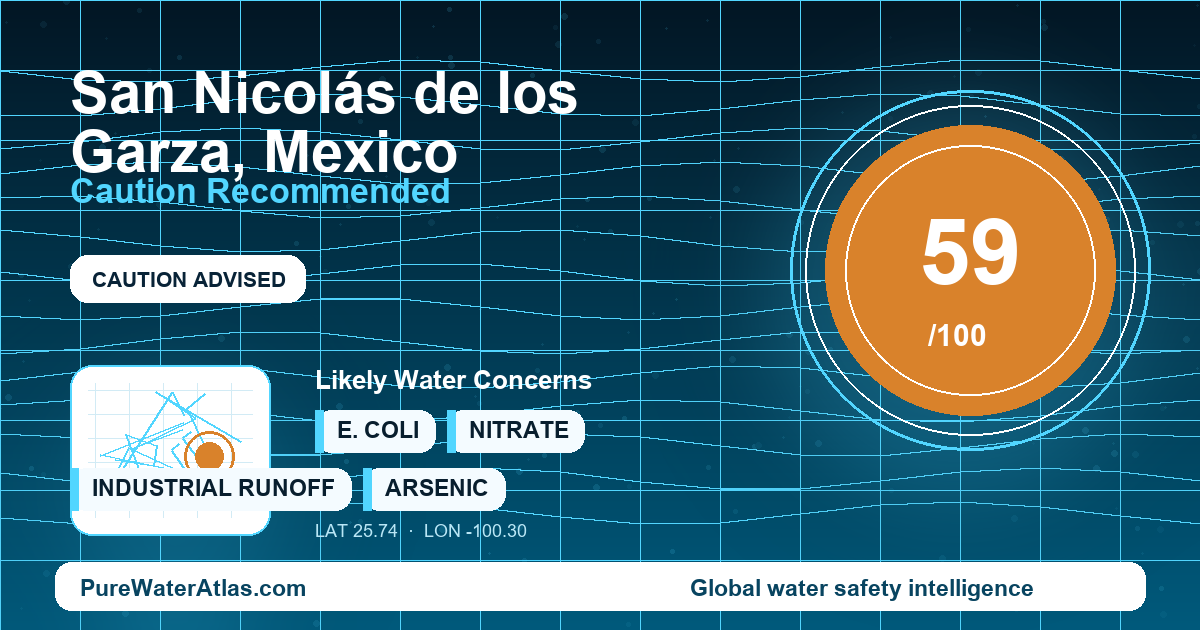
| Overall status | Caution recommended. PureWaterAtlas score: 59/100. San Nicolás de los Garza has a professionally managed public supply, but recent regional drought stress, intermittent service, low-pressure periods, and household storage dependence make untreated tap water a cautious choice. |
|---|---|
| Can visitors drink the tap water? | Not recommended as routine drinking water for most short-term visitors. Use sealed bottled water, garrafón water, or water treated by a reputable hotel or restaurant purification system. |
| Resident advice | Residents can treat the municipal system as a managed public supply, but should use home-level precautions: maintain filters, clean cisterns or rooftop tanks, flush after outages, and test after pressure problems, flooding, or unusual taste, odor, or color. |
| Main water identity | San Nicolás de los Garza is part of the Monterrey Metropolitan Area system operated by Servicios de Agua y Drenaje de Monterrey. Its water is best understood as Monterrey metropolitan water rather than a separate municipal source. |
| Key sources | A regional blend including major reservoirs such as El Cuchillo, Cerro Prieto, and La Boca, reinforced by groundwater wells, galleries, and other metropolitan sources. |
| Water authority | Servicios de Agua y Drenaje de Monterrey, commonly called SADM or Agua y Drenaje de Monterrey. |
| Filter recommendation | A well-maintained point-of-use filter is advisable for many homes. Carbon can improve chlorine taste and odor; reverse osmosis is more appropriate where dissolved solids, salinity, or metals are a concern; UV can be useful after sediment prefiltration where storage-tank microbial risk is the issue. |
Why San Nicolás de los Garza Is Different
San Nicolás de los Garza is a fully urbanized, industrial and residential municipality in the northern part of the Monterrey Metropolitan Area. Its drinking-water situation is not defined by a small local lake or an isolated municipal wellfield. Instead, the city depends on the shared metropolitan network serving the Monterrey urban area. That makes local tap-water safety closely tied to regional reservoir storage, aqueduct capacity, pressure management, and the performance of the metropolitan distribution system.
The most important city-level concern is distribution and premise plumbing rather than a single San Nicolás-only raw-water source. When the regional system experiences intermittent supply, pressure reductions, pipe repairs, or reservoir changes, water arriving at homes and businesses can be affected by sediment disturbance, turbidity, loss of residual chlorine, or intrusion risk during low-pressure events. Once water reaches a building, cisterns, rooftop tanks, pumps, hoses, filters, and internal plumbing can further influence the quality at the tap.
This context matters because Nuevo León and the Monterrey metropolitan area experienced a major water-supply crisis in 2022, involving drought, low reservoir storage, rationing, and pressure restrictions. San Nicolás de los Garza is connected to the same regional reservoirs, aqueducts, wells, and pressure-managed network, so regional water stress is a practical tap-water issue for the municipality.
Where Does San Nicolás de los Garza’s Tap Water Come From?
San Nicolás de los Garza receives water through the Monterrey Metropolitan Area supply operated by Servicios de Agua y Drenaje de Monterrey. The raw-water system is a regional blend that includes major surface reservoirs such as El Cuchillo, Cerro Prieto, and La Boca, supported by groundwater wells, galleries, and other metropolitan sources. Because San Nicolás is a dense urban municipality inside the metro grid, its tap water should be evaluated as part of the broader Monterrey metropolitan water system.
Key infrastructure relevant to San Nicolás includes the SADM metropolitan distribution network, the El Cuchillo reservoir and aqueduct infrastructure, reinforcement works known as El Cuchillo II, the Cerro Prieto and La Boca reservoir supply systems, metropolitan groundwater wells and galleries, treatment and chlorination infrastructure, storage facilities, pumping systems, and pressure-management equipment. At the household or building level, cisterns, rooftop tanks, tinacos, internal pipes, and plumbing fixtures can become just as important as regional infrastructure for final tap-water quality.
Historically, Monterrey relied more heavily on nearby groundwater, springs, galleries, and local sources. As the metropolitan area expanded, the system became increasingly dependent on regional reservoirs and long-distance conveyance, especially El Cuchillo and other Nuevo León reservoir infrastructure. The 2022 drought accelerated emergency works, additional wells, pressure management, and expansion projects.
Who Manages Drinking Water in San Nicolás de los Garza?
Drinking water and sewerage service in San Nicolás de los Garza is managed by Servicios de Agua y Drenaje de Monterrey, I.P.D., the public utility responsible for the Monterrey metropolitan service area. The Government of Nuevo León also identifies the utility through its Agua y Drenaje de Monterrey institutional page.
In Mexico, drinking-water quality is governed by federal health standards, especially NOM-127-SSA1-2021, which establishes requirements for water for human use and consumption. CONAGUA manages national water resources and hydrologic information, while health authorities and the utility are relevant for potability surveillance, chlorination, monitoring, and public advisories.
For San Nicolás residents and visitors, the practical point is that advisories are more likely to come through SADM or Nuevo León state channels than through a separate San Nicolás water department. During drought periods, major pipe breaks, heavy storms, scheduled maintenance, or service interruptions, check SADM service announcements and official state or health authority notices.
Main Local Water Concerns
The main concerns in San Nicolás de los Garza are not based on a claim that the city lacks treatment. The concern is that a treated metropolitan supply can still become less reliable at the tap when the system is stressed or when building-level storage and plumbing are poorly maintained.
- Drought-driven source stress: Monterrey’s regional system has been affected by drought and reservoir pressure, especially highlighted by the 2022 crisis.
- Intermittent service and low pressure: Pressure reductions and outages can increase vulnerability in distribution pipes and building plumbing.
- Turbidity and sediment: Cloudiness, particles, or discoloration may occur after pipe repairs, storm runoff, reservoir changes, or internal plumbing disturbance.
- Chlorine taste and odor: Disinfection residuals can create noticeable taste or smell, especially during warm weather or operational changes.
- Hardness or mineral taste: Groundwater blending in parts of the metropolitan system can contribute to mineral character.
- Storage-tank microbial risk: Cisterns, rooftop tanks, tinacos, pumps, and filters can become contamination points if not cleaned and maintained.
- Older plumbing metals: Older buildings may have fixtures, solder, galvanized iron, or stagnant plumbing that can affect metals and sediment at the tap. This is a building-specific concern, not a confirmed citywide lead claim.
- Urban industrial context: San Nicolás has an industrial urban setting, which supports caution and monitoring, but does not by itself prove contamination at a specific address.
Season also matters. Late dry season and drought years can stress reservoirs and increase pressure-management measures. Summer heat increases demand and makes residual chlorine maintenance more important. Tropical storms and intense rain can rapidly change reservoir conditions and increase raw-water turbidity before treatment. After outages or low-pressure events, residents should flush taps, look for discoloration, and follow any official boil-water or do-not-drink notice.
For Travelers
Short-term visitors to San Nicolás de los Garza should not rely on untreated tap water as their main drinking water. Use sealed bottled water, garrafón water, or water treated by a reliable hotel, restaurant, or purifier. This is especially important for travelers with sensitive stomachs, pregnant travelers, immunocompromised people, and families with young children.
For brushing teeth, tap water is usually acceptable in modern hotels and established accommodations when there is no official advisory. Cautious travelers can use bottled water, especially if the tap has recently been off, appears cloudy, contains sediment, smells unusual, or has a sudden taste change.
For ice, use ice only from reputable hotels, restaurants, and chains that use purified water or commercial ice. Avoid ice from unknown street vendors or informal sources. Most established hotels and restaurants in the Monterrey area are accustomed to using purified drinking water, bottled water, or commercial ice. If uncertain, ask for agua purificada or agua embotellada.
Keep bottled water in your room, do not refill bottles directly from bathroom taps, and check SADM or local advisories during drought restrictions, major storms, or service interruptions. Boiling can reduce microbial risk, but it will not remove dissolved minerals, metals, salts, or chemical contaminants. For more context, see PureWaterAtlas on boiling water purification.
For Residents
For San Nicolás de los Garza residents, a home filter is often a sensible precaution. This does not mean the municipal supply is unmanaged; it means final tap quality can be affected by outages, low pressure, sediment, older plumbing, and household storage. A certified carbon filter can improve chlorine taste and odor. Reverse osmosis is more appropriate where dissolved solids, salinity, or metals are a concern. UV can be useful after a well-maintained sediment prefilter where microbial risk from cisterns or rooftop tanks is the main issue; see the PureWaterAtlas UV water purification guide for technology background.
Testing is recommended after prolonged outages, repeated low-pressure events, flooding, or suspected cistern contamination. Test for total coliform and E. coli when microbial intrusion is a concern. If water appears cloudy, yellow, brown, or has sudden taste or odor changes, check turbidity, color, odor, and residual chlorine. For older homes, apartments, schools, or childcare spaces, consider laboratory testing for lead and other metals using both first-draw and flushed samples. The PureWaterAtlas guide to lead testing and detection is useful for building-specific decisions.
Older buildings and remodeled properties may contain aging pipes, solder, brass fixtures, galvanized iron, or stagnant plumbing sections. Even if water is properly treated in the SADM distribution system, private plumbing can add metals, sediment, taste, or microbial problems. Flush stagnant taps before use and test rather than assuming every unit in a building has the same water quality.
Cisterns, rooftop tanks, and tinacos are common safeguards during pressure reductions, but they can become contamination points if uncovered, cracked, poorly disinfected, or connected with dirty pumps and hoses. Keep lids sealed, clean and disinfect tanks routinely, and avoid drinking stored water untreated after long stagnation or visible contamination.
Relevant Contaminants and Water-Quality Issues
The most relevant water-quality topics for San Nicolás de los Garza are linked to disinfection, distribution conditions, storage tanks, and building plumbing. Chlorine is important because SADM-treated water must maintain disinfectant residual through a large metropolitan network, but chlorine can create taste and odor complaints. Turbidity matters after storms, reservoir changes, pipe repairs, or sediment disturbance. Sediment is relevant when water is discolored or contains particles after outages or plumbing work.
Microbial indicators such as E. coli are especially important after low-pressure events, flooding, or storage-tank problems. Lead should be considered in older private plumbing and first-draw tap testing, but it should not be treated as a confirmed citywide San Nicolás problem without building-specific laboratory results.
How to Verify Your Water Quality
Because public information is generally reported at the metropolitan utility or service-area level, it cannot guarantee conditions at every colonia, apartment tower, school, hotel, or household tap in San Nicolás de los Garza. Water quality can change after outages, pipe repairs, pressure changes, flooding, and according to private storage and plumbing maintenance.
Start with official notices from SADM and Nuevo León authorities during service disruptions. For household decisions, use a recognized laboratory when results will guide health decisions, infant formula preparation, landlord-tenant disputes, or filter selection. If you are deciding what to test for, the PureWaterAtlas Water Testing guide explains sampling strategy and interpretation. The Contaminants Search Engine can help match symptoms such as chlorine odor, cloudiness, sediment, or metallic taste to likely water-quality parameters. For broader comparison, use the Global Water Quality Checker.
For background on choosing protection methods, see PureWaterAtlas resources on Drinking Water Safety, Water Purification, and Water Microbiology.
Official and Technical Sources
- Servicios de Agua y Drenaje de Monterrey — official utility for the Monterrey metropolitan water and sewer system serving San Nicolás de los Garza.
- Gobierno de Nuevo León – Agua y Drenaje de Monterrey — state government page identifying the metropolitan public water utility.
- Diario Oficial de la Federación – NOM-127-SSA1-2021 — federal drinking-water quality standard for water for human use and consumption.
- CONAGUA – Sistema Nacional de Información del Agua — national water resources and reservoir information relevant to Nuevo León.
- CONAGUA and Servicio Meteorológico Nacional – Monitor de Sequía en México — official drought-monitoring source relevant to regional reservoir stress.
- Gobierno de Nuevo León – Plan Hídrico Nuevo León 2050 — long-term state water planning context for infrastructure, demand growth, drought vulnerability, and source diversification.
Bottom Line
Tap water in San Nicolás de los Garza should be approached with caution, not because the city lacks a formal utility, but because it depends on the drought-stressed Monterrey metropolitan system and on building-level storage and plumbing. SADM manages the public supply, drawing from regional reservoirs such as El Cuchillo, Cerro Prieto, and La Boca, reinforced by groundwater and other sources. For visitors, bottled or purified water is the safer routine choice. For residents, the practical risk is often at the final tap: outages, low pressure, sediment, old plumbing, cisterns, rooftop tanks, and filter maintenance. Use official SADM notices, flush after disruptions, clean storage tanks, and test when water changes or health-sensitive decisions depend on the result.
Read the full guide: Global Water Quality Guide
Explore more in this category: Global Water Quality Articles