Pyongyang’s tap water safety depends on whether your building is receiving functioning treated municipal supply from the Taedong River system, and on local distribution, storage, and verification conditions.
Quick Answer
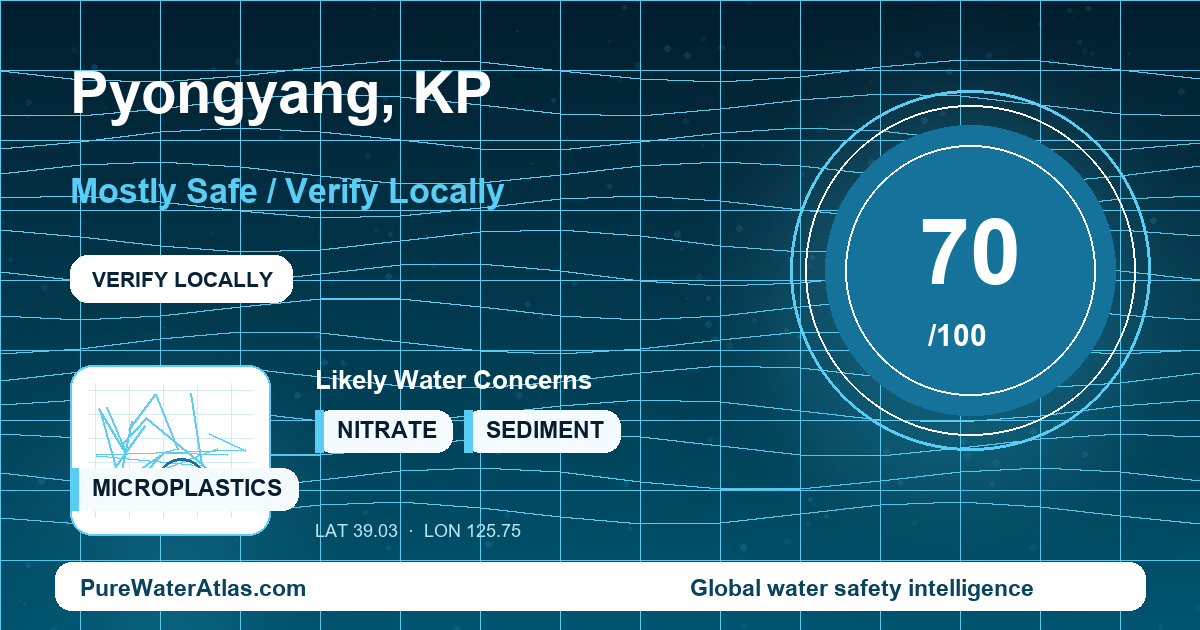
| Overall safety status | Mostly Safe / Verify Locally — PureWaterAtlas score: 70/100. Pyongyang appears to rely mainly on treated surface water, but routine city-level water-quality reporting is very limited. |
|---|---|
| Can tourists drink the tap water? | No, not as a routine default. Short-term visitors should use sealed bottled water or boiled water unless a trusted hotel, host, guide, or medical/logistics provider confirms the water is boiled, filtered, or otherwise treated. |
| Resident advice | Residents connected to the municipal system may often use tap water with safeguards, especially boiling after outages, cloudy water, flooding, low-pressure periods, or when household storage is involved. |
| Main water source | The city is understood to depend primarily on treated surface water abstracted from the Taedong River, the major river running through Pyongyang. |
| Water authority | Urban water supply is handled through state and municipal structures, including national urban-management institutions and Pyongyang municipal authorities. A transparent standalone utility website or regular consumer water-quality report was not found. |
| Filter recommendation | A filter is not automatically required for every connected household, but point-of-use treatment is reasonable because public tap-water data are scarce. Use sediment prefiltration plus activated carbon for everyday improvement; add boiling, UV, ultrafiltration, or reverse osmosis depending on microbial or chemical concerns. |
Why Pyongyang Is Different
Pyongyang is different from many city water profiles because the central risk is not a publicly documented single contaminant exceedance. The main issue is verification. The city sits on the Taedong River, which flows through Pyongyang before continuing southwest toward the Yellow Sea. That geography makes river-water quality, storm runoff, upstream land use, turbidity, and surface-water treatment directly relevant to the capital’s drinking-water risk profile.
The practical verdict is therefore conditional. Pyongyang tap water appears most defensible where a household or institution is connected to a functioning treated municipal supply and where building-level plumbing and storage are maintained. It is much less defensible when the water source is uncertain, when pressure has been intermittent, when water is stored in containers, or when the tap water is cloudy, discolored, or affected by flooding. For visitors, the safest assumption is that unverified tap water is not reliably potable.
Confidence is medium-low. The raw-water identity and infrastructure-risk profile are reasonably clear from Pyongyang’s geography and national WASH context, but current contaminant levels at household taps are not openly documented in the way they are in cities with routine consumer confidence reports. That limitation matters: a treated municipal connection should not be interpreted as proof of continuous compliance at every building tap.
Where Does Pyongyang’s Tap Water Come From?
Pyongyang is a river city on the Taedong River, and the municipal drinking-water system is understood to depend primarily on Taedong River surface-water abstraction, treatment, pumping, and distribution to urban districts. The Taedong is therefore the most important raw-water risk driver for the city. Surface water can carry turbidity, sediment, organic matter, runoff, and upstream pollution pressure, especially after heavy rain or disturbed river conditions.
The city historically developed around the Taedong River and the smaller Pothong River area. Publicly accessible sources do not provide a reliable modern district-by-district split between river water, wells, reservoirs, or supplementary sources. Because that local split is not available, this guide does not claim that every neighborhood receives the same supply or that every building has the same tap-water quality.
Key infrastructure likely includes raw-water intake and treatment facilities associated with the Taedong River supply, pumping stations, transmission mains, and distribution networks serving dense apartment districts and institutional areas. Building-level or household-level storage can also be important where water pressure is intermittent or where water is collected before use. Stored water can become contaminated after treatment if containers, tanks, or handling practices are unhygienic.
The West Sea Barrage downstream on the lower Taedong helps control tidal and saline influence in the lower river system. However, it is not a substitute for drinking-water treatment at the tap. For Pyongyang households and visitors, the relevant safety question remains whether the water reaching the building has been properly treated, protected in distribution, and safely stored before drinking.
Who Manages Drinking Water in Pyongyang?
Urban water supply in DPR Korea is generally handled through state and municipal structures. The relevant roles include national urban-management institutions, such as the Ministry of Urban Management or equivalent bodies, and Pyongyang municipal authorities. Unlike many large cities, Pyongyang does not have an easily accessible standalone utility website publishing routine treated-water results, district maps, residual chlorine data, or consumer water-quality reports.
DPR Korea participates in national water, sanitation, and hygiene planning and reports drinking-water access through international mechanisms such as the WHO/UNICEF Joint Monitoring Programme. Those data are useful for national context, but they are not a Pyongyang tap-water compliance dataset. Similarly, UNICEF DPR Korea’s WASH information supports the broader picture of infrastructure challenges and safe-water needs, but it does not provide building-level results for Pyongyang.
This lack of transparent city-level reporting is one of the biggest reasons the PureWaterAtlas verdict is “Mostly Safe / Verify Locally” rather than simply “safe.” Verification may need to come from local authorities, building managers, hotel staff, household testing, or point-of-use treatment rather than from a public municipal dashboard.
Main Local Water Concerns
Microbial contamination after treatment or during distribution is the most practical concern when pressure is intermittent, water is stored, or service has been disrupted. International WASH sources for DPR Korea emphasize safe water and sanitation challenges, but routine Pyongyang tap microbiology results are not public. Boiling or verified disinfection is prudent after outages, low pressure, flooding, visible cloudiness, or use of stored household water.
Turbidity and sediment are important because Pyongyang relies on a major surface-water river system. Heavy rainfall, snowmelt, construction runoff, and disturbed sediments can make surface water more turbid. Cloudy or muddy water should not be consumed without settling, filtration, and disinfection. High turbidity can also reduce the effectiveness of chlorine or UV treatment.
Old pipes, internal plumbing, and building storage can affect the final quality at the tap even when central treatment is adequate. Pyongyang has older urban districts as well as high-rise housing, and building plumbing or storage practices may influence taste, color, sediment, and microbial risk. No public evidence was found proving or excluding lead service lines at city scale, so lead should not be claimed as widespread. At the same time, older plumbing should not be dismissed without testing.
Disinfection residual uncertainty is another local limitation. No regular public Pyongyang residual-chlorine or treated-water monitoring dataset was found. A chlorine smell does not guarantee safety, and the absence of chlorine smell does not prove the water is unsafe. Testing is more reliable than taste or odor.
Industrial and urban runoff pressure may affect the Taedong basin because it includes urban and economic activity. Public contaminant-specific drinking-water monitoring for Pyongyang is limited. Boiling is useful for microbes, but it does not remove dissolved chemicals, salts, or metals.
For Travelers
Short-term visitors should not routinely drink Pyongyang tap water unless it has been boiled, filtered, or explicitly confirmed safe by a reliable hotel, host, guide, or medical authority. The safest default is sealed bottled water or water brought to a rolling boil. Inspect bottle seals when possible, and arrange enough water before outings because visitor movement and retail options may be limited by itinerary, hotel access, or guide arrangements.
Use bottled or boiled water for brushing teeth if you are a short-term visitor, immunocompromised, pregnant, traveling with children, or unsure about the building’s storage and plumbing. Avoid swallowing shower water, and do not assume that bathroom tap water in a hotel is the same as water provided in a thermos or bottle for drinking.
Avoid ice unless you can confirm it was made from boiled, bottled, or otherwise treated water. Ask specifically what water is used for ice, uncooked foods, and washed produce. Higher-end hotels may provide bottled water, boiled water, or thermos water, but confirmation is still better than assumption.
If carrying a purifier, choose one appropriate for microbial risk. A UV purifier should be used only on clear water; cloudy water needs prefiltration first. For detailed method guidance, see the PureWaterAtlas guides to boiling water purification and UV water purification. The CDC Travelers’ Health page for North Korea supports cautious food and water practices for travelers.
For Residents
For Pyongyang residents, a home filter is not automatically required for every connected household, but it is reasonable where public data are scarce and conditions vary by building. A practical setup is sediment prefiltration plus activated carbon for visible particles, taste, odor, chlorine byproducts, and some organic compounds. If microbial risk is the priority, add boiling, ultrafiltration, or UV. If testing indicates dissolved metals, nitrate, salinity, or other dissolved contaminants, reverse osmosis may be more appropriate.
Testing is especially useful after outages, flooding, low-pressure events, tank-cleaning failures, or any period when water has been stored before drinking. Test for E. coli and total coliforms to assess microbial safety. Check turbidity, color, odor, and visible sediment as practical warning signs. If kits are available, measure free chlorine residual at the tap, particularly after long distribution distances or storage.
In older buildings, consider testing for lead, copper, iron, and manganese when water is rusty, black-stained, metallic-tasting, discolored, or stagnant for long periods. Flush stagnant taps before using water for drinking or cooking. If lead is a concern, test both first-draw and flushed samples; do not rely on taste or appearance. PureWaterAtlas has a dedicated guide to lead testing and detection methods.
For private wells, peri-urban sources, or non-municipal supplies, test nitrate, arsenic, salinity or total dissolved solids, and microbiological indicators before using the water for infants or pregnant people. For nitrate-specific testing context, see nitrate contamination testing methods. Keep storage containers and tanks covered, clean, and protected from hands, ladles, insects, and dust. Boil or disinfect stored water if it has been sitting for long periods or after supply interruption.
Relevant Contaminants and Water-Quality Issues
Because Pyongyang’s supply is linked to the Taedong River system, turbidity in drinking water is one of the most relevant issues. Turbid water can indicate storm runoff, disturbed sediment, or treatment stress, and it can interfere with disinfection. Related visible particles are covered in the PureWaterAtlas profile on sediment in drinking water.
For microbiological risk, E. coli in drinking water is the key indicator to understand after flooding, low pressure, storage problems, or suspected sewage intrusion. For disinfection context, see chlorine in drinking water, especially because chlorine taste or odor is not a complete safety test.
Older internal plumbing can make metals testing relevant. The lead in drinking water profile is useful as a precautionary resource, while recognizing that this guide does not claim lead is widespread in Pyongyang. For broader treatment choices, see Water Purification, Water Microbiology, and Drinking Water Safety.
How to Verify Your Water Quality
Because Pyongyang lacks routine public city-level tap-water reports, verification should be practical and local. Start by asking whether your building receives treated municipal supply, whether there have been recent outages or low-pressure periods, whether water is stored, and whether tanks or containers are cleaned. If the water is cloudy, muddy, discolored, metallic-tasting, or affected by flooding, treat it before drinking and test where feasible.
For a structured testing approach, use the PureWaterAtlas complete guide to water testing and analysis. To compare Pyongyang with other cities where public data availability differs, use the Global Water Quality Checker. To look up specific issues such as turbidity, chlorine, E. coli, iron, manganese, nitrate, or lead, use the Contaminants Search Engine.
Official and Technical Sources
- UNICEF DPR Korea: Water, sanitation and hygiene — national WASH context and infrastructure challenges.
- WHO/UNICEF Joint Monitoring Programme country data for DPR Korea — national drinking-water, sanitation, and hygiene indicators.
- CDC Travelers’ Health: North Korea — travel-health guidance supporting food and water caution.
- Encyclopaedia Britannica: Pyongyang — geographic reference for Pyongyang’s setting on the Taedong River.
- Encyclopaedia Britannica: Taedong River — geographic reference for the river system associated with Pyongyang.
- FAO AQUASTAT country profile: Democratic People’s Republic of Korea — national water resources and basin context.
- World Bank Climate Change Knowledge Portal: Korea, Dem. People’s Rep. — rainfall and climate context relevant to surface-water turbidity and flood risk.
- IFRC DPR Korea floods and disaster response information — flood context relevant to post-flood water contamination risk.
Bottom Line
Pyongyang’s tap water is best judged as conditionally usable rather than automatically safe. The city appears to rely mainly on treated Taedong River surface water, but routine, independently verifiable city-level tap-water results are not publicly available. Residents connected to a functioning municipal supply can often manage risk with flushing, storage hygiene, testing, and point-of-use treatment when conditions change. Travelers should be more conservative: use sealed bottled water or boiled water for drinking and brushing teeth, avoid unverified ice, and ask hotels or hosts specifically what water is used. After outages, low pressure, flooding, cloudiness, or long storage, boiling and microbiological verification are especially important.
Read the full guide: Global Water Quality Guide
Explore more in this category: Global Water Quality Articles