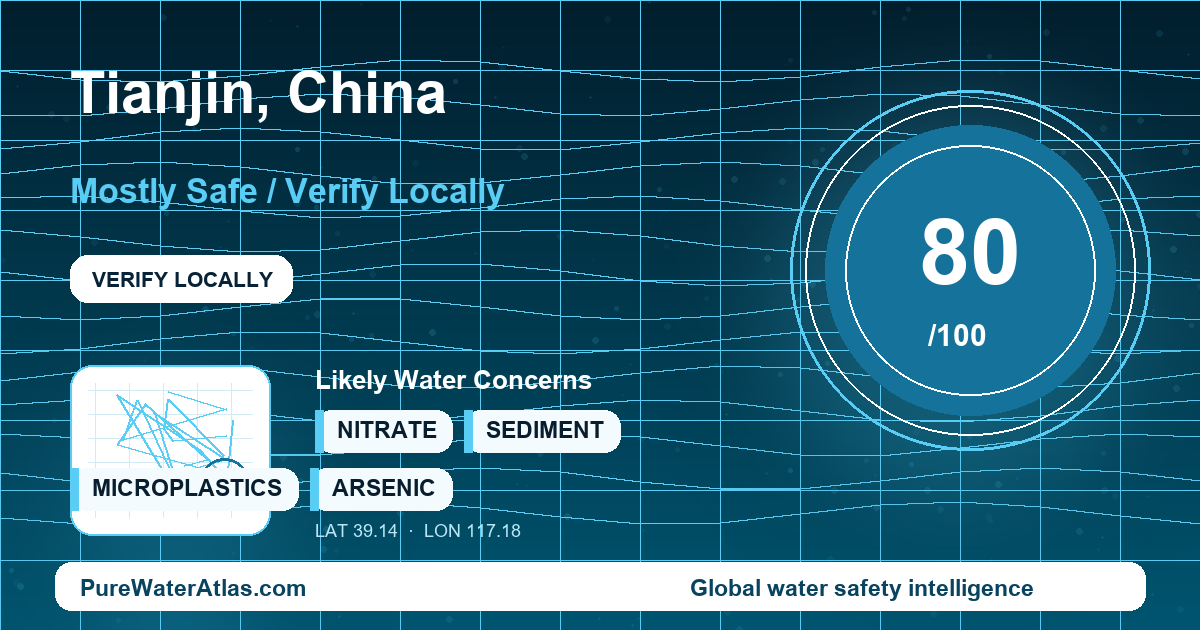
Tianjin’s tap water comes from a regulated municipal system supplied largely by major inter-basin water transfers, but the practical safety question is often what happens inside a building, hotel, tank, or high-rise plumbing system before the water reaches the tap.
Quick Answer
| Overall safety status | Mostly Safe / Verify Locally — PureWaterAtlas score: 80/100. Tianjin’s municipal supply is treated and regulated, but end-of-tap quality can vary by building plumbing, secondary storage, and recent distribution conditions. |
|---|---|
| Can tourists drink the tap water? | Short-term visitors should use sealed bottled water, boiled water, or verified hotel-provided purified water for drinking. Tap water is generally acceptable for handwashing and usually for brushing teeth in modern hotels if clear and no advisory is present. |
| Resident guidance | Residents connected to the municipal network can generally treat Tianjin tap water as a regulated source, but should verify building-level conditions, especially in older apartments, high-rise compounds, or buildings using secondary tanks and pumps. |
| Main raw-water systems | South-to-North Water Diversion Middle Route; Luanhe-to-Tianjin diversion system; Yuqiao Reservoir as an important regulating reservoir for Luanhe diverted water. |
| Water authority | Tianjin Water Affairs Bureau, with major urban water-supply operations by Tianjin Water Group and public-health oversight by Tianjin health authorities. |
| Filter recommendation | A filter is not automatically required for every household, but a maintained point-of-use system is practical for taste, chlorine, sediment, and uncertainty from internal plumbing or storage tanks. Boiling helps microbial risk but does not remove dissolved metals, salinity, nitrate, PFAS, or hardness. |
Why Tianjin Is Different
Tianjin is not a city with abundant nearby mountain reservoirs and simple local source-water conditions. It sits on the low-lying North China coastal plain near the Bohai Sea and the Haihe River system, in a region where freshwater is limited, drought pressure matters, and coastal salinity is part of the background water-security challenge. This geography makes Tianjin’s drinking-water profile different from inland cities with plentiful local upstream catchments.
The city’s modern water safety depends heavily on large engineered transfer systems. Tianjin relies substantially on externally transferred surface water rather than abundant local freshwater. The South-to-North Water Diversion Middle Route brings water from the Danjiangkou Reservoir system toward North China, while the older Luanhe-to-Tianjin diversion project and Yuqiao Reservoir remain important parts of the city’s water identity. Local rivers and groundwater are not the preferred primary urban drinking-water sources because of regional scarcity, historical pollution pressure, and salinity risks in the coastal plain.
For consumers, the most important distinction is between water leaving a municipal treatment plant and water coming out of a specific apartment, hotel, restaurant, or office tap. Tianjin has formal treatment and transmission infrastructure, but many residents live in high-rise buildings or older compounds where secondary water supply systems, tanks, pumps, stagnant internal pipes, and aging building materials can become practical weak points if maintenance is poor.
Where Does Tianjin’s Tap Water Come From?
Tianjin’s core urban drinking-water supply is shaped by two major raw-water systems. The first is the South-to-North Water Diversion Project, especially the Middle Route, which supplies North China with transferred surface water from the Danjiangkou Reservoir system. The second is the Luanhe-to-Tianjin water diversion system, historically critical for Tianjin before the South-to-North system became a major source. Yuqiao Reservoir serves as an important regulating and storage reservoir for Luanhe diverted water.
This reliance on transfers reflects Tianjin’s limited local freshwater base. The city’s location near the Haihe River system and the Bohai coast created chronic source-water stress: local surface water was limited and vulnerable to upstream pollution pressure, while coastal groundwater and some local waters faced salinity and quality constraints. The result is a drinking-water system that depends on large regional infrastructure, source-water protection, reservoirs, treatment plants, and a distribution network extending into dense urban neighborhoods.
Key infrastructure includes South-to-North Water Diversion facilities serving Tianjin, the Luanhe-to-Tianjin diversion project, Yuqiao Reservoir, municipal treatment plants and distribution networks operated by Tianjin’s urban water-supply entities, and secondary water-supply facilities inside high-rise residential and commercial buildings. Those building-level facilities are not a minor detail: tanks, pumps, and internal pipework can affect turbidity, sediment, taste, residual disinfectant, and microbial risk after water has already entered the property.
Who Manages Drinking Water in Tianjin?
The municipal water authority is the Tianjin Water Affairs Bureau. Tianjin Water Group is a major urban water-supply operator; its official site is Tianjin Water Group. Public-health oversight of drinking-water hygiene involves Tianjin health authorities, including the Tianjin Municipal Health Commission. Source-water and broader environmental quality context are relevant to the Tianjin Municipal Ecology and Environment Bureau.
Tianjin’s drinking water is governed under China’s national drinking-water quality framework, including the current national Standard for Drinking Water Quality, GB 5749-2022, associated with the National Health Commission of the People’s Republic of China. National water resources policy and major transfer systems are also connected to the Ministry of Water Resources.
The important data limitation is that city-level governance and source-water context do not prove that every tap in every building is equally safe on a given day. Publicly visible information may summarize compliance or policy rather than provide recent parameter-by-parameter results for a specific district, water-treatment-plant outlet, compound, storage tank, hotel, or apartment. PureWaterAtlas therefore separates the regulated municipal supply from the additional uncertainty created by building plumbing and secondary storage.
Main Local Water Concerns
Tianjin’s main concerns are not best described as a single contaminant crisis. They are a combination of source-water pressure, complex infrastructure, and end-of-pipe uncertainty. The city depends on transferred water in a water-scarce coastal region, so reservoir storage, drought periods, allocation, and source-water protection are important background factors. Industrial and urban pollution pressure in the wider Haihe-Bohai region also makes monitoring and treatment control important, even when treated water is compliant.
At the tap, common practical issues include taste, odor, chlorine residual, hardness, and occasional complaints about turbidity or sediment. These can occur after pipe repairs, pressure changes, building maintenance, distribution disturbances, or periods of stagnation. A yellow, rusty, cloudy, or metallic-tasting first flush should not be ignored, especially in older buildings or where water has been shut off recently.
Secondary water supply is a central concern in Tianjin’s high-rise environment. Rooftop or basement storage tanks, pumps, and internal distribution lines require cleaning and disinfection. If maintenance is poor, sediment, biofilm, low chlorine residual, or microbial contamination can occur after the water has already left the municipal network. Summer heat can increase biological activity in reservoirs and building storage tanks, making disinfection and tank hygiene more important. Heavy rainfall and flood-season runoff can increase turbidity and organic matter in source waters, requiring strong treatment control. After long holidays or vacancies, stagnant pipes may produce first-flush discoloration, metallic taste, or lower disinfectant residual.
For Travelers
For a short visit to Tianjin, the conservative answer is: do not rely on untreated tap water as your main drinking water. Use sealed bottled water, boiled water, or verified hotel or restaurant purified water. This is not because Tianjin lacks a formal water system; it is because travelers usually cannot verify the exact building plumbing, tank cleaning schedule, recent water notices, or local conditions at a hotel, guesthouse, dormitory, or restaurant.
Brushing teeth with tap water is generally acceptable in modern hotels and serviced apartments if the water is clear and there is no official advisory. Travelers with sensitive stomachs, immune compromise, infants, or very low risk tolerance can use bottled water for brushing as well. Use boiled water for infant formula.
For ice, avoid cubes from informal street vendors or venues that cannot confirm purified-water ice. Higher-end hotels and chain restaurants are more likely to use treated or purified water, but cautious travelers should ask. In hotels and restaurants, hot tea, boiled water, sealed bottled drinks, and commercially packaged beverages are the safer default choices. Most hotels provide kettles, bottled water, or water dispensers because boiling or using purified water is common practice in China.
During summer heat, carry bottled water and check that bottle seals are intact. Avoid drinking from taps in older guesthouses, dorm-style accommodation, or buildings where the water appears yellow, cloudy, rusty, or has recently been interrupted. The CDC Travelers’ Health guidance for China is a useful external reference for food and water precautions.
For Residents
For Tianjin residents, the municipal connection is generally a regulated source, but household decisions should focus on the last meters of delivery. A home filter is not automatically required for every apartment, yet it is a practical upgrade for taste, chlorine, sediment, and uncertainty from old plumbing or secondary storage. A certified carbon filter can improve chlorine taste and odor. Reverse osmosis is more appropriate where residents want reduction of dissolved salts, some metals, nitrate, or broader chemical contaminants. Boiling can reduce microbial risk when done correctly, but it does not remove lead, arsenic, nitrate, PFAS, salinity, hardness, or most dissolved metals.
Testing is especially sensible if you live in an older building, have infants, are pregnant, notice metallic taste, rust color, recurring sediment, or use a high-rise secondary supply. Consider both first-draw and flushed samples. Useful parameters include lead, iron, manganese, turbidity, total dissolved solids, hardness, residual chlorine, and microbial indicators such as total coliform or E. coli when building-level conditions are uncertain.
Older apartments and renovated historic buildings may have aging galvanized, iron, copper-alloy, soldered, or mixed-material internal plumbing. If water has been stagnant overnight, use cold water for cooking and drinking, flush before use, and test rather than assuming that municipal plant quality equals apartment tap quality. For high-rise buildings, ask the property manager for the secondary water-supply cleaning and disinfection schedule and any recent inspection records. After tank cleaning, pipe repair, pressure loss, or a water outage, flush taps until clear and follow any official boil-water or do-not-use notice.
Relevant Contaminants and Water-Quality Issues
Several PureWaterAtlas contaminant guides are especially relevant to Tianjin’s practical tap-water profile. Chlorine in Drinking Water explains residual disinfectant, taste, and odor issues that can influence why residents boil or filter water. Turbidity in Drinking Water is relevant after heavy runoff, source-water changes, pipe repairs, pressure shifts, or tank disturbance. Sediment in Drinking Water is directly relevant to old building plumbing, storage tanks, and first-flush discoloration.
Lead in Drinking Water is relevant where internal plumbing materials are old or unknown, even if treated water leaving the plant is compliant. E. coli in Drinking Water is most relevant to tank hygiene, loss of disinfectant residual, boil-water situations, and traveler caution. PFAS in Drinking Water may be considered as an advanced screening topic in industrialized and urbanized watersheds, but the available dataset does not support an overclaim that Tianjin tap water has a confirmed citywide PFAS problem.
How to Verify Your Water Quality
The most reliable way to understand your own Tianjin tap water is to combine official notices with building-specific checks and, when needed, laboratory testing. Start with the Tianjin Water Affairs Bureau, Tianjin Water Group, and health-authority notices for any current advisories. If you live in a high-rise, also ask your property manager about tank cleaning, disinfection, and inspection records.
For household testing strategy, see How to Test Drinking Water: Complete Guide to Water Testing and Analysis and Lead in Drinking Water: Testing and Detection Methods. If you want advanced chemical screening, see PFAS in Drinking Water: Testing and Detection Methods. For local practice around boiling, see Boiling Water Purification: Complete Guide; for microbial control in appropriate systems, see UV Water Purification: Complete Guide.
PureWaterAtlas also provides broader decision tools: the Global Water Quality Checker, the Contaminants Search Engine, Drinking Water Safety: How to Know If Your Tap Water Is Safe to Drink, Water Treatment Systems: Choosing the Right Solution for Safe Drinking Water, and Water Microbiology: Bacteria, Viruses and Microbial Risks in Drinking Water. Related categories include Drinking Water Safety, Global Water Quality, Water Testing, and Water Contamination.
Official and Technical Sources
- Tianjin Water Affairs Bureau — municipal authority for water affairs, water resources, water-supply policy, and public water notices in Tianjin.
- Tianjin Water Group — major Tianjin urban water-supply operator.
- South-to-North Water Diversion Project — official source for the inter-basin transfer system supplying North China, including Tianjin.
- Ministry of Water Resources of the People’s Republic of China — national authority for water-transfer projects, reservoirs, and water resources management.
- National Health Commission of the People’s Republic of China — source for the national drinking-water quality framework, including GB 5749-2022.
- Tianjin Municipal Health Commission — local public-health authority relevant to drinking-water hygiene supervision.
- Tianjin Municipal Ecology and Environment Bureau — environmental quality, surface-water status, pollution-control, and watershed context.
- CDC Travelers’ Health: China — traveler-health guidance for food and water precautions.
- WHO Guidelines for Drinking-water Quality — international benchmark for drinking-water safety, microbial risk, chemical contaminants, and household water safety principles.
Bottom Line
Tianjin’s tap water is best understood as a regulated municipal supply with building-level uncertainty. The city relies heavily on transferred surface water from the South-to-North Water Diversion Middle Route and the Luanhe-to-Tianjin system, with Yuqiao Reservoir playing an important regulating role. For residents in well-maintained modern buildings, tap water is generally lower risk by China city standards, but old internal plumbing, secondary tanks, pumps, stagnation, sediment, and taste issues can change tap-level quality. Travelers should default to bottled, boiled, or verified purified water for drinking. Residents should check tank maintenance, flush stagnant taps, test older buildings when needed, and use a properly maintained filter where taste, sediment, or plumbing uncertainty justifies it.
Read the full guide: Global Water Quality Guide
Explore more in this category: Global Water Quality Articles