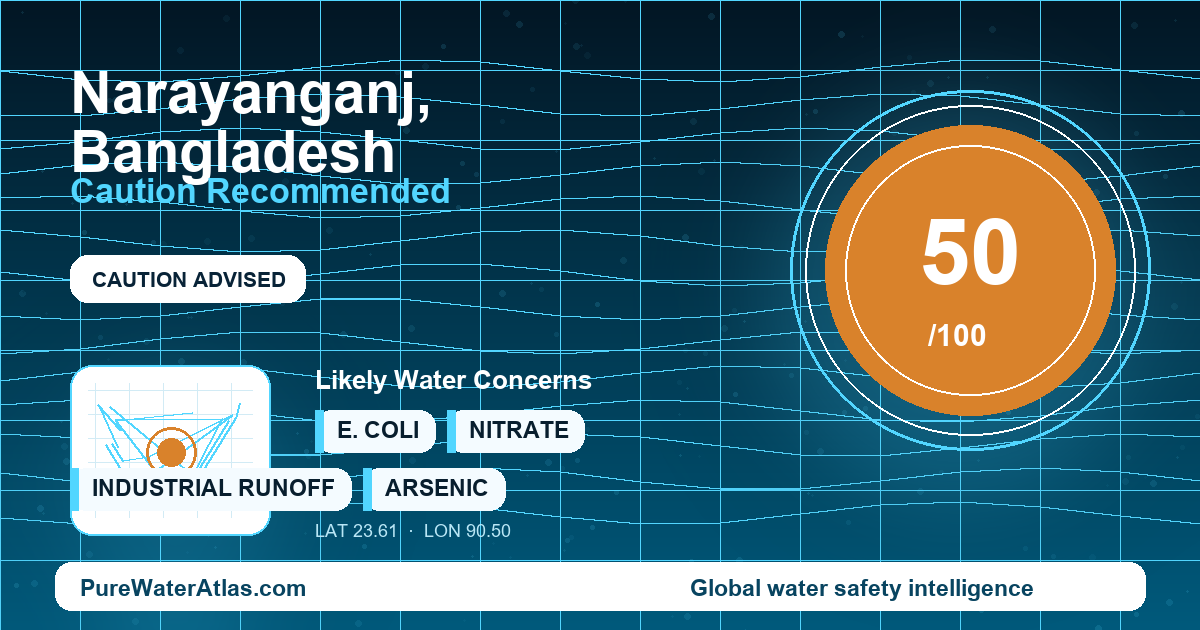
Narayanganj, Bangladesh: caution-level tap water guidance for a dense industrial river-port city on the Shitalakhya River, with mixed surface-water and groundwater supply, legacy Dhaka WASA infrastructure, and consumer-side risks from distribution pipes, pressure loss, and storage tanks.
Quick Answer
| Overall safety status | Caution recommended. PureWaterAtlas assigns Narayanganj a water safety score of 50/100. Available public evidence does not support a blanket claim that untreated tap water is consistently safe to drink at the point of use. |
|---|---|
| Can visitors drink the tap water? | No, not untreated. Short-stay travelers should use sealed bottled water, properly boiled water, or water treated by a reliable purifier with microbial protection. |
| Resident guidance | Residents should treat tap water for drinking unless they have recent reliable test results from their own household outlet. Testing is especially important after flooding, pipe repairs, tank cleaning, taste changes, or repeated stomach illness. |
| Main water identity | Narayanganj is best understood as a mixed legacy system: treated surface water influenced by the Shitalakhya River, including local treatment works such as Godnail and Sonakanda, plus groundwater from deep tube wells. |
| Water authority context | Narayanganj City Corporation is the city-level authority most directly associated with current urban water service improvement and operation. Dhaka WASA remains important historically and technically because Narayanganj was part of its earlier service mandate and infrastructure. |
| Filter recommendation | For most homes, a practical default is sediment prefiltration plus UV or boiling for microbial risk. Activated carbon may help with taste and some organics. Reverse osmosis should be considered only where testing shows arsenic, high TDS, nitrate, salinity, or dissolved metals requiring it. |
Why Narayanganj Is Different
Narayanganj is not a generic Bangladesh tap-water case. It is an industrial river-port city immediately southeast of Dhaka, located on the Shitalakhya River. That geography matters because the Shitalakhya is both a local surface-water influence and a river under strong pollution pressure from industrial discharge, urban wastewater, organic pollution, ammonia, color, odor, and high treatment demand. In Narayanganj, the safety question is therefore not only “is there a treatment plant?” but also “what happens before and after treatment?”
The city’s drinking-water identity is tied to the broader Dhaka metropolitan water system. Dhaka WASA was created to serve Dhaka and Narayanganj, and the Narayanganj system historically included surface-water treatment plants and deep tube wells. More recent development-bank project documents identify Narayanganj City Corporation as the urban authority responsible for improving water supply and sanitation after transfer of service responsibilities from Dhaka WASA.
For consumers, Narayanganj’s most practical risk profile has two separate parts. First, river pollution can make surface-water treatment harder, especially during dry-season low flow when pollutants may be more concentrated. Second, treated water can be degraded after it leaves a plant because of old mains, intermittent pressure, illegal or damaged connections, cross-connections, pumps, and private underground or rooftop tanks. This is why PureWaterAtlas does not treat a connection to the formal urban system as proof that water is safe at the glass.
Where Does Narayanganj’s Tap Water Come From?
Narayanganj’s urban water supply is best described as a mixed legacy system. The dataset supports treated surface water associated with the Shitalakhya River through local treatment works such as Godnail and Sonakanda, along with groundwater abstraction from deep tube wells. The exact mix can vary by service area, season, and operational status, so a resident in one neighborhood should not assume their water has the same source profile as another building elsewhere in the city.
The major infrastructure elements relevant to consumer safety include the Shitalakhya River as a raw-water influence, Godnail and Sonakanda water treatment works in the Narayanganj system context, deep tube wells, urban distribution mains, service connections, and building-level storage tanks. Ongoing or planned rehabilitation and expansion under Narayanganj City Corporation water supply and sanitation investment programs are also part of the city’s current water context.
Surface water and groundwater create different verification needs. Shitalakhya-influenced water can be vulnerable to turbidity, organic pollution, odor, high treatment demand, and dry-season concentration of pollutants. Groundwater in Bangladesh can contain arsenic, iron, manganese, salinity, or other geogenic constituents depending on aquifer depth and location. Deep municipal wells may differ from shallow private wells, but the practical advice remains the same: do not rely on source assumptions; test the water that actually reaches the tap.
Who Manages Drinking Water in Narayanganj?
Narayanganj City Corporation is the city-level authority most directly associated with current urban water service improvement and operation. The city’s institutional history is important because Narayanganj was historically linked to Dhaka WASA’s service area and infrastructure. Dhaka WASA remains relevant for understanding legacy assets, historical service responsibilities, and the broader Dhaka-region surface-water and groundwater context.
Bangladesh drinking-water oversight involves national standards and public-health water-supply institutions including the Local Government Division, the Department of Public Health Engineering, Department of Environment standards, and local government utilities. WHO drinking-water guideline values are commonly used as a technical reference for microbial safety, chemical parameters, and risk management through source protection, treatment, distribution, and household handling.
A key limitation for Narayanganj is transparency at the point of use. PureWaterAtlas found credible sources on the city’s water-system identity, Shitalakhya River pressure, Bangladesh groundwater risks, and planned infrastructure upgrades. However, recent publicly accessible tap-level results by ward, treatment plant, storage zone, and season were not found in a consolidated official dashboard. This profile therefore does not claim that all Narayanganj municipal water meets or fails any specific legal standard. It recommends caution because city-level evidence is not sufficient to verify consistent safety at consumer taps.
Main Local Water Concerns
- Shitalakhya River pollution pressure: Industrial discharge, urban wastewater, organic pollution, ammonia, color, odor, and high treatment demand can challenge surface-water treatment.
- Dry-season concentration: Lower river dilution can intensify pollution and increase chlorine demand or treatment difficulty for surface-water plants.
- Monsoon impacts: Heavy rainfall can increase turbidity, suspended solids, flooding, drain overflow, sewer-drain mixing, and ingress into leaky pipes or tanks.
- Distribution system vulnerability: Old mains, damaged connections, illegal connections, low pressure, pipe repairs, and road works can create contamination pathways after treatment.
- Household and building storage tanks: Underground and rooftop tanks can lose disinfectant residual, collect sediment, allow insect or debris entry, or become contaminated during flooding if not protected.
- Groundwater chemistry: Bangladesh groundwater can contain arsenic, iron, manganese, salinity, or other geogenic constituents depending on aquifer depth and location.
- Old plumbing: Older buildings, brass fixtures, corroded pipes, stagnant first-draw water, pumps, and cross-connections can create household-level risks even if municipal water was adequately treated upstream.
- Limited public monitoring disclosure: The lack of a recent ward-level tap-water dashboard makes consumer-side testing more important than in cities with transparent routine compliance data.
For Travelers
Visitors should not drink untreated tap water in Narayanganj. Use sealed bottled water from reputable brands, properly boiled water, or water treated with a reliable purifier that provides microbial protection. This is especially important for short-stay travelers, children, pregnant travelers, immunocompromised visitors, and anyone with a sensitive stomach.
For brushing teeth, visitors should use bottled or boiled water unless staying in accommodation with a verified treatment system and good tank hygiene. Avoid swallowing shower water, and keep bottled water available at night so you do not need to rely on bathroom taps.
Ice is a common avoidable risk. Do not use ice unless a hotel or restaurant can confirm it was made from treated water. In small shops, street stalls, and informal restaurants, skip ice entirely. Better hotels and restaurants may use filters or bottled water, but do not assume this; ask whether drinking water and ice are made from treated water, and prefer sealed bottles opened at the table.
During the day, carry sealed water and avoid refilled bottles with broken or questionable seals. Hot tea or coffee is a safer option only if the water has reached a rolling boil. In hot weather or during stomach illness, oral rehydration salts can be useful. Boiling helps control microbes, but it does not remove arsenic, lead, nitrate, salts, iron, manganese, or industrial chemicals.
For Residents
For Narayanganj households, a home treatment setup is usually advisable for drinking and cooking water unless recent tests from the actual household tap show acceptable microbial and chemical quality. A sensible baseline is sediment prefiltration followed by UV disinfection or boiling for microbial risk. Activated carbon can improve taste and reduce some organic compounds and chlorine byproducts. Reverse osmosis may be appropriate if testing shows arsenic, high TDS, nitrate, salinity, or certain dissolved metals, but RO systems require maintenance and safe reject-water handling.
Testing should be done at the point of use, not only at the building inlet, because tanks and plumbing can change water quality. For routine safety, test for E. coli or thermotolerant coliforms, total coliforms, turbidity, pH, residual chlorine, and conductivity or TDS. For Bangladesh-specific groundwater risk, include arsenic, iron, and manganese, especially if using a private well or a supply not clearly connected to treated municipal water. For infant formula, pregnancy, or private wells near septic or drainage influence, include nitrate. In older buildings or buildings with renovated plumbing, brass fixtures, or unknown service lines, test first-draw and flushed samples for lead.
Storage tanks deserve special attention in Narayanganj. Underground and rooftop tanks should be covered, screened against insects and debris, protected from drain or floodwater entry, and cleaned on a regular schedule. If water has odor, visible sediment, slime, or low chlorine residual, clean and disinfect the tank before using that water for drinking. Retest after flooding, pipe repairs, major road works, tank cleaning, changes in taste or color, or repeated stomach illness among household members.
Relevant Contaminants and Water-Quality Issues
The most relevant point-of-use microbial concern in Narayanganj is E. coli, especially where storage tanks, low disinfectant residual, or distribution leakage are possible. Turbidity is important during monsoon rainfall, river-treatment stress, and any episode of cloudy water. Sediment is relevant to old mains, tanks, pipe repairs, and brown or particulate water.
Because Narayanganj also uses groundwater in its mixed supply context, residents should understand Bangladesh-relevant geogenic risks such as arsenic, iron, and manganese. These cannot be judged reliably by appearance alone. In older buildings, lead testing is relevant for first-draw water, brass fixtures, and stagnant plumbing. Chlorine is also central because residual disinfectant helps protect against microbial regrowth, but residual can be depleted in long networks, warm rooftop tanks, or dirty storage systems.
How to Verify Your Water Quality
The safest way to verify Narayanganj drinking water is to test the water you actually drink. Start with microbial indicators, turbidity, pH, residual chlorine, and TDS or conductivity. Add arsenic, iron, manganese, nitrate, and lead based on source type, building age, plumbing materials, and household vulnerability. For a broader testing plan, use the PureWaterAtlas guide to water testing and analysis.
If your main worry is biological safety, compare options using the PureWaterAtlas resources on water microbiology, boiling water purification, and UV water purification. For chemical verification, see the guides on arsenic testing, lead testing, and nitrate testing.
You can also explore the PureWaterAtlas Contaminants Search Engine, compare city-level context with the Global Water Quality Checker, and review the main PureWaterAtlas pillars on drinking water safety, global water quality, and water purification methods.
Official and Technical Sources
- Asian Development Bank: Bangladesh, Narayanganj City Corporation Water Supply and Sanitation Project — supports the current Narayanganj City Corporation investment and urban service-improvement context.
- Asian Development Bank project documents for Narayanganj City Corporation Water Supply and Sanitation Project — supports the need for rehabilitation, expansion, and institutional strengthening.
- Narayanganj City Corporation official website — local government source for the municipal authority context.
- Dhaka Water Supply and Sewerage Authority official website — supports the historical link between Dhaka WASA, Narayanganj service responsibilities, and regional water infrastructure.
- Department of Public Health Engineering, Bangladesh — national public-health engineering authority for water-supply and water-quality context.
- UNICEF Bangladesh: Bangladesh National Drinking Water Quality Survey 2009 — documents Bangladesh-wide microbial contamination and arsenic concerns.
- WHO Guidelines for Drinking-water Quality — technical reference for microbial and chemical drinking-water safety.
- WHO/UNICEF Joint Monitoring Programme: Bangladesh household drinking water data — national service context showing that improved source access is not the same as verified safety at consumption.
- World Bank Open Knowledge Repository — background on urban environmental pressures and water-pollution management challenges in Bangladesh.
Bottom Line
Narayanganj has formal urban water infrastructure, including Shitalakhya-influenced surface-water treatment works and groundwater from deep tube wells, but untreated tap water should be treated with caution. The city’s risk is shaped by industrial river pollution pressure, dry-season treatment challenges, monsoon turbidity and flooding pathways, aging distribution infrastructure, household tanks, and limited recent public tap-level monitoring data. Visitors should avoid untreated tap water and use sealed bottled, boiled, or reliably purified water. Residents should test water at the household tap and use sediment filtration plus UV, boiling, or other treatment matched to test results. In Narayanganj, source treatment, pipe integrity, tank hygiene, and point-of-use testing all matter.
Read the full guide: Global Water Quality Guide
Explore more in this category: Global Water Quality Articles