
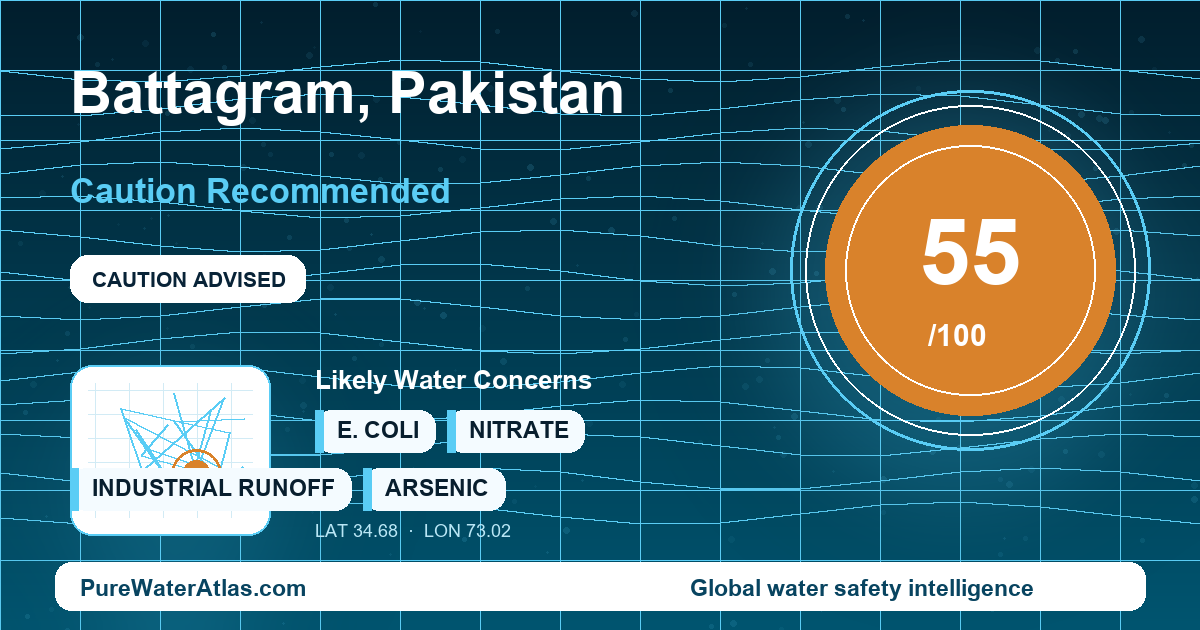
Battagram, Pakistan: tap-water safety guidance for a mountainous Khyber Pakhtunkhwa district headquarters where public city-wide water-quality reporting is limited and untreated household water should be approached with caution.
Quick Answer
| Overall status | Caution recommended. PureWaterAtlas score: 55/100. Recent, complete, public Battagram city tap-water compliance reporting was not found. |
|---|---|
| Can visitors drink the tap water? | No, not without treatment. Visitors should use sealed bottled water, boiled water, or water treated with a credible purifier. |
| Resident guidance | Residents should treat household drinking water unless their exact supply is recently tested, disinfected, and well maintained. |
| Main water identity | A mix of local public water-supply schemes, spring and gravity-fed supplies, hill-stream or nullah catchments, shallow groundwater, hand pumps, wells, and household storage. |
| Relevant authorities | Local urban services are associated with Tehsil Municipal Administration Battagram and the local government system; the Public Health Engineering Department Khyber Pakhtunkhwa is the key provincial agency for drinking-water schemes. |
| Filter recommendation | Use a treatment barrier focused on microbial safety: boiling, UV with prefiltration, or a properly maintained purifier. Simple taste-and-odor filters are not enough when microbial contamination is possible. |
The most realistic safety concern in Battagram is microbial contamination from springs, hill streams, storage tanks, intermittent distribution, local sanitation pressures, and runoff after rain. A clear-looking glass of water is not proof of safety.
Why Battagram Is Different
Battagram is a mountainous district headquarters in Khyber Pakhtunkhwa on the Karakoram Highway corridor. Its water-safety profile is different from a large, continuously pressurized metropolitan treatment system. In Battagram, drinking water is better understood as a combination of local public schemes and household-level sources, with final safety often depending on spring protection, pipe condition, storage-tank hygiene, and point-of-use treatment.
The terrain favors springs and gravity-flow supplies, but it also increases vulnerability. Rain, monsoon runoff, landslides, slope movement, road works, and pipe breaks can disturb intakes and distribution lines. When pressure is intermittent or low, contaminated water can enter cracked or damaged pipes. Household rooftop tanks, underground tanks, drums, and shared storage can then become the final point where water is either protected or recontaminated.
Battagram is not identified here as a major industrial city. Based on the available dataset, the higher-probability concerns are not city-wide industrial chemicals but E. coli or fecal contamination, turbidity, sediment, and contamination introduced during distribution or storage. Chemical testing still matters for private wells, hand pumps, boreholes, and older buildings because local geology and plumbing materials can vary from one property to another.
Where Does Battagram’s Tap Water Come From?
Battagram’s drinking water is best described as a mixed local-source system rather than one single centralized metropolitan supply. Likely raw-water inputs include protected and semi-protected springs, hill-stream or nullah catchments, shallow groundwater, hand pumps, wells, local boreholes, and small storage reservoirs. In hilly terrain, gravity-fed water lines and spring catchments can be practical, but raw water quality can change quickly after rainfall, landslides, pipe repairs, or contamination near an intake.
Historically, settlements in Battagram and the wider Hazara mountain belt have relied heavily on springs, gravity-flow village water schemes, hand pumps, and local wells. These sources can provide relatively low-salinity water, but microbiological safety depends on protection. A spring can look clean and still be contaminated if the spring box, catchment, drains, nearby latrines, livestock areas, pipelines, or household tanks are not properly protected.
Key infrastructure elements relevant to Battagram include local drinking-water supply schemes serving urban and peri-urban settlements, spring catchments, gravity-fed water lines, small service reservoirs, community storage tanks, and distribution pipes exposed to slope movement and road works. For homes outside reliable piped service, private wells, hand pumps, and local boreholes may be used. In all of these cases, household storage and treatment are part of actual drinking-water safety, not just convenience.
Who Manages Drinking Water in Battagram?
Local urban services in Battagram are associated with the Tehsil Municipal Administration Battagram and the local government system. At the provincial level, the Public Health Engineering Department, Government of Khyber Pakhtunkhwa, is the key agency for public health engineering and drinking-water supply schemes, including rural and small-town infrastructure. The Local Government, Elections and Rural Development Department, Khyber Pakhtunkhwa, provides the wider institutional context for local service delivery.
Water-quality testing and technical surveillance may also involve provincial authorities and the Pakistan Council of Research in Water Resources, depending on the project, monitoring program, or testing need. Pakistan has national drinking-water benchmarks through the National Standards for Drinking Water Quality. However, PureWaterAtlas did not find a recent, complete, publicly posted Battagram city tap-water compliance dataset comparable to a municipal annual water-quality report.
This limitation matters. The guidance on this page should not be read as proof that every tap in Battagram is unsafe, nor as proof that any specific neighborhood meets standards. It reflects the available institutional evidence, Pakistan’s standards framework, national WASH context, and the known vulnerability of small mountainous water-supply systems.
Main Local Water Concerns
- Microbial contamination: Possible E. coli in drinking water or fecal coliform contamination can occur from sanitation, animals, runoff, or unprotected spring catchments.
- Monsoon turbidity: Heavy rain can increase runoff, suspended material, and turbidity in drinking water, especially where intakes or catchments are disturbed.
- Sediment and grit: Landslides, road works, disturbed spring boxes, and hillside pipes can contribute to sediment in drinking water.
- Intermittent supply: Low pressure and service interruptions can allow contaminated water to enter cracked or damaged pipes.
- Household storage: Rooftop tanks, underground tanks, drums, and shared storage can recontaminate water if they are uncovered, dirty, or accessed with unclean containers.
- Private wells and hand pumps: Wells close to latrines, septic systems, livestock areas, or fertilizer use may need testing for microbial indicators and nitrate.
- Building plumbing: No Battagram-wide lead dataset was found, but older premises with old pipes, solder, brass fittings, or long stagnation times should consider lead in drinking water testing.
Seasonal risk is especially important. Monsoon rainfall, snowmelt, heavy rain in surrounding hills, landslides, floods, earthquakes, and pipe repairs should be treated as warning periods. After a disruption, water should be boiled or otherwise treated until safety is verified or officially cleared.
For Travelers
Visitors should not drink untreated tap water in Battagram. Because recent city-wide public testing data are limited and microbial risk is plausible, the safest short-term approach is to use sealed bottled water from a reliable shop, freshly boiled water, or water treated with a credible purifier. This is especially important for children, older adults, pregnant travelers, and anyone with a sensitive stomach.
Use bottled, boiled, or properly filtered water for brushing teeth. Avoid ice unless you know it was made from bottled or treated water. Ice made from untreated tap water, stored water, or uncertain guesthouse water can carry the same microbial risks as the original water.
In hotels and restaurants, ask for sealed bottled water or freshly boiled water. Hot tea is generally lower risk if it has been brought to a full boil, but stored drinking water, open jugs, water-diluted chutneys, and ice remain higher-risk items. On road trips along the Karakoram Highway corridor or rural side routes, carry enough sealed water. If bottled water is unavailable, bring water to a rolling boil and let it cool in a clean, covered container. If water is visibly cloudy, filter or settle it before disinfection because turbidity can reduce disinfection effectiveness. See the PureWaterAtlas boiling water purification guide for practical steps.
For Residents
For Battagram households, a home treatment barrier is advisable unless the exact household supply is recently tested, consistently disinfected, and well maintained. If the main concern is microbial safety, boiling, UV with prefiltration, or a properly maintained purifier is more relevant than a simple taste-and-odor filter. Where water is cloudy, prefiltration or settling is important before UV or chemical disinfection. For more detail, see the PureWaterAtlas guides to UV water purification and water purification methods.
Testing is strongly recommended for homes using a spring, well, hand pump, shared tank, private borehole, or intermittent supply. At minimum, test for E. coli or thermotolerant coliforms seasonally and after floods, landslides, pipe repairs, tank cleaning, sewage intrusion concerns, taste changes, or illness clusters. If a supply is supposed to be chlorinated, checking for a measurable free chlorine residual at the tap is useful; the PureWaterAtlas page on chlorine in drinking water explains why residual disinfectant matters.
Private wells or boreholes should have a baseline chemical screen, including nitrate, electrical conductivity or total dissolved solids, hardness, arsenic, iron, manganese, and pH. If a home, school, clinic, shop, or guesthouse has old plumbing, brass fixtures, solder, or long stagnation times, collect first-draw and flushed samples for lead screening through a qualified laboratory. PureWaterAtlas has additional guidance on lead testing methods and nitrate testing methods.
Storage tanks are a major control point in Battagram. Keep tanks covered, protected from runoff, cleaned on a schedule, and disinfected after maintenance. Do not dip cups, hands, or unclean containers into stored drinking water. Recontamination after treatment is a common failure point in household water safety.
Relevant Contaminants and Water-Quality Issues
The most relevant PureWaterAtlas contaminant profiles for Battagram are E. coli, turbidity, sediment, chlorine, nitrate, and lead. These do not mean every Battagram tap has these problems. They identify the issues most worth checking based on the city’s mountainous source profile, intermittent distribution risk, household storage patterns, and the absence of a recent public city-wide compliance report.
For background on judging water safety, use the PureWaterAtlas guide to drinking water safety. For microbial hazards, see water microbiology.
How to Verify Your Water Quality
The only reliable way to know whether a specific Battagram tap, spring, well, or storage tank is safe is to test that source and compare results with relevant standards. Start with microbiological testing for E. coli or thermotolerant coliforms. Add chemical testing for private wells, boreholes, old plumbing, or areas near sanitation, livestock, or fertilizer use.
PureWaterAtlas resources that can help include the complete guide to water testing, the Contaminants Search Engine, and the Global Water Quality Checker. For broader topic navigation, see the Drinking Water Safety, Water Microbiology, and Water Testing categories.
Official and Technical Sources
- Public Health Engineering Department, Government of Khyber Pakhtunkhwa — provincial public health engineering and drinking-water supply authority.
- Local Government, Elections and Rural Development Department, Khyber Pakhtunkhwa — local government and municipal service context.
- District Administration Battagram, Government of Khyber Pakhtunkhwa — local administrative context for Battagram.
- Pakistan Council of Research in Water Resources — national water research and testing institution.
- National Standards for Drinking Water Quality, Pakistan — national benchmark framework for drinking-water quality.
- WHO and UNICEF Joint Monitoring Programme: Pakistan household drinking-water data — national and subnational WASH context.
- UNICEF Pakistan Water, Sanitation and Hygiene — Pakistan WASH and public-health context.
- Provincial Disaster Management Authority Khyber Pakhtunkhwa — relevant for floods, monsoon events, earthquakes, landslides, and infrastructure disruption.
Bottom Line
Battagram tap water should be approached with caution because recent, complete, public city-wide compliance reporting was not found and the local water setting is vulnerable to microbial contamination. The town’s mountainous terrain, spring and gravity-fed sources, intermittent supplies, storage tanks, monsoon runoff, landslides, and pipe disturbances make safety highly source- and household-specific. Visitors should not drink untreated tap water; use sealed bottled, boiled, or properly purified water and avoid uncertain ice. Residents should test springs, wells, hand pumps, shared tanks, and intermittent supplies, especially for E. coli, and maintain covered, clean storage tanks. Clear water is not enough evidence of safety in Battagram.
Read the full guide: Global Water Quality Guide
Explore more in this category: Global Water Quality Articles