
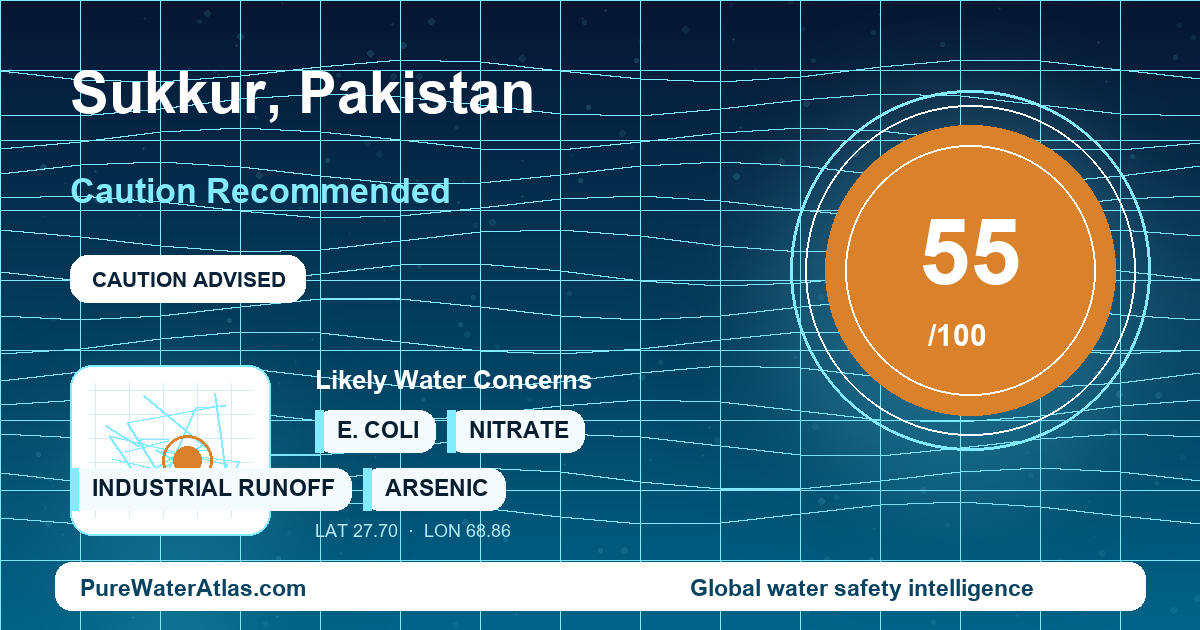
Sukkur’s drinking-water safety depends heavily on the Indus River, the Sukkur Barrage environment, intermittent urban distribution, and the condition of household storage tanks.
Quick Answer
| Overall status | Caution recommended. Sukkur’s water safety score is 55/100, reflecting meaningful local risks and limited current public tap-by-tap compliance data. |
|---|---|
| Can visitors drink the tap water? | Not recommended untreated. Short-term visitors should use sealed bottled water, properly boiled water, or water treated by a reliable filter and disinfection method. |
| Resident advice | Treat tap water as water that may need household protection. Sediment filtration plus reliable disinfection is advisable in many homes, especially where storage tanks or intermittent supply are involved. |
| Main water source | Sukkur is an Indus River city at the Sukkur Barrage. The urban system is best understood as an Indus surface-water and canal-linked supply, with some local or backup groundwater use possible in certain areas or periods. |
| Relevant authority context | Urban water services are associated with Sukkur Municipal Corporation and the Government of Sindh Local Government Department, with legacy links to the North Sindh Urban Services Corporation under the ADB-supported Sindh Cities Improvement Investment Program. |
| Filter recommendation | Start with sediment prefiltration and disinfection. Consider activated carbon for taste, and reverse osmosis only if testing shows high TDS, salinity, arsenic, nitrate, or other dissolved contaminants. |
Why Sukkur Is Different
Sukkur is not a generic groundwater town or a city supplied by a distant upland reservoir. It sits directly on the Indus River in northern Sindh, opposite Rohri, at the location of the Sukkur Barrage. That position gives the city a very specific water identity: local drinking-water conditions are shaped by Indus River flow, canal operations, seasonal sediment loads, and the reliability of urban pumping, filtration, storage, and distribution.
The practical safety question in Sukkur is therefore not simply whether water is available. It is whether Indus-derived or canal-linked water is adequately treated, whether it remains protected while moving through intermittent pipes, and whether it stays safe in roof or underground storage tanks during hot weather. In many households, the final safety barrier is not only a municipal treatment point but also the private tank, internal plumbing, and point-of-use treatment system.
PureWaterAtlas rates Sukkur as Caution Recommended because the main risk pathways are credible and locally relevant, while current public datasets showing routine neighborhood-level tap-water results are limited. This page should not be read as a claim that every Sukkur tap fails standards or that every tap is unsafe. Two homes in the same city can have different results because of tank hygiene, building plumbing, pressure interruptions, and backup water sources.
Where Does Sukkur’s Tap Water Come From?
Sukkur’s main raw-water context is the Indus River reach at Sukkur and Rohri. The city is located at the Sukkur Barrage, one of Pakistan’s major river-control and canal-diversion structures. The barrage is primarily irrigation and river-control infrastructure, but it strongly defines the local raw-water environment by controlling flows and canal offtakes near the city.
The urban water supply is best understood as an Indus surface-water and canal-linked system, supported by municipal pumping, filtration, storage, and distribution assets serving Sukkur, New Sukkur, and adjacent urban areas. In some places or periods, local groundwater or tube-well sources may supplement supply where available, but groundwater in Sindh can be saline or otherwise unsuitable in many locations. That makes reliable treatment and protected distribution of Indus-derived water especially important.
Seasonal conditions matter. During monsoon and high-flow periods, Indus-derived water can carry more turbidity, sediment, and floodwater influence. During canal maintenance, low-flow periods, or service interruptions, households may rely more heavily on stored water, tanker water, or backup sources. In extreme summer heat, roof tanks can warm quickly, chlorine can decay, and microbial regrowth becomes a more practical concern if tanks are dirty or uncovered.
Who Manages Drinking Water in Sukkur?
Urban water services in Sukkur are associated with Sukkur Municipal Corporation and the Local Government Department, Government of Sindh. Sukkur also has important legacy links to the North Sindh Urban Services Corporation, which was created for urban water, wastewater, and solid-waste services in Sukkur and other northern Sindh towns under the Asian Development Bank-supported Sindh Cities Improvement Investment Program.
The ADB-supported program included Sukkur, New Sukkur, Rohri, and nearby urban areas for water-supply and sanitation improvement. That is important context: water infrastructure condition and service reliability have been recognized as urban service issues, not merely household-level inconveniences.
Drinking-water quality in Pakistan is framed by national drinking-water quality standards and public-health guidance. Sindh-level environmental and local-government institutions are relevant for service delivery and environmental control. The Pakistan Council of Research in Water Resources has carried out national and city water-quality monitoring, but routine, current Sukkur tap-by-tap compliance reports are not consistently available in a public, easily verifiable format. For residents, that limitation makes household testing and tank maintenance more important.
Main Local Water Concerns
Microbial contamination is the most important short-term concern. In Sukkur, the risk pathway is tied to intermittent supply, low pressure, sewer proximity, and private storage tanks. These conditions can allow bacteria, viruses, or protozoa to enter treated or partially treated water before it reaches the glass. For travelers and vulnerable residents, this is the main reason untreated tap water should be approached cautiously.
Turbidity, sediment, and suspended solids are also locally relevant because Sukkur’s raw-water setting is tied to the Indus River and canal operations. High turbidity can make disinfection less effective and can clog point-of-use filters quickly. During monsoon or flow disturbances, residents may notice more visible particles or cloudiness.
Variable chlorine residual is a practical concern in intermittent systems. If water travels through old pipes or sits for long periods in household storage tanks, chlorine residual can decay before the water reaches the tap. Too little residual increases microbial risk; too much residual can create taste and odor complaints.
Salinity and high TDS may matter where households, buildings, tankers, or backup systems use groundwater. Some Sindh groundwater is naturally saline or brackish. Clear water can still contain high dissolved solids, so taste and appearance are not enough to verify safety.
Arsenic and nitrate are regional screening issues in parts of Pakistan and the Indus plain. They cannot be detected by smell, taste, boiling, or visual inspection. This page does not assume a specific Sukkur tap is high or low for arsenic or nitrate; laboratory testing is needed for that.
Lead and other metals are mainly building-level concerns. Older plumbing, metal fittings, solder, rooftop tank fixtures, and stagnant internal pipes can affect water quality even if the municipal source is acceptable.
For Travelers
Visitors should not rely on untreated tap water for drinking in Sukkur. Use sealed bottled water from reputable sellers, properly boiled water, or water treated through a reliable filtration and disinfection method. Check bottle seals and avoid bottles that appear refilled.
For brushing teeth, short-term visitors should use bottled or treated water, especially if they are immunocompromised, traveling with young children, or staying in a property where storage-tank hygiene is uncertain. Use treated water for medicines, infant formula, and mouth rinsing.
Ice deserves special caution. Avoid ice from street vendors or unknown sources. In hotels and restaurants, ask whether ice is made from treated or bottled water. If the answer is unclear, skip it. Hotels may use filtration, reverse osmosis, UV, or bottled-water systems, but travelers should not assume this automatically. Ask specifically and prefer sealed bottled water at the table.
Sukkur’s heat also makes hydration planning important. Carry oral rehydration salts in hot weather and be careful with drinks prepared using unknown water sources.
For Residents
Many Sukkur households should consider home treatment, especially where supply is intermittent, water is visibly turbid, storage tanks are used, or vulnerable people live in the home. A practical first layer is sediment filtration to reduce particles and protect downstream treatment. The second essential layer is reliable disinfection, such as boiling, appropriate chlorination, or a properly maintained UV system after turbidity has been reduced.
Activated carbon can help with taste, odor, and some chlorine-related complaints, but it is not a stand-alone microbiological safety solution. Reverse osmosis should not be installed blindly as a universal answer; it is most appropriate when testing shows high TDS, salinity, arsenic, nitrate, or similar dissolved contaminants. Poorly maintained filters and RO units can introduce their own microbial problems, so post-installation testing matters.
Testing priorities for Sukkur homes include E. coli or thermotolerant coliforms at the point of use, turbidity, free chlorine residual where municipal chlorination is expected, TDS, electrical conductivity, hardness, chloride, and sulfate if water tastes salty or comes from a tube well, tanker, or backup supply. Wells and blended supplies should be screened at least once for arsenic and nitrate. Older buildings should test for lead and other metals if water stagnates or metal plumbing and fittings are present.
Storage tanks are a major control point in Sukkur. Keep roof and underground tanks covered, insect-proof, and protected from sewage intrusion. Clean and disinfect tanks on a routine schedule and after flooding, repairs, or visible contamination. A dirty tank can make treated municipal water unsafe.
Relevant Contaminants and Water-Quality Issues
For Sukkur, the most relevant short-term indicator is E. coli, because it signals fecal contamination risk from intermittent supply, tank contamination, or intrusion into distribution pipes. Turbidity and sediment are especially relevant for an Indus surface-water city affected by seasonal flows and canal conditions.
Chlorine matters because residual disinfectant can protect water in distribution, but it can decay in old pipes and warm storage tanks. For long-term chemical screening, residents using wells, tanker water, or blended sources should understand arsenic and nitrate. In older buildings, lead is a premise-plumbing issue that cannot be judged from river-source quality alone.
How to Verify Your Water Quality
The most reliable way to verify Sukkur household water is to test the water that actually comes from the tap used for drinking, not only the source or neighborhood supply. Test after monsoon flooding, pipe repairs, tank cleaning, filter installation, or any major change in taste, smell, color, or supply pattern.
PureWaterAtlas resources can help residents choose the right tests and treatment steps. Start with the Water Testing guide for bacteria, TDS, metals, arsenic, nitrate, and other parameters. For a broader decision framework, see Drinking Water Safety, Water Microbiology, and Water Treatment Systems.
For treatment-specific reading, see Boiling Water Purification, UV Water Purification, Arsenic Testing and Detection, Nitrate Testing and Detection, and Lead Testing and Detection. You can also use the Contaminants Search Engine and compare destinations with the Global Water Quality Checker.
Official and Technical Sources
- Sindh Cities Improvement Investment Program — Asian Development Bank documentation covering urban water, wastewater, and municipal-service improvement in Sukkur, New Sukkur, Rohri, and other northern Sindh towns.
- Sukkur Barrage — Government of Sindh Irrigation Department context for the Indus River barrage infrastructure shaping Sukkur’s raw-water environment.
- Pakistan Traveler View — U.S. Centers for Disease Control and Prevention traveler-health guidance supporting conservative food and water precautions.
- Foreign travel advice: Pakistan health — UK Foreign, Commonwealth and Development Office health guidance for travelers.
- Pakistan Council of Research in Water Resources — national water-research institution relevant to Pakistan water-quality monitoring and drinking-water research.
- WHO Guidelines for Drinking-water Quality — international benchmark for microbial risk, turbidity, disinfection, and chemical contaminants.
- WHO/UNICEF JMP household drinking water data for Pakistan — national water-service context for Pakistan, not a substitute for Sukkur tap testing.
- Local Government Department, Government of Sindh — provincial institution relevant to municipal service oversight.
- Sindh Environmental Protection Agency — provincial environmental authority relevant to regulation, pollution control, and water-quality governance.
Bottom Line
Sukkur’s tap water should be approached with caution, especially by visitors. The city’s water identity is tied to the Indus River, Sukkur Barrage, canal-linked raw water, municipal infrastructure, intermittent distribution, and household storage tanks. The main practical risks are microbial contamination, turbidity and sediment, chlorine residual loss, and variable safety at the building level. Residents should protect stored water, clean tanks, test at the point of use, and choose treatment based on results: sediment filtration plus disinfection as a baseline, with RO considered only when dissolved contaminants such as high TDS, salinity, arsenic, or nitrate are confirmed. Because current public neighborhood-level tap data is limited, household verification is essential.
Read the full guide: Global Water Quality Guide
Explore more in this category: Global Water Quality Articles